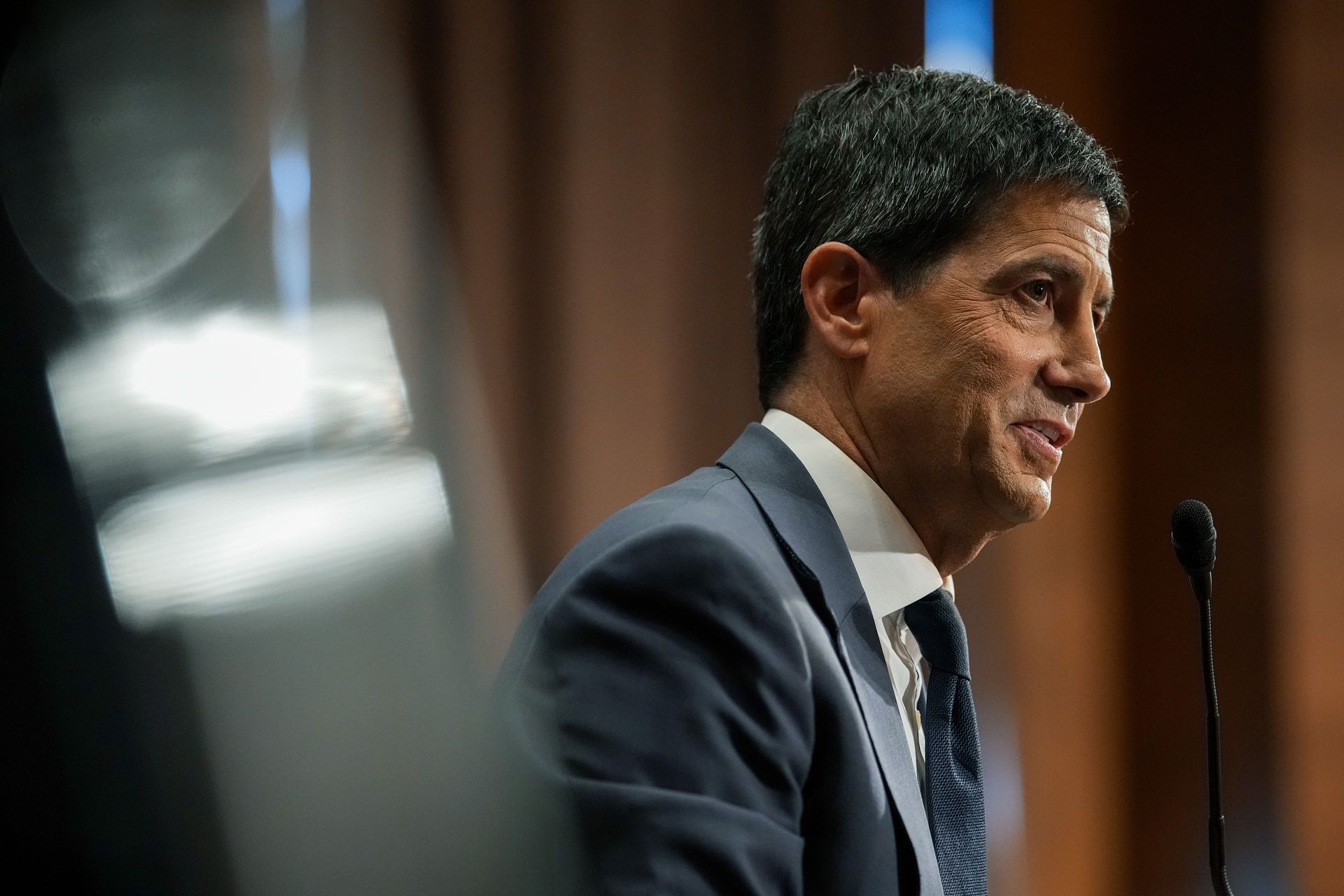
Kevin Warsh told lawmakers on Tuesday that he would be "an independent actor" if confirmed as chair of the Federal Reserve, pushing back against suggestions that he would defer to President Donald Trump on interest rate decisions.

Sen. Elizabeth Warren grilled the nominee over $100 million in undisclosed assets and his willingness to defy the president on interest rates
Andrew Harnik / Getty Images
Kevin Warsh told lawmakers on Tuesday that he would be "an independent actor" if confirmed as chair of the Federal Reserve, pushing back against suggestions that he would defer to President Donald Trump on interest rate decisions.
At the center of the Senate Banking Committee hearing's most contentious moments was Sen. Elizabeth Warren, the Massachusetts Democrat who serves as the committee's senior minority member. She accused Warsh of being Trump's "sock puppet" and questioned whether he could truly operate free of White House influence. A version of the same challenge came from the Republican side of the aisle, with Louisiana Sen. John Kennedy asking Warsh to deny he would function as the president's "human sock puppet." Warsh's answer was unequivocal: "Senator, absolutely not."
Warsh also said Trump had never conditioned his nomination on a commitment to cut rates. "The president never once asked me to commit to any particular interest rate decision, period," he said.
Much of Warren's scrutiny was directed at Warsh's financial paperwork, according to Politico, which put his total holdings somewhere between $130 million and $210 million and included positions in private investment funds, stakes in technology ventures including SpaceX and Polymarket, the prediction-markets site backed by Elon Musk. Although Warsh has committed under a signed agreement to shed nearly his entire portfolio before assuming the role — with a 90-day window after confirmation to do so — he refused to name individual holdings, pointing to prior confidentiality obligations as his reason for withholding that information. Among Warren's pointed questions was whether investment vehicles in Warsh's portfolio had put money into businesses connected to Trump's orbit or his family members, or into financial structures tied to Jeffrey Epstein. Warsh did not directly answer.
"It's critical that the next chair have no financial conflicts — none," Warren said.
Warsh's prepared remarks cast independence as a value the Fed must itself uphold rather than one that depends on political restraint from outside. He drew a distinction between presidents or lawmakers expressing rate preferences — something he said poses no particular threat to the central bank's autonomy — and the Fed straying into policy territory beyond its core mandate, which he argued it should avoid.
On policy direction, Warsh told the committee he envisioned a fundamental restructuring of how the Fed operates — including a revised approach to inflation targeting — and took aim at the quarterly forecasting process in which officials anonymously project future rate levels, suggesting it represents a form of overcommunication that he would reconsider. He left open the question of how many times a year the Fed's policymaking body should convene, saying only that four meetings would be too few, while declining to endorse the current practice of holding eight.
The hearing unfolded against a backdrop of a separate obstacle to Warsh's confirmation. North Carolina's Thom Tillis, a Republican whose vote is pivotal on the evenly contested committee, declared his personal support for Warsh while making clear he would refuse to let the nomination move forward unless prosecutors abandon their criminal inquiry into Powell. A Tillis defection would leave the 24-member panel split evenly, denying Warsh the majority he needs to advance. Powell's term ends May 15.
Warsh has previously said he would work to keep the Fed "mindful of its limits, focused on its mission." His proposed overhaul of the Fed includes reducing the central bank's $6.7 trillion balance sheet, and he told senators that the Fed bears some responsibility for the growing divide between asset-owning Americans and those without such holdings.
Join 500,000+ readers who start their day with Quartz.
By subscribing, you agree to our Terms of Service and Privacy Policy.