
From the Icon of the Seas' eight neighborhoods to MSC World America's over-water swing ride 160 feet above the ocean
David Sacks / Getty Images
A modern cruise ship is less a vessel than a floating city, complete with neighborhoods, Broadway shows, robot bartenders, and waterslides that drop passengers 10 stories above the sea. The scale of today’s megaships challenges the imagination in a way that the word “large” no longer suits them. These are structures that stretch roughly three times the length of a football field, rise nearly two dozen decks above the waterline, and carry passenger populations comparable to a small town. The engineering required to keep them stable, maneuverable, and livable across weeks at sea represents one of the more extraordinary ongoing achievements in applied design and naval architecture.
The cruise industry has treated size as a deliberate design philosophy, not a byproduct, building successive generations of ships that expand what passengers expect from a week at sea. Early oceanliners offered passage and meals. Today’s flagships offer laser tag, escape rooms, over-water swing rides suspended 160 feet above the ocean, food halls modeled on urban markets, and robot bartenders mixing cocktails on demand. The gap between those two visions of cruising represents decades of investment and an enormous bet on the idea that more — more decks, more dining venues, more entertainment formats — consistently outperforms less. For travelers, the practical implication is that the largest ships function as floating resorts where the vessel itself competes with its ports of call as the primary attraction.
The ships below come from two cruise lines, and the ranking reflects gross tonnage, a standard measure of a vessel’s total internal volume. U.S. News & World Report compiled the list, drawing on publicly available specifications for the 10 largest cruise ships currently sailing. The source covers maximum passenger capacity, gross tonnage, crew complement, stateroom counts, and the signature amenities that distinguish each vessel. All 10 ships appear below, ordered from largest to smallest by gross tonnage.
Credit: Royal Caribbean
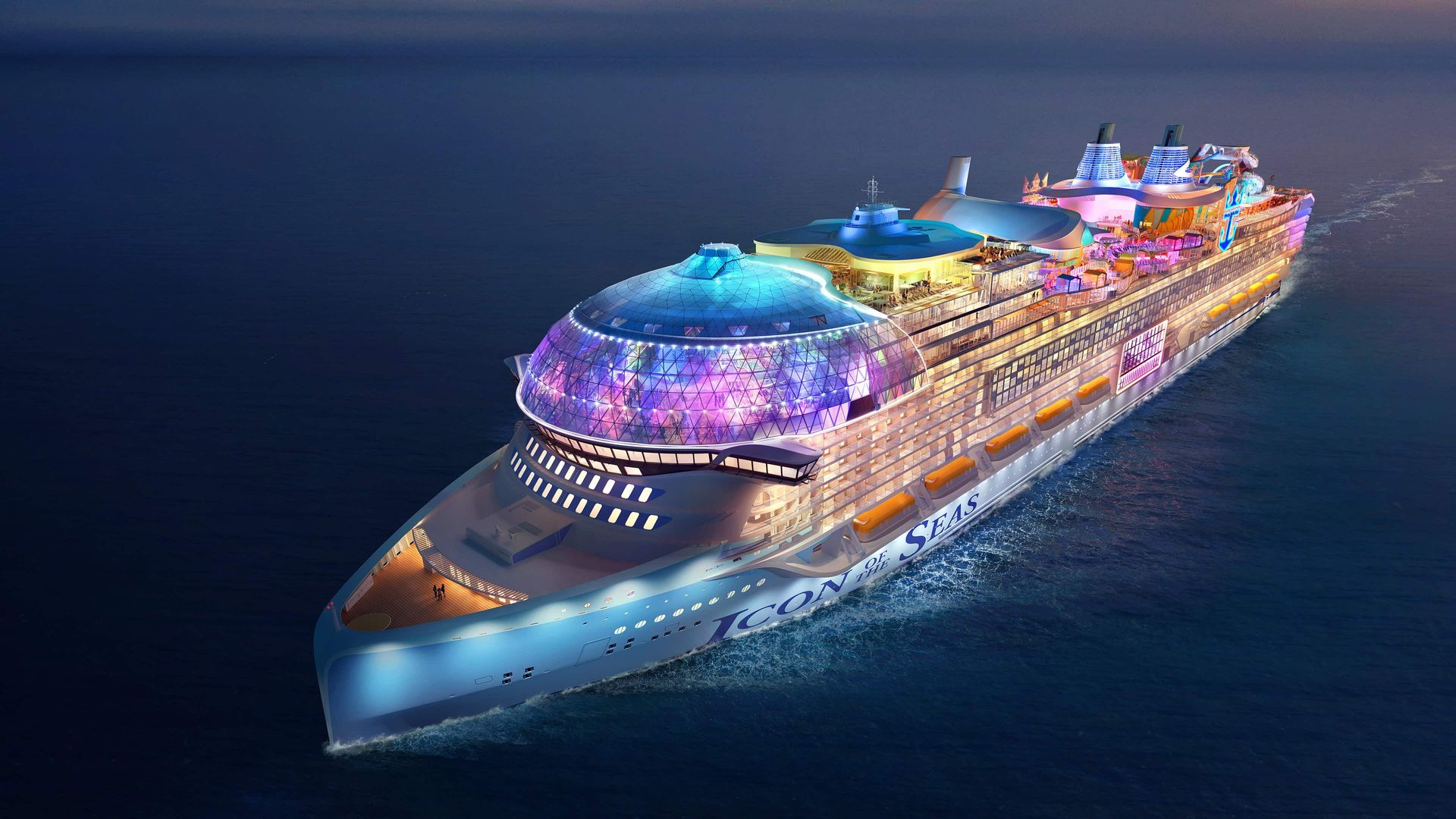
Icon of the Seas claimed the title of the world’s largest cruise ship when it launched in January 2024, registering 248,663 gross tons and carrying up to 7,600 passengers. Royal Caribbean $RCL built the ship as the first vessel in its Icon class, and the debut set an entirely new benchmark for what a passenger vessel could be. The ship holds 2,805 staterooms and accommodates up to 2,350 crew members, numbers that underscore the logistical complexity of operating a structure at this scale.
Eight distinct neighborhoods organize the ship’s offerings, a concept that transforms onboard navigation from simple deck-walking into something closer to moving between urban districts. Surfside anchors the family-oriented end of the ship, designed as a stay-all-day destination for families. Seven pools, nine whirlpools, and six record-breaking waterslides give the ship a water-park footprint that most land-based attractions would envy. The sheer density of water features makes the vessel function as its own aquatic resort, independent of whatever port it happens to be visiting.
Dining extends across more than 40 venues, including the swanky Empire Supper Club, Izumi in the Park, a sushi restaurant, and the AquaDome Market, the first food hall Royal Caribbean has introduced on any vessel. The AquaDome Market represents a format shift for the line, moving away from individual specialty restaurants toward an open, multi-vendor food hall that gives passengers more flexibility in how they eat. The fuel powering the ship marks an additional departure from industry convention: Icon of the Seas runs on liquefied natural gas, making it the first Icon-class vessel to use LNG as a more sustainable alternative to conventional marine fuel. Record tonnage, LNG propulsion, and a food hall format new to the fleet together signal that Icon of the Seas was built to define a generation of ships, not simply to exceed the one before it.
Credit: Royal Caribbean
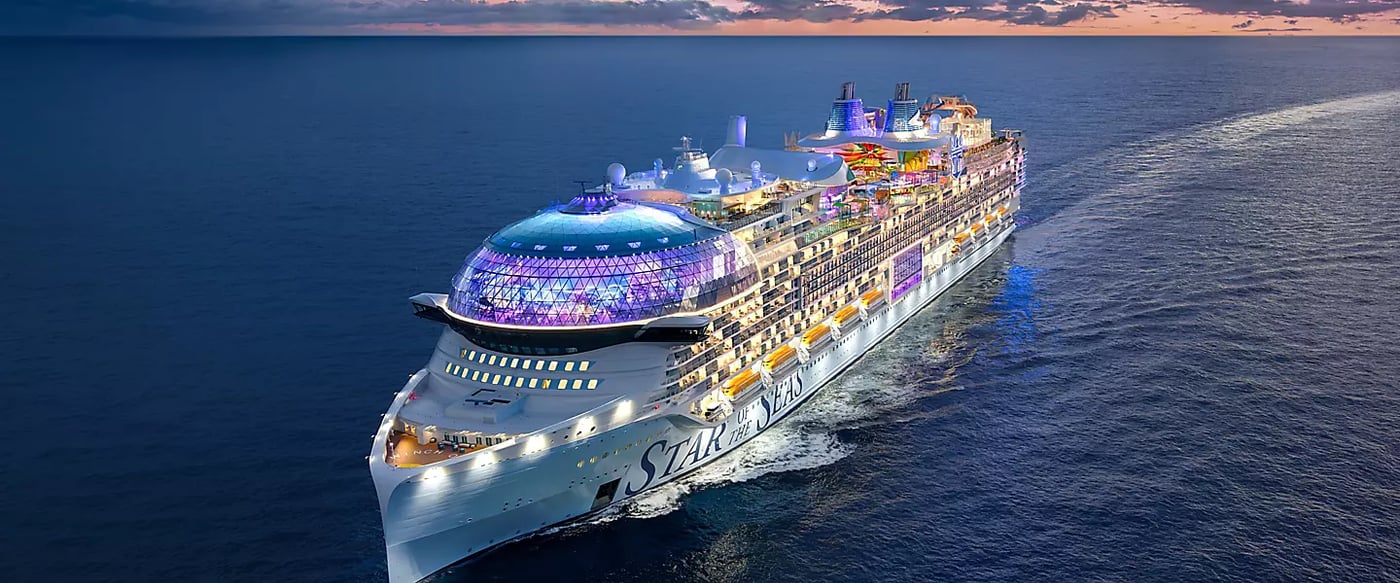
Star of the Seas matches Icon of the Seas exactly at 248,663 gross tons and 7,600 maximum passengers, making the two ships co-holders of the world’s largest cruise ship designation. Royal Caribbean $RCL launched the vessel in August 2025 as the second Icon-class ship, and while the sister ships share the same LNG fuel system and eight-neighborhood structure, five of those neighborhoods carry identities unique to this pairing: Surfside, AquaDome, Thrill Island, Chill Island, and The Hideaway.
The Hideaway functions as an adults-only retreat perched 135 feet above the ocean, a physical elevation that separates it from the rest of the ship’s activity in both altitude and atmosphere. The design provides adult passengers with a defined sanctuary on a vessel otherwise built for broad-spectrum entertainment for all ages. More than 40 dining and drinking venues fill the ship, including the Lincoln Park Supper Club, a concept modeled after a 1930s Chicago supper club. The Lincoln Park concept gives Star a distinct culinary identity from Icon, where the equivalent upscale venue is the Empire Supper Club — a difference that gives repeat Royal Caribbean travelers a concrete reason to choose one Icon-class ship over the other.
Several features carry over from Icon of the Seas, including the Royal Promenade, the Suite Neighborhood, Central Park, and Pearl — the largest kinetic art sculpture in the world. Pearl’s presence on both ships connects them aesthetically across the shared tonnage and capacity figures that define them technically. Passengers choosing between the two Icon-class ships find the distinction not in scale, but in the specific neighborhood identities and dining concepts each vessel develops around its shared structural template. The five neighborhoods unique to Icon and Star give repeat Royal Caribbean travelers a meaningful reason to sail both rather than treating the two vessels as interchangeable.
Credit: Royal Caribbean
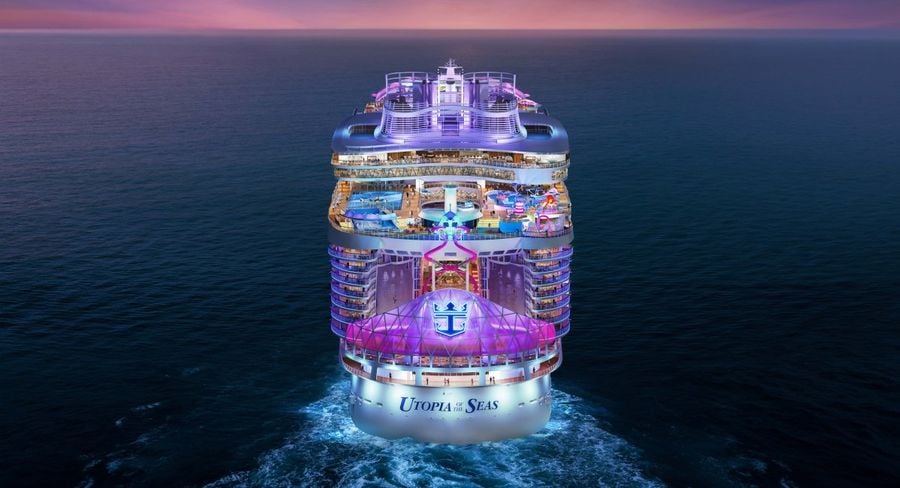
Utopia of the Seas sailed its inaugural voyage in July 2024 as Royal Caribbean $RCL’s first LNG-powered Oasis-class ship, registering 236,473 gross tons and carrying up to 6,509 passengers. The ship holds 2,834 staterooms and berths 2,290 crew members. Royal Caribbean marketed the vessel under the tagline “The World’s Biggest Weekend,” positioning it as a short-getaway destination as much as a traditional cruise — a framing that distinguishes Utopia from the longer-itinerary vessels elsewhere in the Oasis fleet.
Eight neighborhoods house the ship’s amenities, and dining spans more than 40 venues, 10 of which are complimentary. Returning favorites such as Chops Grille and Giovanni’s Italian Kitchen & Wine Bar share space with venue concepts exclusive to Utopia, including Royal Railway — Utopia Station. Entertainment options span the AquaTheater, Splashaway Bay, laser tag, mini-golf, the Sports Court, Studio B, and two casinos, a breadth that reflects the ship’s weekend-destination identity. Five pools give the vessel a water recreation footprint consistent with other Oasis-class ships.
Itineraries frequently include Royal Caribbean’s private island, Perfect Day at CocoCay, extending the resort experience beyond the hull. Utopia of the Seas occupies a specific position in the Oasis fleet as the largest ship in the class and the first in the class to run on LNG. Its propulsion system connects it to the Icon-class ships above it in tonnage and marks the Oasis class’s step toward the fuel infrastructure Royal Caribbean is building across its newest vessels. The tagline “The World’s Biggest Weekend” captures the ship’s practical identity: a vessel designed to deliver a concentrated, high-intensity experience on a shortened schedule, giving passengers who want the megaship experience access to it on a three- or four-night sailing rather than a full week at sea.
Credit: Royal Caribbean
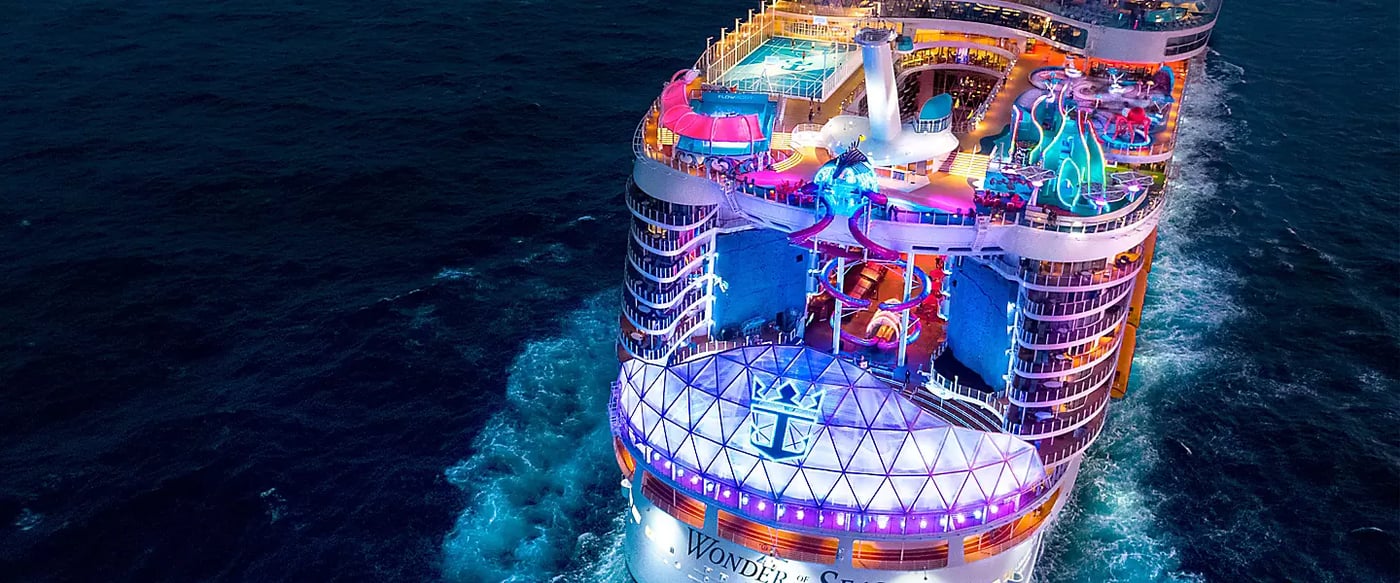
Wonder of the Seas entered service in March 2022 as an Oasis-class vessel, registering 235,600 gross tons and carrying up to 7,084 passengers, a maximum capacity higher than Utopia’s despite lower gross tonnage. The ship contains 2,867 staterooms and berths, and accommodates 2,204 crew members across eight neighborhoods that follow the structural blueprint Royal Caribbean $RCL established with earlier Oasis ships, while adding amenities that extend the class’s entertainment range.
The Ultimate Abyss anchors the ship’s thrill offering: the 10-story dry slide rises 150 feet above the sea, making it one of the most vertically dramatic single attractions on any vessel in the fleet. Wonder Playscape offers a counterpart for younger passengers: an outdoor space with an underwater theme, slides, climbing walls, and games designed to hold children’s attention across extended sessions. FlowRider surf simulators, a rock climbing wall, an ice skating rink, and laser tag round out the activity roster for passengers who want structured recreation alongside the pool and waterslide options.
Dining covers more than 20 complimentary and specialty restaurants, with roughly a dozen bars and lounges for passengers seeking drinks outside a full meal, including a Starbucks $SBUX. The gap between Wonder’s passenger capacity of 7,084 and Utopia’s 6,509 reflects how differently the two vessels allocate internal volume between staterooms and shared-amenity spaces. Wonder of the Seas also features live outdoor shows at the AquaTheater, a performance format that uses the ship’s stern and the open ocean as its setting — a venue type that gives the ship an entertainment signature distinct from the indoor shows that fill most other vessels’ evening schedules. The depth of the activity roster, from the 150-foot slide to the underwater-themed kids' playscape, makes Wonder one of the more program-dense ships in the Oasis lineup.
Credit: Royal Caribbean
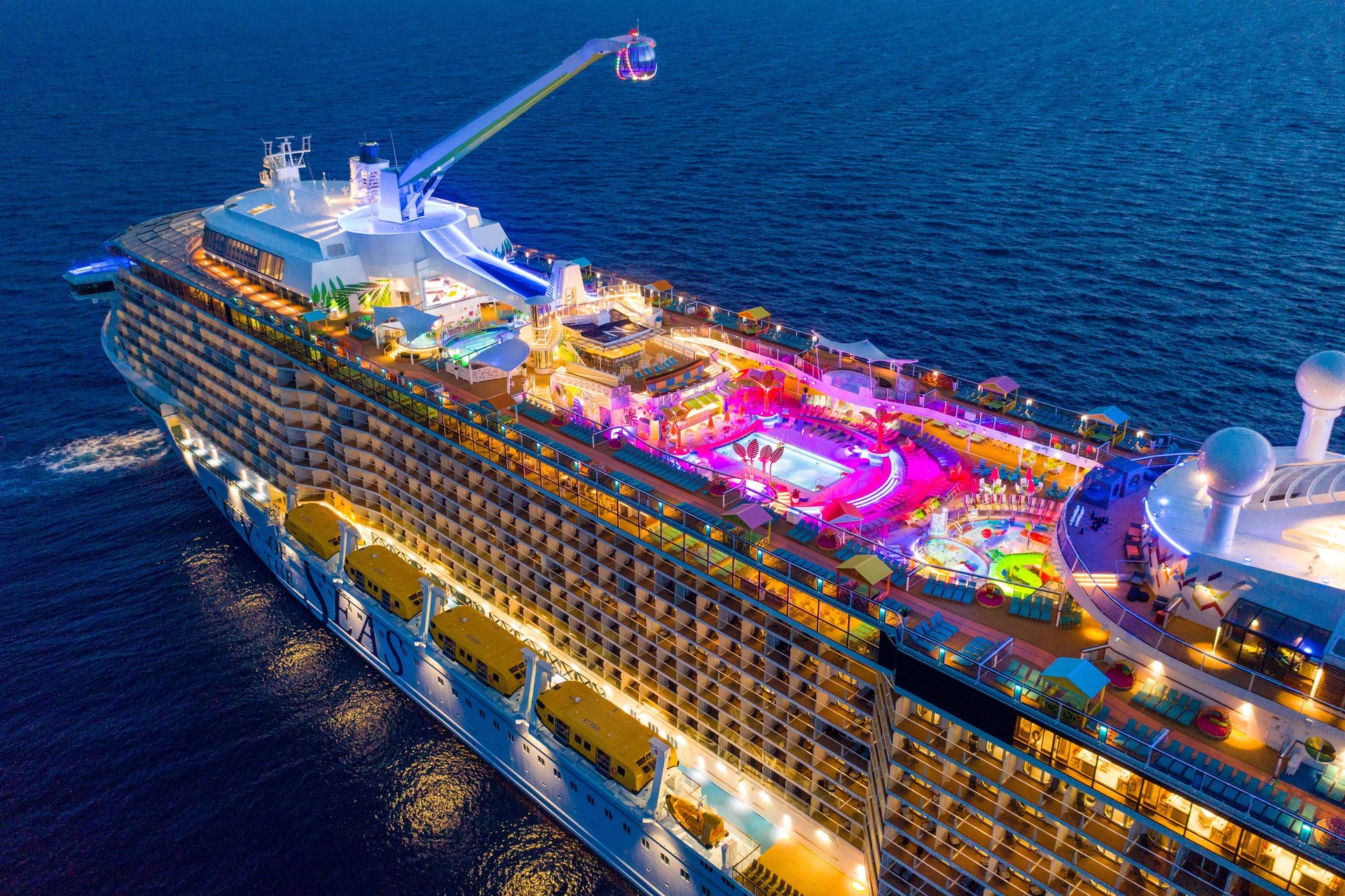
Symphony of the Seas launched in April 2018 as an Oasis-class vessel with 228,081 gross tons and a maximum capacity of 6,680 passengers. The ship holds 2,759 staterooms and accommodates 2,200 crew members across 16 guest decks and seven neighborhoods. Two FlowRider surf simulators distinguish Symphony from Oasis-class ships that carry only one, doubling throughput for passengers who want extended time on the wave feature.
The seven neighborhoods pack in glow-in-the-dark laser tag, a zip line, the AquaTheater, and the Solarium alongside the twin FlowRiders. Dining venues include Jamie’s Italian, the Coastal Kitchen, and the Playmakers Sports Bar & Arcade, with a Starbucks $SBUX rounding out the food options. The Bionic Bar offers a draw unlike any standard drinks venue: two robot bartenders mix cocktails on demand, turning the act of ordering a drink into a spectacle as much as a transaction.
Evening programming includes a Broadway adaptation of “Hairspray,” giving Symphony a live-performance anchor that sets its nighttime schedule apart from ships that rely primarily on bars and casinos for after-dinner entertainment. Sixteen guest decks place it among the taller Oasis-class structures, and while its 2018 launch makes Symphony one of the older vessels in Royal Caribbean $RCL’s current megaship fleet, the depth of the amenity lineup it launched with — dual wave simulators, the Bionic Bar, full Broadway programming — has kept the ship competitive with vessels built years later. The combination of a robot bartender concept and a Broadway production gives Symphony an entertainment profile that relies on novelty and production quality in equal measure, not on sheer scale alone.
Credit: Royal Caribbean
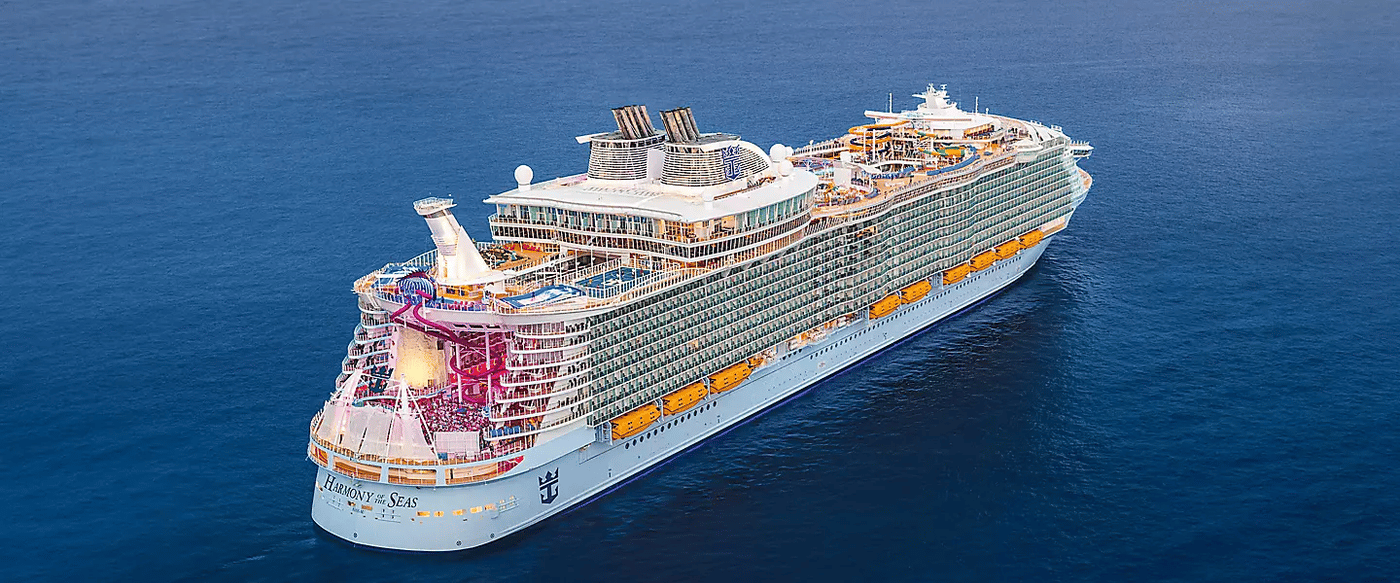
Harmony of the Seas entered service in May 2016 as an Oasis-class ship, registering 226,963 gross tons and carrying up to 6,687 passengers. The vessel holds 2,747 cabins and berths 2,200 crew members across seven neighborhoods. The Ultimate Abyss — the tallest slide at sea — has defined the ship’s thrill identity since launch and gives Harmony a superlative that anchors its identity within the Oasis fleet.
Amenities are distributed across seven neighborhoods: a carousel, rock-climbing walls, Splashaway Bay, The Perfect Storm waterslides, and mini-golf. Dining covers El Loco Fresh for tacos, Izumi for sushi, and the Dog House for hot dogs, a spread that reflects Royal Caribbean $RCL’s strategy of building distinct venue identities across casual options instead of consolidating them into a single buffet. The Vitality Spa gives adult passengers a quieter alternative to the activity-heavy zones, with massage and facial treatments available. Age-appropriate clubs provide children with a structured social environment separate from family-wide options.
Royal Caribbean has scheduled Harmony of the Seas for a major amplification in April and May 2026, with El Loco Fresh arriving in summer 2026 as one confirmed post-refurbishment addition. The amplification addresses the amenity gap that widened between Harmony’s 2016 debut and the more recently launched ships above it in the fleet. For passengers drawn specifically to the tallest-slide-at-sea designation, Harmony holds it. After the 2026 amplification, the vessel will carry that title alongside an updated amenity set designed to bring it into closer alignment with the Oasis-class ships Royal Caribbean has launched in the decade since Harmony first entered service.
Credit: Royal Caribbean
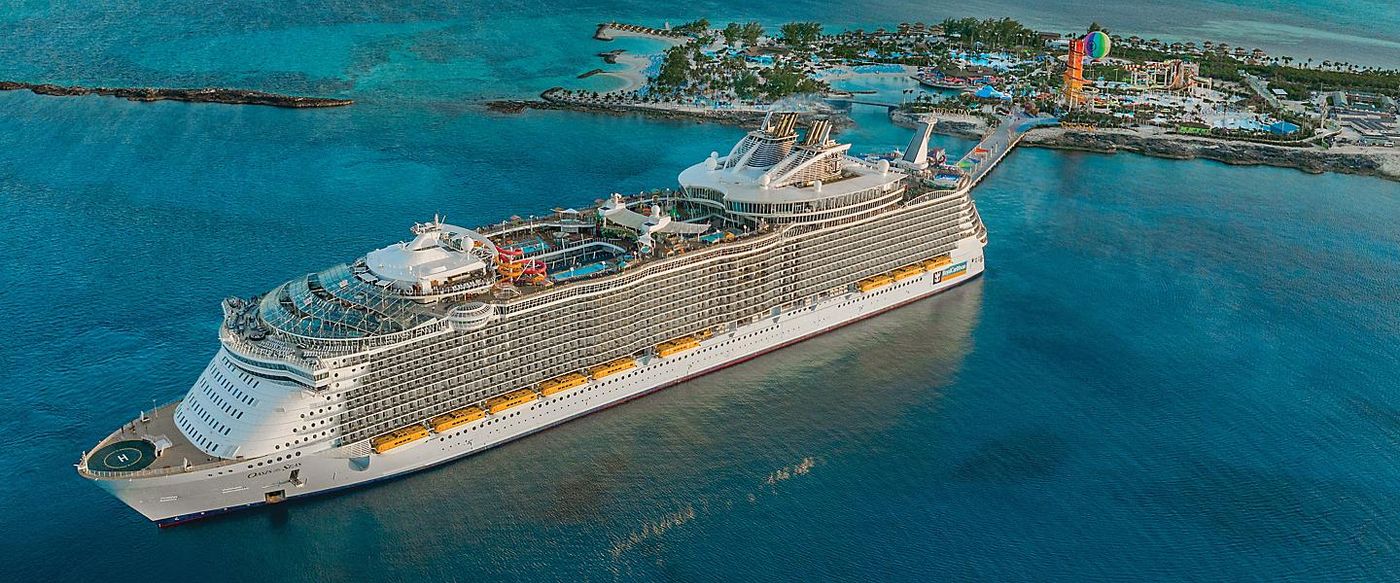
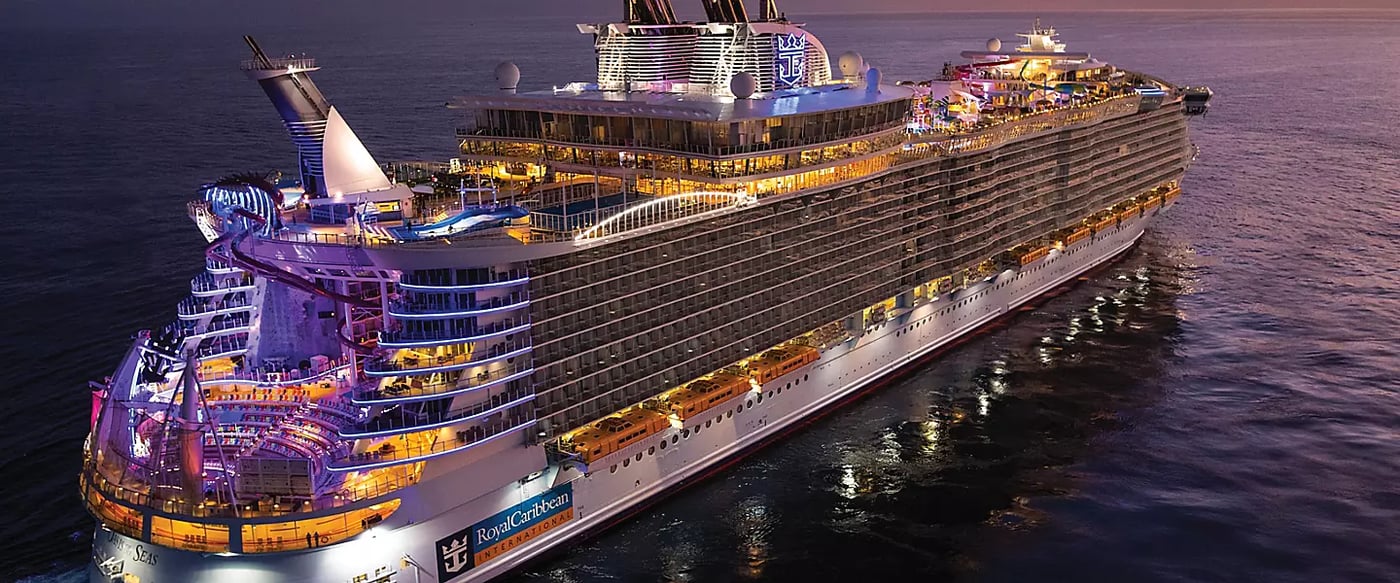
Oasis of the Seas debuted in December 2009 and held the title of the world’s largest cruise ship at launch, a distinction it has since ceded to five vessels above it in tonnage. The ship registers 226,838 gross tons and carries up to 6,771 passengers across 2,801 staterooms, with space for 2,109 crew members. Royal Caribbean $RCL fully refurbished the vessel in 2019, updating a ship that originated many of the design conventions its successors adopted and expanded into standard practice.
The neighborhood concept that now defines the entire Oasis class originated here. The Royal Promenade and Central Park debuted on Oasis of the Seas as entirely new onboard spaces, establishing the idea that a cruise ship could be organized around distinct zones with distinct characters and purposes. Twenty-seven dining and drinking venues give passengers a range that would have seemed implausible for any vessel when Oasis first launched, and entertainment spans from the AquaTheater to a Broadway adaptation of “Cats.”
Family-focused programming covers karaoke, glow-in-the-dark laser tag, and an outer space-themed escape room, giving the ship a children’s activity layer built on top of the neighborhood framework. The 2019 refurbishment updated the amenity profile without dismantling the structural approach that made the original design so influential. Oasis of the Seas is now the oldest active vessel in Royal Caribbean’s Oasis class, and its continued presence reflects the durability of the organizing concepts it introduced. Every ship above it on this list — the Icon-class vessels, the newer Oasis builds — traces its neighborhood logic back to the Royal Promenade and Central Park that Oasis of the Seas placed aboard a cruise ship for the first time in 2009.
Credit: Royal Caribbean
Allure of the Seas entered the cruise market in December 2010 as Royal Caribbean $RCL’s second Oasis-class ship, registering 225,282 gross tons and carrying up to 6,780 passengers. The vessel holds 2,859 guest cabins and accommodates 2,103 crew members across seven neighborhoods. A $100 million amplification completed in spring 2025 substantially updated the amenity profile, adding three waterslides, a reimagined pool deck, a new Splashaway Bay kids area, and The Lime and Coconut poolside bar.
The refurbishment also introduced the Pesky Parrot tiki bar, a sports bar, and The Mason Jar, a southern-inspired eatery, expanding dining and drinking options well beyond what the original 2010 configuration included. An outdoor movie screen, an escape room, the Solarium, a casino, and a zip line round out the entertainment offerings alongside the post-amplification additions. Committing $100 million to a vessel already 15 years into service reflects Royal Caribbean’s assessment that a ship of Allure’s tonnage and capacity retains commercial value worth preserving through significant capital expenditure.
Allure of the Seas holds the lowest gross tonnage of the eight Royal Caribbean ships on this list, but its maximum passenger capacity of 6,780 exceeds several vessels above it in the tonnage ranking, including Utopia of the Seas and Symphony of the Seas. The 2025 amplification updates the areas — pool deck, kids water zone, bar lineup — where the gap between a 2010 build and a 2020s ship is most evident, bringing Allure closer in alignment with the recreational profile of Oasis-class vessels launched a decade after it. The rebuilt pool deck and three new waterslides give passengers who sailed Allure before the refurbishment a materially different ship from the one they remember, making the vessel’s age considerably less apparent than it was before the rebuild.
Credit: MSC Cruises
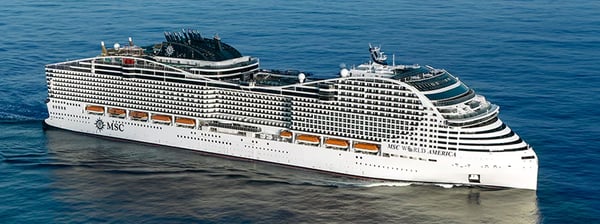
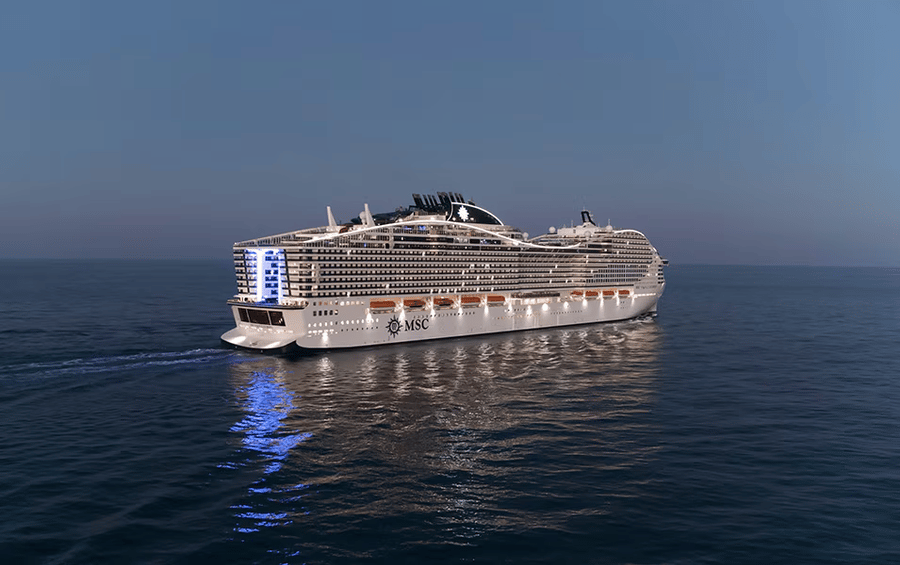
MSC World America launched in April 2025 as the newest vessel on this list outside Royal Caribbean $RCL’s fleet, registering 216,638 gross tons and carrying up to 6,764 passengers. The ship holds 2,614 staterooms and accommodates 2,138 crew members. Like its sister ship World Europa, it runs on LNG and earned recognition as one of the most energy-efficient cruise ships at the time of its debut, continuing the propulsion standard MSC established with the first World-class vessel.
Seven districts offer ship amenities, catering to passenger demographics from families to adults seeking a quieter environment. The Family Aventura district contains the Harbour, home to Cliffhanger — the only over-water swing ride at sea — which carries passengers 160 feet above the ocean. The adults-only Zen Area provides a counterpart to the family-focused districts, and the MSC Yacht Club, the largest MSC, operates in North America, giving premium-cabin passengers a ship-within-a-ship experience with dedicated spaces and services.
Dining and entertainment venues include the only Eataly location at sea, a Paxos Greek restaurant, Promenade Bites, a sports bar, and a comedy club. The Eataly partnership gives MSC World America a dining anchor tied to a recognized land-based brand, distinguishing its food program from the specialty restaurant formats used by the Royal Caribbean vessels on this list. Cliffhanger does the same for the activities program: at 160 feet above the ocean, the over-water swing gives MSC World America a thrill exclusive that no other ship currently offers, positioning the vessel as a destination for passengers who seek novel onboard experiences as a primary reason for choosing a particular sailing.
Credit: MSC Cruises
MSC World Europa debuted in December 2022 as the inaugural vessel in MSC Cruises’ World-class fleet, registering 215,863 gross tons and carrying up to 6,762 passengers. The ship holds 2,626 staterooms and berths 2,138 crew members. Its debut marked the first time MSC Cruises operated an LNG dual-fuel vessel, establishing the propulsion standard that MSC World America carried forward when it launched three years later.
Each passenger deck is named after an international city — London, Paris, Lisbon, Athens, Rome — a navigational and aesthetic choice that gives the ship a geographic identity distinct from the numbered deck systems most cruise ships use. The fleet’s largest onboard water park occupies a section of the ship alongside the Venom Drop @ The Spiral, an 11-deck-high stainless steel dry slide that competes with Royal Caribbean $RCL’s Ultimate Abyss for sheer vertical drama. Luna Park Arena seats 300 passengers in a multifunction entertainment venue designed to accommodate virtually any performance or event format, from concerts to competitive games.
Thirteen restaurants give passengers a dining spread consistent with the World-class ship’s scale, and the MSC Aurea Spa draws on Balinese design principles for its treatment menu and aesthetic. The MSC Yacht Club operates on World Europa as it does on World America, extending the ship-within-a-ship premium concept across both vessels in the World-class fleet. World Europa’s position as the smallest ship on this list by gross tonnage does not diminish its significance within MSC Cruises’ development: it introduced LNG dual-fuel propulsion to the line, gave the World-class fleet its structural template, established the city-named deck system, and created the Luna Park Arena format. Everything MSC World America refined, World Europa originated.