15 letters that changed history
From a smuggled telegram to a jailhouse manifesto, these 15 pieces of correspondence started wars, ended crises, and redrew maps across two millennia

Credit: Magic Fan / Unsplash
History likes to remember speeches, battles, and treaties. It tends to forget that many of its sharpest turns began with a piece of paper, an envelope, and a single reader. A letter is a strange instrument of power. It is private by design but public by consequence. It can be written in an afternoon, yet it can commit nations to war, launch scientific revolutions, or crack open political systems that seemed permanent. Before the telephone, the fax, and the email thread, correspondence was how power actually moved — slowly, physically, and often irreversibly.
The 15 letters collected here span nearly 2,000 years. Some were meant for one reader, such as the note Nikita Khrushchev sent John F. Kennedy at the most dangerous moment of the Cold War. Others were open letters aimed at millions, such as Émile Zola's front-page accusation in a Paris newspaper or Martin Luther King Jr.'s reply to his critics, drafted in the margins of a smuggled newspaper inside a Birmingham jail cell. A few were never intended to change anything at all. Alfred Russel Wallace mailed a scientific essay to Charles Darwin as a professional courtesy. It forced the publication of one of the most consequential books ever written.
What unites them is leverage. Each letter arrived at a moment when the right words, delivered to the right reader, could tip a balance that armies, parliaments, and markets could not. A 67-word note from a British foreign secretary helped reshape the Middle East. A coded telegram intercepted by British cryptographers pulled the U.S. into World War I. A physicist's two-page warning to a president set in motion the atomic age. A software company founder's complaint in a hobbyist newsletter sketched the business model that now underpins a multitrillion-dollar industry.
Reading these letters today is a reminder that history is not only made by institutions. It is also made by individuals who sat down, chose their words carefully, and sent them. Here are 15 letters that changed the course of history, presented in chronological order.
1 / 15
Paul's epistle to the Romans (c. 57 CE)
Credit: Kelly Sikkema / Pexels
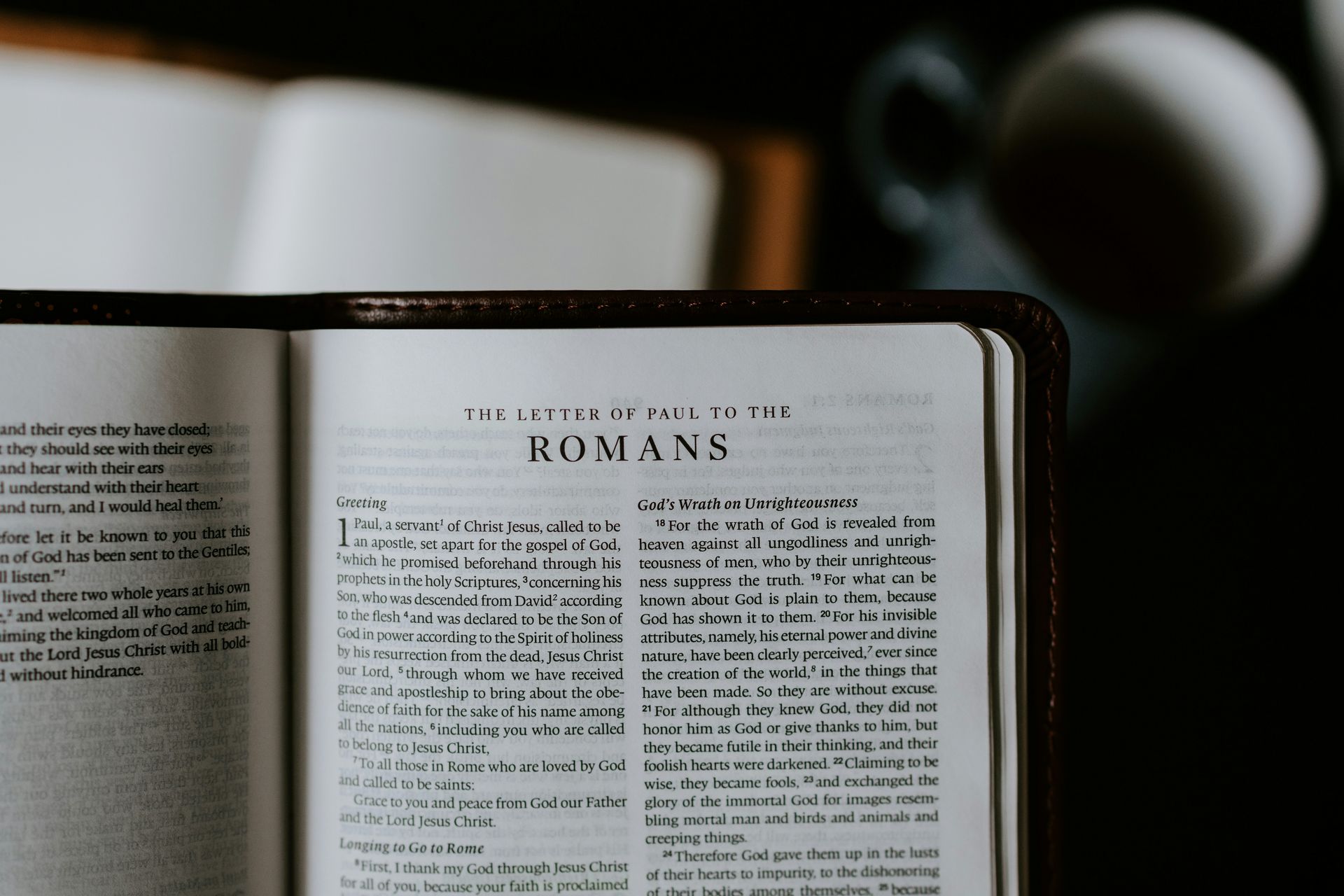
Christianity spread through the ancient Mediterranean partly by ship, partly by road, and largely by mail. Its founding documents include a stack of letters, and none proved more consequential than the one Paul of Tarsus wrote to the Christian community in Rome around 57 CE, most likely from Corinth. He had never visited the Roman congregation. The letter was his introduction, his fundraising pitch for a planned mission to Spain, and his most systematic statement of belief.
Romans is the longest of Paul's surviving letters, and it laid out ideas that would define Western religious thought: that human beings are justified by faith rather than by works of the law, that sin is a universal condition, and that salvation is open to Jews and gentiles alike. That last point mattered enormously. It helped transform a movement within Judaism into a religion that could absorb the Roman Empire itself.
The letter's afterlife is as important as its original delivery. In the fourth century, Augustine of Hippo described his conversion as the moment he picked up Paul's letters and read a passage from Romans in a Milan garden. More than 1,000 years later, Martin Luther's reading of Romans — particularly its line about the righteous living by faith — triggered the theological breakthrough behind the Protestant Reformation. In 1738, John Wesley wrote that his heart was "strangely warmed" while listening to Luther's preface to Romans, an experience that fueled the Methodist movement. In 1919, the Swiss theologian Karl Barth published a commentary on Romans that upended 20th-century Protestant theology.
Few documents have been reread so consequentially by so many people across so many centuries. Empires adopted its theology, reformers weaponized it, and entire denominations trace their origins to someone's encounter with it. It began as a practical piece of correspondence: a traveling preacher writing ahead to a city he hoped to visit.
2 / 15
Christopher Columbus's letter announcing his voyage (1493)
Credit: Marcelo Barboza / Pexels
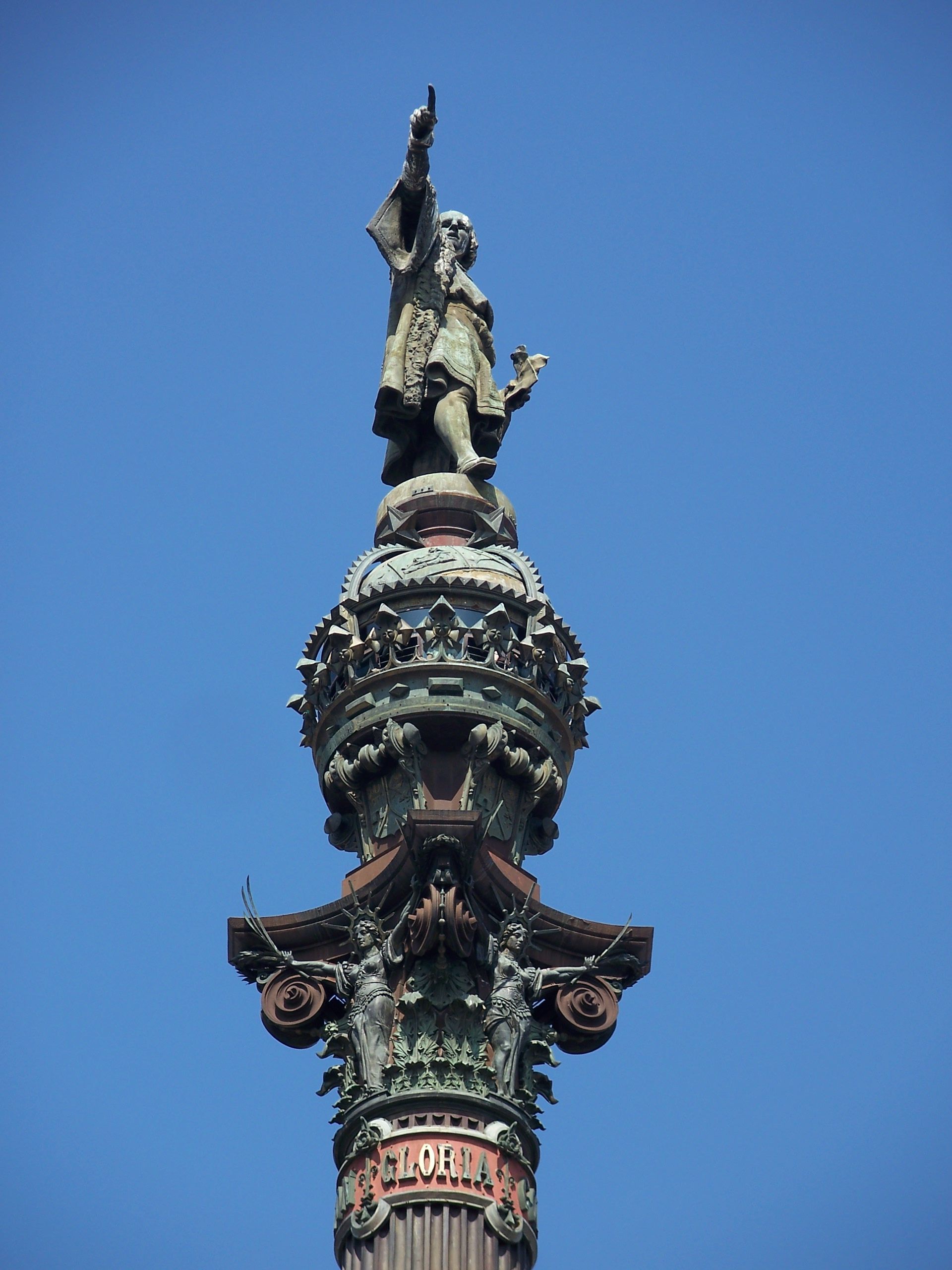
Columbus reached the Caribbean in October 1492, but Europe learned about it through a letter. Sailing home in February 1493, he wrote an account of his voyage addressed to Luis de Santángel, the finance official of the Crown of Aragon who had helped arrange funding for the expedition. The letter described islands he had claimed for Spain, including Hispaniola and Cuba, the people he encountered, the landscape, and — crucially for his royal sponsors — the prospect of gold, spices, and future settlement.
The letter's power came from the printing press. A Spanish edition appeared in Barcelona within weeks of his return in the spring of 1493. A Latin translation printed in Rome followed, and further editions spread across European cities within about a year. For most literate Europeans, this short document was the first news that lands existed across the Atlantic. It framed how the encounter would be understood: as a discovery, a commercial opportunity, and a field for conversion and conquest.
The diplomatic consequences arrived almost immediately. In 1493, Pope Alexander VI issued bulls granting Spain rights over the newly reached lands. In June 1494, Spain and Portugal signed the Treaty of Tordesillas, drawing a line down the Atlantic and dividing future claims between the two kingdoms. Those decisions, made on the strength of early reports like Columbus's letter, shaped which European languages, legal systems, and religions would dominate the Americas for centuries.
The letter also set a template. It presented indigenous people through European eyes, emphasized their supposed readiness for conversion and servitude, and treated their lands as available for the taking. The centuries of colonization, enslavement, and demographic catastrophe that followed cannot be pinned on one document. But this piece of correspondence was the press release of the Columbian exchange — the text that turned a single voyage into a European project.
3 / 15
Martin Luther's letter to the archbishop of Mainz (1517)
Credit: Pixabay / Pexels
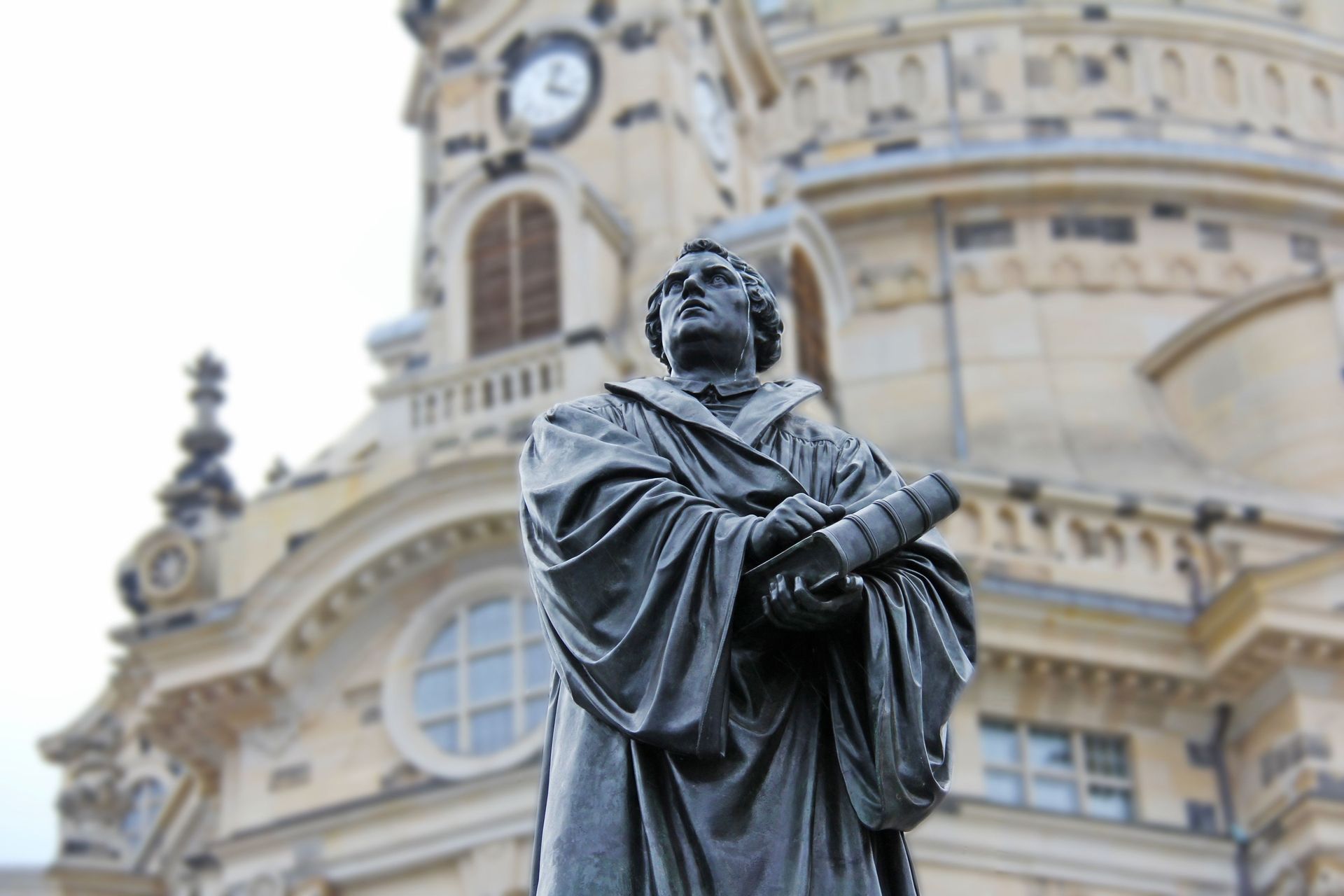
The popular image of the Reformation begins with a hammer: Luther nailing his 95 Theses to a church door in Wittenberg. Historians still debate whether that scene happened as described. What is documented is a letter. On October 31, 1517, Martin Luther, an Augustinian friar and university professor, wrote to Albrecht of Brandenburg, the archbishop of Mainz, protesting the sale of indulgences — certificates promising reduced punishment for sins — in his region. Enclosed with the letter was his Latin disputation on the subject, the document now known as the 95 Theses.
Luther's immediate target was the indulgence campaign run by the preacher Johann Tetzel, whose proceeds helped fund the rebuilding of St. Peter's Basilica in Rome and repay debts connected to Albrecht's own accumulation of church offices. The letter itself was respectful in tone. Luther presented himself as a loyal churchman alerting a superior to an abuse. Albrecht forwarded the material to Rome, setting in motion the process that would lead to Luther's excommunication.
The printing press did the rest. The theses were reprinted and translated into German, spreading through the Holy Roman Empire within months. What began as an academic invitation to debate became a public confrontation with papal authority. By 1521, Luther stood before the emperor at the Diet of Worms and refused to recant.
The consequences reordered Europe. Western Christianity split into Catholic and Protestant branches. Wars of religion followed for more than a century, culminating in the Thirty Years' War. Political authority, education, literacy, and eventually ideas about individual conscience were all transformed in the process. Whatever happened at the church door, the paper trail of the Reformation starts with a letter from a provincial professor to his archbishop — a complaint filed through proper channels that ended up breaking the channels themselves, and with them the religious unity of a continent.
4 / 15
Galileo's letter to the Grand Duchess Christina (1615)
Credit: Pam Crane / Pexels
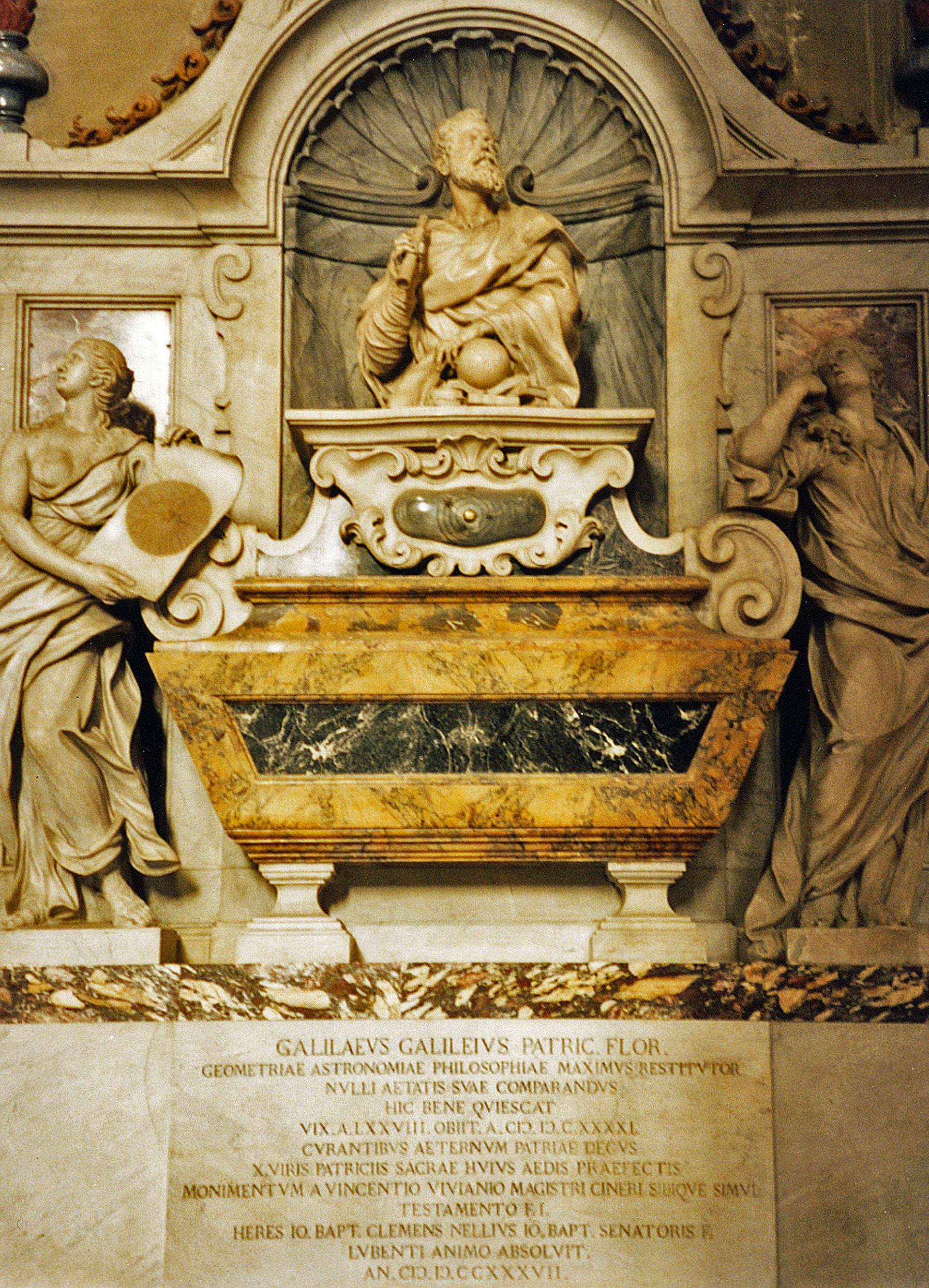
By 1615, Galileo Galilei had a problem that was less about astronomy than about interpretation. His telescopic observations supported the Copernican view that the Earth moves around the sun, but critics argued that this contradicted scripture. When the question began circulating at the Tuscan court, Galileo responded with a long letter addressed to Christina of Lorraine, the Grand Duchess of Tuscany and grandmother of his patron, Cosimo II de' Medici.
The letter is one of the earliest and most influential arguments for the independence of scientific inquiry from scriptural interpretation. Galileo argued that the Bible speaks in the everyday language of its audience and is concerned with salvation, not natural philosophy. He endorsed a formulation he attributed to Cardinal Cesare Baronio: scripture teaches how one goes to heaven, not how the heavens go. Where demonstrated physical truths appear to conflict with scripture, he argued, the scriptural passage should be reinterpreted, because two truths cannot contradict each other.
The letter circulated in manuscript rather than print, and it did not save him. In 1616, church authorities censured Copernicus's book and warned Galileo away from defending the theory. In 1633, after publishing his "Dialogue Concerning the Two Chief World Systems," he was tried by the Roman Inquisition, forced to abjure, and held under house arrest for the rest of his life. The letter to Christina was finally printed in Strasbourg in 1636, beyond the reach of Italian censors.
Its long-term influence outstripped its immediate failure. The letter became a founding text for the argument that empirical evidence, not textual authority, should settle questions about nature — a principle at the core of modern science. In 1992, Pope John Paul II formally acknowledged that the church had erred in the Galileo affair. The vindication took 359 years, but the argument had been sitting in a letter the whole time.
5 / 15
Alfred Russel Wallace's letter to Charles Darwin (1858)
Credit: Matt Brown / Wikimedia Commons (CC BY 2.0)
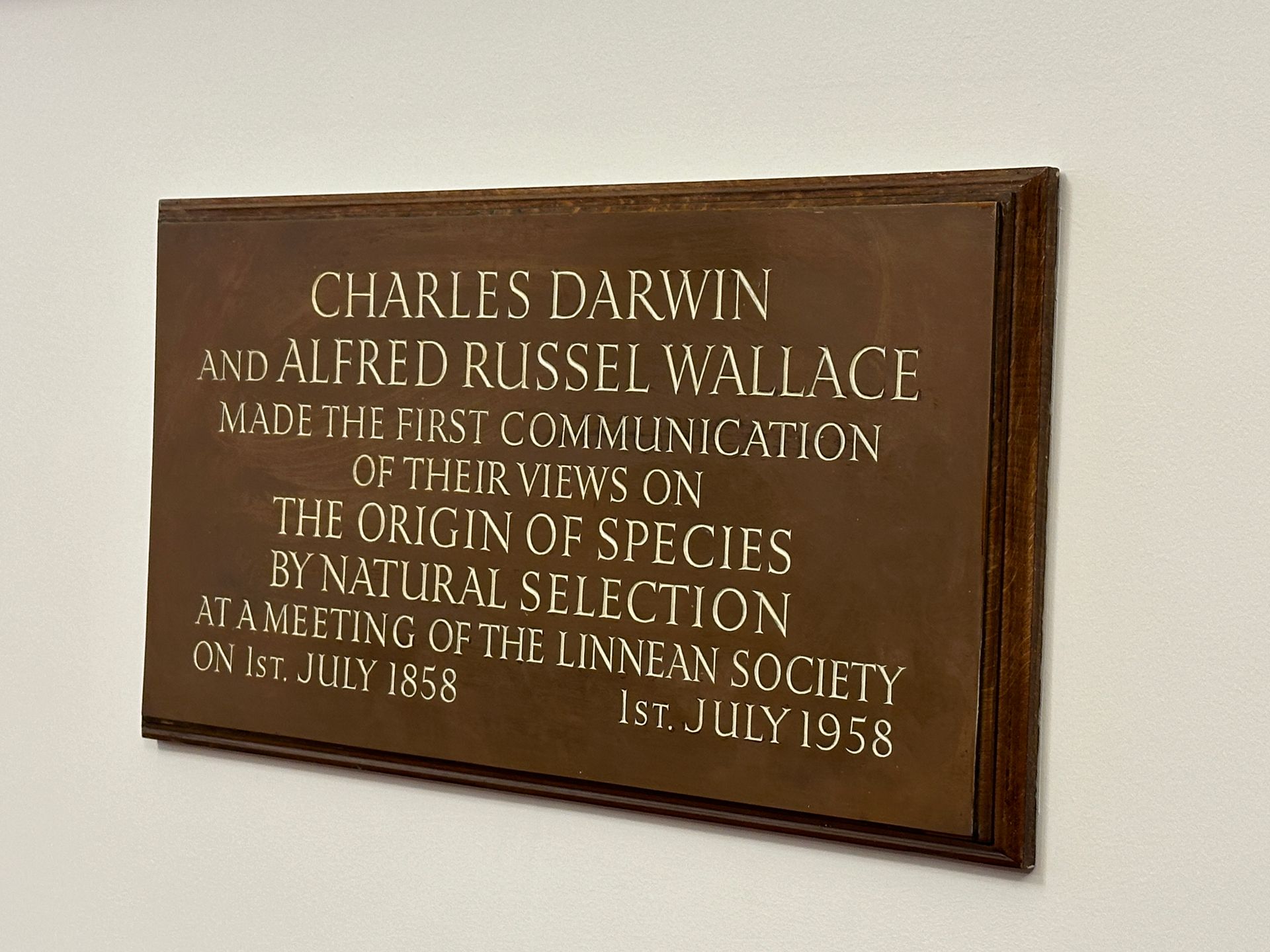
Charles Darwin had been developing his theory of natural selection in private for about two decades when the mail forced his hand. In June 1858, a package reached his home in Kent from Ternate, an island in the Dutch East Indies, in present-day Indonesia. It came from Alfred Russel Wallace, a self-funded naturalist collecting specimens in the region. Inside was an essay describing how varieties diverge from original species through a struggle for existence — in essence, natural selection, arrived at independently.
Wallace was not trying to change history. He admired Darwin, knew he was interested in the species question, and asked him to pass the essay along to the geologist Charles Lyell if it seemed worthwhile. Darwin was stunned. He wrote to Lyell that he had never seen a more striking coincidence, and that Wallace could not have produced a better short abstract of his own unpublished theory.
Darwin's friends Lyell and the botanist Joseph Hooker engineered a compromise. On July 1, 1858, Wallace's essay and extracts from Darwin's earlier private writings were read together at a meeting of the Linnean Society of London, establishing joint credit. The event drew little immediate attention. The pressure it created did not fade, though. Darwin abandoned plans for an enormous, slow-moving book and wrote what he called an abstract instead. "On the Origin of Species" was published in November 1859 and sold out its first printing.
The original letter no longer survives, which is fitting for a document whose importance was entirely in its effect. Without it, Darwin might have delayed publication for years. Wallace, for his part, remained gracious about sharing credit for the rest of his life. Evolution by natural selection would likely have emerged eventually. That it emerged when it did, and in the form of Darwin's book, traces back to an envelope from Ternate.
6 / 15
Abraham Lincoln's letter to Horace Greeley (1862)
Credit: Library of Congress / PICRYL
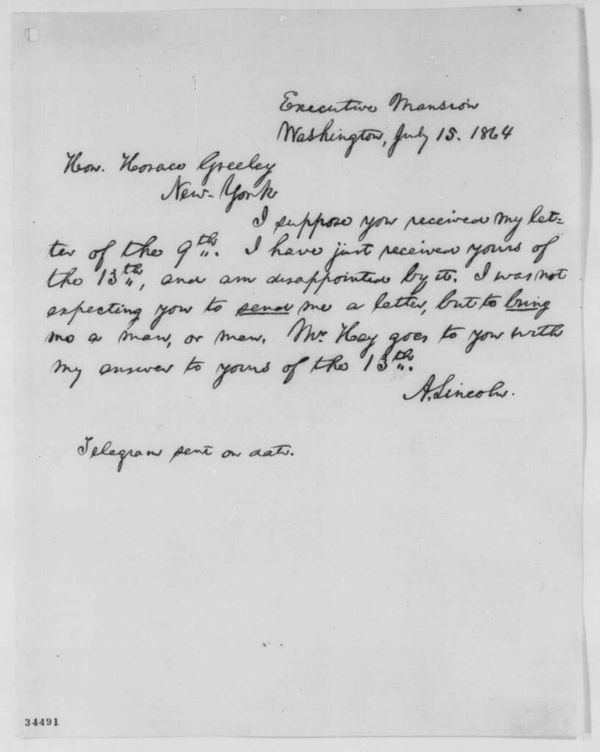
In August 1862, the Civil War was going badly for the Union, and pressure on Abraham Lincoln was coming from every direction. Horace Greeley, the influential editor of the New York Tribune, published an open letter titled "The Prayer of Twenty Millions" on August 20, accusing the president of moving too slowly against slavery. Lincoln answered two days later with a public letter of his own, published in the National Intelligencer.
The reply contained one of the most quoted passages Lincoln ever wrote. He declared that his paramount object in the struggle was to save the Union, and that it was not either to save or to destroy slavery. If he could save the Union without freeing any slave, he would do it; if he could save it by freeing all the slaves, he would do that; and if he could save it by freeing some and leaving others alone, he would do that too. He closed by distinguishing his official duty from his personal wish that all men everywhere could be free.
What readers did not know was that Lincoln had already made his decision. He had drafted a preliminary Emancipation Proclamation in July 1862 and was waiting for a Union battlefield victory before announcing it, on the advice of his cabinet. The Greeley letter was preparation, not hesitation. It framed emancipation in advance as a war measure taken to preserve the nation — the constitutional and political ground on which the proclamation would have to stand.
The victory came at Antietam in September. Lincoln issued the preliminary proclamation on September 22, 1862, and the final version on January 1, 1863. The letter to Greeley shows a wartime president managing public opinion with precision: conservative enough to hold border states and skeptical Northerners, while quietly clearing the path for the most consequential executive act in American history.
7 / 15
Émile Zola's "J'Accuse...!" (1898)

Credit: Uclqjh0 / Musée Criminocorpu / Wikimedia Commons (CC BY-SA 4.0)
On January 13, 1898, the Paris newspaper L'Aurore devoted its front page to an open letter from Émile Zola, France's most famous novelist, addressed to President Félix Faure. The headline, chosen by the paper's editor Georges Clemenceau, was "J'Accuse...!" — I accuse. The paper reportedly sold on the order of 300,000 copies that day, roughly 10 times its normal circulation.
The subject was the Dreyfus affair. Alfred Dreyfus, a Jewish artillery officer, had been convicted of treason in 1894 on flimsy evidence and sent to the penal colony on Devil's Island. Evidence later pointed to another officer, Ferdinand Walsin Esterhazy, as the real author of the incriminating document, but a military court acquitted Esterhazy in early 1898. Zola's letter named names. He accused specific officers and war ministry officials of framing Dreyfus, suppressing evidence, and orchestrating a cover-up, and he accused the court that cleared Esterhazy of acting on command.
Zola knew the letter was legally reckless. That was the point. By making accusations he could be prosecuted for, he forced the evidence into a civilian courtroom. He was convicted of criminal libel the following month and fled to England to avoid prison. The affair split France into warring camps and exposed the depth of French antisemitism. Dreyfus was retried in 1899, convicted again, then pardoned; full exoneration came in 1906, when he was reinstated in the army.
The letter's legacy extends beyond the case. It established the modern role of the public intellectual — the writer who spends accumulated fame on a political cause — and it created a template for the open letter as a weapon of accountability. Zola died in 1902, before the final vindication, but his gamble had already changed how writers engage with state power. More than a century later, "J'accuse" remains shorthand in many languages for a public indictment of institutional injustice.
8 / 15
The Zimmermann Telegram (1917)
Credit: Abervid21 / Wikimedia Commons (CC BY-SA 4.0)
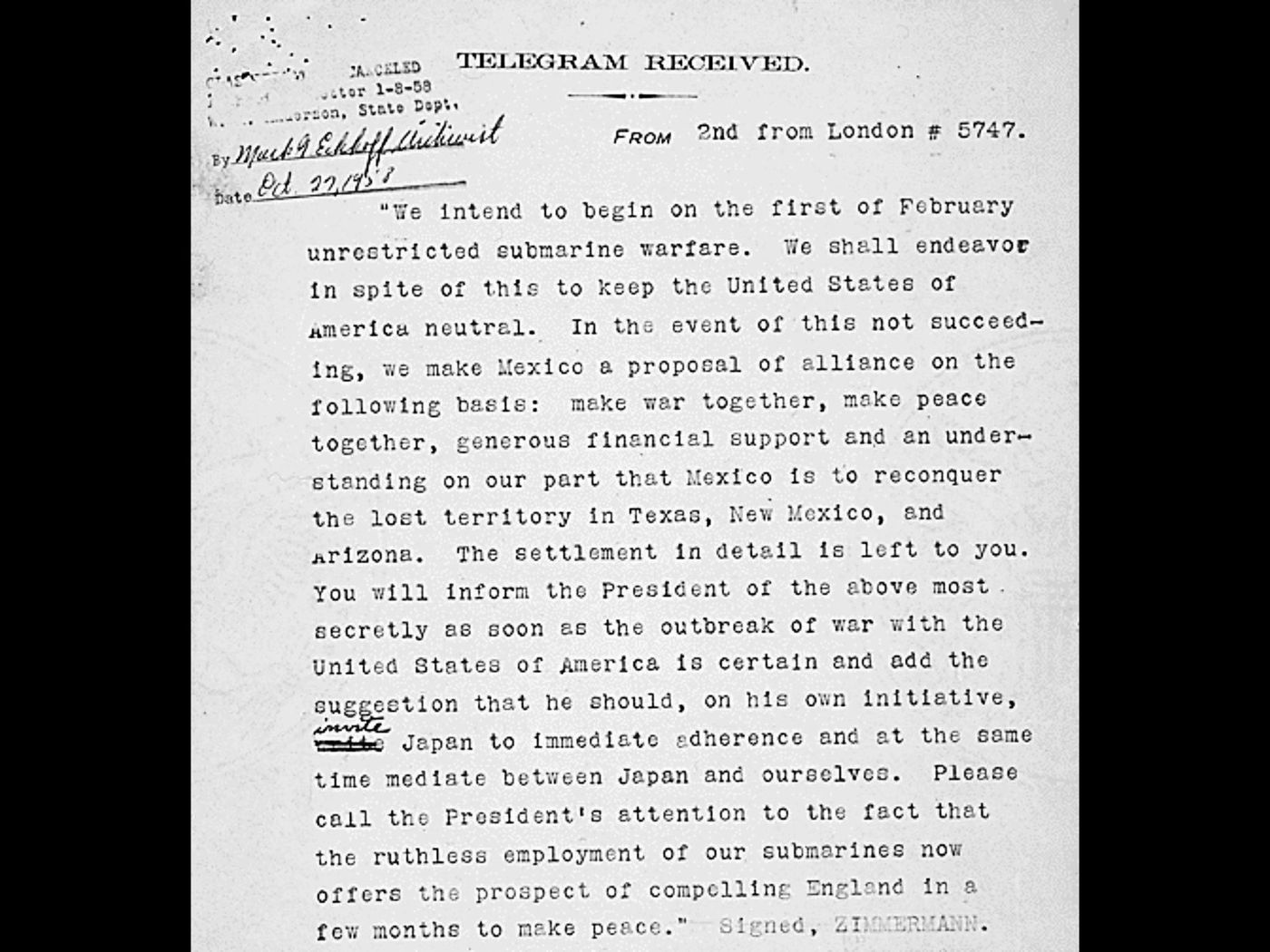
The letter that pulled the U.S. into World War I traveled as a coded cable. In January 1917, Arthur Zimmermann, Germany's foreign secretary, sent an encrypted message to the German minister in Mexico, Heinrich von Eckardt. It instructed him that if the U.S. entered the war in response to Germany's imminent resumption of unrestricted submarine warfare, he should propose a military alliance with Mexico. Germany would provide financial support, and Mexico would be able to reconquer its lost territory in Texas, New Mexico, and Arizona.
British naval intelligence intercepted the message. The codebreakers of the Admiralty's Room 40 decrypted it, then faced a delicate problem: revealing the telegram would expose the fact that Britain was reading both German and neutral diplomatic traffic. They engineered a cover story involving a copy obtained in Mexico and handed the decrypted text to the U.S. in late February 1917.
President Woodrow Wilson released it to the press, and the story broke on March 1. Many Americans initially suspected a British forgery — until Zimmermann himself confirmed the telegram was genuine at a press conference on March 3. The admission removed the last ambiguity. Combined with German submarines sinking American ships after the February 1 resumption of unrestricted attacks, the telegram collapsed what remained of U.S. neutrality. Wilson asked Congress for a declaration of war, which passed on April 6, 1917.
American entry transformed the war. Fresh troops and industrial capacity tilted the Western Front against Germany in 1918, and the U.S. emerged as a decisive power in the peace negotiations that followed at Versailles. The episode is also a landmark in intelligence history: one of the first cases in which signals intelligence — the interception and decryption of communications — visibly changed the strategic direction of a world conflict, a lesson every major power absorbed before the next one.
9 / 15
The Balfour Declaration (1917)
Credit: British Library. Originally published 9 November 1917 / PICRYL
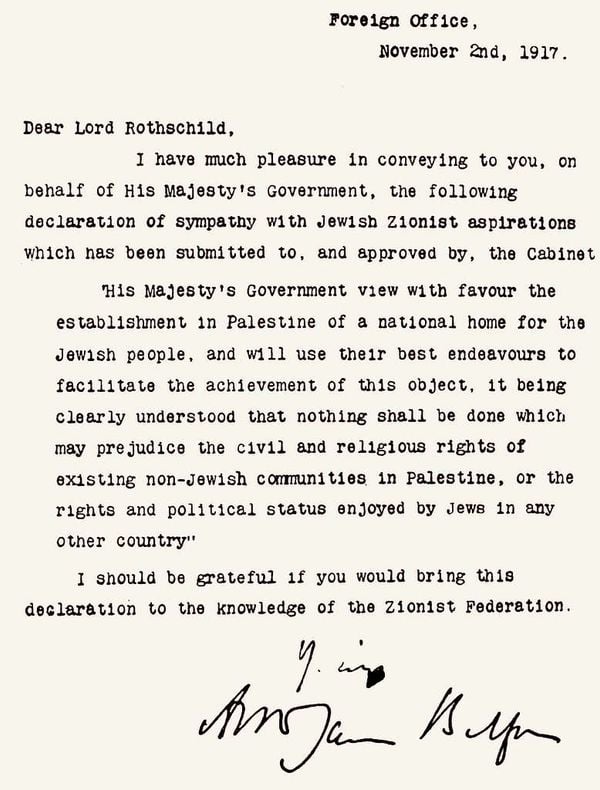
Some letters change history by their length; this one did it in 67 words. On November 2, 1917, British Foreign Secretary Arthur James Balfour sent a short typed letter to Lionel Walter Rothschild, a prominent figure in Britain's Jewish community, for transmission to the Zionist Federation. It stated that the British government viewed with favor the establishment in Palestine of a national home for the Jewish people, and would use its best endeavors to facilitate that object — while adding that nothing should be done to prejudice the civil and religious rights of existing non-Jewish communities in Palestine, or the rights and political status of Jews in other countries.
The letter was a wartime calculation as much as a statement of principle. Britain was fighting the Ottoman Empire, which controlled Palestine, and the government hoped the declaration would rally Jewish support for the Allied cause in the U.S. and Russia. It also overlapped awkwardly with other British wartime commitments, including correspondence with Arab leaders encouraging revolt against the Ottomans and a secret Anglo-French agreement on dividing the region.
After the war, the declaration acquired legal force. Its text was incorporated into the League of Nations mandate that placed Palestine under British administration in 1922, making support for a Jewish national home an obligation of the governing power. Jewish immigration to Palestine grew during the mandate years, and tensions between Jewish and Arab communities escalated into recurring violence that Britain proved unable to resolve.
The state of Israel declared independence in 1948, three decades after Balfour signed the letter. The document remains one of the most contested texts of the 20th century — celebrated by many as a foundation of Jewish statehood, and cited by Palestinians as the moment an imperial power promised away land whose population had no say in the matter. Few pieces of correspondence carry so much weight per word.
10 / 15
Gandhi's letter to Lord Irwin (1930)

Credit: Ryan Thomas / Pexels
Mohandas Gandhi announced one of the 20th century's most effective acts of civil disobedience by mail, in a letter that began "Dear Friend." On March 2, 1930, he wrote to Lord Irwin, the British viceroy of India, setting out the case that British rule had impoverished India and listing demands that included the abolition of the salt tax. The colonial government held a monopoly on salt production and taxed a substance every Indian needed, rich or poor. Gandhi told Irwin plainly that if the demands were not met, he would break the salt laws, and he explained the nonviolent methods he intended to use. He even invited the viceroy to arrest him.
Irwin declined to meet him, replying through a secretary. On March 12, Gandhi set out from his ashram near Ahmedabad with 78 followers and walked roughly 240 miles to the coastal village of Dandi. Crowds gathered along the route, and journalists followed the march day by day. On April 6, he picked up a handful of natural salt from the shore, illegally, in front of the press.
The gesture detonated a mass movement. Indians across the country began making and selling salt in defiance of the law, alongside boycotts of British goods. Tens of thousands were arrested in the months that followed, including Gandhi himself in early May. International coverage, particularly in the U.S., reframed the independence struggle as a moral confrontation between unarmed protesters and an empire.
The campaign led to direct talks: the Gandhi-Irwin Pact of March 1931 and Gandhi's participation in negotiations in London. Independence took another 16 years, but the salt campaign established mass nonviolent resistance as a political technology, one later studied and adapted by movements worldwide, including the American civil rights movement. Its opening move was a courteous letter warning an empire exactly what was coming.
11 / 15
The Einstein-Szilard letter (1939)
Credit: Time Life Pictures - Life Magazine / Wikimedia Commons (CC BY-SA 4.0)
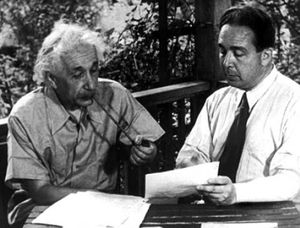
The atomic age has a cover letter. In the summer of 1939, the Hungarian-born physicist Leo Szilard grew alarmed by evidence that nuclear fission of uranium could sustain a chain reaction — and by the fact that Germany, which had annexed Czechoslovakia and its uranium mines, employed physicists capable of drawing the same conclusion. Szilard drafted a warning to the U.S. government but knew his own name carried little weight. He turned to the most famous scientist alive.
Albert Einstein was spending the summer on Long Island. Szilard visited him, and Einstein agreed to sign a letter addressed to President Franklin D. Roosevelt, dated August 2, 1939. The letter explained that recent work made it conceivable that extremely powerful bombs of a new type could be constructed from uranium, urged the administration to secure ore supplies and support American research, and noted that Germany had stopped the sale of uranium from Czechoslovak mines.
Delivery took time. The economist Alexander Sachs, an informal Roosevelt adviser, personally presented the letter to the president on October 11, 1939, weeks after World War II had begun in Europe. Roosevelt responded by creating an Advisory Committee on Uranium. Early funding was modest, but the effort grew, accelerated by British research, and in 1942 became the Manhattan Project. The first nuclear test took place in New Mexico in July 1945, and atomic bombs destroyed Hiroshima and Nagasaki the following month.
Einstein performed no scientific work on the bomb; his role began and ended with his signature and a follow-up letter or two. He later expressed deep regret, saying that had he known the Germans would fail to build the weapon, he would never have lent his name to the effort. The letter stands as a case study in scientific responsibility: a warning meant to prevent a Nazi bomb that ended up helping to start the nuclear arms race.
12 / 15
George Kennan's Long Telegram (1946)
In February 1946, the U.S. Treasury asked the American embassy in Moscow to explain puzzling Soviet behavior, including its refusal to join the new World Bank and International Monetary Fund. The reply came from George Kennan, the embassy's deputy chief of mission, who was sick in bed and had been waiting years for Washington to ask. His answer, cabled on February 22, ran to several thousand words — enormous by diplomatic standards — and became known as the Long Telegram.
Kennan argued that Soviet hostility toward the West was not a reaction to anything the U.S. had done and could not be talked away. It flowed from internal needs: an insecure regime that required an image of a hostile outside world to justify its rule, layered onto older Russian anxieties. Moscow, he wrote, would probe for weakness wherever it found it, but it was not adventurous like Hitler's Germany. It respected firmness and would pull back when met with resistance. War was neither necessary nor desirable; patient, resolute counterpressure was.
The telegram electrified official Washington. Navy Secretary James Forrestal circulated it widely, and Kennan was brought home to teach and then to run the State Department's new policy planning staff. In July 1947, he published a refined version in Foreign Affairs under the pseudonym "X $TWTR," giving the strategy its name: containment.
Containment became the organizing idea of U.S. foreign policy for four decades, visible in the Truman Doctrine, the Marshall Plan, and the creation of NATO in 1949. Kennan himself spent much of his later life objecting that the doctrine had been militarized far beyond his intent; he had emphasized political and economic strength, not an endless arms competition. The strategy his cable inspired outlived him in its broad outcome: the Soviet collapse in 1991 arrived through internal decay, roughly as the Long Telegram had predicted.
13 / 15
Khrushchev's letter to Kennedy (1962)
Credit: Khrushchev's letter to Kennedy / PICRYL
For 13 days in October 1962, the Cuban missile crisis brought the U.S. and the Soviet Union closer to nuclear war than at any other point in history. It was defused, in large part, by letters. After American U-2 reconnaissance photographed Soviet missile sites under construction in Cuba, President John F. Kennedy announced a naval quarantine of the island on October 22. Soviet ships approached the line, U.S. forces went to a heightened alert, and both governments understood that a single miscalculation could escalate beyond recall.
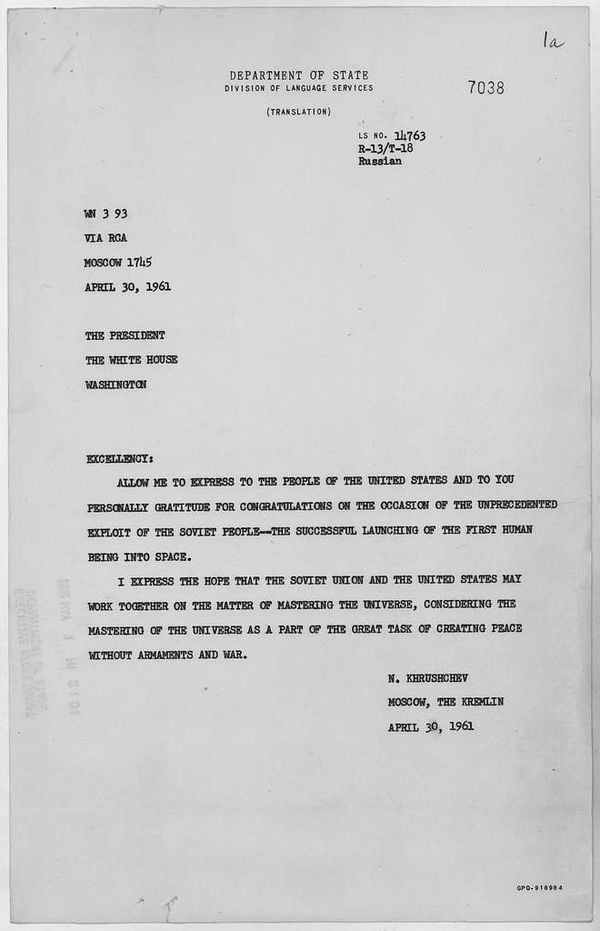
On October 26, a long, private letter from Nikita Khrushchev arrived at the U.S. embassy in Moscow in sections through the evening. Its tone was personal and at moments anguished. Khrushchev wrote of the catastrophe of nuclear war and compared the crisis to a rope with a knot in the middle: the harder each side pulled, the tighter the knot would become, until it could only be cut. He offered a way out — the Soviet Union would remove the missiles in exchange for an American pledge not to invade Cuba.
The next day, a second, harder message arrived, this one broadcast publicly, adding a demand that the U.S. withdraw its Jupiter missiles from Turkey. That same day, a U-2 was shot down over Cuba. Kennedy's advisers adopted the approach of answering the first letter's terms while sidestepping the second's public demand. Privately, Robert Kennedy assured the Soviet ambassador that the Turkish missiles would come out within months, provided the arrangement stayed secret.
On October 28, Khrushchev announced the missiles would be dismantled. The correspondence had done what fleets and alerts could not: it let two leaders step back without public humiliation. The near miss produced lasting changes, including the Moscow-Washington hotline established in 1963 and the Limited Test Ban Treaty signed that August.
14 / 15
Martin Luther King Jr.'s letter from Birmingham jail (1963)

Credit: Adam Jones, Ph.D. / Wikimedia Commons (CC BY-SA 3.0)
On April 12, 1963, Martin Luther King Jr. was arrested in Birmingham, Alabama, for leading demonstrations in defiance of a court injunction. That same day, eight white Alabama clergymen published a statement calling the protests "unwise and untimely" and urging Black residents to pursue change through the courts instead of the streets. King answered them from his cell, beginning in the margins of the newspaper in which their statement appeared, then continuing on scraps of paper smuggled in and out by his lawyers.
The result, dated April 16, 1963, is the most influential American political letter of the 20th century. King dismantled the counsel of patience, writing that "justice too long delayed is justice denied" had been the reality for Black Americans told to wait for more than 340 years. He set out a framework for civil disobedience rooted in Augustine and Aquinas: a just law squares with moral law and must be obeyed; an unjust law degrades human personality and may be broken openly and lovingly, with willingness to accept the penalty. He reserved his sharpest criticism not for the Ku Klux Klan but for the white moderate more devoted to order than to justice.
The letter circulated first in pamphlets and magazines, then reached a mass audience, and appeared in King's 1964 book "Why We Can't Wait." Its timing amplified its force. Within weeks, images of Birmingham police using dogs and fire hoses against young demonstrators shocked the country. President Kennedy proposed sweeping civil rights legislation that June, and the Civil Rights Act became law in 1964.
Written without notes or reference books by a prisoner in solitary confinement, the letter became a standard text in courses on rhetoric, law, theology, and political philosophy. Movements around the world still borrow its central move: answering a demand for patience with a precise moral argument for urgency.
15 / 15
Bill Gates's open letter to hobbyists (1976)
Credit: Bill Gates - DigiBarn Computer Museum / Len Shustek / Wikimedia Commons (Public Domain)
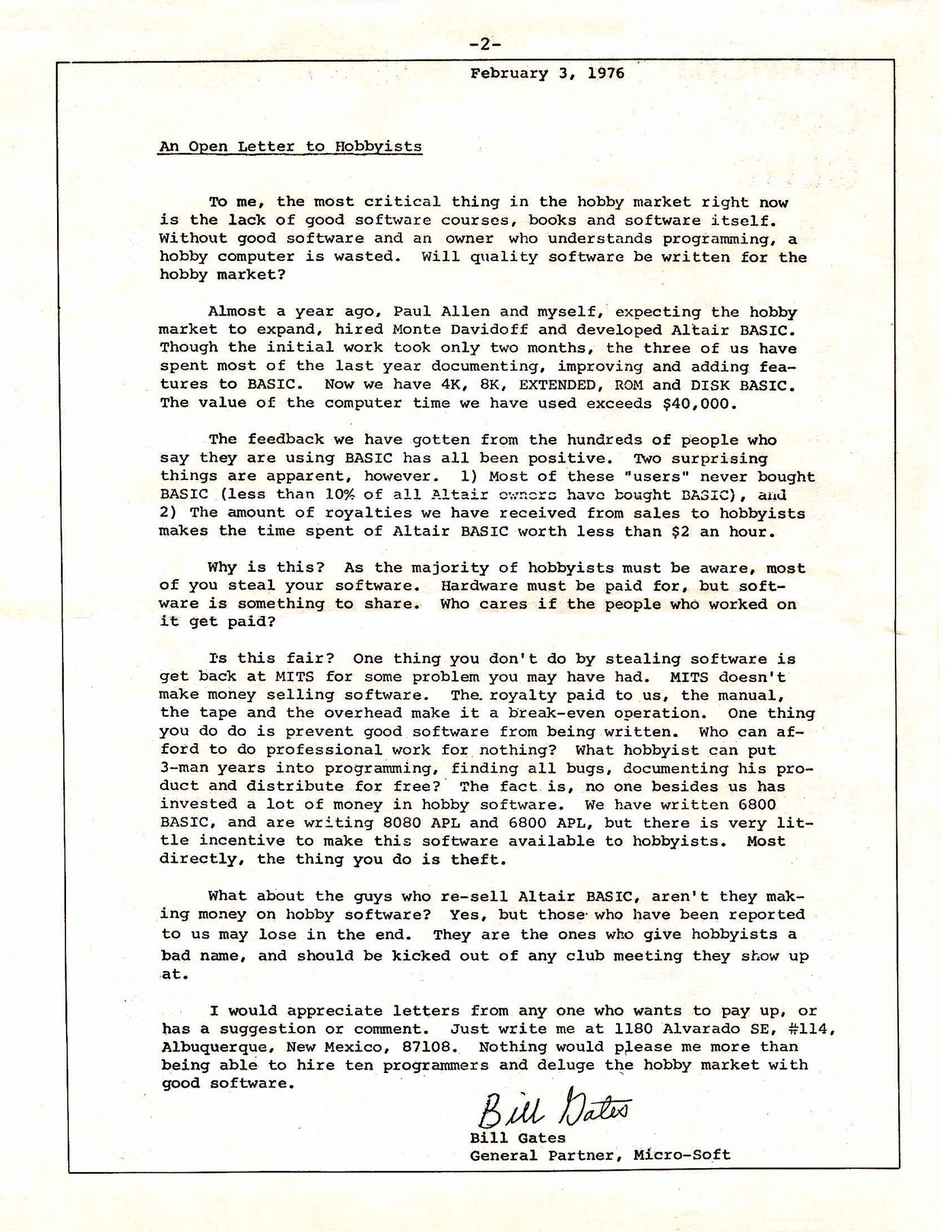
In February 1976, a 20-year-old software developer published an angry letter in the newsletter of the Homebrew Computer Club, a gathering of Silicon Valley tinkerers. The author was Bill Gates, co-founder of a small company then called Micro-Soft. His complaint: hobbyists were freely copying the BASIC interpreter he and Paul Allen had written for the Altair 8800, the machine that launched the personal computer era, and almost nobody was paying for it.
Gates argued that the copying was theft with consequences. Good software required professional work — writing, documenting, maintaining — and by his accounting, the royalties received made the time spent on Altair BASIC worth less than $2 an hour. Who could afford to do professional work for nothing, he asked, and what hobbyist could put years into a program and then distribute it for free? The prevailing culture at the time treated software as something shared among enthusiasts, the way club members swapped circuit designs. Hardware was the product; code came with it.
The letter was widely reprinted in computer publications and provoked furious responses. It also marked a dividing line. Gates was asserting that software was a standalone commercial product, protected by ownership and worth paying for — the premise on which Microsoft $MSFT built its licensing business, including the 1980 deal to supply the operating system for the IBM $IBM PC. Software licensing became one of the most profitable business models ever devised, and it underpins today's multitrillion-dollar industry.
The opposing view never disappeared. The sharing culture Gates attacked resurfaced in the free software movement launched by Richard Stallman in 1983 and in the open-source ecosystem that now runs much of the internet. The modern software economy is, in effect, a long negotiation between the two positions staked out around that 1976 newsletter. Few business manifestos have been shorter, angrier, or more prophetic.

