
Meta is building an AI version of its CEO, raising new questions about management, trust, and whether executives can automate themselves
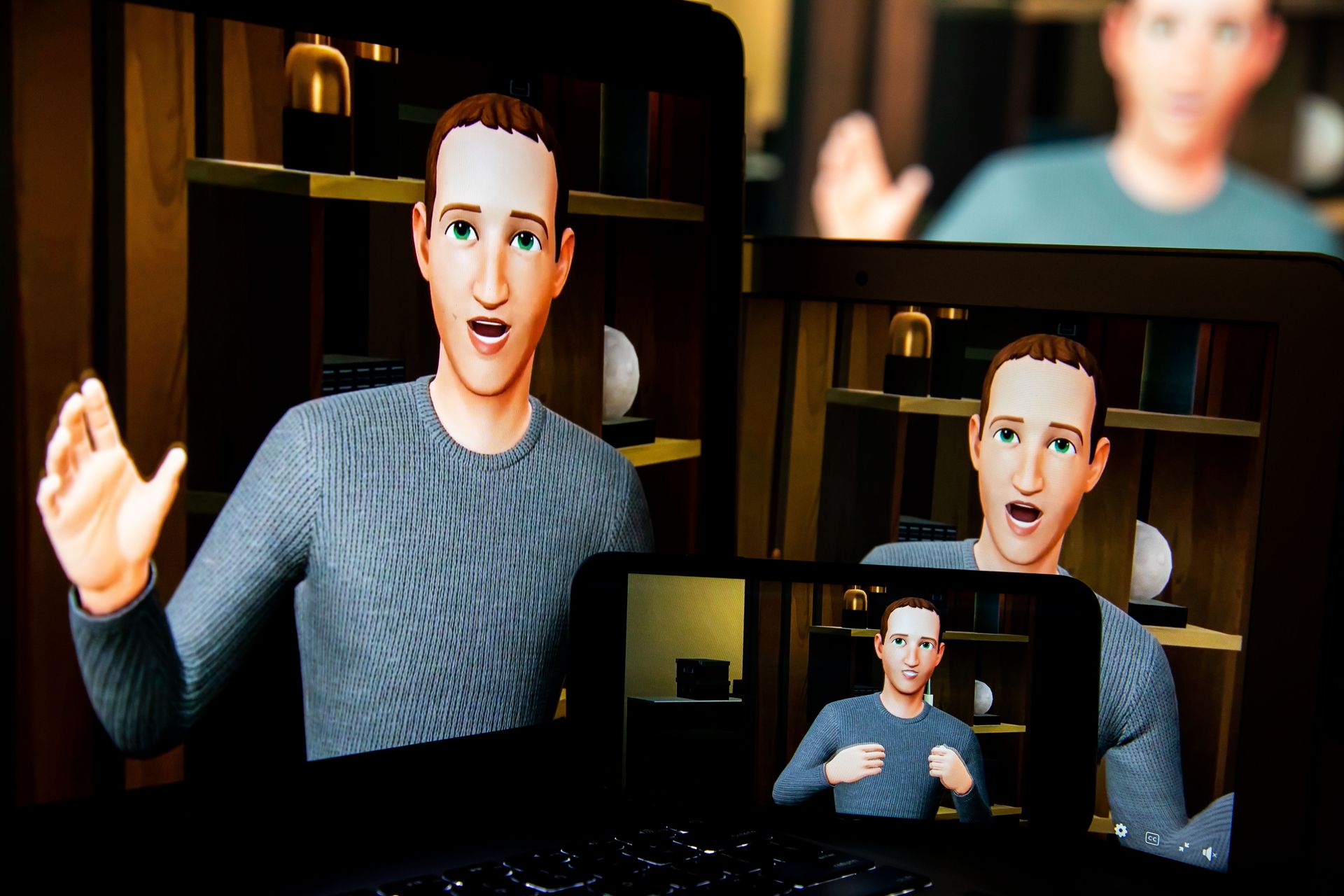
Michael Nagle/Bloomberg via Getty Images
A version of this article originally appeared in Quartz’s AI & Tech newsletter. Sign up here to get the latest AI & tech news, analysis and insights straight to your inbox.
Mark Zuckerberg has spent years trying to convince the world that the future of human connection runs through Meta $META. Now he is testing that theory on his own employees.
Join 500,000+ readers who start their day with Quartz.
By subscribing, you agree to our Terms of Service and Privacy Policy.
Meta is developing a photorealistic, AI-powered version of its founder and CEO that could engage with workers directly, offering conversation, feedback, and a simulation of Zuckerberg's presence at scale.
The character is being trained on his mannerisms, tone, and publicly available statements, as well as his own current thinking on company strategy, so that employees interacting with it might feel meaningfully connected to the person running one of the world's most valuable companies. Zuckerberg himself is reportedly involved in training and testing it.
If it works, it will be one of the more remarkable experiments in the history of management. If it doesn't, it will still be one of the more memorable.
Zuckerberg, who has spent much of his career watching what other people build and then deciding he should also build it, is hardly the first chief executive to try this. The past couple of years have produced a small but telling wave of AI avatars at the top of the corporate org chart.
Klarna CEO Sebastian Siemiatkowski has used an AI-generated version of himself to deliver quarterly earnings, with the avatar announcing itself as "my AI avatar" before presenting financial results. Zoom $ZM CEO Eric Yuan deployed his digital double for parts of an earnings call, then appeared in person for the Q&A section, describing the experience as one he genuinely enjoyed.
Sam Liang, the CEO of transcription company Otter.ai, has been developing a "Sam-bot" trained on thousands of hours of his meetings, designed to handle the roughly 90% of meeting content he considers routine. Reid Hoffman, the LinkedIn co-founder and venture capitalist, built a digital twin trained on two decades of his public thinking, deploying it at live events and across his social channels.
The appeal is not hard to understand. A Harvard Business School study of 27 CEOs found that chief executives spend nearly three-quarters of their time in meetings, calls, and other interactions. Executives themselves report that time wasted in unnecessary meetings has risen more than 50% since 2019, according to Asana Work Innovation Lab. A digital stand-in that can handle the predictable, lower-stakes moments of leadership would, in theory, free the human to focus on the decisions that actually require one.
Workers are less enthusiastic. A Quinnipiac poll conducted last month found that only 15% of Americans said they would be willing to work for a direct supervisor that was an AI program. When researchers from Carnegie Mellon and Emory asked workers what they actually wanted from a boss (AI or otherwise), the answers were not about efficiency.
The concerns also did not focus entirely on accuracy or accountability, though both came up repeatedly. They were more so about recognition. Several participants described the moments before and after meetings, the casual check-ins, the sense that a manager actually noticed their work as the interactions that mattered most.
There is also the trust problem. Workers extend credibility to an AI manager because they trust the human it is based on, not because they trust the AI itself. The moment the bot says something the real boss would never say, that credibility evaporates. And research suggests it may not come back — not to the bot, and not to the human behind it.
It is a risk executives appear willing to take. They have spent the past few years presiding over layoffs that were, depending on who was asked, either about AI or definitely not about AI, while their workforces drew their own conclusions. The avatar boom applies the same logic one floor up. The difference is that no CEO promoting this technology seems to think the story ends the same way for them.
The assumption, stated or not, was that the people at the top were safe because their work was too complex, too human, too irreplaceable to automate.
But if a CEO's presence can be synthesized, their communication automated, their institutional knowledge packaged into a bot dispatched to meetings they would rather skip, the question of what exactly justifies an eight-, nine-, or ten-figure salary does not have an obvious answer. The executives doing this have one ready. Deeper thinking. Mentorship. Vision.
Maybe. The workers still sitting in those meetings, the ones for whom there is no avatar option, might reasonably wonder why human replaceability has always flowed in one direction. Their bosses, freed up for vision work, or golf, or whatever it is that leaders do when the routine has been handled, do not appear to have lingered on the question.