
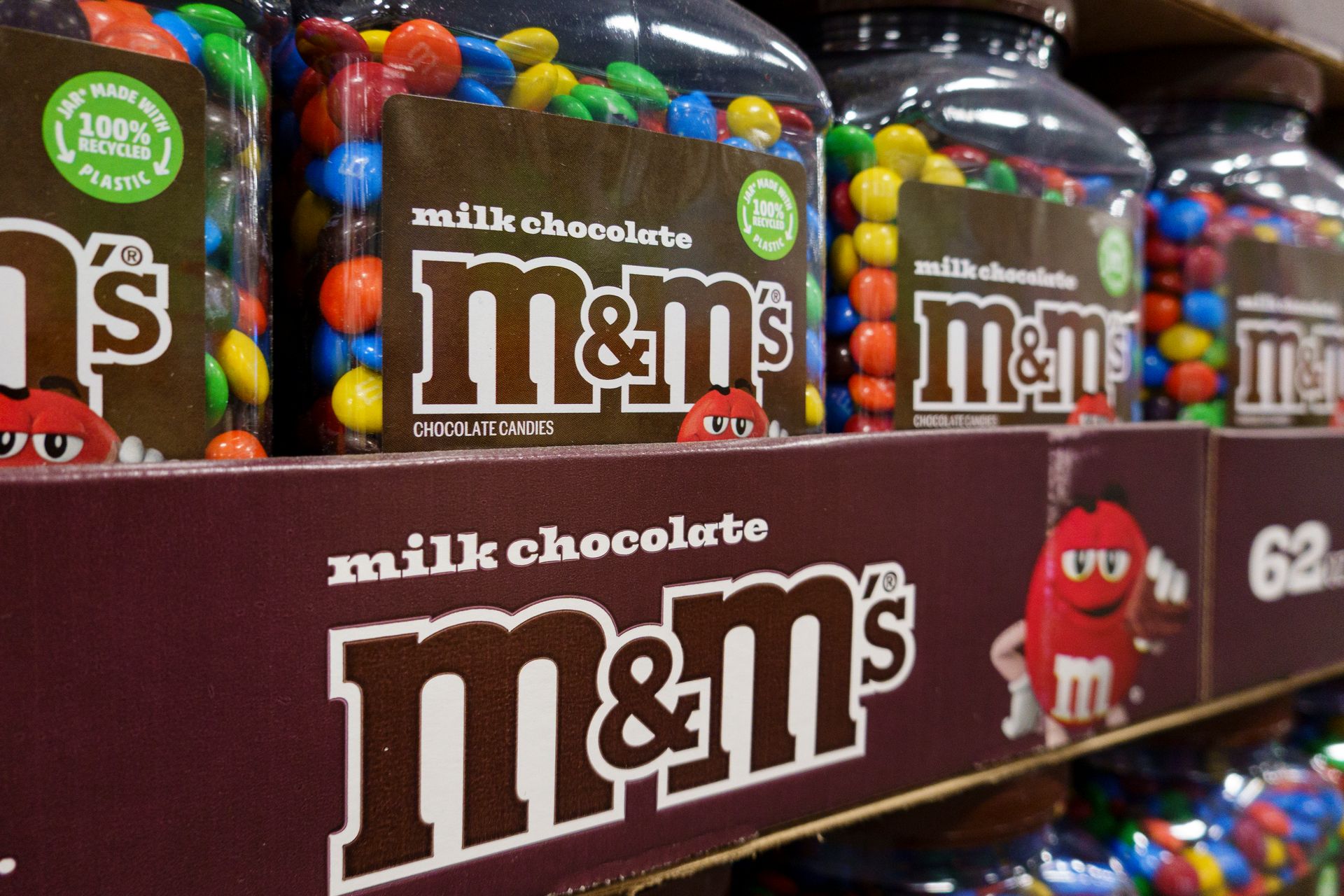
Mars will debut a version of M&M's made without artificial dyes in August, but the bags will be missing two of the candy's classic colors — blue and brown — as the company struggles to replicate those shades using natural ingredients, according to The Wall Street Journal.
Timed to the candy's 85th anniversary, the launch will feature four of the six classic colors — red, orange, yellow, and green — after Mars's researchers successfully matched those shades using plant-based sources such as beets and turmeric, while blue and brown remain obstacles at industrial scale. Achieving the traditional brown shade is complicated by the fact that the color depends heavily on blue pigment as a component.
To replace Blue No. 1, the synthetic dye behind both blue and brown M&M's, Mars turned to spirulina, a concentrated powder derived from blue-green algae. Getting it to work on factory floors has been another matter: the ingredient's thick consistency has fouled spray nozzles and left residue throughout manufacturing equipment. Mars has upgraded more than 300 machines across its facilities to handle the ingredient, according to Allrecipes.
The cost gap between the two ingredients is striking: bulk turmeric runs roughly $9 to $11 per pound at wholesale, while the high-concentration spirulina extract required for food dye applications can exceed $100 per pound, according to Fox Business.
A three-color bag of red, orange, and yellow was one option on the table, but internal discussions rejected it over concerns that the palette read as a sunset. Purple presented its own spirulina supply problem, and pink was dismissed for failing to register strongly enough visually. The company aims to include all six colors, including blue and brown, by 2028.
Anton Vincent, who heads Mars's North American snacks business, called the reformulation "a daunting situation" and acknowledged that the team was "messing with an 85-year-old icon." The naturally dyed bags will initially be available only on Amazon $AMZN.
The move comes as major food manufacturers have been eliminating synthetic dyes from their products under pressure from Health Secretary Robert F. Kennedy Jr. and his Make America Healthy Again campaign. The August debut follows a broader 2025 commitment by Mars to eliminate artificial dyes from several flagship products — M&M's Chocolate, Skittles Original, Extra Gum Spearmint, and Starburst Original fruit chews — with a 2026 target across all of them. A comparable effort nearly a decade ago ended quietly, with Mars shelving the 2016 initiative after concluding there was insufficient consumer demand.
Kraft Heinz $KHC, General Mills $GIS, Nestlé, and Conagra Brands are among the companies that have committed to removing artificial dyes from their U.S. products in recent months. The FDA has formally banned Red No. 3 and has called for a phase-out of petroleum-based synthetic dyes across the food industry.