
15 techniques that actually improve how you memorize things
From spaced repetition to the method of loci, these evidence-based memory techniques help you retain more of what you learn — and forget less of what matters

Credit: Google DeepMind / Pexels
The human brain does not work like a hard drive. Information does not get saved automatically just because you encountered it. What gets stored, and for how long, depends almost entirely on how the brain processed the material in the first place — and most of the ways people study or try to remember things run directly against how memory actually functions.
The standard approach most people default to is re-reading. Read the chapter, then read it again. Highlight the key parts. Read them a third time. It feels productive. It builds a sense of familiarity. And familiarity is not the same as memory. Recognizing something when you see it again is a much weaker cognitive feat than being able to retrieve it on demand — which is what memory actually requires.
The neuroscience of memory is more useful than most people realize. Memory consolidation — the process by which short-term impressions become durable long-term knowledge — depends on encoding quality, repetition timing, emotional and contextual associations, and the active involvement of retrieval systems. Most of these factors are things a person can deliberately control.
That's what makes the study of memory techniques so practical. Researchers including Hermann Ebbinghaus, who mapped the forgetting curve in the 19th century, and more recent cognitive psychologists like Henry Roediger and Mark McDaniel have established a solid body of knowledge about what actually works. Their findings consistently point in the same direction: passive exposure to material is far less effective than active engagement with it.
This is also why context matters. The same information encountered in different ways, at different times, in different formats, becomes far more durable than information reviewed identically over and over again. Variation forces the brain to reconstruct its understanding rather than merely recognize a familiar pattern.
The techniques in this list are drawn from that body of knowledge. Some are simple enough to use immediately. Others require a bit of setup or practice before they become natural. What they share is a grounding in how memory actually operates — not in the intuitive sense that more exposure equals more learning, but in the counter-intuitive truth that effort, delay, and retrieval are the actual drivers of retention. None of them are shortcuts. They are, instead, more honest about the work memory requires.
Spaced repetition

Credit: Yen Vu / Unsplash
Memory fades predictably. Ebbinghaus established this in the 1880s through systematic self-experimentation, producing what became known as the forgetting curve — a graph showing how rapidly newly learned information drops off if not revisited. The curve is steep: roughly half of new material is forgotten within an hour if left unreviewed, and after 24 hours the loss deepens further.
What spaced repetition does is exploit the inverse of that pattern. Instead of reviewing material once in a long session, you review it at increasing intervals — first after a short delay, then after a longer one, then longer still. Each review happens just as the information is beginning to fade, which forces the brain to work harder to retrieve it. That retrieval effort is what strengthens the memory trace.
The logic is elegant: reviewing something just before you forget it is more efficient than reviewing it when it's still fresh. When a memory is fresh, retrieving it requires little effort, and the retrieval does not substantially strengthen the long-term trace. When it has begun to fade, retrieval is harder, and the effort involved consolidates the memory more effectively.
The practical implementation of spaced repetition has been transformed by software. Apps like Anki use algorithms that track how well you recalled each piece of information and schedule the next review accordingly. Cards you remembered easily get pushed further out. Cards you struggled with come back sooner. Over time, the system builds a personalized review schedule calibrated to your actual forgetting rate.
You don't need software to apply the basic principle, though. Simply reviewing new material after one day, then three days, then a week, then two weeks applies the core logic with nothing more than a calendar. Language learners who have used spaced repetition to acquire vocabulary often find that words reviewed on this schedule remain accessible months or years later, while words crammed for a test are gone within days.
The investment of time is also lower than it appears. Because each review session is short and targeted — you're only reviewing the cards or items that are due, not everything you've ever studied — the total time per week is often surprisingly small relative to the retention it produces. Fifteen minutes of spaced review per day tends to outperform several hours of a massed study session by a wide margin when retention is tested weeks later.
The spacing effect works across domains: vocabulary, medical facts, legal concepts, historical dates, musical theory, programming syntax. Any subject that requires the retention of discrete pieces of information benefits from it. It is one of the most well-replicated findings in memory research, and one of the most underused.
Active recall

Credit: Canva Images
The standard study habit is passive: read, re-read, highlight. Active recall flips the process. Instead of reviewing information by looking at it, you close the material and try to retrieve it from memory — answering a question, reciting a fact, summarizing a concept without notes.
The act of retrieval itself is what strengthens memory. Psychologists call this the testing effect or retrieval practice effect. The key finding is that being tested on material — or testing yourself — produces far better long-term retention than an equivalent amount of re-reading, even when the test is difficult and errors are made.
This seems counterintuitive at first. Testing feels like a way of measuring what you know, not a way of building knowledge. But retrieval is not a neutral read of memory. Every time you retrieve a piece of information, the memory trace is reconstructed and then re-stored in a slightly more robust form. The effort of retrieval — the sense of straining to remember, of pulling something to the surface — appears to be what drives consolidation.
The implication for studying is significant. Time spent staring at a highlighted textbook page is almost entirely wasted compared to the same amount of time spent closing the book and writing down everything you can remember. The second method is harder and more uncomfortable. It produces errors and gaps. Those errors and gaps are informative — they tell you exactly what you haven't actually learned yet — and the process of retrieving what you do know strengthens those memories measurably.
Flash cards are the simplest implementation of active recall: you see a prompt, you generate the answer from memory before flipping to check. Practice tests are another. The act of writing from memory — closing your notes and drafting a summary — is another. Even simply pausing at the end of a chapter or lecture and asking yourself what you just learned, without looking at any materials, is a low-effort application of the same principle.
One useful variant is the blank page method: take a blank sheet of paper and write down everything you can remember about a topic without consulting any source. What you can't recall is what you need to study. What you get wrong is what you need to correct. What you do remember has just been strengthened by the act of retrieval.
Active recall takes more effort than passive review, and it feels less comfortable because it involves repeated failure in the short term. The failure is the point. The brain doesn't consolidate what's easy; it consolidates what requires effort.
The method of loci

Credit: Kaan Keskin / Pexels
The method of loci is one of the oldest memory techniques in recorded history, described by ancient Greek and Roman rhetoricians as a tool for memorizing long speeches. The basic mechanism is the deliberate use of spatial memory, which humans carry as a strong cognitive asset evolved over hundreds of thousands of years of navigating physical environments.
The technique works by associating items to be remembered with specific locations along a familiar mental route — a walk through your home, a path through a familiar neighborhood, a sequence of rooms in a building you know well. Each location becomes a mental hook. You place a vivid, exaggerated mental image at each location, encoding the information you want to retain into a visual and spatial form.
When you want to retrieve the information, you mentally walk the route, visiting each location in sequence and finding the image you placed there. The image serves as a retrieval cue that pulls up the associated information. Because the spatial route is already deeply encoded — you know your home effortlessly — it provides a stable scaffolding on which new information can be hung.
The technique demands imagery that is vivid and even absurd. Memory researchers and competitive memorizers consistently find that bizarre, animated, emotionally charged images are retained more easily than neutral or realistic ones. If you're memorizing a speech about economic policy, you don't picture a generic briefcase — you picture a giant briefcase with legs chasing a terrified economist through your kitchen.
Competitors in memory championships use this technique routinely to memorize the order of an entire shuffled deck of cards in under two minutes, or hundreds of random digits. The technique scales well because you're not limited to one mental location — you can have multiple routes, multiple buildings, multiple imaginary landscapes serving as palaces for different subjects.
For everyday use, the method of loci is especially well-suited to ordered information: speech outlines, lists of points to cover in a presentation, historical sequences, procedural steps. It requires upfront effort to construct the associations, but retrieval tends to be reliable once the images are fixed. The technique also makes memorization active and imaginative rather than passive and repetitive, which many people find more engaging.
Interleaving

Credit: Magda Ehlers / Pexels
Most people study a single topic until they feel they've mastered it, then move on to the next. This feels efficient. It produces rapid apparent progress within each subject. And it consistently produces worse long-term retention than an alternative approach: interleaving.
Interleaving means deliberately mixing different topics, subjects, or problem types within a single study session rather than blocking them. Instead of doing 30 algebra problems in a row, you alternate: five algebra, five geometry, five trigonometry, then cycle back. Instead of studying French vocabulary for an hour and then grammar for an hour, you switch between the two throughout.
The reason interleaving works comes back to retrieval effort. When you block practice on a single topic, each new problem looks nearly identical to the previous one, and your working memory still holds the relevant approach. Little actual retrieval is required. When you interleave, you have to figure out which approach applies each time — you can't rely on the momentum of having just done the same thing. That identification process is an additional cognitive demand, and it's one that significantly strengthens both retention and the ability to transfer knowledge to new contexts.
Research on interleaved practice has found it consistently outperforms blocked practice on delayed tests, even though learners themselves often rate blocked practice as more effective while it's happening. The immediate sensation of smooth progress during blocked practice is misleading. The struggle and occasional confusion of interleaving are the mechanism by which more durable learning happens.
One important distinction: interleaving is not the same as randomly disorganized study. The topics being interleaved should be related enough that switching between them requires comparing and distinguishing them — math topics, language skills, historical periods. The contrast forces the brain to encode each concept more precisely, because it can no longer rely on a single mental mode running in the background.
For practical use, build a study session that cycles through several topics rather than devoting large blocks to one. The discomfort of switching is a signal that retrieval work is happening. That work is what builds the knowledge.
The Feynman technique
Credit: Jeswin Thomas / Unsplash
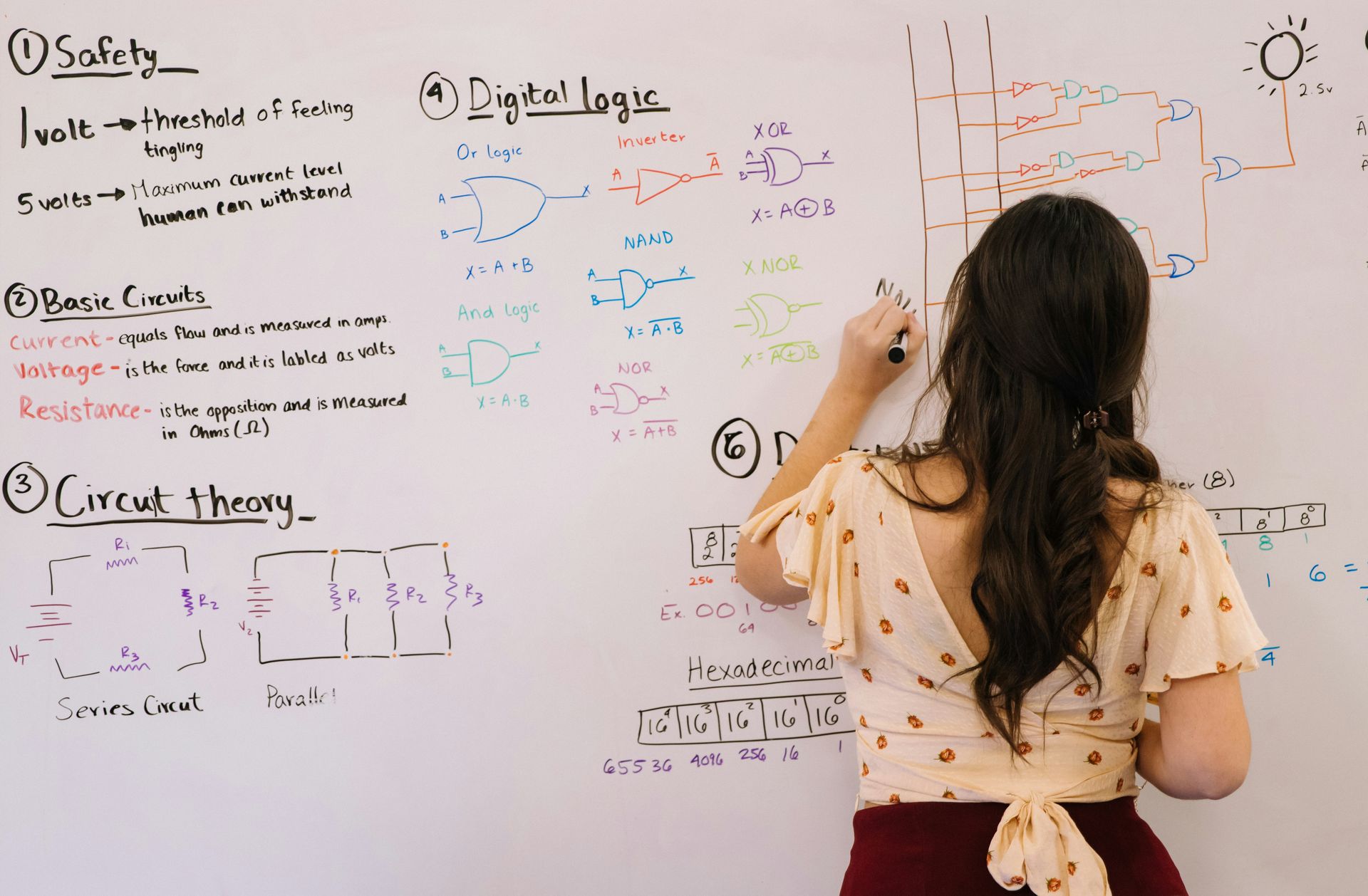
Richard Feynman, the physicist, believed that the test of whether you understand something is whether you can explain it simply. The technique associated with his name operationalizes that belief into a four-step process for learning and retaining material.
The first step is to choose a concept and write out an explanation of it as if you were teaching it to someone with no background in the subject — not a colleague, but a curious ten-year-old. Write it in plain language, without jargon, without shorthand. The act of translating technical knowledge into plain terms immediately reveals where your understanding is solid and where it has gaps.
The gaps are the productive part. When you hit a point where your explanation breaks down — where you can't explain why something is true, or where you resort to restating the textbook definition without actually understanding it — you've found a boundary of your real knowledge. Step two is to go back to your source material and study specifically those points until you can explain them clearly.
Step three is to refine and simplify the explanation further. Cut the jargon. Eliminate any phrase that sounds like you're reciting rather than understanding. Use analogies and concrete examples. If you can't produce an analogy, you probably don't understand the concept well enough to generate one — which is useful information.
Step four, optional but effective, is to actually explain it to someone. A real audience, even a willing friend or family member with no subject knowledge, creates accountability that solo study lacks. If you stumble, it tells you something. If they don't follow, it tells you more.
The value of this technique is that it attacks the most common form of false knowledge: the feeling of understanding that comes from familiarity with words rather than actual comprehension of concepts. Reading a sentence about quantum superposition can make it feel familiar without conveying real understanding. Being forced to explain it to an imagined ten-year-old strips that comfort away.
The Feynman technique works for any conceptual subject: mathematics, science, economics, history, philosophy. It is less directly applicable to pure memorization tasks like vocabulary lists, but for anything requiring genuine comprehension, it is among the most demanding and most effective approaches available.
Elaborative interrogation

Credit: Canva Images
Elaborative interrogation is a study technique built around a single question: why? Rather than reading a fact and moving on, you pause and ask why that fact is true — and then work out or look up the answer.
The mechanism is conceptual integration. When you understand why something is true rather than simply knowing that it is, the fact becomes connected to a network of other knowledge. Connected memories are more durable and easier to retrieve than isolated ones. A fact that stands alone in your memory is vulnerable to forgetting in a way that a fact embedded in a logical structure is not.
Consider the difference between memorizing "warm air rises" as a bare fact versus understanding why it rises — that warmer air is less dense, that less dense fluids float above denser ones, that this is the same principle behind why oil sits above water, and that it's what drives convection currents, thunderstorms, and why pilots care about air temperature. The why transforms a single fact into an interlocking structure. Any one node in that structure can cue the others.
Elaborative interrogation is most effective when the why question produces a genuine explanation rather than a circular restatement. "Warm air rises because it's lighter" is the beginning of an answer; following up on why it's lighter leads deeper into the network. The depth of explanation is what produces the retention benefit.
For studying, the practical application is simple: as you move through any text or set of notes, regularly pause at factual claims and generate the explanation behind them. If you can't generate one, that's a cue to research further or ask someone. If you can, articulate it in your own words rather than repeating the source's phrasing.
This technique pairs well with the Feynman approach. Together they push toward the same goal: genuine understanding rather than surface familiarity. The student who asks why at every step builds a mental model of the subject. The student who merely records what has notes, not knowledge.
Chunking

Credit: Peter F / Unsplash
The working memory — the cognitive system that holds and manipulates information you're actively using — has a limited capacity. Early research, most influentially George Miller's 1956 paper, suggested the limit was around seven items, plus or minus two. More recent estimates place the limit for novel information closer to four. The constraint is real regardless of the exact number: try to hold too many independent pieces of information in working memory at once and earlier items begin to drop out.
Chunking is the process of grouping individual items into larger, meaningful units, which reduces the number of discrete items the working memory must hold. A phone number like 8005551234 is ten individual digits — difficult to hold. Chunked as 800-555-1234, it becomes three units, which is far more manageable.
The principle extends beyond phone numbers. Learning to read involves chunking letters into words and words into phrases — an experienced reader doesn't process individual letters, they process whole words and sometimes whole familiar phrases as single units. An experienced chess player doesn't see 32 pieces in positions; they see a handful of recognized patterns and formations. An experienced programmer doesn't read code character by character; they see familiar structures and idioms.
What this means for memory is that building familiarity with the domain you're studying creates larger and larger chunks. A medical student early in training must memorize dozens of individual symptoms. An experienced physician looks at a patient and immediately recognizes a syndrome — a meaningful cluster — because years of exposure have chunked those symptoms into a single pattern. The expert isn't smarter; they have more and larger chunks.
Deliberate chunking as a study strategy means looking for meaningful groups in the material you're learning. Instead of memorizing ten unrelated historical dates, ask what they have in common — are they all events in the same conflict? All outcomes of the same policy? Organizing them into a coherent narrative chunk reduces the memory load and strengthens each element through its connection to the others.
Dual coding

Credit: fauxels / Pexels
Dual coding theory, developed by Allan Paivio in the 1970s, holds that the brain processes verbal and visual information through separate but connected systems. Information encoded through both systems simultaneously is more robustly stored than information encoded through just one.
The practical implication is that pairing words with images — or visual representations with verbal labels — produces stronger memories than either alone. This is not simply because you've encoded the information twice. The two systems are distinct enough that accessing one can cue the other, meaning you have two independent retrieval pathways to the same information.
The value of this for learners is substantial. Drawing diagrams while studying written material, making concept maps, sketching processes out visually, or finding and studying genuine visual representations of what you're reading — all of these activate the visual system alongside the verbal system and produce stronger encoding.
This is different from decoration. Adding an irrelevant image to a textbook page does not help memory. The visual representation must actually encode the same information as the text, in visual form. A diagram showing the steps of the water cycle activates dual coding. A photograph of a river placed next to a description of the water cycle does not, because the image doesn't actually represent the conceptual content.
For note-taking, this suggests drawing quick sketches or diagrams alongside written notes rather than writing in continuous prose only. Even rough, imprecise drawings that capture the structure of a concept appear to benefit retention. Mind maps and concept maps, when they genuinely reflect the relationships between ideas rather than merely listing them, apply dual coding at a structural level.
The technique is particularly valuable in science, engineering, and mathematics, where visual representations of abstract relationships are natural — graphs, diagrams, flowcharts. But it applies in history (timelines and maps), language learning (associating words with vivid visual images), and even philosophy (diagrams of argument structure).
Teaching others

Credit: Armin Rimoldi / Pexels
The act of teaching material you're learning is among the most effective memory techniques available, and also one of the most underused. It forces a level of active engagement with the material that passive review never can, and it produces gaps and errors that are immediately visible — the teacher's version of the retrieval process described earlier, but with an external audience creating additional accountability.
One mechanism behind this is sometimes called the protégé effect: people prepare more thoroughly, organize their knowledge more carefully, and work harder to understand material when they know they'll be responsible for explaining it to someone else. The knowledge of an upcoming explanation primes deeper processing during the learning phase.
The other mechanism is that explaining material requires continuous on-the-spot retrieval, organization, and translation. You can't read from a script and truly teach. You have to hold what you know in working memory, organize it into a coherent sequence, adapt to what your audience does or doesn't understand, and find ways to make the unfamiliar familiar through analogy and example. Each of these demands active cognitive work that passive review doesn't require.
You don't need a willing audience to apply this. The Feynman technique already leverages a version of this — explaining to an imagined audience. But teaching a real person, even briefly and informally, adds something. The questions a real listener asks are unpredictable. Their confusion points precisely to the boundaries of your explanation. Their follow-ups may reveal connections or implications you hadn't considered.
Study groups, peer teaching arrangements, or simply explaining what you've been learning to a friend or family member over dinner all apply this principle. The key is that the explanation must be real — not a performance of understanding, but a genuine effort to transfer knowledge. Where the explanation breaks down is information. Those breakdowns, when studied and repaired, become some of the most durable parts of your knowledge.
Sleep and memory consolidation

Credit: Polina / Pexels
Sleep is not passive recovery time. During sleep, the brain actively processes and consolidates memories formed during waking hours — transferring information from temporary storage in the hippocampus to more stable long-term storage in the cortex.
This process happens primarily during specific sleep stages. Slow-wave sleep, which dominates the early part of the night, appears particularly important for consolidating declarative memories — facts, events, and concepts. REM sleep, which increases in proportion through the night, appears more involved in procedural and emotional memory. Both stages contribute to overall memory consolidation.
The consequence for learning is that the hours following a study session are among the most important for determining what gets retained. A learner who pulls an all-nighter before an exam, eliminating the sleep window during which consolidation would occur, is actively undermining the memory storage process — regardless of how many additional hours of review the sleeplessness allows.
Sleep deprivation also impairs the encoding phase. A sleep-deprived hippocampus encodes new information less effectively to begin with, meaning that studying while exhausted produces weaker initial memories that are then poorly consolidated. The compounding effect is significant.
Naps have been shown to benefit memory, particularly when scheduled after a learning session. Even a 20-minute nap in the afternoon following morning study appears to reduce forgetting compared to remaining awake. Longer naps that include slow-wave sleep produce stronger effects.
The practical implication is to prioritize sleep around intensive learning. Studying in the morning and sleeping well the following night is more effective than studying late at night and sleeping poorly. Taking a short nap after study is more effective than extending the study session at the cost of sleep. These are not intuitive conclusions for people accustomed to treating sleep as the variable to be sacrificed when time runs short — but the evidence on them is consistent and strong.
Memory palaces for abstract information

Credit: Canva Images
The method of loci works readily for ordered lists and concrete imagery. Adapting it to abstract information — numbers, formulas, philosophical arguments, legal principles — requires an additional step: converting the abstract into something concrete and visual before placing it on the mental route.
This conversion process is itself a technique. The major system, developed over centuries and refined by memory practitioners, assigns a consonant sound to each digit from zero to nine. The number 27, for example, maps to "n" and "k" (or similar, depending on the variant used). Those sounds can be combined with vowels to create a word — "neck" — which can then be visualized vividly and placed in a mental location. Longer numbers produce longer sequences of words, and those words become a narrative or a series of images along the route.
This sounds complicated and it is, in the initial learning phase. Competitive memorizers spend time building fluency with the system before it becomes fast. But the investment pays off for people who regularly need to retain numerical information — dates, measurements, phone numbers, financial figures, chemical constants.
For non-numerical abstract information, the conversion challenge is different. A legal principle can be encoded by finding a concrete image or brief narrative that captures its essence — something vivid enough to cue the principle reliably during retrieval. A philosophical argument can be broken into its key steps, each converted to an image that captures the logical move.
The process of conversion is itself a learning exercise. Finding an image that genuinely represents an abstract concept requires understanding that concept well enough to identify its essential character. The conversion step functions like the Feynman technique applied to a memory problem: you can only convert what you've understood.
Memory palace work for abstract subjects is genuinely demanding. It is most worth the investment for material that must be retained for years rather than weeks, or for information that will be retrieved under conditions — public speaking, exams, high-stakes conversations — where reliable access matters.
Emotion and memory

Credit: Canva Images
Memory is not a neutral recording system. The brain assigns emotional weight to experiences, and emotionally significant material is consistently remembered better than neutral material. This is a consequence of how the amygdala, the brain's emotional processing center, interacts with the hippocampus during memory encoding.
When the amygdala is activated — by fear, excitement, surprise, or strong personal relevance — it signals the hippocampus to encode the current experience with higher priority. Hormones including norepinephrine and cortisol released during emotional states appear to strengthen memory consolidation. The result is that emotionally charged events are remembered in more detail, for longer, than comparable emotionally neutral events.
This asymmetry has practical uses. If you can find a way to make material emotionally meaningful — to connect it to something personally relevant, to find genuine interest or curiosity in it, to appreciate its stakes — encoding will be stronger. This is not about manufacturing fake enthusiasm. It's about actively looking for the aspects of a subject that genuinely connect to things you care about.
Storytelling is one powerful application of this. Narrative activates emotional responses in ways that lists of facts do not. Embedding information in a narrative context — the story of how a discovery was made, the human consequences of an economic policy, the biography of a mathematician whose work you're studying — produces stronger encoding than the same information presented as bare facts.
Personal connection is another mechanism. Information that connects to your own experience, your own life, your own goals, is encoded more deeply than information you encounter as a stranger. Finding the bridge between what you're studying and something you already know and care about is an active encoding strategy, not merely a motivational one.
The implication for study is to engage with the why of personal relevance. Why does this material matter to you? What would change in your understanding of something you care about if you mastered this? These questions aren't just motivational — they're cognitive. The answers create the emotional encoding that makes the material stick.
Context and state-dependent memory

Credit: Canva Images
Memory is not stored in isolation from the conditions under which it was formed. The physical environment, the internal state of the learner, and the contextual cues present at encoding all become associated with the memory and can serve as retrieval cues later.
State-dependent memory refers to the finding that information learned in a particular mental or physical state is more easily retrieved in the same state. Early research demonstrated that divers who learned word lists underwater retrieved them better underwater than on land, and vice versa. Other research found similar effects with mood states and with the presence or absence of caffeine at the time of learning.
Context-dependent memory refers to environmental cues. People who study in a particular room and are then tested in that room perform better than those tested in a different room. The environmental cues present at encoding become part of the retrieval pathway.
These effects have practical implications in both directions. On the positive side: if you can study material in conditions similar to those in which you'll be tested or expected to use it, you'll retrieve it more easily. If you're preparing for a formal exam, spending some study time in quiet, exam-like conditions activates relevant context cues. If you're preparing to use knowledge in a specific professional environment, practicing in similar conditions helps.
On the cautionary side: studying exclusively in one context, always with the same music, always at the same time of day, creates associations that may not transfer to other conditions. Varying study contexts — studying the same material in different rooms, at different times, in different formats — creates more robust memories that can be retrieved across a wider range of conditions. The memory becomes associated with the content rather than the context, making it more portable.
For most practical purposes, the main takeaway is to vary your study environment deliberately and to do at least some preparation in conditions similar to those where the knowledge will be needed.
The generation effect

Credit: Julio Lopez / Pexels
Information that you generate yourself is remembered better than information you merely read. This is the generation effect, and it is robust across a wide range of learning contexts and material types.
The phenomenon can be observed in a simple form: if you're given "hot — c___" and asked to complete the word, you'll remember "cold" better than if you'd simply been shown "hot — cold." The act of producing the answer, even when it's trivially easy, produces stronger encoding than passive reception.
The generation effect applies to note-taking in ways that matter practically. Verbatim transcription of lecture content — writing down exactly what you hear or see — produces weaker memories than writing notes in your own words. The paraphrase requires generation: you have to process the meaning, find your own formulation, and produce language that captures it. Each of those steps strengthens encoding. Transcription, by contrast, can become so automatic that meaning never fully registers.
One implication is that typing notes, which enables fast transcription, may be counterproductive compared to handwriting notes, which requires greater selectivity and more active processing of what to record. Research on this has found better conceptual recall among handwriters, likely because they cannot keep up verbatim and so are forced to generate their own summaries.
The generation effect also applies to predictions. If you attempt to predict the answer to a question before seeing the correct answer, your memory for the correct answer will be better than if you'd simply read it — even if your prediction was wrong. The wrong prediction is not a waste. It primes memory for the correct answer in a way that passive reading cannot.
Practical applications: write notes in your own words, generate questions about the material before or during study, attempt exercises before reading the solutions, make predictions before checking answers. In each case, the act of production is itself the memory-building mechanism.
The testing effect at different difficulty levels
Credit: Andy Barbour / Pexels
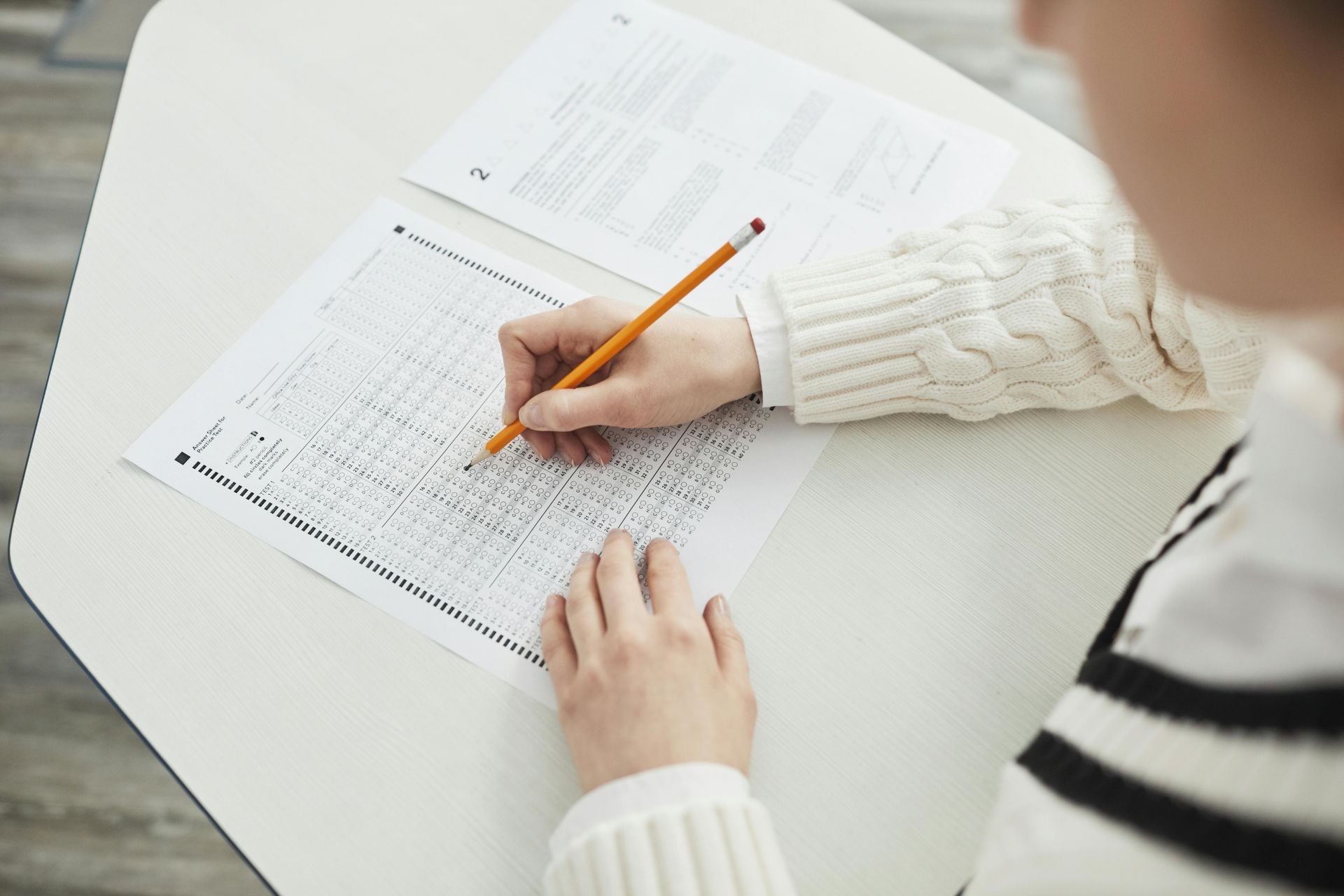
Active recall and testing produce better retention than passive review — that principle is well established. But the difficulty of the test matters. Retrieval that is too easy produces minimal benefit. Retrieval that is too hard — beyond the point where any answer can be generated — produces minimal benefit. The sweet spot is what researchers call desirable difficulty: hard enough to require real effort, not so hard that the attempt fails completely.
This calibration principle has implications for how to design practice tests and retrieval sessions. Immediately after learning something, testing yourself is both easy (because the information is still fresh) and of limited benefit. Testing a day or two later, when the information has begun to fade, is harder and more productive. The increasing-interval logic of spaced repetition is partly an application of this: reviews are scheduled to happen when the material is in the zone of moderate difficulty to retrieve.
The type of question matters too. Recognition tasks — multiple choice questions where you identify the correct answer from a set of options — are easier and produce weaker retention benefits than recall tasks, where you must generate the answer from scratch. Free recall, where you retrieve as much as possible from an entire domain without any cues, is the hardest and produces the strongest retention when material is in range of retrieval.
Interleaving (described earlier) increases difficulty by forcing you to distinguish between related approaches — which problem type am I dealing with? This additional difficulty is a key part of why interleaving outperforms blocked practice on delayed tests. The challenge of identifying the correct method is itself a retrieval and categorization task.
The principle of desirable difficulty suggests calibrating your study sessions to stay in a productive difficulty range. If everything feels easy, you're either not being challenged enough or you've already learned it well enough that review time would be better spent elsewhere. If nothing can be retrieved, break the material into smaller pieces, review, then attempt retrieval again. The goal is consistent productive struggle — not comfort, and not despair.