From the sinking Catedral Metropolitana on the Zócalo to a Coyoacán parish with painted vault frescoes that rival Italian fresco cycles
Laurentiu Morariu / Unsplash
Churches are the architectural spine of Mexico City. Walk through any historic neighborhood in the capital, and the skyline resolves into bell towers, domes, and stone façades built over three centuries of colonial rule. Spain governed Mexico for 300 years, and the imposition of Catholicism during that period produced a building program without parallel in the Americas: churches rose in every city square, every town center, and every indigenous community where Spanish missionaries established a presence. The religion arrived through colonialism, but the architecture it generated drew on the labor, craft knowledge, and artistic vocabulary of indigenous builders whose influence is woven into the stonework, iconography, and spatial logic of the structures they raised.
Mexico City concentrates this legacy at extraordinary density. The capital was built on the ruins of Tenochtitlan, the Aztec imperial city destroyed in 1521, and the churches that followed frequently occupied the same ground as the temples they displaced, sometimes incorporating the original stone directly into the new walls. The result is a city where Catholic architecture carries pre-colonial memory in ways the surfaces do not always advertise. Some of that fusion appears in explicit iconographic mixing: the stone cross in San Angel blends pagan and Catholic imagery without resolving the tension between them. Other traces are structural and geological. The cathedral at the city’s center has been sinking into the soft lakebed of the ancient lake for centuries, its massive frame settling unevenly into ground the Spanish chose without understanding what lay beneath it.
The five churches below appear in Travel + Leisure, selected by a Mexico City-born writer for visual impact and historical importance. Each sits in or near a neighborhood that rewards extended exploration beyond the church itself, and each represents a distinct moment in the capital’s long relationship with sacred architecture.
Credit: Mexico City Official Site
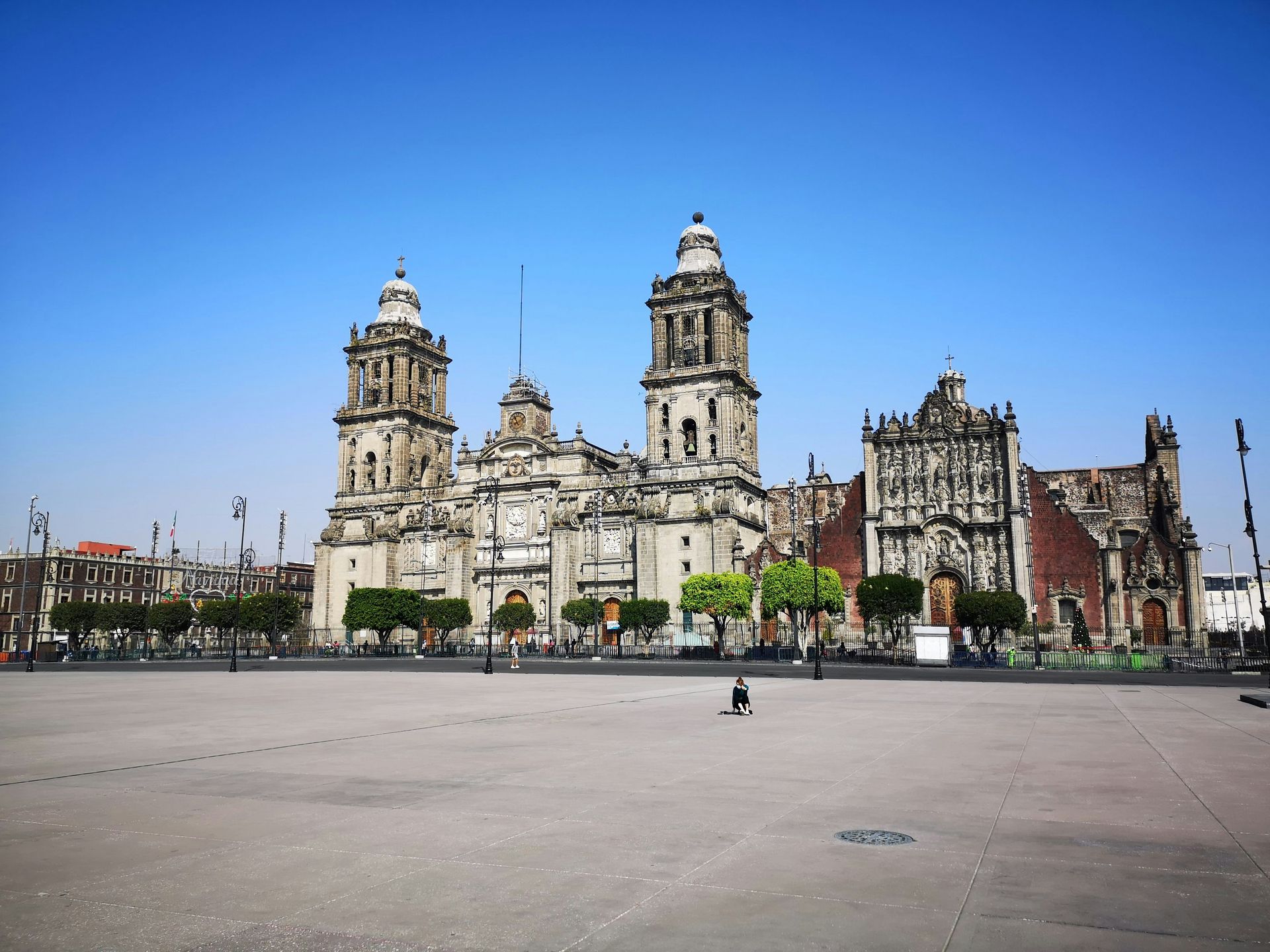
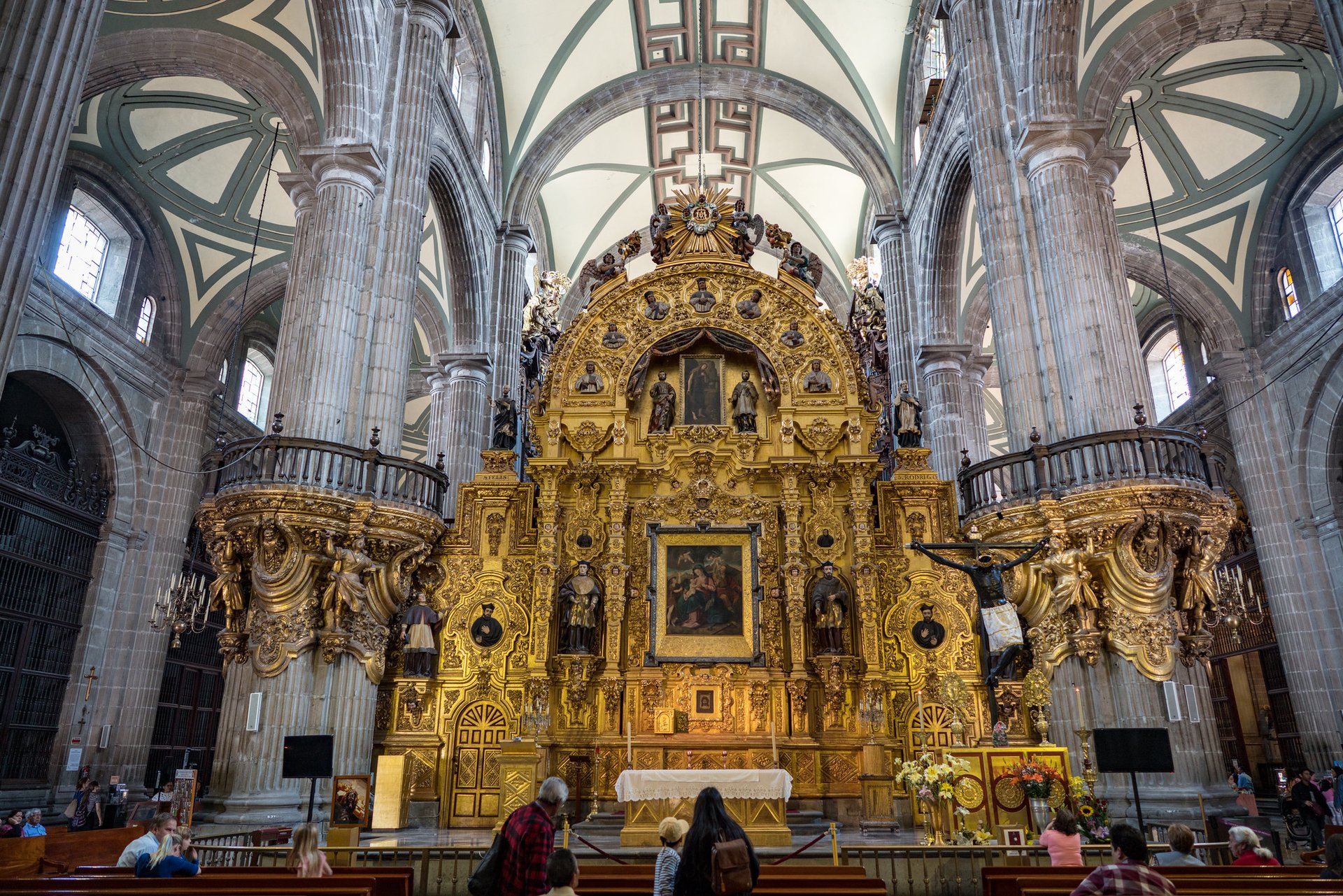
Mexico City’s Catedral Metropolitana took nearly 300 years to build, beginning in the 16th century and concluding in the 19th, and the extended construction period left its architectural history embedded in the stone. Renaissance, baroque, and neoclassical elements appear across the façade, chapels, and interior furnishings, not as a coherent stylistic program but as a layered record of changing aesthetic priorities throughout the colonial period. The bell towers and completed façade, finished by architect Manuel Tolsá, give the exterior its unified visual authority despite the stylistic accumulation beneath.
Inside, 14 of the cathedral’s 16 chapels are open to the public, each dedicated to a different saint or aspect of Catholic devotion and each reflecting a distinct moment in the building’s history through its altarpiece, sculpture, and decorative program. Two 18th-century organs occupy the upper gallery, massive instruments whose pipes extend toward the vaulted ceiling in a demonstration of the resources the colonial church commanded at its peak. The interior’s scale is not immediately legible from the plaza outside. The nave’s length and the crossing dome’s height become apparent only after the visitor moves through the entrance and allows the eye to adjust to the interior’s full depth.
The cathedral sits on the northeastern edge of the Zócalo, Mexico City’s central plaza and one of the largest public squares in the world. The plaza’s scale gives the façade the setback distance it needs to be properly seen. The building’s ongoing subsidence into the ancient lakebed has produced a visible tilt in the towers and a slight warping of the floor plan that structural intervention has slowed but not stopped. Engineers have managed the cathedral’s relationship with its unstable ground for decades, and the building’s survival above it is itself an ongoing architectural achievement, as the visitor standing in the nave experiences directly through the slightly uneven floor. No other church in Mexico City encodes its own history, from the colonial ambitions of its 16th-century founders to the geological instability its 19th-century completion could not resolve, with the same physical immediacy.
Credit: Mexico City Official Site
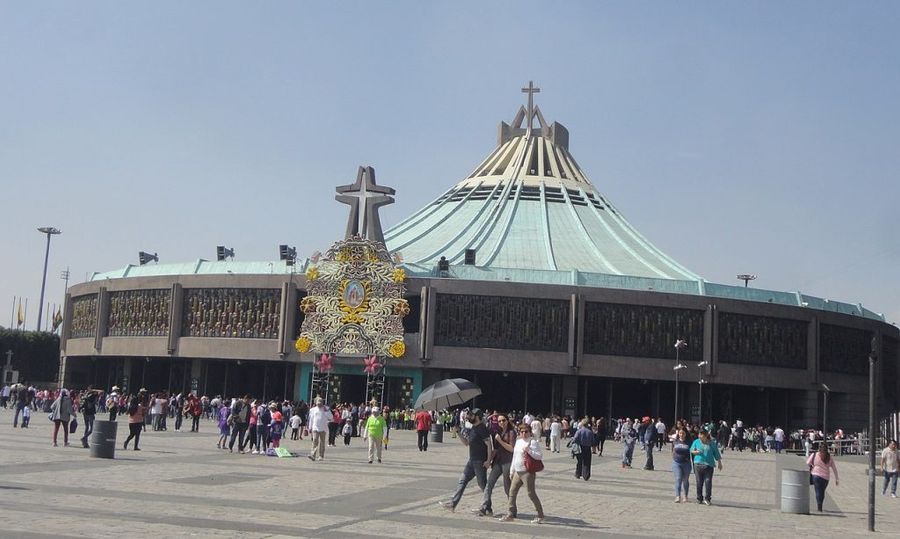
The Basílica de Santa María de Guadalupe is one of the most visited Catholic pilgrimage sites in the world, drawing millions of worshippers each year to Tepeyac Hill on the northern edge of Mexico City, where Juan Diego, a young indigenous man, reported a vision of the Virgin Mary in 1531. The image of the Virgin, dark-skinned and appearing to a native Mexican surrounded by indigenous imagery, became central to Mexican Catholic identity in ways no other religious image in the country approaches. The basilica complex that developed around the site holds that image, and pilgrims travel from every part of Mexico, often on foot for the final stretch, to venerate it.
The plaza at Tepeyac holds two basilicas: the original, built between the 16th and 18th centuries and now closed to regular worship due to structural instability, and the modern structure completed in the 1970s. The new basilica’s circular plan was designed specifically so that the tilma, the cloak on which the Virgin’s image is said to have miraculously appeared, remains visible from every point in the interior. The building seats 50,000 people,, and its curved floor plan gives it a civic scale more reminiscent of a stadium than a conventional church, reflecting the practical reality of accommodating the volumes of worshippers who arrive on December 12, the feast of Our Lady of Guadalupe, when crowds number in the hundreds of thousands.
The site rewards a visit on an ordinary day, when the pilgrims who arrive continuously from around the country give the plaza its specific devotional atmosphere without the feast-day density that makes navigation difficult. The old basilica’s tilted façade, visible from the plaza, gives the site a doubled historical presence: the new building’s modernity and the old building’s baroque stonework occupy the same plaza in a juxtaposition that makes the pilgrimage tradition’s continuity across architectural eras concrete and immediate. Few religious sites in Latin America convey the living intensity of popular Catholic devotion as directly as Tepeyac does on an ordinary Tuesday morning, when the pilgrims arriving from distant states outnumber the tourists and the plaza belongs to the faithful.
Credit: Visit Mexico Official Site
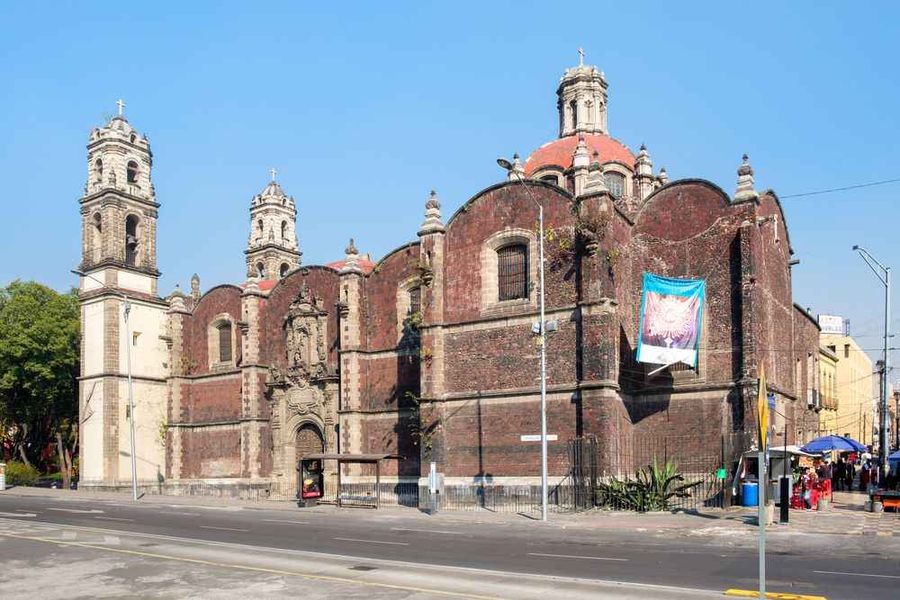
The Templo de San Hipólito stands on the site of La Noche Triste, the Night of Sorrows, when Aztec forces routed the Spanish army on June 30, 1520, killing hundreds of conquistadors as Hernán Cortés attempted to withdraw his troops from Tenochtitlan under cover of darkness. The Spanish built the church to memorialize their fallen soldiers, making the site’s commemorative function explicit in a way that most colonial churches, built to honor saints rather than military campaigns, do not. Its location near the intersection of Hidalgo and Pugibet, in the Guerrero neighborhood west of the historic center, places the church outside the main tourist circuit and offers visitors a sense of discovery that the Zócalo churches cannot provide.
The architecture works in a baroque-neoclassical register, with columns, stone reliefs, and a restrained interior whose ornament reflects the church’s status as a smaller, neighborhood-scale structure. The columns on the façade carry carved reliefs whose craftsmanship rewards close examination, and the interior’s proportions give the space an intimacy the Catedral Metropolitana’s vast nave does not permit. The church functions as an active parish, meaning visitors encounter it as a functioning religious space. The daily life of the congregation gives the building a social presence that pure heritage sites lack.
October 28, the feast of St. Jude Thaddeus, patron of lost causes, draws enormous crowds to the temple. St. Jude’s feast is one of the most widely observed popular Catholic celebrations in Mexico City, and the Templo de San Hipólito is a primary gathering point. Devotees arrive throughout the day to have their images of the saint blessed and to participate in the street-level religious life that spills out of the church and across the surrounding sidewalks. Visiting on any other date gives access to the architecture and the commemorative history without navigating the feast-day crowds, the source specifically cautions against. The site’s dual identity — a working parish honoring its community’s spiritual life and a colonial monument marking a specific moment of military catastrophe — gives San Hipólito a layered significance that churches built purely for religious purposes do not carry in the same terms.
Credit: Mexico City Official Site
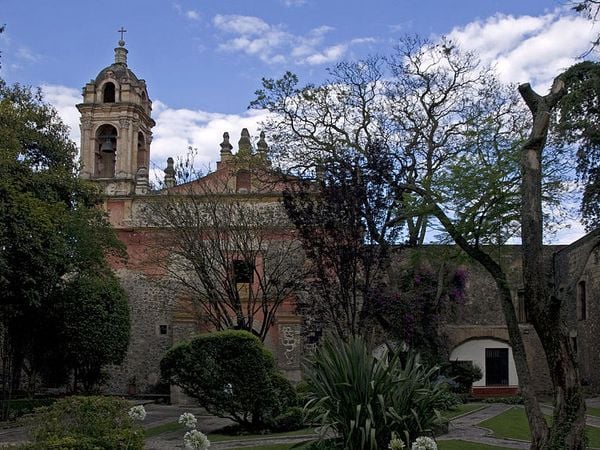
San Angel is one of Mexico City’s most appealing neighborhoods, a former village absorbed by the expanding capital whose cobblestone streets, colonial mansions, and tree-lined plazas give it a character distinct from the historic center’s monumental scale. The Iglesia de San Jacinto occupies the neighborhood’s central position, its peach-colored façade and tree-lined garden giving it a visual warmth that the darker stone of the center’s churches does not. Dominican priests built the church in the 16th and 17th centuries, and the garden’s mature trees create a layered quality of enclosure, moving from street to garden to church, that draws visitors into the compound gradually.
The stone cross in the garden is the site’s most distinctive iconographic element. It mixes Catholic and pre-Columbian imagery without subordinating one tradition to the other, reflecting the syncretic negotiation that occurred across New Spain as indigenous communities incorporated Catholic forms into existing ritual frameworks. Missionaries sometimes encouraged this mixing as a conversion strategy. Communities sometimes used it to preserve indigenous practice under Catholic cover. The cross in San Jacinto’s garden does not resolve which dynamic produced it, and that ambiguity is part of what makes it worth examining carefully.
Inside, the retablo, the elaborate altar screen behind the main altar, demonstrates the Churrigueresque style at its most expressive. Churrigueresque is the Spanish Baroque’s most ornate iteration, characterized by dense sculptural program, layered relief, and surface decoration that leaves almost no plane uncarved. The retablo at San Jacinto carries this tradition into a relatively intimate interior space, which concentrates the visual effect in ways larger churches, where the retablo is seen from a greater distance, do not achieve in the same terms. The neighborhood’s Saturday artisan market, held in the adjacent Bazar del Sábado, gives visitors a practical reason to extend their time in San Angel beyond the church itself. The church and the market together give the neighborhood its rhythm on weekends: the morning devoted to the retablo’s ornamental excess and the garden’s quiet syncretism, the afternoon to the open-air commerce that has occupied the same colonial streets for generations.
Credit: Mexico City Official Site
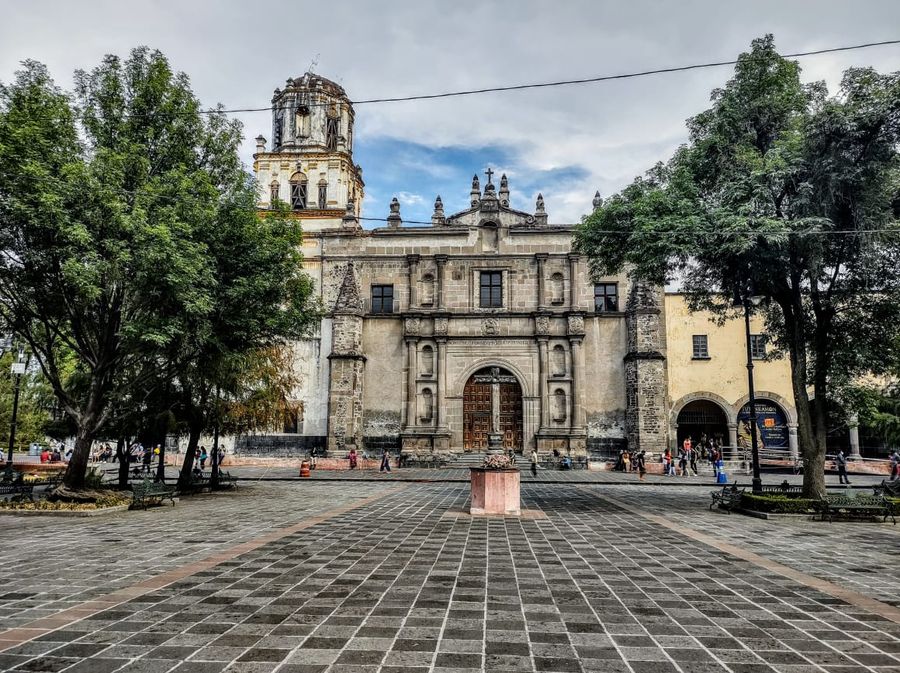
Coyoacán is the neighborhood most visitors associate with Frida Kahlo, whose family home draws steady crowds to the area’s southern reaches. The Parroquia San Juan Bautista predates the Kahlo mythology by several centuries: it was among the first churches built after the Spanish arrived, making it one of the oldest surviving religious structures in the country. Its location on the Jardín Centenario, Coyoacán’s central plaza, gives it the community-defining position colonial churches occupied across New Spain, where the church and the plaza together formed the social and political center of every settlement.
The church’s interior underwent significant renovation in the early 20th century, altering the altars and some of the original colonial furnishings but leaving the ceiling as the building’s primary visual reward. The frescoes and ornamental painting overhead are extraordinary, covering the barrel vault with figures, foliage, and decorative programs whose condition and color give them a freshness the building’s age does not predict. Visitors who walk through the entrance and look at eye level will see a functioning parish church of modest ornamental ambition. Visitors who look up will find something else: a painted ceiling whose program rewards sustained attention the way great fresco cycles in Italian churches reward theirs, scaled to a neighborhood parish but no less carefully executed.
The Coyoacán plaza itself gives the church visit a social and culinary context. The surrounding cafes, food stalls, and the weekend market, which fills the square with vendors, give the neighborhood its festive energy. The church stands at the center of it all, functioning simultaneously as an active parish, a colonial monument, and the architectural anchor of a plaza where Mexico City residents have gathered for centuries. Walking the perimeter of the Jardín Centenario after visiting the church provides a full exterior view of the building; the interior’s intimacy does not prepare the visitor for the façade’s scale relative to the square. The church has anchored this plaza for nearly five centuries, and the quality of daily life that continues to flow around it gives the colonial architecture its most compelling possible context: not a monument frozen in time but a building still doing what the Spanish built it to do.
