From a Swiss alpine crossing at nearly 7,000 feet to a Mexican canyon four times deeper than the Grand Canyon, the world's most scenic train rides
Sean Ferigan / Unsplash
Train travel does something that flying cannot: it puts the journey in the foreground. The landscape that a plane crosses in an hour at altitude becomes hours of changing scenery at ground level, with the specific quality of light, terrain, and distance that only proximity to the land produces. The best scenic train routes were designed with this in mind — either deliberately built to traverse spectacular, otherwise inaccessible terrain, or repurposed as tourism destinations from railway lines that originally served mining, logging, or regional transportation needs. The train journey's infrastructure becomes part of what the ticket buys.
The variety of what a scenic train ride offers reflects the world’s landscapes and the different ways railways have been built through them. Steam engines cross Scottish viaducts above highland lochs. Glass-dome cars glide through Utah canyons and Colorado mountains. Narrow-gauge trains thread through Mexican gorges four times deeper than the Grand Canyon. A Swiss railway climbs to nearly 7,000 feet above sea level before descending through what the Swiss call their own Grand Canyon. Each route makes an argument for a specific landscape and a specific pace of travel that no other mode of transportation delivers in the same way.
The 10 journeys below appear in Travel + Leisure, drawn from a global list of 12. Each offers a distinct combination of landscape, on-train experience, and destination access that makes the journey itself worth planning a trip around.
Credit: Glacier Express
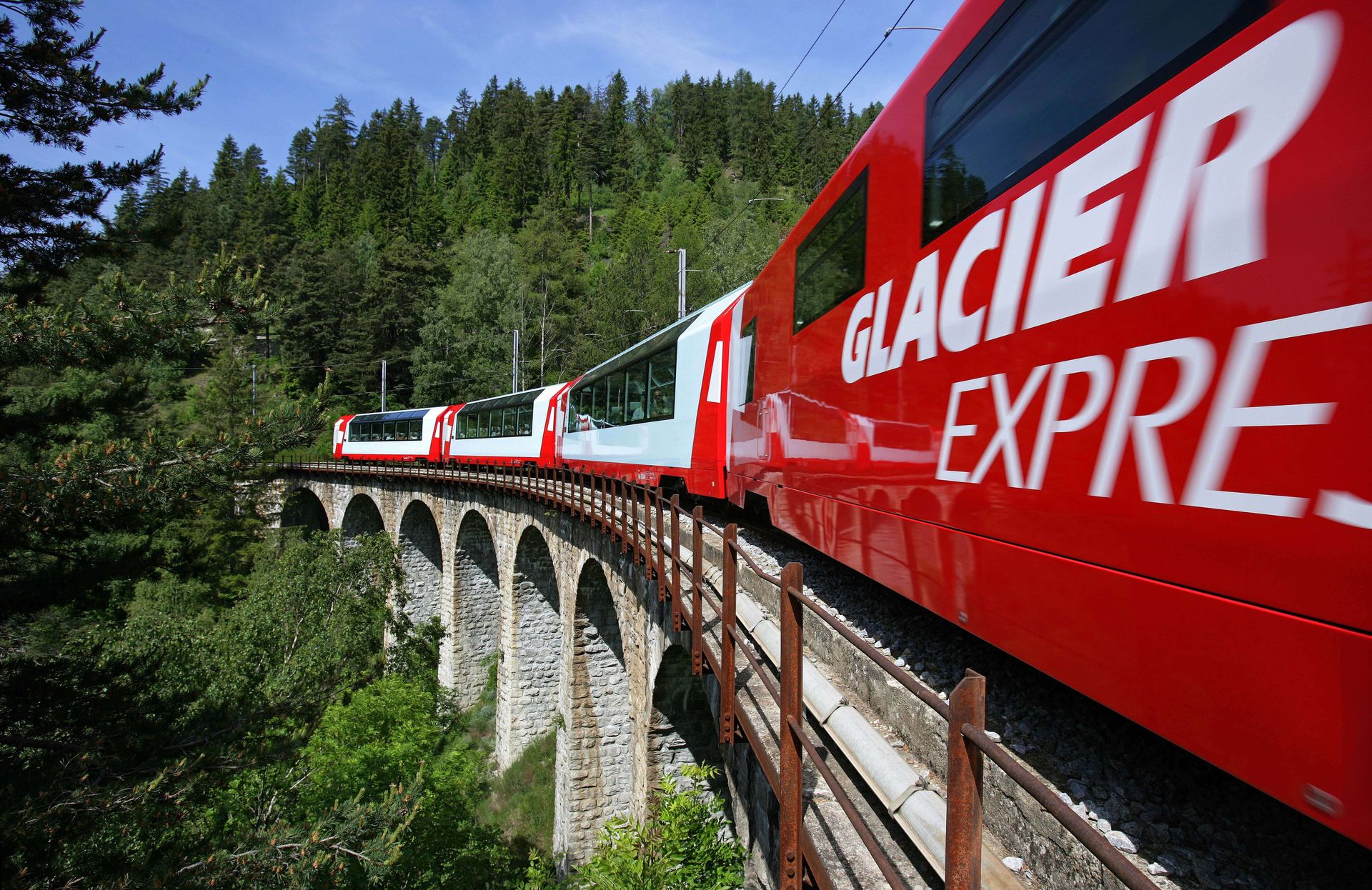
The Glacier Express begins in Zermatt, the car-free mountain village in the shadow of the Matterhorn, and spends eight hours traversing the Swiss Alps to St. Moritz, the country’s most celebrated alpine resort city. The route crosses the Rhone into the Upper Rhone Valley, climbs to the Oberalp Pass at nearly 7,000 feet — the highest point of the journey — before descending along the Rhine Valley to the Rhine Gorge, a section the Swiss sometimes call their Grand Canyon, and continuing through the Albula tunnel to the final destination. The panoramic windows that frame all of this give passengers a continuous view of the Alpine landscape without the physical exposure of an observation platform.
The train’s Excellence Class offers a premium multicourse meal with local wines in a dedicated seating area, but the standard service already includes a snack trolley, full meals, and an onboard bar, along with headphone narration throughout the journey. The service levels give travelers a choice between experiencing the route as a purely scenic journey and as a culinary and scenic journey. Either version justifies the eight-hour duration: the landscape changes continuously enough that the trip does not feel static at any point along its length.
Tickets for the Glacier Express sell out well in advance during peak season, and the combination of the route’s international profile and its limited daily capacity makes booking early a practical requirement rather than an optional convenience. The Zermatt starting point gives travelers who spend additional time in the mountain village a complementary destination to frame the railway departure, and St. Moritz at the other end offers equivalent appeal for those who want to extend the journey’s conclusion.
Intricate Explorer / Unsplash
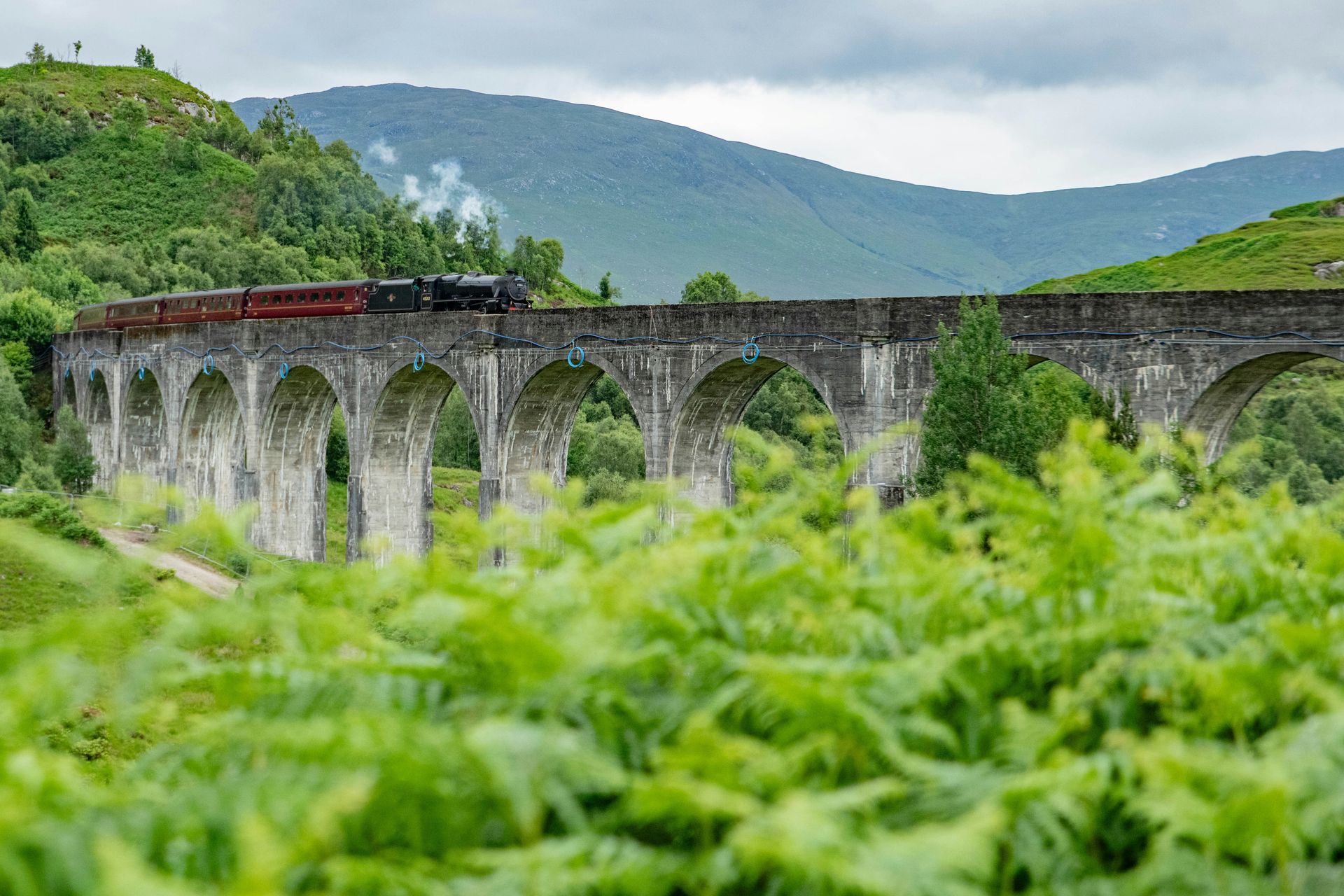
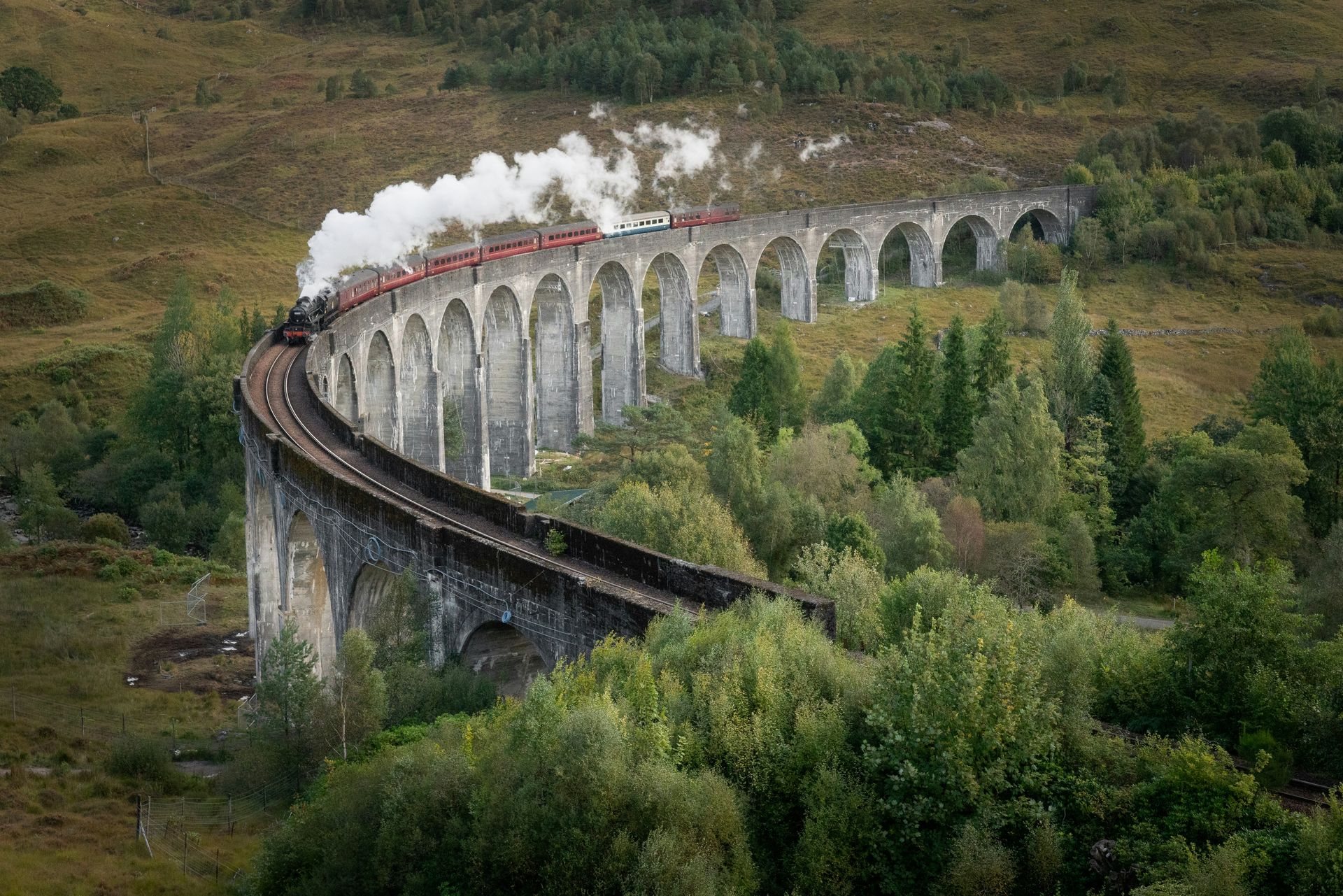
The Jacobite steam train runs an 84-mile round trip from Fort William, near Britain’s highest mountain, Ben Nevis, through the Scottish Highlands to the coastal town of Mallaig and back. The route crosses the Glenfinnan Viaduct, the 21-arched stone structure that curves above Loch Shiel with the Jacobite monument visible in the valley below, in a crossing that has become one of the most photographed moments in British rail tourism. The viaduct’s graceful curves and towering columns give the passage a structural drama that the surrounding highland landscape amplifies rather than competes with.
The Harry Potter connection that the Glenfinnan Viaduct carries gives the Jacobite a cultural dimension alongside its scenic one: West Coast Railways, the route’s parent company, supplied similar steam engines and carriages to portray the Hogwarts Express in the film series, and the viaduct crossing appears in the films in a shot that fans of the books and movies recognize immediately upon seeing the actual structure from the train window. The recognition works in both directions — visitors who arrive knowing the viaduct from the films encounter the real landscape behind the cinematic one, which gives the crossing a layered quality specific to this route.
Passengers have roughly an hour and a half in Mallaig at the end of the outbound journey before the return trip to Fort William begins. The Jacobite runs from April to October, which means seasonal availability affects when the route is accessible. The route passes the towns of Glenfinnan, Lochailort, Arisaig, and Morar between the viaduct and the coastal terminus, each adding its own register of highland scenery to the journey.
Credit: Chepe Express
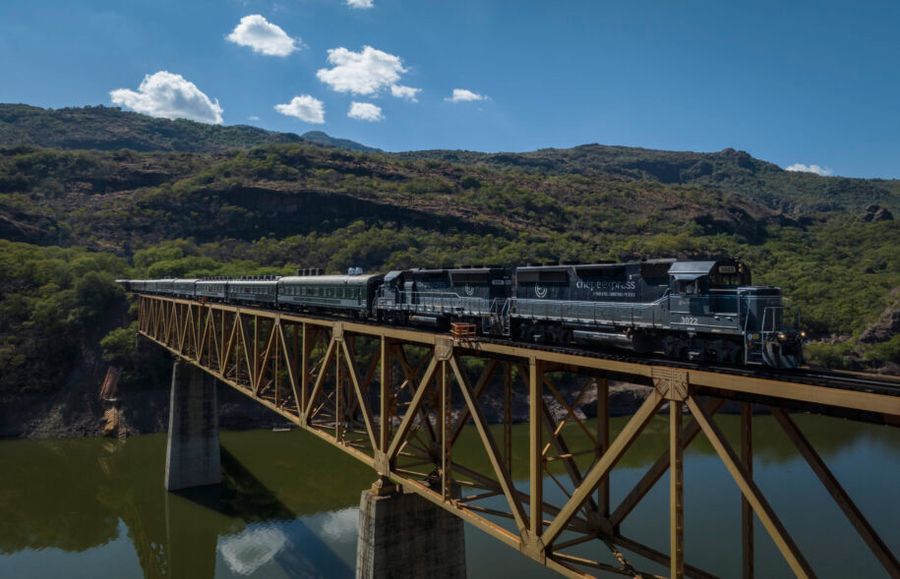
The Chepe Express in northwestern Mexico crosses terrain that the train line itself made accessible: Copper Canyon, a system of several canyons in the state of Chihuahua, with the deepest point reaching 6,167 feet, covers an area the source describes as four times the size of the Grand Canyon. The railway, which took several decades to build before its 1961 launch, crosses 37 bridges and passes through 86 tunnels along a route that traverses rugged mountain terrain, gorges, deep ravines, and agricultural valleys that no road network reaches as deeply. The journey from Los Mochis on the Pacific coast to the inland town of Creel takes approximately nine hours.
The engineering required to build the Chepe through this terrain gives the journey a structural dimension alongside its scenic one: the bridges and tunnels are part of what the ticket grants access to, as much as the gorge views they make possible. Crossing a bridge above a canyon of this depth while moving at train speed produces a physical experience of scale that static viewpoints cannot replicate, and the tunnels that punctuate the route give the emergence into mountain light after each dark passage a rhythmic quality that structures the journey’s progression through the landscape.
Booking through a tour company or well in advance is advisable, as the route’s profile as a destination train has created demand that its capacity does not always accommodate without advance planning. Passengers who sit on the right side of the train when traveling eastward toward Creel get the best positions for the canyon views that the route’s western descents provide.
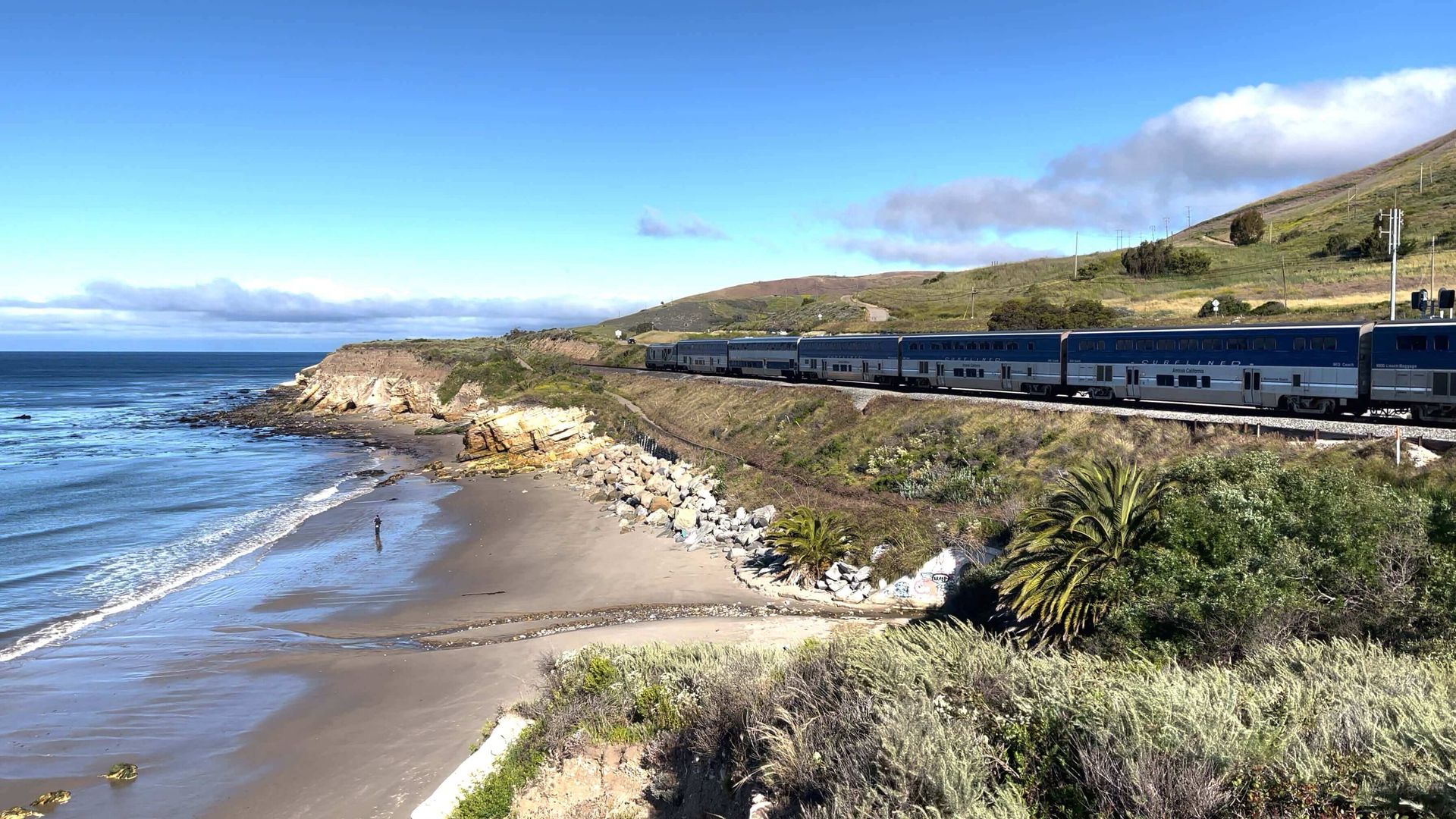
Credit: Pacific Surfliner
The Pacific Surfliner’s Amtrak route leaves little between passengers and the Pacific Ocean along the most dramatic sections of the California coast, where the track runs close enough to the water’s edge that the blue of the ocean fills the window without interruption. The 351-mile journey from San Diego to San Luis Obispo passes through the three largest cities on the California coast — San Diego, Los Angeles, and Santa Barbara — as well as dozens of smaller communities where the train’s downtown station stops give passengers convenient access to neighborhoods and attractions without the parking and traffic logistics that driving the same route requires.
Los Angeles’s Union Station gives the Pacific Surfliner a mid-route stop worthy of its own visit: the 1939 Mission Revival building holds historic art and decor that make it one of the architecturally significant train stations in the United States. The bar and restaurant Traxx, located within the station, allows passengers with a long layover to experience the building’s social dimension rather than simply its architectural one. Santa Barbara’s stop gives passengers access to the Funk Zone, an arts and dining district, and to the Urban Wine Trail, which organizes the city’s walkable tasting room culture.
San Luis Obispo at the northern terminus gives the full journey an endpoint that the college town’s activity level and the surrounding wine country and historic mission sustain beyond the train station. The journey is best used as a one-way trip rather than a round trip, with travelers who want the full coastal experience choosing a direction based on which endpoint they want to explore most deeply before returning by another means.
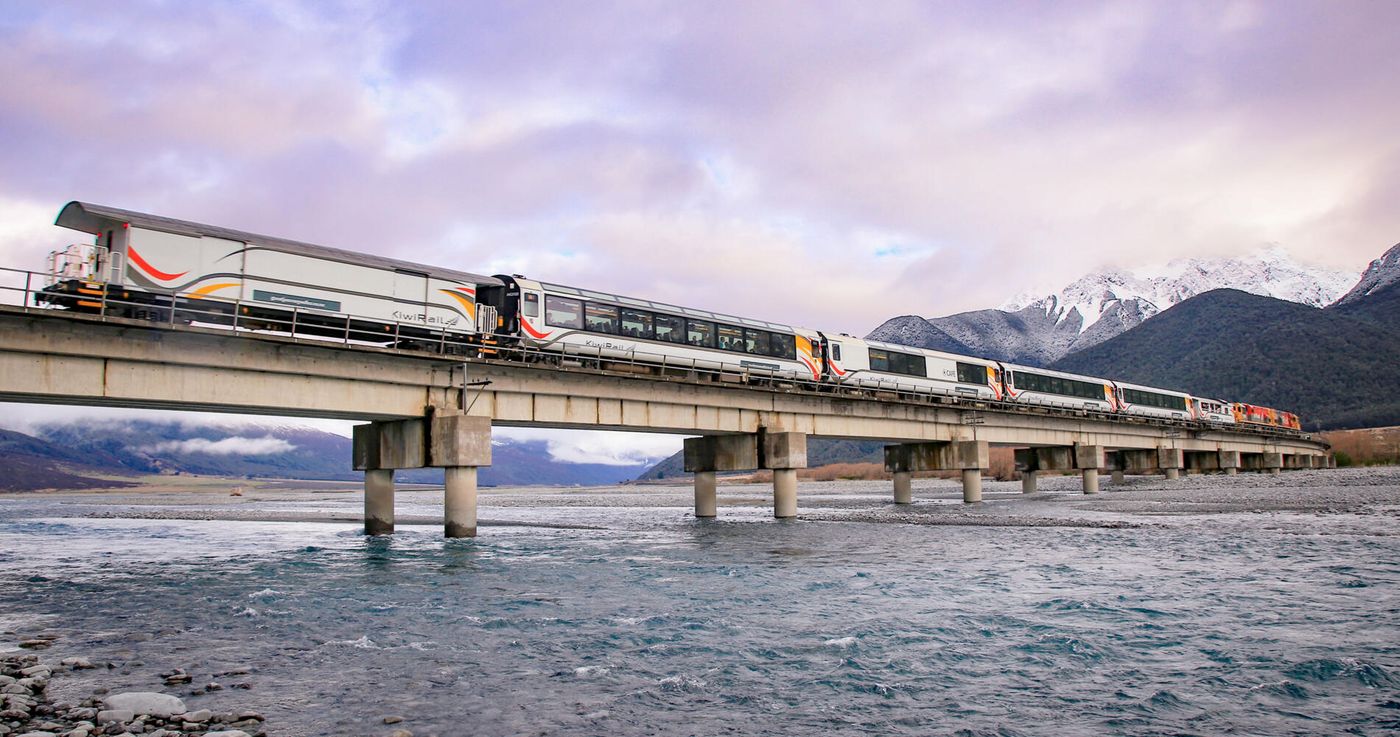
Credit: New Zealand Official Site
The TranzAlpine runs once daily between Christchurch and Greymouth, making the four-and-a-half-hour one-way journey across the Southern Alps of New Zealand’s South Island in each direction. Departing Christchurch at 8:15 a.m., the train crosses the Canterbury Plains through sheep and cattle farmland before the terrain rises toward the Southern Alps, where steel bridges cross deep gorges and short tunnels break the mountain passage. The climb culminates in Arthur’s Pass, a brief station stop before one of New Zealand’s longest tunnels delivers passengers through the alpine spine and into the West Coast’s dramatically different landscape of rivers and waterfalls.
Greymouth gives passengers an hour before the return journey begins, making the full round trip approximately 11 hours. Travelers $TRV who want to extend the West Coast stop can arrange separate accommodation in Greymouth and return on a subsequent day’s train, which gives the crossing a different character as a point-to-point journey rather than a same-day return. The reclining seats, panoramic windows, and skylights give the onboard experience a physical comfort suited to the journey’s duration, and the cafe car’s food, beer, wine, and spirits give passengers an option beyond the window for the hours between the alpine highlights.
The best views heading toward Greymouth are on the right side of the train, where the gorges and waterfalls revealed by the western descent are most directly visible. The landscape transition from the Canterbury Plains’ open agricultural character to the Southern Alps’ vertical drama to the West Coast’s river and forest terrain gives the TranzAlpine a three-act structure that the journey’s duration allows each section to develop fully.
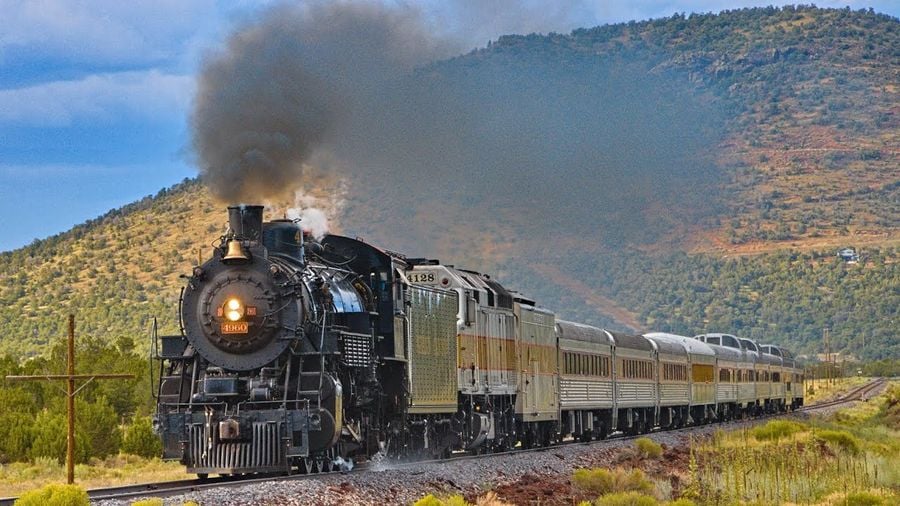
Credit: Grand Canyon Railway & Hotel
The Grand Canyon Railway’s 130-mile round trip begins in Williams, Arizona, 30 miles west of Flagstaff, and travels north to the South Rim of Grand Canyon National Park in a two-hour and 15-minute journey that crosses Ponderosa pine forest, open prairie, and pinyon pine terrain before arriving at one of the world’s most visited natural landmarks. The Old West entertainment that runs on board during the journey — musical performances, cowboy characters, and other programmatic surprises — gives the route a theatrical dimension, positioning the train as a full experience rather than merely a means of transportation.
Wildlife along the route includes elk, mountain lions, deer, bald eagles, owls, and California condors, which gives the landscape between Williams and the rim an active natural content that the open terrain of the prairie section displays most directly. The daily 9:30 a.m. departure gives passengers approximately three hours at the South Rim before the return journey, which is enough time to visit the historic Grand Canyon Depot dating to 1910, walk sections of the Rim Trail, see the El Tovar Hotel, and take in the canyon views from the rim’s edge.
The Grand Canyon Railway offers visitors who prefer not to drive the 90-minute route from Williams an alternative to the South Rim that includes on-board entertainment and access to the South Rim’s full visitor infrastructure at the destination. The train’s parking at the Williams depot resolves the rim’s notorious congestion by removing one vehicle from the park’s approach roads, which has practical as well as experiential value during the summer months when South Rim traffic reaches its peak.
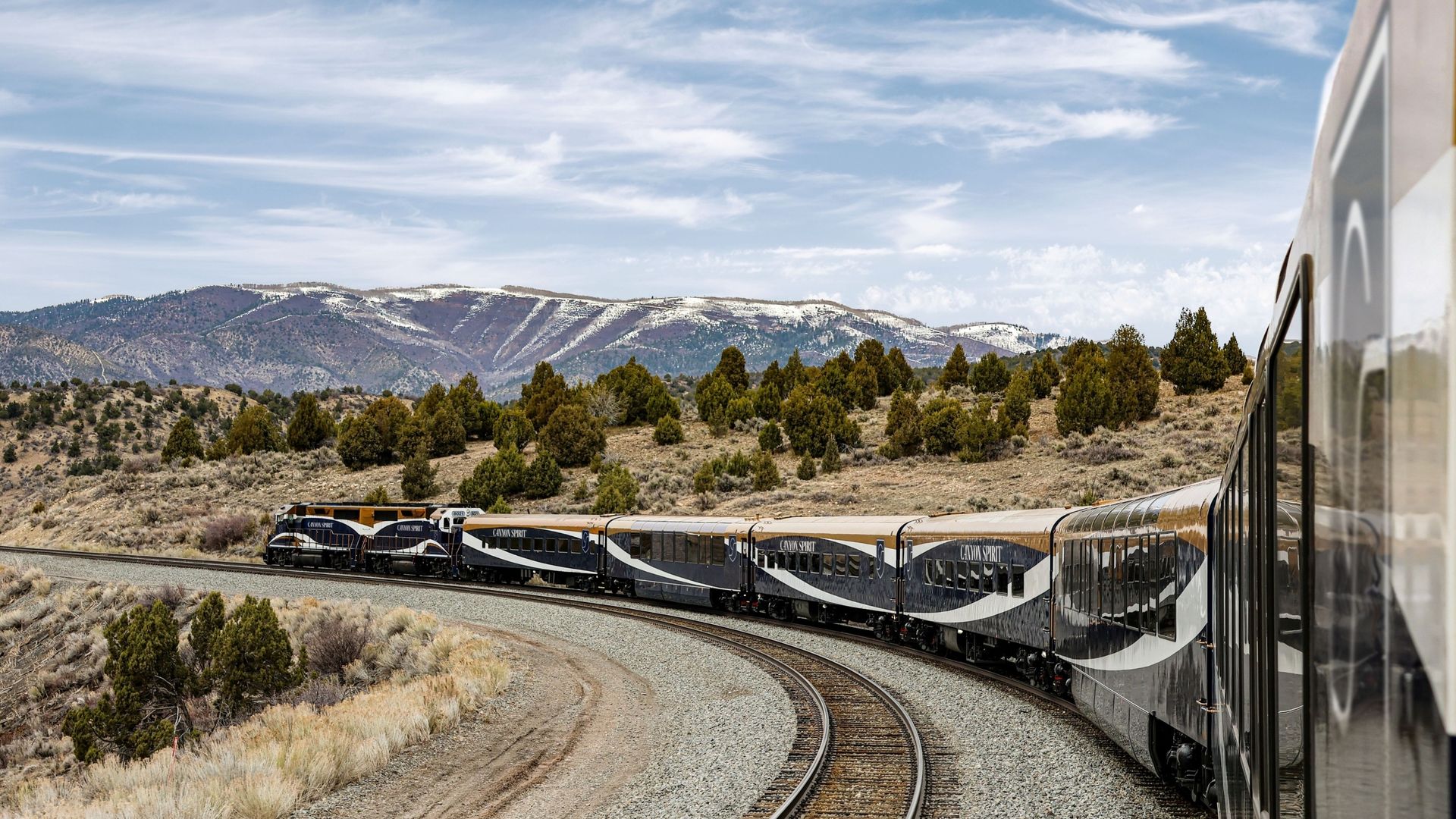
Credit: Canyon Spirit
The Canyon Spirit, formerly known as the Rockies to the Red Rocks route under the Rocky Mountaineer brand, connects Moab, Utah, to Denver, Colorado, in a two-day journey that breaks overnight in Glenwood Springs, Colorado. The glass-dome windows that run through the train’s cars frame the red canyon terrain of eastern Utah and western Colorado in a viewing format that conventional train windows cannot match in the same way: the dome’s overhead glass extends the visible sky above the landscape rather than limiting the view to a rectangular side window. The canyons, mountains, and rivers the route crosses give each section of the journey a distinct character as the terrain transitions from the desert Southwest to the Rocky Mountains.
The overnight stop in Glenwood Springs gives the two-day itinerary a break that the journey’s scenery uses productively: Glenwood Canyon, one of the route’s most dramatic sections, can be experienced again in the opposite direction on the second day’s departure. Glenwood Springs itself, known for its hot springs, gives the overnight stop a specific activity that the train’s momentum on a single-day journey would not allow. The food and beverage service aboard the Canyon Spirit gives passengers on-board dining that the two-day duration makes more relevant than it would be on a shorter journey.
The connection between Moab and Denver gives the Canyon Spirit a route that serves travelers moving between two destinations with strong independent appeal: Moab, gateway to Arches and Canyonlands National Parks, and Denver, one of the Rocky Mountain region’s primary urban hubs. Using the train between these two endpoints gives the overland journey a scenic value that flying the same route eliminates entirely.
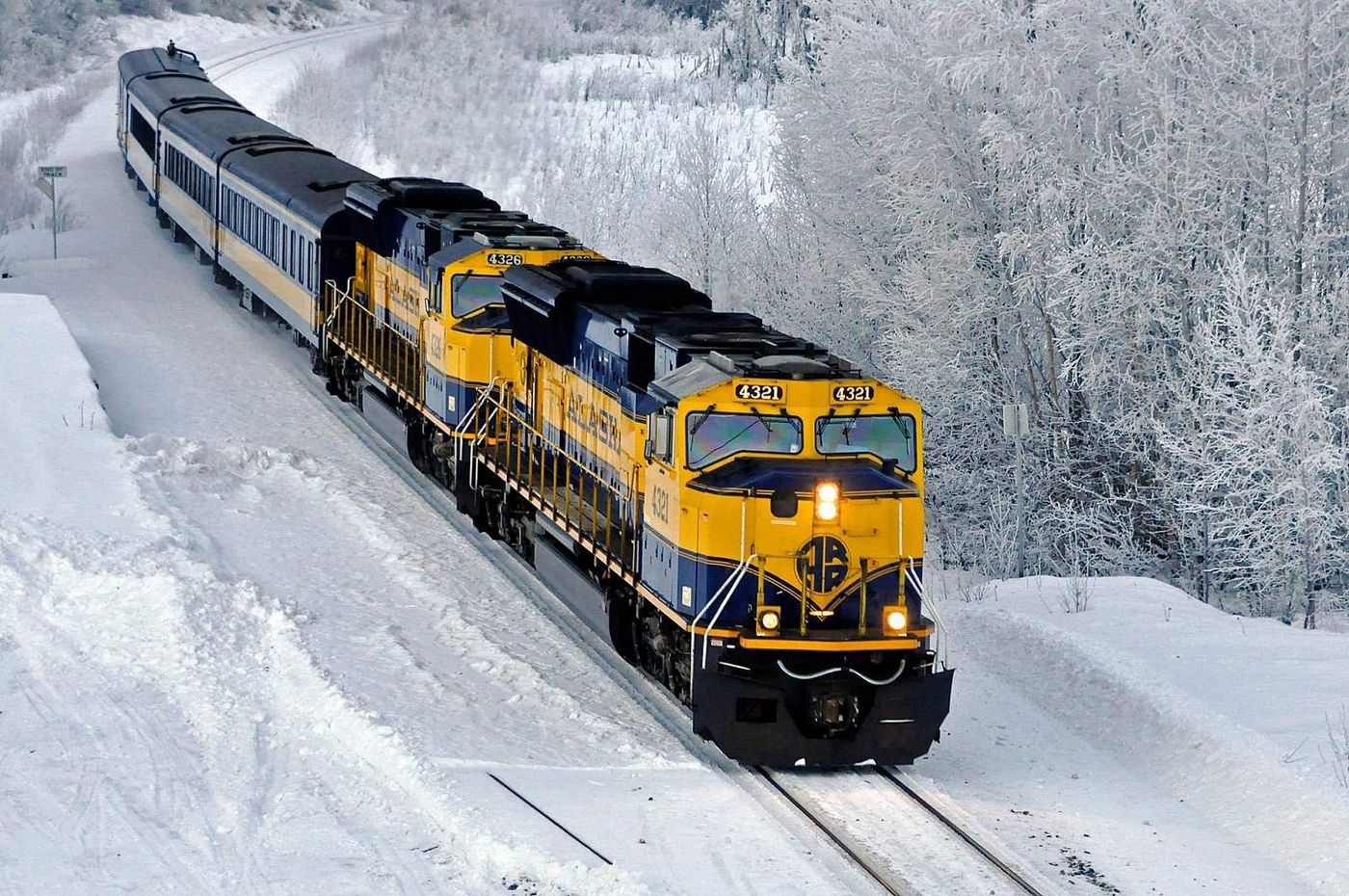
Credit: Alaska Winter Train
The Alaska Railroad’s Aurora Winter Train makes a 12-hour journey from Anchorage to Fairbanks through an Alaskan winter landscape, with large picture windows and comfortable seating making it accessible throughout the journey. The frozen scenery that passes outside the windows through daylight hours gives way to the possibility of northern lights viewing upon arrival in Fairbanks, which sits under the auroral oval where northern lights activity concentrates most reliably in the region. The train’s function as both a scenic journey and a northern lights delivery vehicle gives the 12-hour journey a purpose that a shorter route to the same destination would not.
The Alaska Railroad’s winter operation through terrain that road conditions and darkness make challenging for private vehicles gives the Aurora route a practical access dimension alongside its scenic one. Some communities along the route have limited road access during winter months, and the train serves as a lifeline for residents and a tourism vehicle for visitors, giving the journey an authentic operational character that purely tourist railways do not share.
Fairbanks, as a destination for northern lights viewing, carries a specific advantage that the train’s arrival timing acknowledges: the city’s position under the auroral oval gives it a reliability of northern lights activity during the winter months that coastal Alaskan cities, including Anchorage, cannot match. Travelers $TRV who arrive in Fairbanks after spending the day aboard the Aurora Train find themselves well-positioned to make the primary reason for the winter journey to interior Alaska.
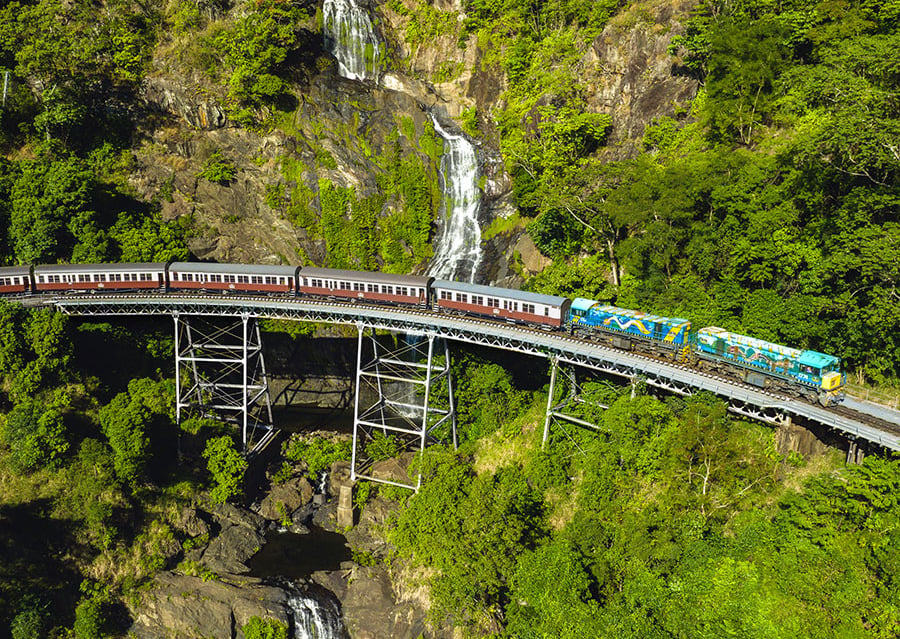
Credit: Kuranda
The Kuranda Scenic Railway runs for two hours from Cairns to the rainforest village of Kuranda through the Wet Tropics of Queensland, a World Heritage Area that contains one of the oldest continuously surviving rainforests on Earth. The journey passes waterfalls, mountains, and ravines, with Barron Gorge — one of Queensland’s most visited national parks — visible either from the train or accessible by road from Kuranda at the end of the line. The historic Kuranda Station, built in the early 1900s, gives the terminus a physical character that modern train infrastructure rarely maintains, and the Heritage Markets in Kuranda give passengers who spend time in the village locally made art and handicrafts alongside the natural environment that surrounds the town.
The Skyrail Rainforest Cableway, which operates between Cairns and Kuranda, allows visitors to combine the railway in one direction with the aerial cableway in the other, offering two perspectives on the same rainforest landscape from entirely different vantage points. The train moves through the forest at ground level, with the rainforest’s density visible close to the track; the cableway moves through and above the canopy, giving the aerial view that the train’s ground-level passage cannot provide. Together, the two routes give the Wet Tropics landscape a completeness of encounter that neither alone would produce.
The Kuranda village itself extends the journey beyond the train, with the bird aviary, butterfly sanctuary, and reptile park that add a wildlife dimension to the destination alongside the rainforest scenery. The Heritage Markets provide a locally produced cultural experience that the surrounding natural environment complements without duplicating, and the combination of wildlife, markets, and the historic station gives passengers who time their visit to spend several hours in Kuranda enough content to justify the full day the round trip requires.
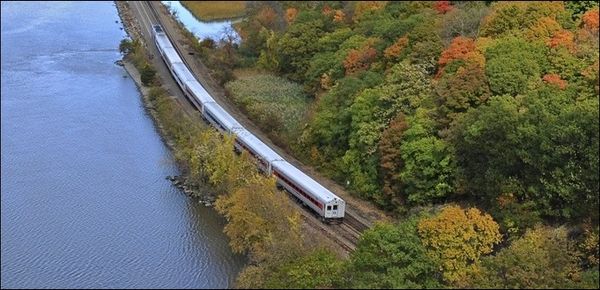
Credit: NYC Subway
The Metro-North Hudson Line from Grand Central Terminal to Poughkeepsie travels along the eastern bank of the Hudson River through the Hudson Valley, giving passengers views of the river, forested slopes, and the stately mansions that the valley’s 19th-century wealthy residents built along the waterway. The two-hour journey uses commuter rail infrastructure that daily travelers take for granted, but visitors who sit on the left side of the train heading north find a continuous riverside panorama that reveals a natural and architectural landscape within two hours of Manhattan that most international visitors to New York City never see.
Grand Central Terminal itself provides a starting point worth spending time in before boarding: the Beaux-Arts building’s main concourse, the celestial ceiling, and the dining and bar options within the terminal offer visitors a historic New York experience before the train departs. The communities along the Hudson Line give passengers reasons to disembark and return at their own pace. Beacon’s walkable arts community includes galleries, boutiques, and the Dia Beacon contemporary art museum, which alone justifies the 90-minute train journey from the city. The mansions open to tours along the route — Boscobel in Garrison, Kykuit in Sleepy Hollow, the Vanderbilt Mansion in Hyde Park, and Locust Grove in Poughkeepsie — give architecture and history travelers a self-directed itinerary that the train’s frequent schedule makes practical.
The Hudson Line gives the scenic train journey category a format specific to commuter rail: a route designed for daily transportation that reveals a landscape of genuine quality to anyone who looks out the window with attention. The relative accessibility of the journey, at a cost well below the dedicated scenic rail experiences on this list, gives the Hudson Line an appeal specific to value-conscious travelers and to visitors who want to see what lies beyond the New York City that most itineraries contain.
