
Stress levels vary widely across the U.S. WalletHub ranked all 50 states on work, money, health, and safety

Oliver Helbig / Getty Images
Millions of Americans carry the weight of financial insecurity, poor health access, and community instability every single day. Where they live shapes how heavy that load becomes. A parent in rural Appalachia faces a fundamentally different daily existence than a remote worker in Minnesota. She navigates unaffordable childcare and works long hours. Her counterpart holds strong job security and reliable healthcare nearby.
Geography does not determine fate, but it stacks the odds. The conditions a state provides — or fails to — either compound life's inevitable difficulties or cushion them. Housing costs, crime rates, unemployment figures, and mental health access all vary dramatically across state lines, and those differences translate directly into how much chronic strain residents carry.
The gap between the most and least burdened states is wide. States at the top of the stress index carry poverty rates more than three times higher than states near the bottom. Residents in the highest-pressure states report worse mental health, lower credit scores, higher divorce rates, and less access to psychologists than their counterparts elsewhere in the country. Those are not isolated indicators. They cluster together and reinforce each other. Financial strain corrodes health outcomes, which worsens family stability, which deepens economic hardship.
WalletHub produced the 2026 ranking by measuring all 50 states across 40 indicators grouped into four equally weighted categories: Work-Related Stress, Money-Related Stress, Family-Related Stress, and Health- and Safety-Related Stress. Each metric was scored on a 100-point scale, with 100 representing the highest level of burden. WalletHub then calculated each state's weighted average to produce a total score and a final rank. The five worst states, as examined below, sit at the convergence of several overlapping burdens.

Atlantide Phototravel / Getty Images
Louisiana earned the top overall score — 62.86 out of 100 — by finishing worst or near-worst in nearly every major stress category. The state ties Mississippi for the highest poverty rate in the country. Poverty limits access to healthcare, depresses credit scores, and raises the probability of housing instability. It also drives financial anxiety. WalletHub tracks the share of adults who report that thinking about personal finances makes them feel anxious, and Louisiana performs poorly on this measure as well.
The Bayou State finished last among all 50 states in job security. Louisiana posted the eighth-highest average unemployment rate in the country in the most recent measurement period, and workers who do hold jobs face the additional uncertainty of weak employment protections, making financial planning extremely difficult. Income growth between 2023 and 2024 was also among the slowest in the country, meaning residents saw little relief from the economic inflation of prior years.
Healthcare access is a critical stress multiplier in Louisiana. Roughly 16% of residents skipped a doctor visit in the past year because they could not afford it, placing the state among the worst nationally on unaffordability of care. Mental health outcomes reflect this neglect: Louisiana finishes in the worst 10 states for both the share of adults reporting poor mental health and the share diagnosed with depression. Compounding those outcomes, Louisiana has fewer psychologists per capita than nearly every other state, leaving residents with limited professional options when they do seek help.
Crime figures add a safety dimension to the burden. Louisiana finishes fourth nationally in crime per capita, a position that generates persistent background anxiety for residents across the state. Financial fragility, poor healthcare access, mental health conditions, and physical safety concerns create a self-reinforcing cycle of strain. Reducing any one factor in isolation produces limited relief when the others remain this severe.

Henryk Sadura / Getty Images
Kentucky earned a total score of 58.18, placing it second nationally in overall burden. Its most acute problems are financial. The state carries the third-highest unemployment rate in the country, reflecting persistent structural weakness in its labor market. The sixth-highest personal bankruptcy rate adds another layer of economic fragility. Bankruptcy damages credit access for years, limiting residents' ability to obtain loans, secure housing, or recover from setbacks. Kentucky's median credit score of 689 sits among the lowest in the country and acts as a barrier to upward financial mobility.
Family life in Kentucky carries its own distinct pressures. The commonwealth shows some of the highest rates of separation and divorce nationally. It also finishes among the worst states for parental stress, a composite metric that captures how frequently parents feel anger toward their child, view the child as difficult to care for, or feel the child intentionally provokes them. Elevated parental stress is not simply a private emotional matter. Research links it to worse child developmental outcomes and increased family instability over time. Kentucky's position near the bottom of this measure signals widespread family-level strain that extends well beyond any single household.
Health conditions in Kentucky are severe. About 23% of residents describe their own health as "fair" or "poor," placing the state fourth nationally on that measure. The share of adults diagnosed with depression is the second-highest in the country, and the share reporting poor mental health overall finishes 10th. These figures reflect a population carrying significant chronic illness alongside a serious mental health burden. Access to care remains limited, further widening the gap between need and treatment. Residents face compounding long-term consequences if they cannot get help early.
Kentucky's financial hardships and health challenges interact in ways the data make plain. Low credit scores restrict the ability to pay for medical care or insurance. High unemployment limits employer-provided coverage. Financial instability worsens mental health, which in turn reduces workplace productivity and increases absenteeism. The commonwealth does not face one big problem. It faces several mid-sized ones that share a common root in economic insecurity.

Mark Gibson / Getty Images
New Mexico scored 57.65, finishing third overall, and its most distinctive characteristic is physical danger. The state posts the second-highest violent crime rate per capita in the country and the highest property crime rate per capita. Crime does not just harm its direct victims. It raises ambient anxiety across entire communities, drives up insurance costs, reduces neighborhood investment, and depresses property values, all of which increase financial pressure on households that already face other strains.
Family instability compounds New Mexico's burden. The state has the highest separation and divorce rate in the country, a figure that reflects a level of household disruption with no parallel elsewhere. It also holds the third-highest share of single-parent households nationally. Single-parent households carry a structurally higher financial and time burden: one adult performs all of the income-generating, childcare, and household work that two-parent households divide. Children in these homes face statistically greater economic insecurity, and the parents themselves report significantly higher stress levels than those in partnered households.
Financial conditions in New Mexico reinforce the burden its crime and family figures create. The state has the second-highest poverty rate in the country. Residents have a median credit score of 692, among the lowest nationally, which constrains their ability to build wealth or manage financial emergencies without taking on expensive debt. Low credit scores and high poverty interact directly: limited credit access pushes residents toward high-cost borrowing options, which increases total debt load and diverts income from savings and investment into debt service.
New Mexico's stress profile differs from Louisiana's primarily in emphasis. Louisiana's dominant problem is economic fragility, exacerbated by poor health care access. New Mexico's dominant problem is crime and family instability, reinforced by poverty. Both states arrive at similar outcomes because multiple distinct stressors converge at the same time. Addressing any single indicator in isolation would likely produce limited improvement in overall resident well-being. Reducing the divorce rate without also addressing poverty, for example, leaves the economic foundations of instability intact.

DenisTangneyJr / Getty Images
West Virginia earned a total score of 56.20 and finished fourth, driven primarily by health outcomes that are the worst in the country across several key measures. More residents here describe their health as "fair" or "poor" than in any other state, a striking finding given that self-reported health correlates strongly with objective clinical outcomes. West Virginia also has the second-highest share of adults who get fewer than seven hours of sleep per night. Chronic sleep deprivation raises the risk of cardiovascular disease, obesity, depression, and cognitive impairment, meaning this single metric amplifies nearly every other health challenge the state faces.
The Mountain State has the country's fourth-highest poverty rate, and its economy is generally weak. West Virginia finishes third nationally in overall job security concerns, meaning residents face both the near-term pressure of possible job loss and the chronic strain of low incomes and limited economic opportunity. The state's low housing costs provide some financial relief. West Virginia finishes near the top nationally for housing affordability, but that advantage does not offset its weak income levels, high unemployment, and limited economic growth.
Access to professional healthcare support in West Virginia is insufficient relative to the population's needs. The state finishes third nationally in the share of adults who skipped a doctor visit due to cost. This matters enormously in a state where physical health is already poor: residents who most need clinical care are least able to afford it. Mental health conditions follow a similar pattern. West Virginia posts high rates of depression diagnosis and poor mental health self-reporting, while professional mental health resources remain scarce.
West Virginia's health burden is self-reinforcing in a way that distinguishes it from other high-stress states. Poor physical health limits workforce participation, which reduces income, which reduces access to care, which worsens health further. Sleep deprivation accelerates this cycle by impairing decision-making, increasing accident risk, and worsening existing medical conditions. Addressing the Mountain State's stress profile would require simultaneous investment in healthcare access, income support, and employer-side job security.
Walter Bibikow / Getty Images
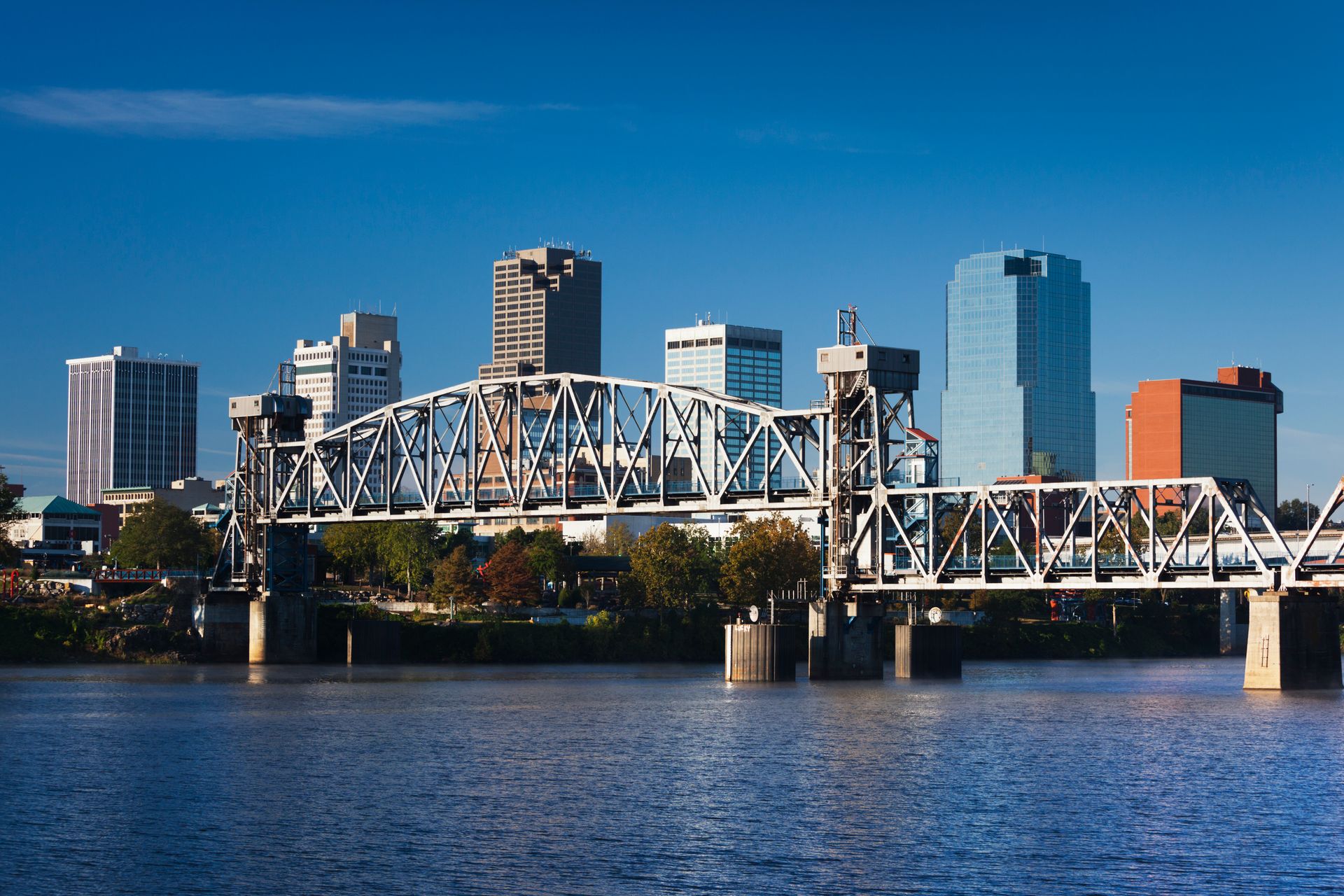
Arkansas earned a total score of 55.60, placing fifth nationally. Its Money-Related Stress composite finishes third-worst in the country, driven by persistent economic hardship across multiple dimensions. Residents in poverty face reduced access to nutritious food, stable housing, quality healthcare, and financial products with reasonable interest rates. Those deprivations do not stay in their separate categories. They interact and accumulate, producing the broad multi-domain strain that drives Arkansas' position near the top of the overall ranking.
Work conditions in Arkansas generate significant pressure. The state's Work-Related Stress composite also finishes third-worst nationally, reflecting poor performance across hours worked, unemployment, underemployment, income growth, and job security. Workers who face stagnant wages and elevated unemployment risk carry a double burden: the immediate threat of job loss and the long-term difficulty of building financial reserves on flat income. Arkansas saw limited income growth between 2023 and 2024, offering little forward momentum for residents looking to build financial security from their labor.
Health indicators in Arkansas are poor across multiple dimensions. The state ranks second nationally in the share of adults who describe their health as "fair" or "poor," trailing only West Virginia. It also finishes among the worst five states in the share of adults getting insufficient sleep, consistent with a population under sustained physical and mental load. Crime is a safety concern. Arkansas places fifth nationally in crime per capita, exposing residents to a level of community safety risk that adds persistent low-grade anxiety to the other strains they carry.
Arkansas's Health and Safety composite is the fifth-worst in the country, making it one of the few states that performs poorly across all major dimensions. Work, money, health, and safety all weigh against residents at once, and no structural advantage in any single category offsets the others. Arkansas's position in this ranking does not reflect a single acute problem. It reflects decades of underinvestment in infrastructure, healthcare systems, and economic development that might otherwise lift residents out of chronic strain.