From a roaring Godzilla statue atop Hotel Gracery's roof to sleeping cubbies built directly into floor-to-ceiling bookshelves in Shinjuku
Credit: Reversible Destiny Foundation
Tokyo has ordinary hotels by the thousands, the kind with predictable rooms and predictable service that you’d find in any major city. That’s not what this list is about. This is a city where you can sleep among bookshelves, check into a capsule the size of a bunk bed, or wake up under the gaze of a roaring Godzilla statue mounted on a hotel rooftop. Robots staff entire front desks. Architects design apartments with undulating floors specifically to disorient your sense of balance. None of this is gimmick for gimmick’s sake. It reflects a city that treats hospitality as a genuine creative category, not a commodity.
The variety here spans budgets and styles as much as concepts. A capsule hotel costs a fraction of a standard room and delivers an experience no Western hotel chain has ever attempted at scale. A short-term rental in an experimental architecture complex puts you inside a piece of contemporary art for a few nights. A listening bar hotel hands you a curated vinyl collection and a private soundtrack for your stay. Picking one of these over a standard hotel room changes the character of a Tokyo trip more than almost any other single decision.
The nine stays below appear in Lonely Planet, written by Tokyo-based writer Rebecca Milner. The hotels span most of the city’s central neighborhoods, from Shinjuku’s neon density to Yanesen’s preserved old streets, and several of them sit close enough together to combine on a single trip without much added travel time. Most of these properties cost more than a budget hostel but considerably less than a flagship international luxury hotel, which makes the concept itself, not sheer price, the main differentiator across the list. Booking well ahead is worth doing for nearly all of them, since the most distinctive properties tend to sell out fastest precisely because they’re not interchangeable with the dozens of standard hotels nearby.
Credit: Hotel Gracery
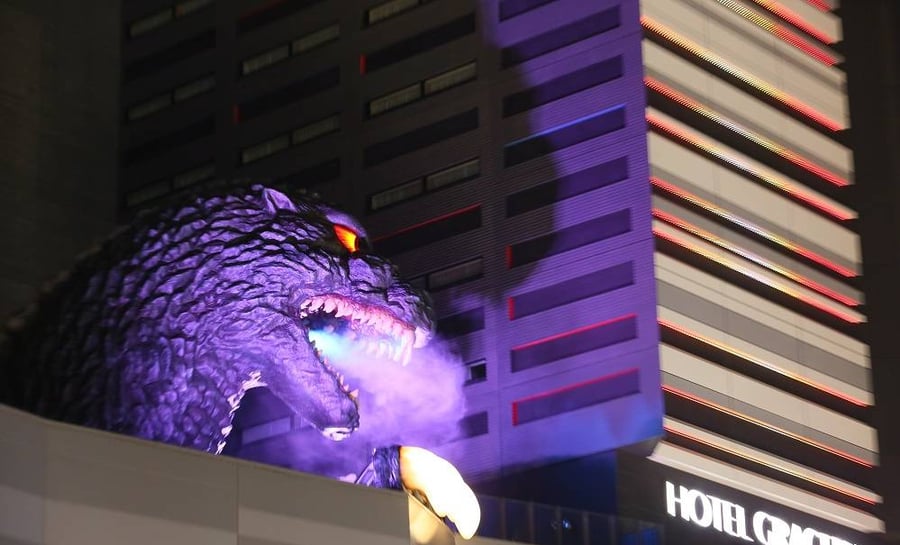
Tokyo loves a themed hotel, and the city has plenty of them: Hello Kitty rooms at the Keio Plaza, Gundam decor at the Grand Nikko Tokyo Daiba. Hotel Gracery takes the concept further than any of them. A massive Godzilla statue sits on the rooftop, looking like it’s mid-bite into the building below, and at intervals throughout the day, it roars to life with glowing eyes and smoke pouring from its mouth.
The hotel occupies the top floors of the Shinjuku Toho Building, named for Toho, the production company that created Godzilla and turned the character into a six-decade fixture of Japanese cinema. The name itself is a portmanteau of the Japanese words for gorilla and whale, which gives some sense of how seriously the country takes its monster mythology. Most of the rooms are standard, but one is fully decorated with Godzilla paraphernalia, and another has a window positioned for a direct view of the statue.
The surrounding neighborhood aligns with the hotel’s commitment to the theme. Deathmatch in Hell, a death metal bar, sits nearby alongside Bar Cinema Club for film buffs and Bar Plastic Model for music and books. Staying at Gracery means the theming doesn’t stop at the lobby. It extends into an entire pocket of Shinjuku built around enthusiastic, specific obsessions. Booking the Godzilla-view room or the fully themed suite requires planning ahead, since both are limited in number and popular enough to sell out during peak tourist seasons. The hotel’s lobby continues the theme with movie posters and memorabilia spanning Godzilla’s six-decade film history, giving fans a reason to linger downstairs before heading up to the room. The rooftop observation deck, accessible to guests, offers close-up views of the statue and a wider panorama of Shinjuku’s dense neon skyline, particularly striking after dark when the entire district lights up. Visitors who aren’t staying at the hotel can still see Godzilla from the street below at scheduled times, but the full effect, glowing eyes and smoke included, is best appreciated from inside the building itself, ideally with a room that puts the statue in clear view through the window.
Credit: Japan Travel
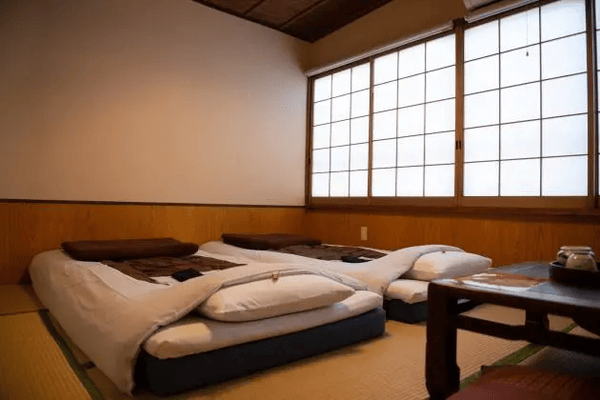
Most travelers associate the ryokan experience with Kyoto, but Tokyo has its own version, and Ryokan Sawanoya is the best of them. A ryokan is a traditional Japanese inn: tatami mat floors, futons instead of beds, and a style of hospitality built around anticipating guest needs before they’re voiced. Ryokan range from rambling wooden buildings that look pulled from a woodblock print to ultra-modern luxury properties, and Sawanoya sits closer to the former, run by the same family for three generations.
The inn has welcomed international guests for decades and built a loyal following among repeat visitors who specifically seek it out. The traditional soaking tubs, available for private use with garden views, are a highlight worth booking ahead for, particularly for couples or families who want the bath experience without sharing it with strangers. The rooms themselves are cozy, not spacious, in keeping with the ryokan tradition of modest, well-considered spaces over square footage.
Yanesen, the neighborhood where Sawanoya sits, is one of Tokyo’s most visually appealing districts, full of wooden buildings dating to the early 20th century that survived both the 1923 earthquake and WWII bombing raids that leveled much of the rest of the city. Walking the streets around the ryokan feels like stepping into a Tokyo that no longer exists anywhere else. The Tokyo National Museum, Ueno Park, and the old-fashioned shopping street Yanaka Ginza are all within easy walking distance. The inn’s owners speak English well enough to make booking and check-in straightforward for international guests who might otherwise feel intimidated by the formality of ryokan etiquette. Breakfast, served in a communal dining area, typically includes traditional Japanese dishes prepared with the same attention to detail that defines the rest of the stay, giving guests a proper introduction to ryokan hospitality before they head out to explore the city. Sawanoya’s staff are known for going beyond standard hospitality, helping guests plan day trips, book restaurant reservations, and navigate Tokyo’s transit system in ways that larger hotels rarely bother with anymore. The inn’s small size, just a dozen or so rooms, means the same staff tends to recognize returning guests, and many travelers report a level of warmth here that feels closer to visiting family than checking into a commercial property.
Credit: 9h nine hours
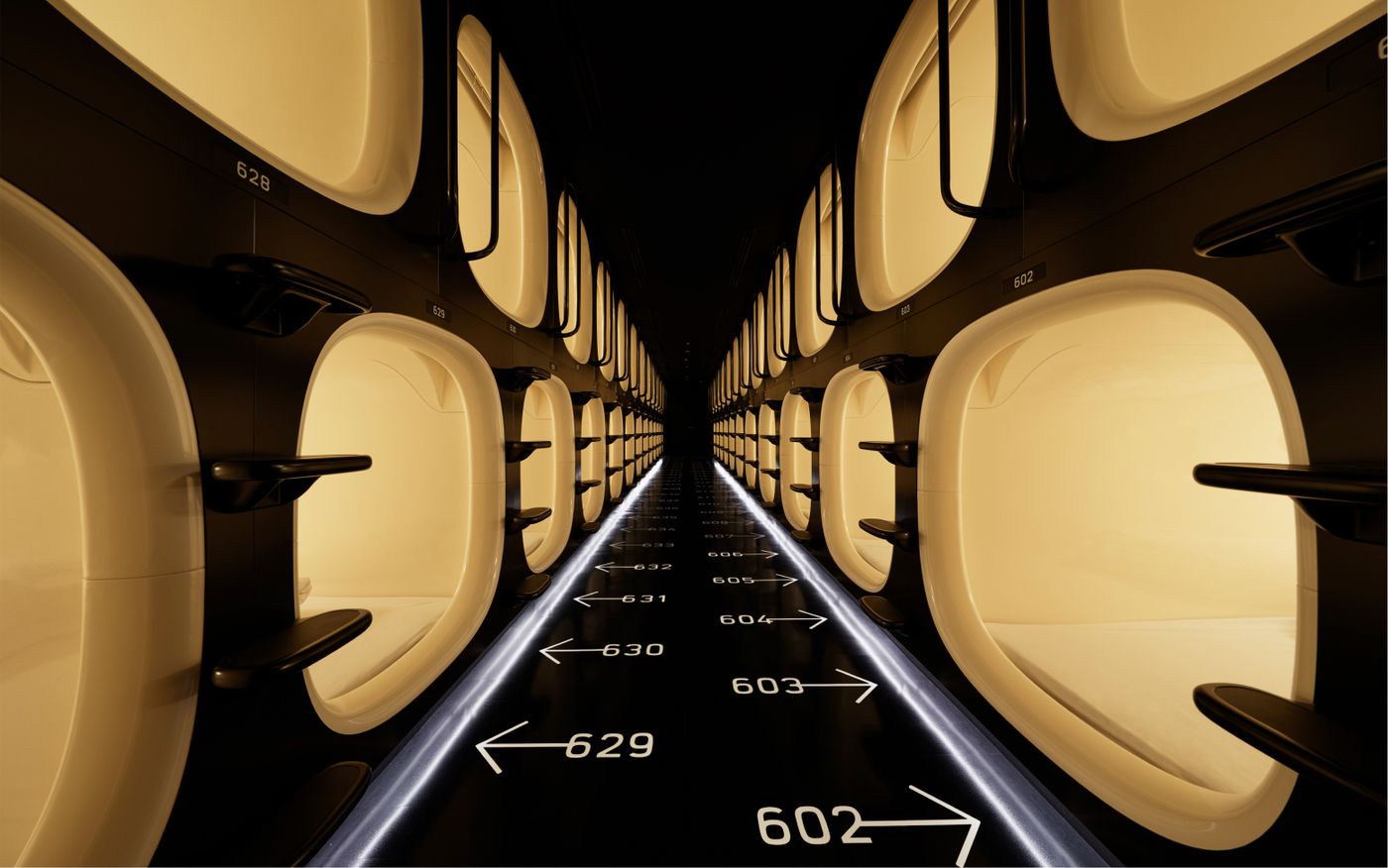
Capsule hotels emerged in Japan during the 1980s economic bubble, originally conceived as places for exhausted commuters to catch a few hours of sleep before heading back to the office, rather than making the long trip home. Each capsule is roughly the size of a single bed with just enough headroom to sit up, sealed off from the corridor by a curtain and separated from neighboring capsules by plastic or fiberglass walls. It’s not for anyone with claustrophobia, but for everyone else, it’s one of the more genuinely unique overnight experiences Tokyo offers.
9h nine hours in central Shinjuku North is the best entry point for first-time capsule hotel guests, specifically because it’s designed with foreign travelers in mind. All policies, including the gender-segregated floors that are standard across the capsule hotel industry, are explained in English, which removes a layer of confusion that can otherwise make the experience intimidating. The capsules themselves are styled like futuristic space pods, sleek and minimal instead of cramped and utilitarian, and private shower booths replace the communal bathing setup found at many older capsule properties.
The location puts you within walking distance of Golden Gai, the famously tiny bar alleys of Shinjuku, and Hanazono Shrine, a working Shinto shrine tucked improbably into the middle of the neighborhood’s entertainment district. A night here costs a fraction of a standard hotel room and delivers an experience no conventional hotel can match. The lobby and common areas at 9 Hours extend the minimalist design language found inside the capsules themselves, with clean lines and soft lighting that feel considerably more upscale than the budget price point suggests. Lockers are provided for luggage storage, since the capsules themselves have no room for bags, and the overall system runs efficiently enough that check-in and checkout rarely take more than a few minutes. Earplugs and eye masks are provided in every capsule, a small but necessary touch given the open corridor design, and the gender-segregated floors mean solo female travelers often report feeling more comfortable here than at a mixed-dorm hostel. The shared lounge areas on each floor give guests a place to work or relax outside the capsule, helping offset the inevitable claustrophobia some people feel during the first hour or two of the stay.
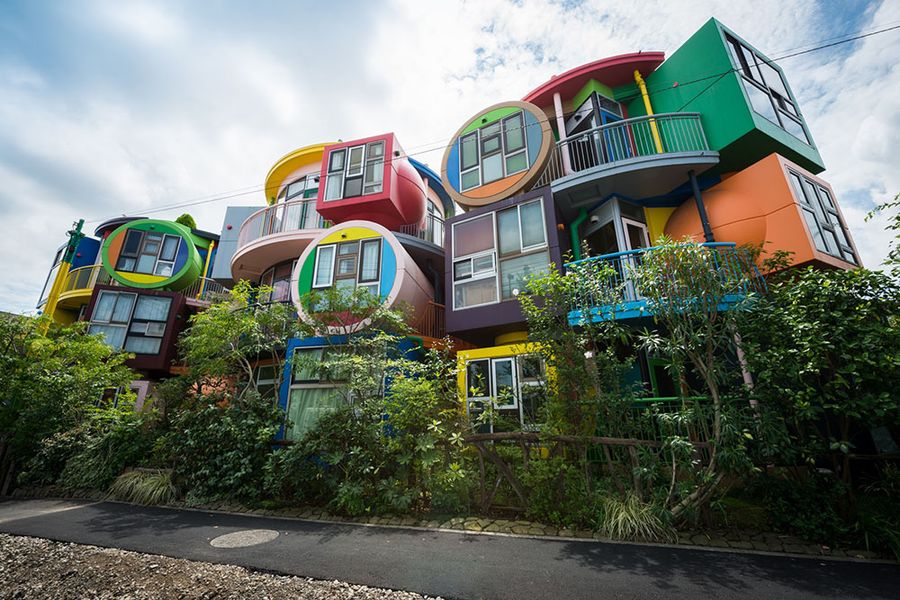
Credit: Reversible Destiny Foundation
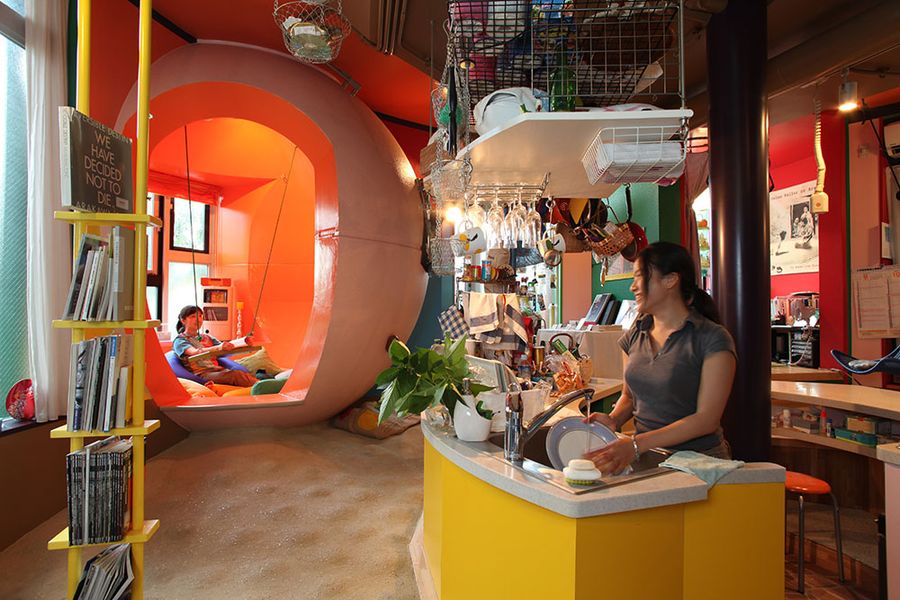
The Reversible Destiny Lofts are among Tokyo’s most genuinely strange architectural landmarks, and renting one for a night or two is a rare opportunity to live inside a piece of experimental design, not just look at it. Architects Arakawa Shūsaku and Madeleine Gins designed the complex, completed in 2005, with nine units featuring undulating floors, spherical rooms, and ceiling hooks installed specifically for hammocks and swings. The goal was a full sensory experience that goes beyond visual interest, though the building’s riot of color ensures visual interest is covered as well.
Two of the nine units are available as short-term rentals, one sleeping two guests and the other sleeping four, both equipped with kitchens and washing machines for visitors who want an extended stay with some domestic normalcy mixed into the architectural disorientation. The remaining units house long-term tenants, which means the complex functions as a genuine residential community rather than a tourist attraction dressed up as housing.
Living in a space with no flat floors and curved walls takes some adjustment. Simple tasks like setting down a coffee cup require new habits, and the architects intended exactly that: a built environment designed to keep residents physically and mentally engaged, refusing to let domestic life slip into autopilot. The Ghibli Museum and Inokashira Park are both nearby, making Mitaka a worthwhile base for a day or two beyond the Lofts themselves. Booking one of the two available units requires planning well ahead, since demand from architecture enthusiasts and curious travelers alike keeps both apartments reserved months in advance during peak travel seasons. The complex’s broader neighborhood, a quiet residential pocket of Mitaka, offers little of the typical Tokyo bustle, making the contrast between the wild interior architecture and the calm exterior setting feel even more pronounced. Photography is generally permitted inside the rented units, making the Lofts a minor pilgrimage site for architecture students and design enthusiasts who document the space extensively during their stays. The lack of straight walls or flat surfaces means furniture placement becomes a genuine creative problem, not a simple logistical task, and most guests report needing at least a full day to stop noticing the unusual geometry and start actually relaxing into it.
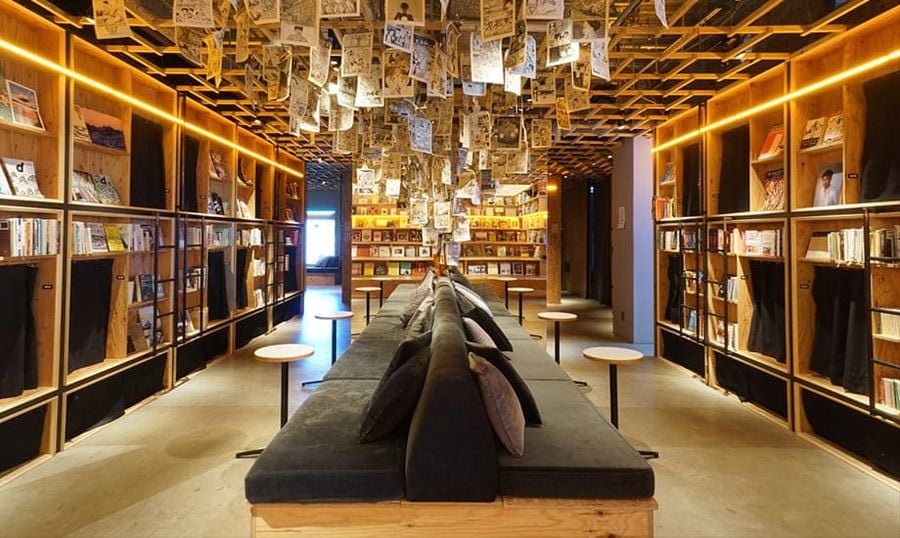
Credit: Book and Bed Tokyo
Hostels have offered small book exchanges for decades, usually a single shelf in a common room where guests trade worn paperbacks. Book and Bed takes the opposite approach: instead of treating the library as an afterthought, the entire property is built around it. Sleeping cubbies are fitted directly into floor-to-ceiling plywood bookshelves stocked with comic books, novels, travelogues, and essay collections, so guests sleep literally surrounded by books, not merely near them.
Most of the collection is in Japanese, which makes sense given the location, but there’s a meaningful selection of English material as well, including Japanese fiction in translation and English-language books about Japanese culture and history. Falling asleep in a cubby lined with spines you can reach out and touch is a specific kind of pleasure for anyone who finds bookshelves comforting in general.
The property stays open during the day as a paid lounge space, 700 yen per hour, for visitors who aren’t staying overnight, which makes it a practical rainy-day option or a place to decompress before heading out into Shinjuku’s nightlife. The Tokyo Metropolitan Government Building and Shinjuku Gyoen, one of the city’s best gardens, are both within easy reach. The cubbies themselves come with reading lights, outlets, and enough room to sit up and read comfortably, which sets Book and Bed apart from a standard capsule hotel despite their superficially similar format. Staff can recommend titles based on genre preference, a small but thoughtful touch that turns checking in into something closer to a personalized library visit than a standard hotel transaction. The property also runs occasional themed pop-up shelving sections built around specific genres or author retrospectives, giving repeat visitors something new to discover, even if they’ve stayed before. Earplugs are advisable given the open-plan layout shared with the lounge area, though the overall noise level tends to remain low due to the bookish, introverted crowd the concept naturally attracts. Visitors who want total quiet can request cubbies positioned farther from the lounge entrance, away from the small amount of foot traffic that passes through during the busiest afternoon hours.
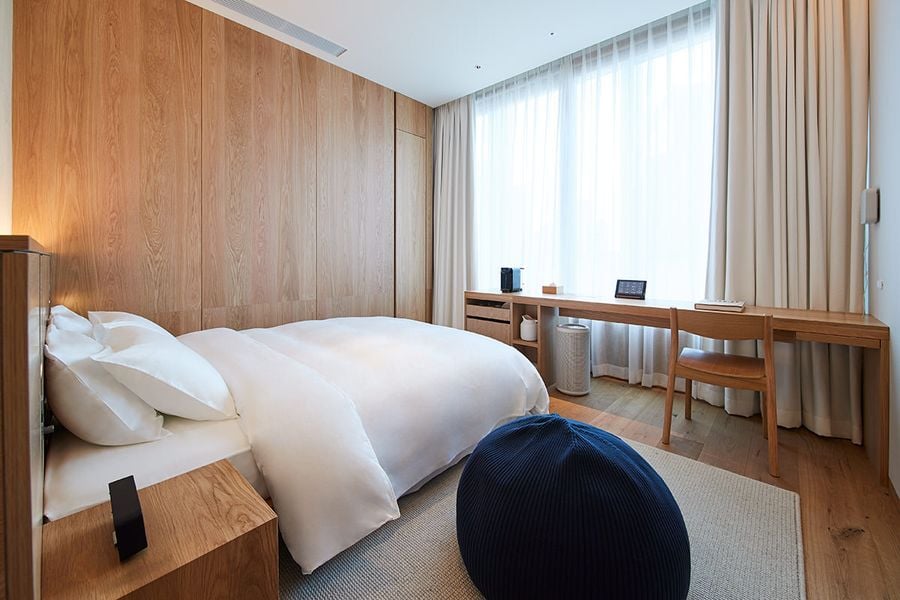
Credit: Muji Hotel Ginza
Ginza is Tokyo’s luxury shopping district, home to international flagship stores, high-end restaurants, and buildings whose creative window displays serve as a rotating public art exhibition. Staying at Muji Hotel takes the neighborhood’s design obsession and applies it directly to the room you sleep in: every piece of furniture, every amenity, and every product on the shelf comes from Muji, the lifestyle brand whose unornamented, function-first aesthetic has become globally recognized shorthand for a certain kind of Japanese design sensibility.
The effect is less like staying at a branded hotel and more like spending a few nights inside the brand’s actual design philosophy, tested in real time against the practical demands of daily living, not just browsed on a showroom floor. Everything from the toiletries to the stationery to the slippers follows the same restrained visual logic, and guests who arrive skeptical of minimalist design as a lifestyle often leave persuaded.
The location puts Ginza’s specialty shops within walking distance: Koju for incense, Ōnoya for textiles, and Kyukyudo for traditional paper goods. Spending an afternoon browsing these shops after checking into Muji Hotel makes for a coherent day built entirely around Japanese craft and design, with almost no detour required. The hotel’s restaurant serves a Muji-branded take on Japanese comfort food, simple, well-sourced dishes plated with the same restraint found throughout the rooms, and breakfast here functions as a quiet extension of the design philosophy guests came specifically to experience. Even the hotel’s signage and wayfinding follow Muji’s visual language, giving the entire stay a coherence that branded hotel partnerships rarely achieve. A small Muji retail counter in the lobby lets guests purchase anything they particularly liked during their stay, from bedding to bath products, turning more than a few overnight stays into unplanned shopping trips. The hotel’s overall calm, muted aesthetic also makes it a popular choice for travelers who find Tokyo’s broader sensory intensity occasionally overwhelming and want a guaranteed quiet retreat to return to each evening.
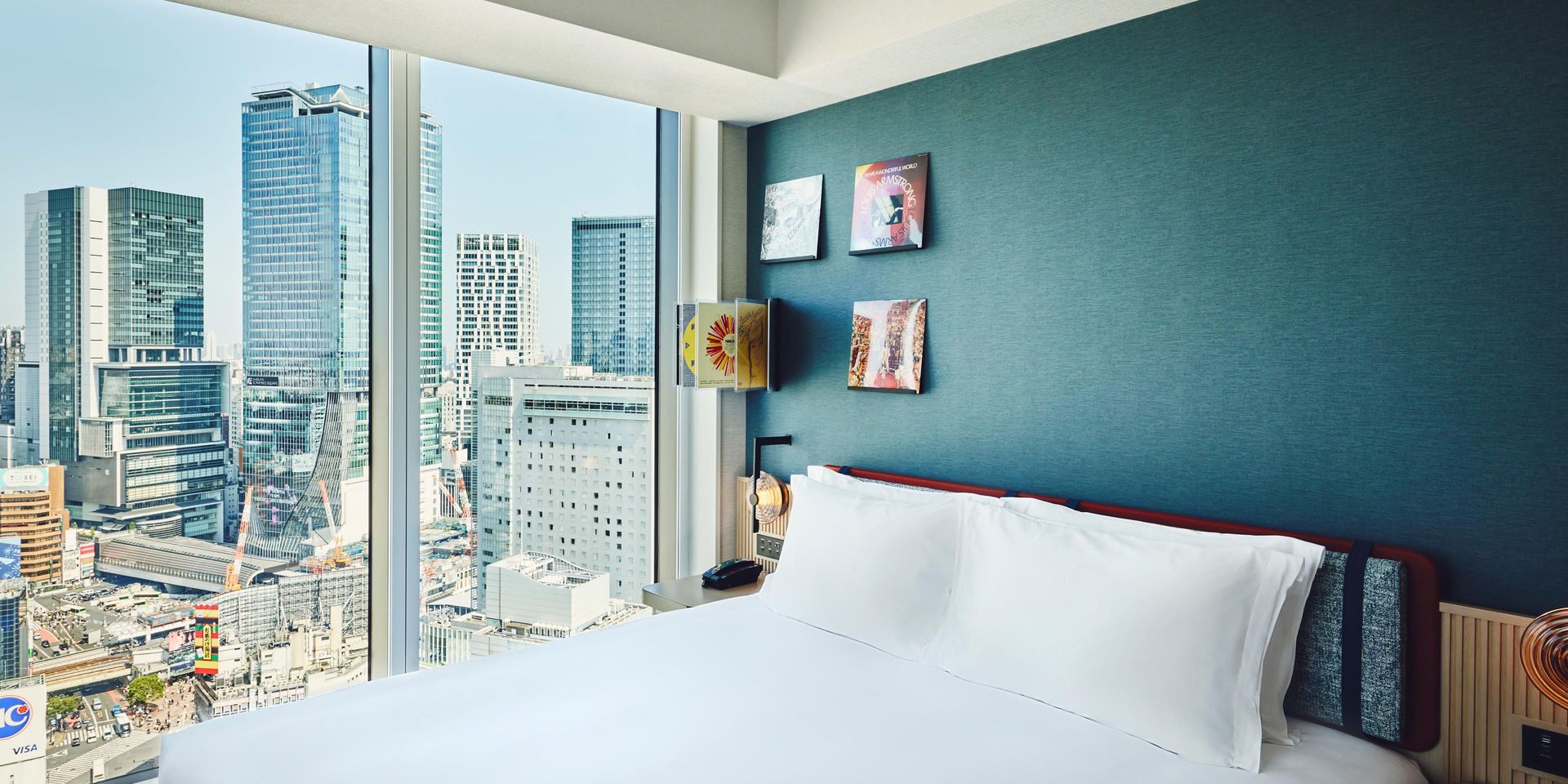
Credit: Hotel Indigo Tokyo Shibuya
Japan’s kissaten culture emerged after World War II, when bars dedicated to playing jazz records on high-quality sound systems became sanctuaries from the increasingly frantic pace of postwar urban life. These listening bars prized vinyl quality, top-tier audio equipment, and carefully curated playlists over conversation or crowds, and the culture has persisted in pockets of Tokyo ever since.
Hotel Indigo Tokyo Shibuya brings that culture directly into its guest rooms. The luxury high-rise’s colorful rooms offer towering views of the city, and guests can request a handpicked collection of vinyl records for in-room use, turning a standard hotel stay into something closer to a private listening bar session with a skyline backdrop. The novelty here isn’t the records themselves but the privacy: getting the full kissaten experience without sharing the room with strangers or working around someone else’s bar hours.
The hotel sits close to Shibuya Crossing, the famously chaotic pedestrian intersection that’s become one of Tokyo’s most photographed locations, along with the Hachikō Statue and the steep, atmospheric Spain-zaka shopping street. Few hotels in Tokyo combine this level of musical curation with this central a location. The hotel’s design throughout draws on Shibuya’s creative, slightly chaotic energy, with bold color choices and artwork that reference the neighborhood’s fashion and music scenes, rather than playing it safe with generic luxury-hotel neutrals. Requesting the vinyl collection ahead of arrival is recommended, as the most popular records can run low during busy periods. The front desk is also happy to suggest selections based on genre preference if guests aren’t sure where to start. The rooms themselves feature large windows facing the Shibuya skyline, and pairing the city view with a record spinning on a proper turntable creates an atmosphere that few hotel rooms anywhere can convincingly replicate. Even guests with no particular interest in vinyl culture tend to find the experience appealing simply because it feels so unusual compared to the default streaming-service soundtrack of most modern hotel stays.
Credit: Henn na Hotel
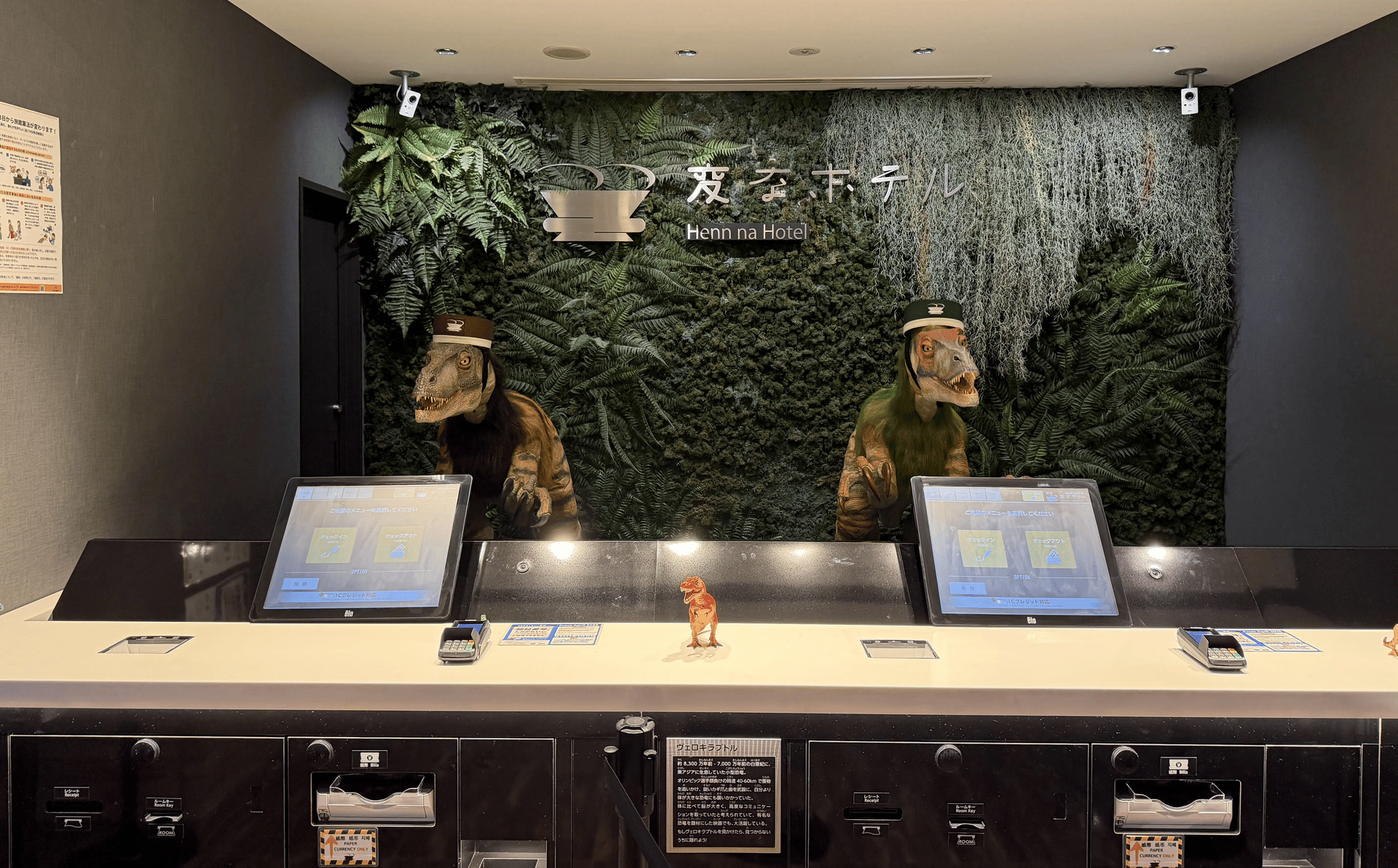
The Henn na Hotel chain made headlines in 2015 as the first hotel in the world to use robots for every customer-facing role, from check-in through checkout. Automation in hospitality has become considerably more common since then, but few hotels anywhere can claim a robot workforce that includes a grouchy-looking animatronic Tyrannosaurus rex handling front desk duties, as is the case at certain branches of the chain.
Human staff remain on-site in case anything goes wrong, though the robots handle most languages more fluently than the humans do, which is its own small irony given that robots are usually the ones criticized for communication gaps. The chain now has multiple locations across Tokyo and Japan more broadly, with outposts as far afield as Seoul and New York City, but the Maihama branch is the specific pick here, since it’s the one where the dinosaur works the desk.
Maihama is best known as the location of Tokyo Disney $DIS Resort, which makes Henn na Hotel a practical and genuinely memorable base for families splitting time between robot-staffed check-in and a day at the parks. The novelty of the dinosaur receptionist tends to be the thing kids remember most clearly from the whole trip. Rooms at Henn na Hotel are functional and comfortable, not luxurious, reflecting the chain’s original positioning as an efficient, tech-forward alternative to standard business hotels. Facial recognition technology handles room entry at most branches, eliminating the need for physical key cards, which adds one more small but genuinely futuristic touch to a stay that’s already built around the novelty of automation. The hotel’s pricing is notably lower than comparable Tokyo hotels of similar size and location, as reduced staffing costs from automation translate into real savings passed on to guests. Families traveling with young children tend to find the novelty factor especially effective at making check-in, normally a tedious part of any trip, into something the kids actively look forward to instead of tolerating.
Credit: Dormy Inn
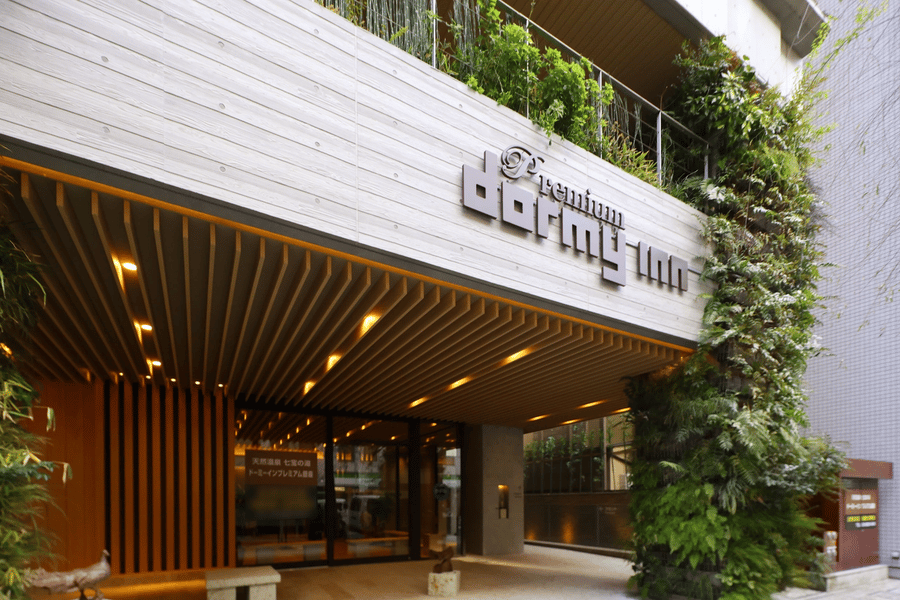
Japan’s volcanic geology produces thousands of onsen, natural hot springs that feed soaking tubs across the entire archipelago, from countryside pools surrounded by forest to ryokan with private outdoor rotemburo baths. Most travelers associate onsen culture with mountain retreats, hiking trips, or post-ski relaxation, but Dormy Inn Premium proves that an authentic onsen experience works just as well after a long day spent walking around Tokyo’s neighborhoods.
The hotel’s real onsen, fed by genuine hot spring water rather than a heated municipal supply, gives guests an actual soak rather than an approximation, which matters to anyone who’s experienced both and knows the difference in mineral content and overall feel. A post-soak ice cream, included as part of the hotel’s standard offering, is a small but genuinely pleasant touch that turns the evening ritual into something closer to a reward than a routine.
The Ginza location puts guests within reach of Kabuki-za, Tokyo’s premier kabuki theater, the Shiseido Gallery, and what remains of the old Tsukiji Market area, now mostly relocated but still home to some of the city’s best seafood restaurants and street food stalls. Ending a day of sightseeing in this part of the city with a hot spring soak instead of a standard hotel shower changes the whole rhythm of a Tokyo evening. The hotel’s location in Ginza means the onsen sits within a genuinely upscale neighborhood, but Dormy Inn Premium itself prices well below the luxury hotels surrounding it, making the onsen experience accessible without the matching price tag. Towels and basic toiletries are provided at the bath, so guests can head straight from a day of walking into the soak without detouring back to the room first. The baths are gender-segregated, following standard onsen etiquette across Japan, and tattoos, traditionally associated with organized crime in Japanese culture, may require covering depending on the specific property’s current policy, which is worth checking before arrival if it applies. Visitors unfamiliar with onsen customs, full-body washing before entering the shared bath, no swimwear, and quiet voices, will find the staff generally patient about explaining the etiquette to first-timers, not expecting instinctive knowledge of unwritten rules.
