
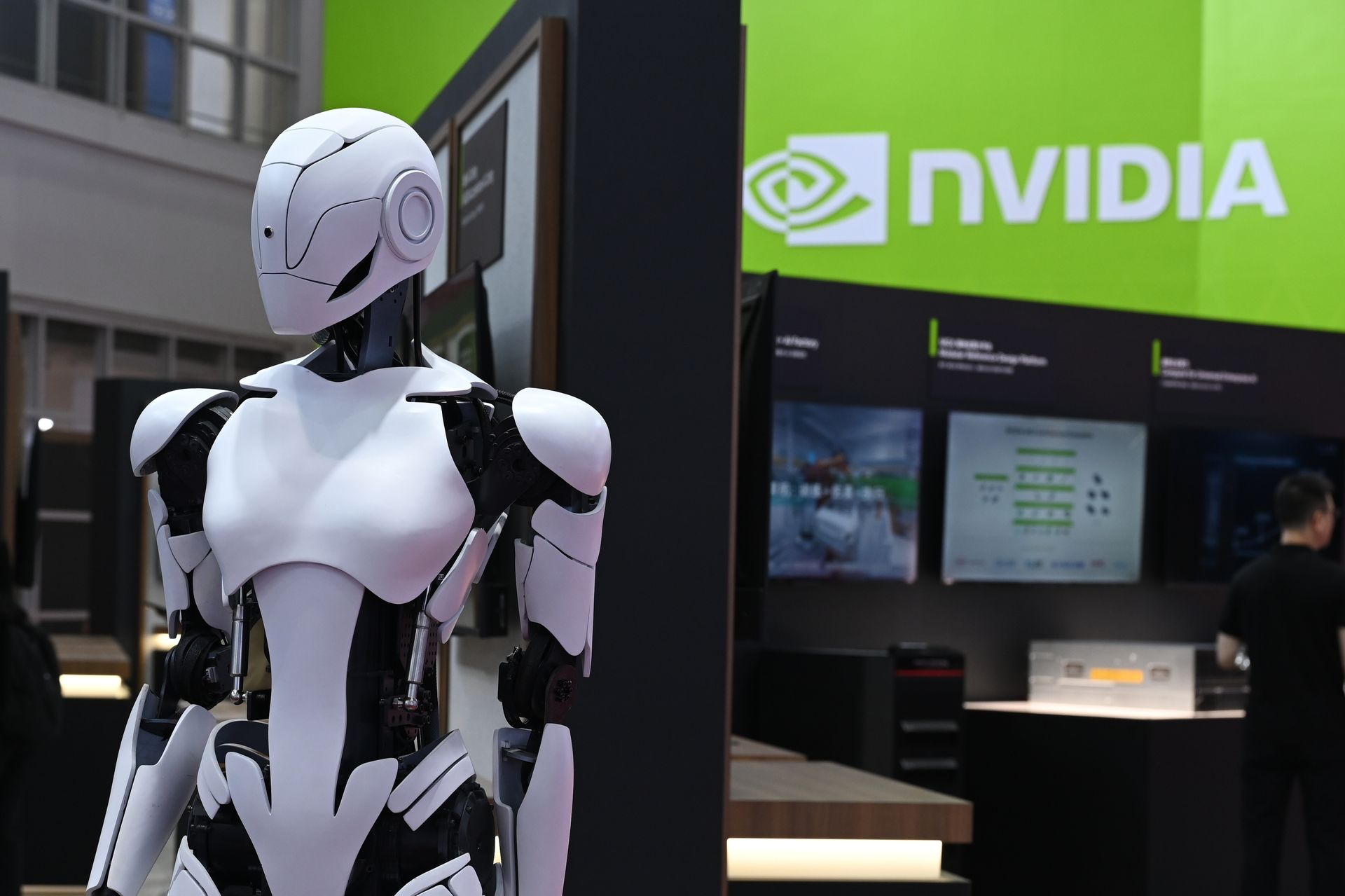
Nvidia $NVDA announced a safety system for robots operating in factories, warehouses, and logistics facilities alongside human workers, as the industry works to make humanoids reliable enough for close contact with people.
Branded as Halos for Robotics, the offering brings AI compute hardware, system software, sensor data, safety applications, and inspection together within a unified architecture, according to the company. The technology behind it was built on a foundation representing more than 18,600 engineering years of work on autonomous vehicle safety.
Agility Robotics is the first company to incorporate elements of the system into its humanoid robot, Digit, which is already deployed at facilities run by customers including Amazon $AMZN, GXO, Schaeffler, and Toyota $TM Motor Manufacturing Canada. Under the arrangement, Digit's proprietary human detection system will incorporate Nvidia's IGX Thor compute hardware and Halos Core software.
The safety challenge with humanoids is distinct from traditional industrial robots, according to Bloomberg. Existing approaches to robot safety tend to freeze or slow machines the moment a human enters their vicinity — a blunt solution that cuts into productivity and makes genuinely collaborative work, such as passing tools or sharing a physical load, essentially impossible. A humanoid requires real-time reasoning about what it can and cannot touch or exert force on.
"If you think about safety in the context of a traditional robot, it is basically you need to put it in a cage or you need to have sensors which can detect there's an obstacle and the robot comes to a stop," said Amit Goel, a senior director of product management at Nvidia. "But that is not enough for a humanoid robot."
One component of the architecture, the Outside-In Safety Blueprint, feeds data from external cameras and AI agents into the robot's decision-making loop, allowing its behavior to be adjusted dynamically based on conditions in the surrounding environment, the company said. By pulling in feeds from cameras mounted around a facility, a self-driving forklift could, for instance, evaluate conditions on the other side of a blind corner and adjust its speed accordingly.
Nvidia also created what it calls the Halos AI Systems Inspection Lab, an ANSI National Accreditation Board-accredited program where robot makers can complete safety testing before seeking third-party certification. Participation spans more than 40 organizations, and certification bodies such as TÜV Rheinland, TÜV SÜD, and UL Solutions have all formally accepted the lab as part of their respective certification workflows.
Before seeking final third-party certification, the two companies plan to run Digit through the lab to confirm its software, AI elements, and cybersecurity measures conform to standards that include IEC 61508, ISO 13849, and ISO/IEC TR 5469.
"For humanoids to deliver value at scale, safety has to be built into the robot and validated across the entire system," Agility CEO Peggy Johnson said in a statement.
Registered developers can access Halos Core for Nvidia IGX through an early access program. The Outside-In Safety Blueprint has also been released in early access as an open-source project hosted on GitHub.
Nvidia has been positioning Halos as a safety umbrella across its physical AI and robotics ambitions, alongside simulation tools, robot foundation models, and edge compute hardware aimed at bringing autonomous systems from development into deployment.