While Trump wages his campaign over port ownership, the canal faces threats no amount of geopolitical pressure can fix
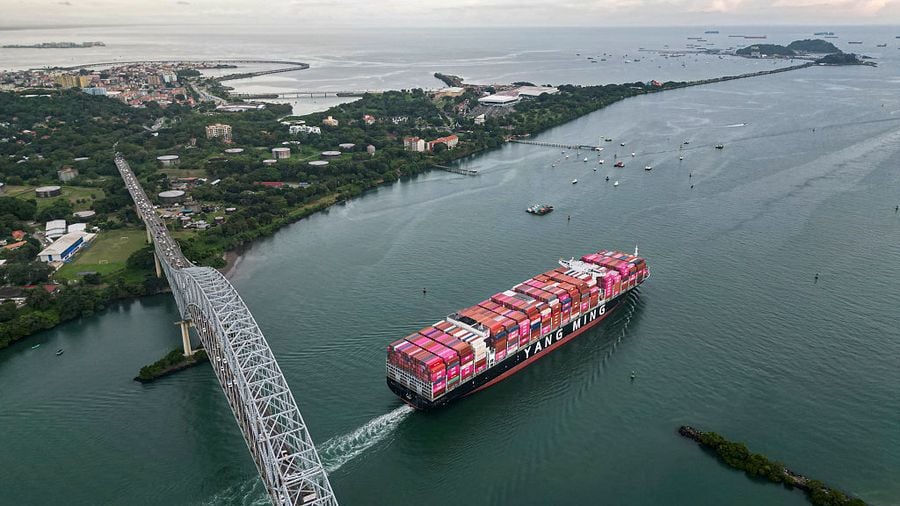
MARTIN BERNETTI/AFP via Getty Images
A version of this article originally appeared in Quartz’s members-only Weekend Brief newsletter. Quartz members get access to exclusive newsletters and more. Sign up here.
When President Donald Trump took office in January, he wasted no time declaring his intention to "reclaim" the Panama Canal, warning of Chinese influence over the critical waterway. By August, he was still hammering the point at the United Nations, insisting that Beijing's role poses "a potential threat to global trade and security."
Join 500,000+ readers who start their day with Quartz.
By subscribing, you agree to our Terms of Service and Privacy Policy.
The Panama Canal looms large in American history, having been built by the U.S. in the early 1900s at tremendous cost — both financial and human — before control transferred to Panama in 1999. And it remains central to American commerce today: The set of locks moves roughly $270 billion in cargo annually and handles 40% of U.S. container traffic.
Yet while Trump wages his campaign over port ownership, the canal faces threats no amount of geopolitical pressure can fix. A Mexican railway is positioning itself as a credible alternative. Severe droughts have driven away liquified natural gas (LNG) carriers to longer routes around Africa. And climate change promises more headaches for the stretch of locks that span about 50 miles and make the world’s shipping go round.
Competitors have tried to challenge the Panama Canal before — and failed spectacularly. Nicaragua's proposed $50 billion Chinese-backed canal, which broke ground in 2014, never got past symbolic groundbreaking ceremonies and access roads. By 2024, the project was quietly canceled after a decade of protests, environmental concerns, and the financial collapse of its Chinese backer.
But while the Panama Canal battles nature, Mexico is betting it can succeed where Nicaragua failed. Not by building another canal, but with a railway that Mexico hopes can capture a slice of the cargo that flows through the waterway.
The Interoceanic Corridor, spanning 188 miles across the Isthmus of Tehuantepec in southern Mexico, is a calculated hedge on the canal's vulnerabilities. During recent droughts, the canal raised toll prices almost eight-fold and restricted the number and size of ships that could pass through.
The Mexico route would allow shippers to transfer containers from a Pacific port to railway, then pick them up with another ship on the Atlantic side. The Interoceanic Corridor could move goods in six to seven, though when you add loading and unloading time, the total transit time is more like 15 hours. By comparison, sailing through the Panama Canal takes 8 to 10 hours, although recent waiting times have caused delays of up to two weeks.
The project has attracted about $6 billion in funding from the Mexican government and more than $2 billion from international sources including the World Bank. There are plans for 10 industrial complexes along the route, positioning Mexico to benefit from nearshoring trends as U.S. companies move supply chains out of China.
The railway isn't a replacement for the canal — the current plan would only allow it to handle about 5% of the capacity. But 5% of a multi-trillion dollar industry is still substantial, and could be expanded if things go well, threatening the chokehold that the waterway has on transit in the region.
The recent delays were due to the lack of rain, which the Panama Canal relies on for the water to fill its locks. During severe drought conditions from 2022 to 2024, the canal was forced to drastically reduce transits and impose vessel weight restrictions to conserve water.
The impact was dramatic. Vessel transits dropped 29% during fiscal year 2024, with LNG traffic down 66%.
But fiscal year 2025 told a different story. As water levels recovered, so did the canal's fortunes. Transits surged almost 20% and revenues jumped 14.4% to $5.7 billion, exceeding expectations. Net profits hit $4.1 billion, up $695 million from the previous year.
Yet the recovery comes with caveats. LNG shipments, a lucrative segment, "posted results below expectations" according to the canal authority, with carriers sticking with the longer route around Africa's Cape of Good Hope. And the rebound was helped by "frontloading," when companies did advance shipments to get ahead of potential trade war costs. that contributed at least $100 million to the bottom line, but isn't sustainable.
The canal authority is racing to be ready for a drier future. A $1.6 billion dam project on the Rio Indo is expected to begin construction in 2027. There's also a plan for a natural gas liquids pipeline that skips the canal by turning to a 76-kilometer "land bridge.”
The Panama Canal's strong fiscal 2025 results show it can bounce back from a crisis. But outside of the geopolitical fighting, the underlying tension remains: A century-old waterway built when climate patterns were more predictable is now confronting an era of severe droughts and extreme weather.
All while a hungry competitor waits in the wings.
