
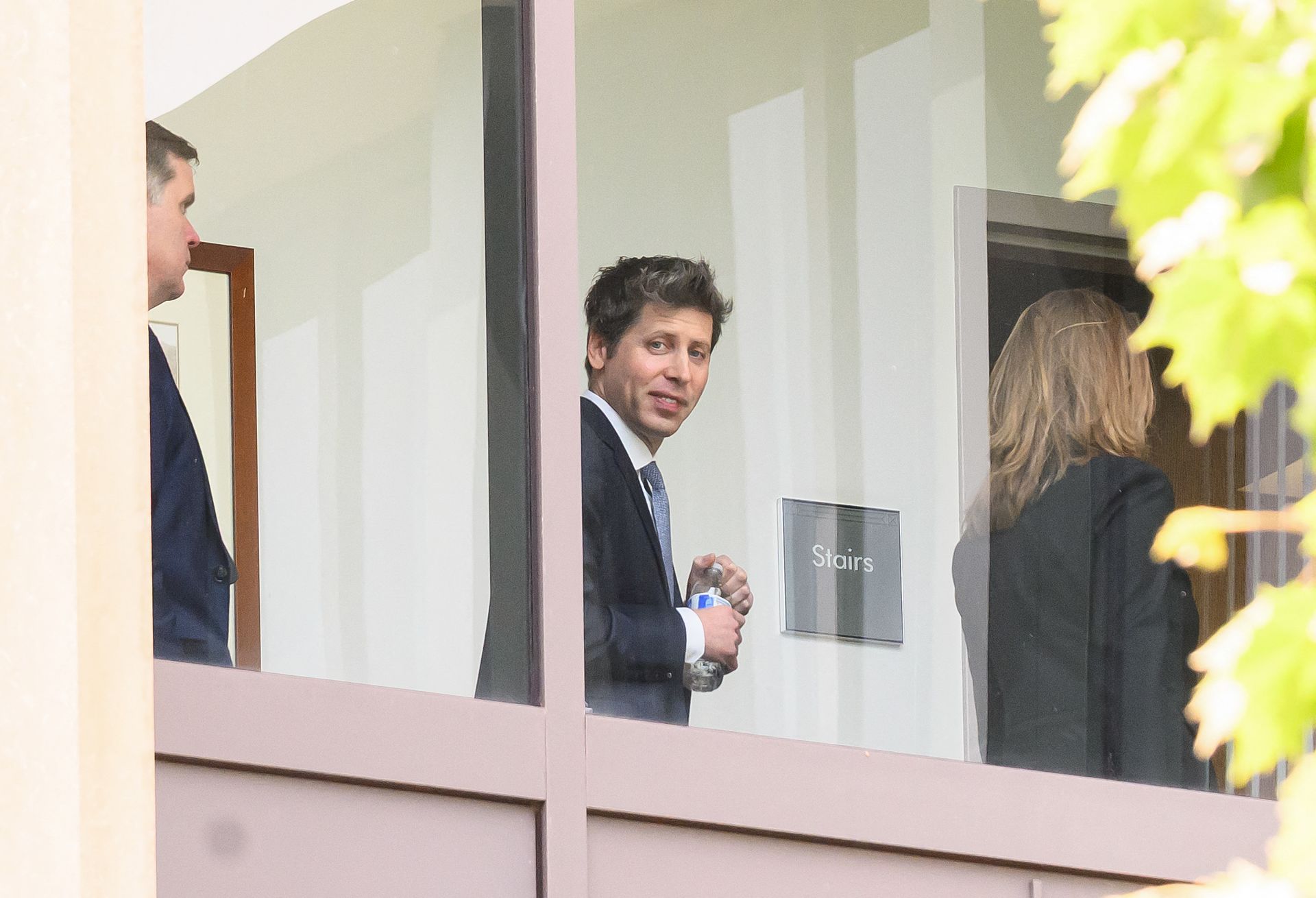
OpenAI CEO Sam Altman testified Tuesday that Elon Musk wanted total control of OpenAI in its early days, pushing back on Musk's central claim that Altman and other executives betrayed the company's charitable mission by steering it toward a for-profit structure.
During his roughly four hours of testimony, Altman told the court that Musk had insisted on holding majority control over any for-profit version of OpenAI, offering only a vague promise that his ownership share would shrink as time went on, according to CNBC. Altman testified he did not believe Musk would step back. "My belief is he wanted to have long-term control and that he would have had that had we agreed to the structure he wanted," Altman told the court, according to CNN.
Altman said two factors drove Musk's push for dominance: a general unwillingness to trust others with consequential decisions, and a rule Musk had adopted for himself that he would only involve himself in ventures where he held the reins. "I was extremely uncomfortable with it," Altman testified.
The two sides also clashed over OpenAI's founding principles. Altman said the company was created in part on the belief that no single person should control artificial general intelligence if it were achieved. The question of what would become of OpenAI if Musk were to die while controlling it was put to him directly by the cofounders, Altman testified; Musk offered little more than a shrug, saying the question hadn't crossed his mind and floating the idea that his children might inherit it — an answer Altman described from the stand as a "hair-raising moment."
Musk's attorney Steven Molo used his cross-examination to challenge Altman's credibility, pressing him on accusations of dishonesty from former colleagues, including former OpenAI chief scientist Ilya Sutskever, who testified Monday that he gathered evidence of what he described as Altman's pattern of deception. The cross-examination began with a single pointed question from Molo — "Are you completely trustworthy?" — to which Altman first offered "I believe so" as his answer, then quickly revised that to an unqualified yes.
Altman revisited the circumstances of his 2023 ouster as well, characterizing it as an "incredible betrayal" that blindsided him entirely. The board, he said, offered little in the way of justification — only the claim that he had been less than forthcoming with them. Delivering some of his more emotional testimony, Altman said: "I had poured the last years of my life into this. I was watching it about to be destroyed."
On the question of OpenAI's structure, Altman testified that Musk left the organization because he lost confidence in its prospects, not because he was pushed out over a principled dispute. As evidence of Musk's loss of faith in the organization, Altman pointed to an email Musk sent in December 2018 declaring a zero-percent probability that OpenAI would matter against competitors like Google $GOOGL's DeepMind absent a wholesale overhaul — words Altman said had stayed with him, describing them as "burned into my memory."
The trial centers on Musk's 2024 lawsuit against OpenAI, Altman, and OpenAI president Greg Brockman, in which Musk alleges the three steered the company away from the nonprofit structure under which it was founded in 2015. Central to Musk's grievance is the claim that the approximately $38 million he contributed to OpenAI was ultimately directed toward commercial ends he never sanctioned. OpenAI, whose valuation among private investors now exceeds $850 billion, has countered that Musk understood and accepted the for-profit direction all along, and that his lawsuit materialized only after his bid to run the company came to nothing.
Musk's requested remedies include ousting Altman and Brockman from their roles and compelling more than $130 billion to be redirected to OpenAI's nonprofit foundation. The case moves to closing arguments Thursday, at which point deliberations by the nine-person panel could begin; the panel's verdict, however, is purely advisory, leaving Judge Yvonne Gonzalez Rogers of the U.S. District Court for the Northern District of California as the ultimate decision-maker on liability.