
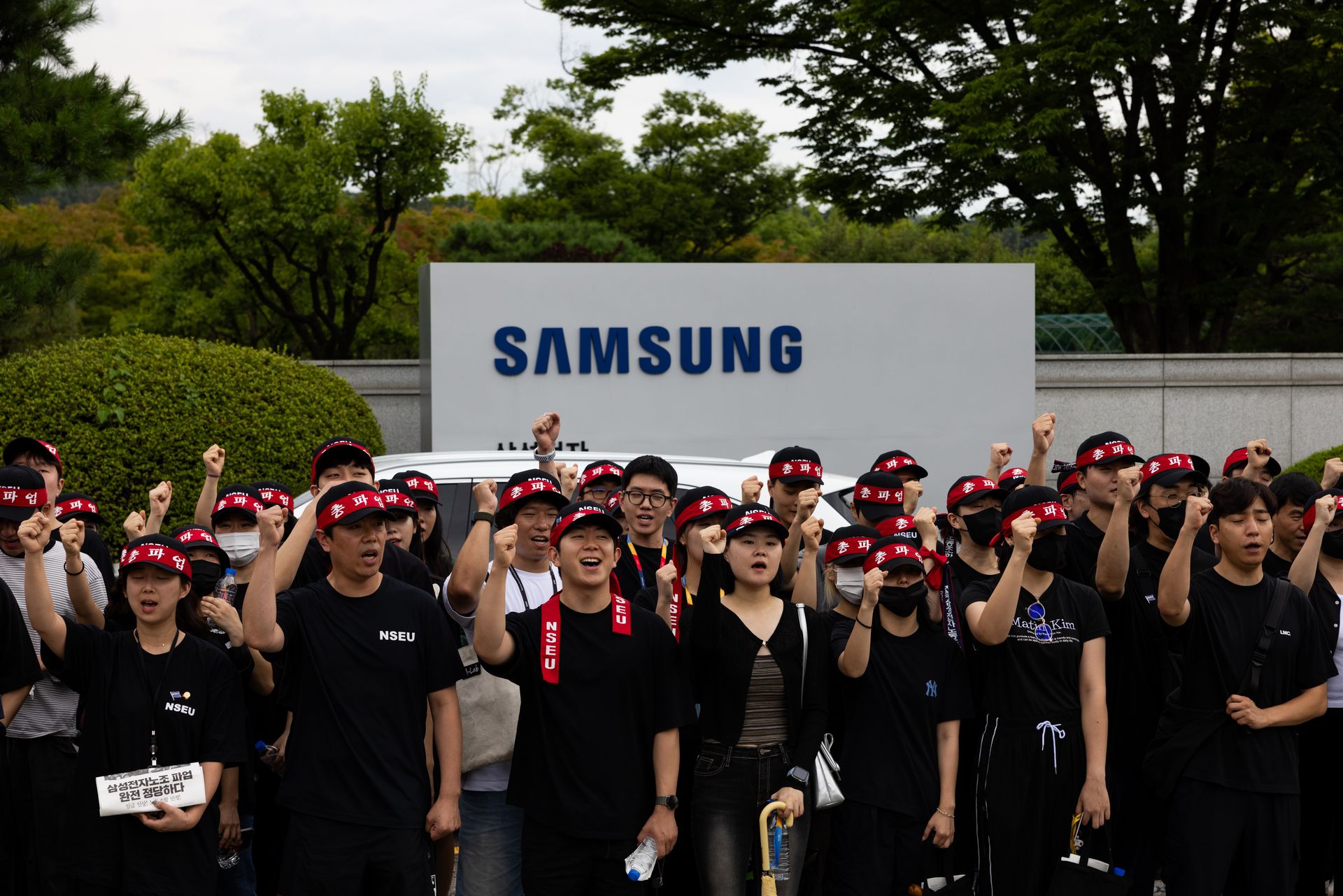
Samsung Electronics and its largest union extended pay negotiations into Tuesday in a last-ditch attempt to avert an 18-day strike by more than 45,000 workers, as South Korean President Lee Jae Myung called on both sides to reach a settlement.
A court also granted Samsung a partial injunction limiting union action, as the government warns losses could reach 100 trillion won
Bloomberg / Getty Images
Samsung Electronics and its largest union extended pay negotiations into Tuesday in a last-ditch attempt to avert an 18-day strike by more than 45,000 workers, as South Korean President Lee Jae Myung called on both sides to reach a settlement.
Posting on X $TWTR in Korean on Monday, President Lee wrote that workers deserved the same respect as business interests, and that corporate management rights were equally entitled to respect as labor rights. His comments were among a series of statements from officials calling on Samsung and its union to settle their differences before Thursday's scheduled walkout.
On Sunday, Prime Minister Kim Min-seok announced that every available tool, up to and including emergency arbitration, was on the table to head off the work stoppage. South Korean law gives the labor minister authority to halt a work stoppage for 30 days through an emergency adjustment order whenever a labor dispute poses a credible threat to economic stability or public welfare. Kim put the immediate cost of a strike at 1 trillion won ($664.7 million), warning that total economic damage could balloon to 100 trillion won if disruptions to chip manufacturing caused Samsung to discard in-process semiconductor wafers.
Pushing back on both the arbitration push and the government's figures, the union pointed out in a written statement that past production slowdowns had been planned events tied to routine maintenance, equipment checks, and manufacturing adjustments. The union further accused officials of ignoring the counterarguments it had submitted and relying exclusively on the company's version of events.
A South Korean court added legal pressure on Monday by partially granting Samsung's request for an injunction, barring the union from obstructing safety-related facilities and banning occupation of company premises. Under the court's order, a portion of the workforce would be obligated to report to their posts to protect production equipment and materials from damage during any walkout. According to a court spokesperson cited by Reuters, each of the two main unions would incur daily penalties of 100 million won ($72,000) for any violations, with individual union leaders exposed to fines of 10 million won per day. Acknowledging the court's decision, the union said it remained committed to moving forward with the strike unless negotiations yielded an acceptable agreement.
Shares of Samsung Electronics climbed as high as 6.7% during morning trading Monday, finishing the session with a gain of roughly 3.88%.
The dispute centers on Samsung's performance-based bonus system. Among the union's core demands are a dedicated bonus pool equal to 15% of yearly operating profit, elimination of the ceiling that limits payouts to half of a worker's annual salary, and a contractual guarantee locking in that structure. For its part, Samsung offered to direct between 9% and 10% of operating profit into bonuses, but only if annual profit clears 200 trillion won, and the company has signaled it intends to keep the salary-linked ceiling in place, according to CNBC.
Park Su-keun, chairman of the National Labor Relations Commission, said Monday that the two sides remained far apart and that talks would resume Tuesday morning. Seoul's presidential office has noted that Samsung Electronics generates revenue equal to roughly 12.5% of South Korea's GDP and is responsible for approximately 22.8% of the country's total exports.
Join 500,000+ readers who start their day with Quartz.
By subscribing, you agree to our Terms of Service and Privacy Policy.