From Newton's laws of motion to the second law of thermodynamics, these are the rules that govern how the universe actually works — explained without jargon

Credit: Nikhil Manan / Pexels
The universe runs on rules. Not guidelines or suggestions — actual mathematical laws that hold everywhere, from subatomic particles to galaxy clusters, from the inside of a living cell to the surface of a neutron star. Scientists have been uncovering these laws for centuries, and they form the backbone of physics, chemistry, biology, and every applied science built on top of them.
Most people encounter these laws in school and then promptly forget them. That's partly because they're often taught as formulas to memorize rather than ideas to understand. But the laws themselves are not complicated in the way a tax code is complicated. They describe patterns that show up everywhere in everyday experience — why things fall, why engines can't be perfectly efficient, why your coffee goes cold, why identical twins share so much but aren't clones. The math captures the pattern precisely, but the idea behind the math is almost always graspable without a single equation.
These laws also have practical consequences that most people don't appreciate. The second law of thermodynamics explains why no engineer, no matter how clever, will ever build a perpetual motion machine. Ohm's law is why your phone charger gets warm. The ideal gas law is why your car tires feel flatter in winter. Mendel's laws explain how genetic diseases skip generations. These aren't abstract academic concerns — they are descriptions of the physical world you move through every day.
What distinguishes a scientific law from a theory or a hypothesis is a useful thing to understand. A law describes what happens, usually in mathematical terms, with a high degree of reliability across many observed cases. A theory explains why it happens. Newton's law of gravitation describes how gravitational attraction scales with mass and distance. General relativity is the theory that explains why. Both are "true" in the scientific sense — both are tested, predictive, and essential tools. The word "law" implies nothing about completeness; some laws turn out to be approximations of deeper laws discovered later. Newtonian mechanics is technically superseded by relativity and quantum mechanics, but it remains exactly correct for any engineering problem you're likely to encounter.
This collection covers 25 of the most important and instructive scientific laws across physics, chemistry, and biology. Each is explained in plain terms — what it says, why it matters, and where you can see it operating in the world around you.

Credit: Ron Lach / Pexels
Isaac Newton published his three laws of motion in 1687, in his landmark work Principia Mathematica, and they remained the foundation of mechanics for over two centuries. The first law is also the one with the most counterintuitive implication: an object at rest stays at rest, and an object in motion stays in motion, unless acted upon by an external force.
This principle is also called the law of inertia. Inertia is the tendency of matter to resist changes in its state of motion — whether that means resisting being moved from rest, or resisting being slowed when already moving. The more mass an object has, the more inertia it possesses, and the harder it is to change its motion.
The counterintuitive part is the second half: objects in motion tend to stay in motion. Everyday experience seems to suggest otherwise. A ball rolled across the floor slows down and stops. A bicycle, once you stop pedaling, eventually comes to a halt. The reason is friction — an external force that removes energy from the system. In a frictionless environment, objects keep moving forever. This is exactly what happens in space, where spacecraft, once given an initial push, travel for decades without any propulsion at all.
Seatbelts exist because of the first law. When a car stops suddenly, the car stops because brakes apply external force to it. The passengers, however, have no such force applied — they keep moving forward at the original speed until they hit the windshield or the seatbelt applies a decelerating force to them. This is why "the seatbelt saved my life" is a direct statement about physics, not just luck.
The law also explains why it's so hard to stop a heavy truck. A fully loaded freight truck traveling at highway speeds has enormous inertia — an enormous resistance to changing its state of motion. The brakes must apply a large force over a long distance to bring it to rest, which is why stopping distances for heavy vehicles are so much longer than for small cars.
Inertia has a less obvious application in rotation. A spinning top stays spinning and keeps its orientation in space because of rotational inertia. This is the same principle used in gyroscopes, which are used in aircraft navigation, satellite orientation, and smartphone sensors that detect which way your device is pointed.
Newton's first law seems simple, but it represents a profound shift in how scientists think about motion. Before Newton, the dominant view — going back to Aristotle — was that a constant force was needed to maintain constant motion. Newton showed the opposite: force is only needed to change motion. Rest and constant velocity are equivalent, natural states. That insight took nearly 2,000 years to fully establish, and it reshapes the way physicists think about everything from planetary orbits to particle physics.

Credit: Jay Brand / Pexels
The second of Newton's laws is the one that gets expressed as a formula: force equals mass times acceleration, usually written as F = ma. It is one of the most used equations in all of science and engineering. Virtually every mechanical calculation — from designing a bridge to predicting the trajectory of a cannonball — depends on it in some form.
The law states that the acceleration of an object is directly proportional to the net force applied to it, and inversely proportional to its mass. In plain terms: push harder, and the object speeds up faster. Push the same force on something heavier, and it accelerates more slowly.
These relationships are perfectly intuitive from daily experience. Pushing a shopping cart loaded with groceries requires more force to reach the same acceleration as an empty one. A small car accelerates more quickly than a large truck with the same engine output. What the law does is put precise numbers on these relationships and make them predictive.
The key concept here is net force — the total force taking all directions into account. If you push a box to the right with 10 newtons of force and friction pushes back with 4 newtons, the net force is 6 newtons to the right. That net force divided by the mass gives the acceleration. If the opposing forces exactly balance — as they do when a book sits still on a table — the net force is zero and acceleration is zero, which takes you back to the first law.
The second law is also why mass and weight are different things, a distinction that confuses people endlessly. Mass is the amount of matter in an object — its resistance to acceleration. Weight is the force of gravity acting on that mass. On the Moon, where gravity is weaker, your mass stays the same but your weight decreases. An astronaut who weighs 70 kilograms on Earth has the same mass on the Moon but weighs about 11.6 kilograms there. The equation F = ma makes this precise: the gravitational acceleration (a) is different on the Moon, so the force (F, which is weight) is different even though mass stays constant.
The second law also underpins rocket propulsion. A rocket engine expels mass — hot gases — backward at high speed. The reaction force accelerates the rocket forward. Because the rocket's mass decreases as fuel burns, the same thrust produces greater acceleration over time, which is why rockets don't fly in a straight line at constant speed but instead accelerate continuously as long as the engines fire. Engineers apply F = ma constantly in planning rocket trajectories, accounting for the changing mass of the vehicle.

Credit: Pixabay / Pexels
The third law is perhaps the most frequently quoted, often in the form of a colloquial summary: for every action, there is an equal and opposite reaction. The full statement is more precise: when one object exerts a force on a second object, the second object exerts a force equal in magnitude and opposite in direction on the first.
What makes this law tricky to understand is that it's describing two forces acting on two different objects — not two forces acting on the same object that cancel each other out. A hand pushes a wall to the right with some force. The wall pushes the hand back to the left with exactly the same force. These forces don't cancel because they act on different things: one acts on the wall, the other acts on the hand.
This is the physics behind rockets and jet engines. A rocket engine burns propellant and expels exhaust gases at high speed through the nozzle at the back. The engine exerts a force on those gases, pushing them backward. The gases exert an equal and opposite force on the engine, pushing it forward. There's nothing for the engine to push against — no ground, no air — and none is needed. The rocket pushes against the propellant it ejects, and the reaction propels the vehicle.
The same principle applies when you fire a gun. The gun exerts a force on the bullet, accelerating it forward at high speed. The bullet exerts an equal and opposite force on the gun, causing recoil — the kickback felt by the shooter. Because the gun is much more massive than the bullet, F = ma means the gun accelerates much less than the bullet does, even though the forces are equal. This is why the bullet moves fast and the gun moves slowly.
The third law also explains how you walk. Your foot pushes backward against the ground. The ground pushes forward against your foot. That forward push from the ground is what moves you. Without a surface capable of pushing back — as when walking on ice — the foot slips and locomotion fails. Ice is slippery because it has very low friction, which means it can't exert much horizontal force against your foot even though you push against it.
Swimmers use the same principle. The arm stroke pushes water backward. The water pushes the swimmer forward. More powerful strokes displace more water and generate more reaction force, which is why upper-body strength matters in swimming speed.
One important implication of the third law: isolated objects cannot accelerate themselves. A ball sitting on a frictionless surface cannot start moving by itself. Any motion requires an interaction with something else. This constrains what's physically possible and rules out certain fictional physics devices that appear in popular imagination.

Credit: Alina Komarevska / Pexels
Gravity is the most familiar force in daily life and, for a long time, the most mysterious. Newton's law of universal gravitation, also published in Principia Mathematica in 1687, gave the first precise mathematical description of how gravity works between any two masses in the universe.
The law states that every object with mass attracts every other object with mass. The strength of the attraction depends on the product of their masses and decreases with the square of the distance between them. Double the distance between two objects, and the gravitational force drops to one-quarter of what it was. Triple the distance, and it drops to one-ninth.
This inverse-square relationship has profound consequences for the structure of the solar system. The planets closer to the Sun feel much stronger gravitational pull than those farther out, which is why Mercury orbits the Sun in about 88 Earth days while Neptune takes 165 years. The same law governs the Moon orbiting Earth, satellites orbiting Earth, and the orbits of stars around the center of galaxies.
Newton's law was revolutionary because it was universal — it applied to the apple falling from the tree and the Moon falling around Earth by exactly the same mathematical rule. Before Newton, earthly mechanics and celestial mechanics were thought to operate by completely different principles. Newton showed they were the same thing.
The law is an excellent approximation for most practical purposes. It correctly predicts the motion of planets, the trajectories of spacecraft, the behavior of tides, and the paths of comets. Where it fails is in extreme conditions: near very massive objects, or when objects move at speeds close to the speed of light. In those situations, Einstein's general theory of relativity gives more accurate predictions. But for anything in the solar system traveling at ordinary speeds, Newton's version works with extraordinary precision.
The gravitational constant in the equation — the factor that sets the overall strength of gravity — is called G. It was not measured directly in Newton's time; he could only work with ratios. Henry Cavendish made the first laboratory measurement of G in 1798, using a torsion balance experiment that measured the tiny gravitational attraction between lead spheres. The value of G is about 6.674 × 10^-11 in SI units, which is vanishingly small — explaining why gravity, despite its unlimited range, is by far the weakest of the four fundamental forces at small scales.
Gravity's long range is what makes it dominant at cosmic scales. Electromagnetism is far stronger between charged particles, but most large objects are electrically neutral, so the charges cancel. Gravity has no such cancellation. Every bit of mass attracts every other bit of mass, with no negative mass to cancel it out.

Credit: Rodrigo Santos / Pexels
The law of conservation of energy states that energy can neither be created nor destroyed — only converted from one form to another. The total energy of an isolated system remains constant over time, regardless of what processes occur inside it.
This is one of the most fundamental laws in all of physics, and its implications touch every field of science and engineering. It means that when you burn gasoline in a car engine, the chemical energy in the fuel doesn't disappear — it converts into kinetic energy (the car moving), heat (the engine warming up and exhaust gases heating), and sound. Add all these up, and you get the same total you started with. Nothing is lost, nothing is created.
The many forms energy takes are all interconvertible within this constraint. Kinetic energy is the energy of motion. Potential energy is stored energy — a compressed spring, a raised weight, a charged battery. Thermal energy is the random motion of molecules. Chemical energy is stored in the bonds of molecules. Nuclear energy is stored in atomic nuclei. Electromagnetic energy is carried by light and radio waves. When a rock falls off a cliff, potential energy converts to kinetic energy. When it hits the ground and stops, that kinetic energy converts to heat and sound.
The law has a direct practical consequence: the impossibility of perpetual motion machines of the first kind — devices that produce more energy than they consume. If such a machine existed, it would be creating energy from nothing, violating the conservation law. Centuries of attempts to build such devices have produced only embarrassment and wasted capital. The law allows engineers to immediately identify claims of overunity devices as fraudulent without reviewing the engineering details.
The law was not established by a single scientist but was gradually recognized through the work of several researchers in the mid-19th century. Julius Robert von Mayer, James Prescott Joule, and Hermann von Helmholtz all contributed to demonstrating that mechanical work, heat, and electrical energy were equivalent and interconvertible forms of the same underlying quantity.
One subtlety: in nuclear reactions and particle physics, mass and energy are related by Einstein's famous equation E = mc². In these reactions, a small amount of mass can convert to a large amount of energy, or vice versa. The conservation law still holds — but the system being tracked must include both energy and the energy equivalent of any mass that changes. When uranium-235 undergoes fission in a nuclear reactor, a small fraction of the total mass of the atoms is converted to energy. The total of mass-plus-energy is conserved.

Credit: Wolfgang Weiser / Pexels
The first law of thermodynamics is closely related to the law of conservation of energy but frames it specifically for thermodynamic systems — systems involving heat, work, and internal energy. The law states that the change in the internal energy of a system equals the heat added to the system minus the work done by the system.
Put plainly: a system's energy goes up when you add heat to it and goes down when the system does work on its surroundings. The total energy is always accounted for.
This is the principle that governs heat engines — machines that convert heat into mechanical work, including steam engines, internal combustion engines, and turbines. Every joule of mechanical work an engine produces must come from somewhere: ultimately from burning fuel or from some other heat source. The first law tells you that you can never get more work out of an engine than the heat you put in.
The concept of internal energy deserves explanation. For a gas, internal energy is primarily the kinetic energy of the molecules — how fast they're moving on average. When you heat a gas, its molecules move faster, its internal energy increases, and it tends to expand. When the gas expands and pushes against a piston — as in a car engine's cylinder — it does work on the piston, and that work output comes at the expense of the internal energy.
An important application is in understanding compression. When you compress a gas rapidly — squeezing air in a bicycle pump — the gas heats up. This is not because friction is adding heat from outside. It's because the pump piston does work on the gas, and that work goes into the internal energy of the gas, raising its temperature. Diesel engines exploit this: the compression in a diesel cylinder is so intense that the air heats enough to ignite the fuel without a spark plug.
The first law also explains why refrigerators require electricity. To move heat from a cold interior to a warm room — which is the opposite of the spontaneous direction of heat flow — requires work. The refrigerator compressor does that work, powered by electricity. Without the electrical input, there is no source of work to drive heat the "wrong" way, and the refrigerator would stop working.
This law, combined with the second law, sets the hard physical limits on the efficiency of all heat engines and refrigerators — limits that no engineering improvement can overcome.
Credit: Marek Piwnicki / Pexels
The second law of thermodynamics is one of the most profound and far-reaching laws in all of science. It addresses not just how much energy is available but which direction physical processes naturally go. Its most common statement: the total entropy of an isolated system tends to increase over time, or at best remain the same.
Entropy is a measure of disorder, or more precisely, of the number of microscopic arrangements available to a system. A gas that has been released from a small container and expanded to fill a room has much higher entropy than it did when confined — there are far more ways to arrange the molecules throughout the room than confined to one corner. The second law says this expansion will happen spontaneously; the reverse will not.
The law has a striking corollary: heat flows spontaneously from hot objects to cold ones, never from cold to hot. A hot cup of coffee cools to room temperature; a cold glass of water warms to room temperature. Neither reverses on its own. This gives time a direction in the physical world — the past is the direction of lower entropy, the future is the direction of higher entropy. This is connected to what physicists call the arrow of time.
The second law is why no heat engine can be 100% efficient. When you burn fuel to produce mechanical work, some of the energy inevitably ends up as heat that spreads into the environment and becomes unavailable for doing further work. This unavoidable energy loss sets a theoretical maximum efficiency for every heat engine, known as the Carnot efficiency, which depends only on the temperatures of the hot and cold reservoirs the engine operates between.
A critical implication: the law does not forbid local decreases in entropy. Your refrigerator makes its interior more ordered (colder, lower entropy) than the surrounding room. Life itself creates highly ordered structures — organisms, cells, DNA — from disordered starting materials. These processes are possible because they are driven by external energy inputs that increase entropy elsewhere by more than the local decrease. A living organism maintains its order only by continuously taking in energy (food, sunlight) and releasing heat to its surroundings. Total entropy still increases.
The second law is also the reason recycling and energy production always involve losses. You cannot recover all the energy that went into making a product. Smelting aluminum from aluminum oxide requires a large energy input, and some fraction of that energy is always lost to entropy. Recycling aluminum still requires energy — just much less than primary production — because converting it back to a usable form requires moving against the natural direction of entropy.

Credit: Nic Wood / Pexels
Ohm's law describes the relationship between voltage, current, and resistance in an electrical circuit. It states that the current flowing through a conductor is directly proportional to the voltage applied across it, provided the temperature remains constant. The formula is V = IR: voltage equals current times resistance.
Georg Simon Ohm published this finding in 1827, and it is one of the foundational laws of electrical engineering. Every circuit calculation, whether for a flashlight battery or a power distribution grid, relies on Ohm's law in some form.
To understand the law intuitively, think of water flowing through a pipe. Voltage is analogous to water pressure — the force pushing the water through. Current is analogous to the flow rate — how much water passes a point per second. Resistance is analogous to the narrowness of the pipe — how much it restricts the flow. A high pressure with a narrow pipe produces the same flow rate as a lower pressure with a wider pipe. In electricity, a higher voltage driving current through a high-resistance circuit produces the same current as a lower voltage across a low-resistance circuit.
The reason electrical devices get warm is Ohm's law in action. When current flows through a resistor, it does work against the resistance, and that work appears as heat — a phenomenon described precisely by a related equation. Incandescent lightbulbs work entirely on this principle: a thin tungsten filament has high resistance, so when current flows through it, it heats up enough to glow white-hot. The same principle, less intentionally, is why electrical wiring in walls must be sized correctly — too thin a wire carries too much current for its resistance, heats up, and can start a fire.
Ohm's law also explains why high-voltage transmission lines are used to carry electricity over long distances. When transmitting a given amount of electrical power, using higher voltage allows you to use lower current. Lower current means less heat generated in the transmission wires — less energy wasted. High-voltage transmission lines operating at hundreds of thousands of volts can carry the same power with far less energy loss than lower-voltage lines. Step-up and step-down transformers at either end of the transmission line raise and lower the voltage as needed.
It's worth noting that Ohm's law is not universal — it applies to ohmic materials, which maintain a constant resistance regardless of the voltage applied. Non-ohmic devices like diodes, transistors, and fluorescent bulbs have resistances that change with voltage, and their behavior requires more complex equations. But for resistors, ordinary wiring, and many passive circuit components, Ohm's law is the fundamental design rule.
Credit: Troy Winther / Unsplash
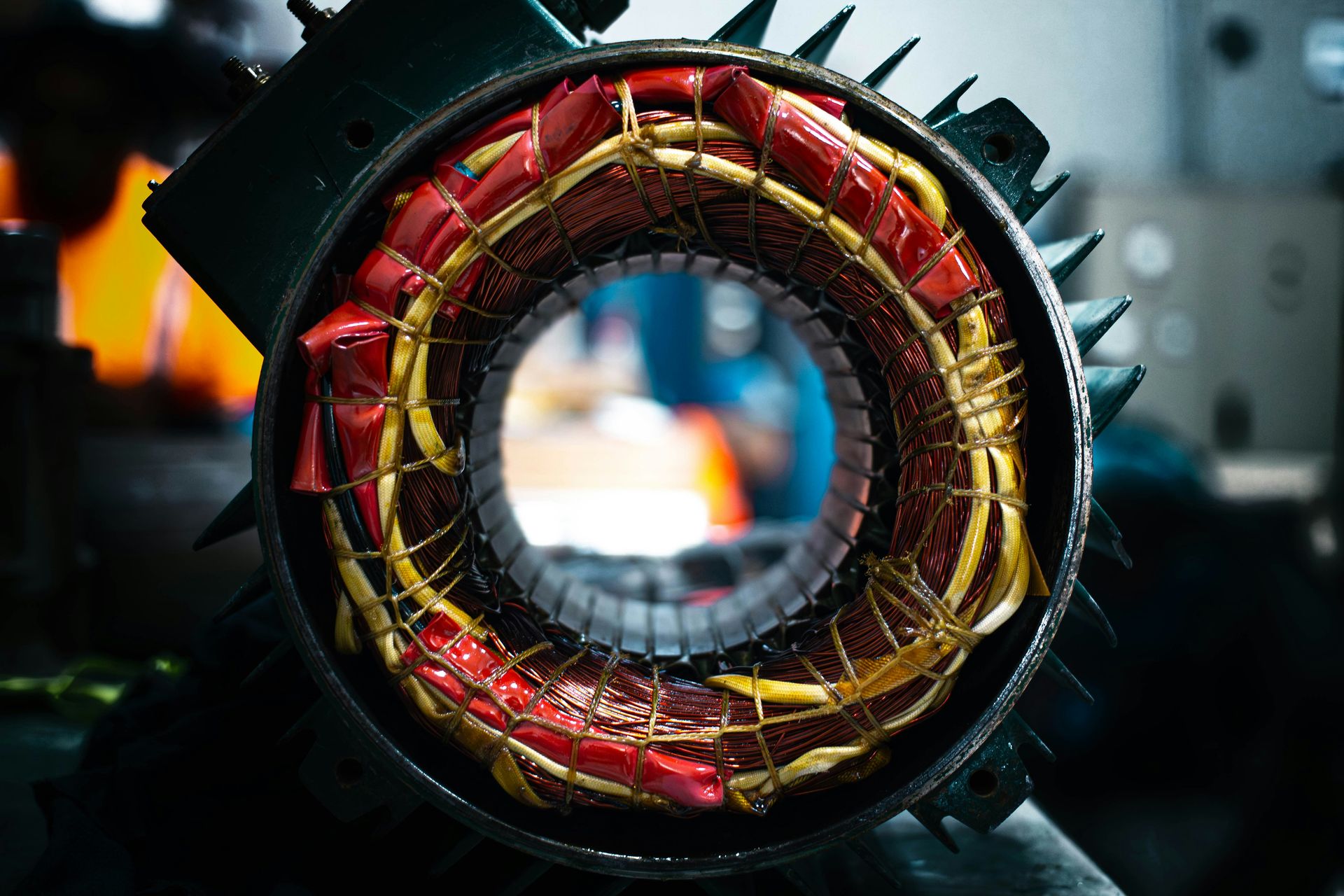
Michael Faraday discovered in 1831 that a changing magnetic field can produce an electric current — a phenomenon he called electromagnetic induction. The law that bears his name states that the voltage induced in a conductor is proportional to the rate of change of the magnetic flux passing through it.
In plainer terms: move a magnet near a coil of wire, and a current flows in the wire. Move the magnet faster, or use a stronger magnet, and a larger voltage is induced. Stop moving the magnet, and the current stops. It's the change that matters, not the presence of a magnetic field.
This discovery is the basis of almost every electrical generator on Earth. In a generator — whether driven by steam from burning coal, falling water at a hydroelectric dam, wind turning a turbine, or nuclear heat — the fundamental mechanism is the same. A coil of wire rotates within a magnetic field (or a magnet rotates within a coil), causing the magnetic flux through the coil to change continuously. That changing flux induces a voltage in the coil, driving current through an external circuit. The mechanical energy of rotation converts to electrical energy.
The same principle runs backward in electric motors. Pass a current through a coil in a magnetic field, and the coil experiences a force that makes it rotate. Motors and generators are physically very similar devices, and in fact many motors can also function as generators. Electric vehicle regenerative braking works on exactly this principle: the drive motors are switched to generator mode during braking, converting the car's kinetic energy back to electrical energy that recharges the battery, rather than wasting it as heat in friction brakes.
Faraday's law also underlies transformers — devices that change voltage levels in AC circuits. A transformer has two coils wound around an iron core. Alternating current in the primary coil creates a continuously changing magnetic flux in the core, which induces a voltage in the secondary coil. The ratio of turns in the two coils determines the ratio of voltages. No moving parts are required. Transformers are everywhere in the electrical grid and in power supplies for household electronics — the "brick" on a laptop charger is a compact transformer.
The relationship Faraday discovered was unified with the laws of electrostatics and optics by James Clerk Maxwell in the 1860s into four equations — Maxwell's equations — that completely describe classical electromagnetism. Maxwell also showed that electromagnetic waves, including visible light, propagate at a fixed speed through empty space: approximately 3 × 10^8 meters per second. This is the speed of light.

Credit: alejandro penner / Pexels
Coulomb's law describes the electrostatic force between two charged objects. It states that the force between two point charges is proportional to the product of their charges and inversely proportional to the square of the distance between them. The force is attractive if the charges are opposite in sign, and repulsive if they are the same sign.
Charles-Augustin de Coulomb established this relationship experimentally in 1785, using a torsion balance to measure tiny electrical forces. The form of the law is mathematically identical to Newton's law of gravitation — both are inverse-square laws — but the physical quantities involved are different. Gravity depends on mass; electrostatic force depends on charge.
The most striking feature of Coulomb's law is the strength of the electrostatic force compared to gravity. Between two protons, the electrostatic repulsion is approximately 10^36 times stronger than the gravitational attraction between them. This enormous ratio is why electrostatic forces dominate chemistry and biology, while gravity is essentially irrelevant at the atomic scale.
Coulomb's law explains why atoms hold together. A hydrogen atom consists of one proton and one electron. The opposite charges attract, pulling the electron toward the nucleus. The electron doesn't fall in because quantum mechanics constrains it to certain stable orbits — the subject of quantum theory, not classical electrostatics — but the force holding the atom together is the Coulomb attraction. All chemical bonds involve either direct electrostatic attraction between opposite charges or subtler arrangements of charge that produce net attractive forces between atoms.
The law also explains why rubbing a balloon on hair allows it to stick to a wall. Friction transfers electrons from the hair to the balloon, giving the balloon a net negative charge. When held near a wall, the balloon induces a redistribution of charge in the wall's surface — pushing negative charges away from the part of the wall nearest the balloon and leaving a slightly positive surface nearby. The attraction between the balloon's negative charge and the wall's induced positive surface charge holds the balloon in place. The forces involved are tiny, but then so is the weight of the balloon.
Lightning is Coulomb's law at atmospheric scale. Charge separation in storm clouds — driven by collisions between ice particles — builds up a large charge difference between the cloud and the ground. When the electrostatic force becomes strong enough to overcome the resistance of the air, a discharge occurs. The channel of the lightning bolt is typically a few centimeters wide but can carry hundreds of thousands of amperes of current for a fraction of a second.

Credit: aboodi vesakaran / Pexels
The ideal gas law is a mathematical equation that describes the relationship between the pressure, volume, temperature, and quantity of a gas. It is written as PV = nRT, where P is pressure, V is volume, n is the amount of gas in moles, R is the gas constant, and T is temperature in kelvin.
The law combines three earlier empirical relationships that were discovered separately. Boyle's law (1662) established that at constant temperature, the pressure and volume of a gas vary inversely — compress the gas, and pressure rises. Charles's law (late 18th century) established that at constant pressure, volume is proportional to temperature — heat a gas, and it expands. Avogadro's law established that equal volumes of different gases at the same temperature and pressure contain equal numbers of molecules.
The ideal gas law is a useful model because it describes gas behavior accurately under many common conditions. Where it becomes imprecise is at very high pressures or very low temperatures, where the gas molecules are packed close enough that interactions between them become significant. Real gas behavior under extreme conditions requires more complex equations.
The practical applications are numerous. Tire pressure changes with temperature because the ideal gas law says pressure and temperature vary together at constant volume. Driving in cold weather deflates your tires slightly; hot summer roads inflate them. Weather balloons are filled to only a fraction of their maximum capacity at launch: as they rise and atmospheric pressure drops, the gas inside expands dramatically. If the balloon were fully inflated at launch, it would burst at altitude before reaching the upper atmosphere.
The law also underlies how engines work. In a gasoline engine, fuel and air burn explosively inside a cylinder, raising the temperature of the gases dramatically. By the ideal gas law, this drives a large pressure increase in the fixed volume of the cylinder, pushing the piston down with force. The combustion process converts chemical energy into thermal energy, the thermal energy into high-pressure gas, and the high-pressure gas into mechanical work on the piston.
Breathing is governed by the same law. The diaphragm contracts and flattens, increasing lung volume. With volume up and temperature constant, pressure inside the lungs drops below atmospheric pressure, and air flows in down the pressure gradient. Exhalation reverses the process: the diaphragm relaxes and lung volume decreases, raising internal pressure above atmospheric and driving air out.

Credit: Canva Images
Boyle's law is one of the component laws that combine to form the ideal gas law. It states that for a fixed amount of gas at constant temperature, pressure and volume are inversely proportional. Double the volume, and the pressure halves. Compress the gas to half its volume, and the pressure doubles.
Robert Boyle published this relationship in 1662, based on experiments performed with a J-shaped glass tube sealed at one end, using mercury to trap and compress air. It was one of the first laws in chemistry established through systematic experimental measurement, and it helped establish the quantitative tradition in natural science.
The inverse relationship between pressure and volume can be understood from the molecular picture of gas. Gas pressure arises from molecules hitting the walls of their container. If you reduce the volume, the same number of molecules is packed into a smaller space, and they hit the walls more frequently — producing higher pressure. Increase the volume, and they have more space, hit the walls less often, and produce lower pressure.
Boyle's law is critical in diving physiology. At the surface, the air in a diver's lungs is at atmospheric pressure. At 10 meters underwater, water pressure has doubled, and the air in the lungs has compressed to half its surface volume. At 40 meters — a depth recreational divers sometimes reach — the pressure is five times atmospheric, and gas volumes compress to one-fifth. If a diver ascends without exhaling — holding a breath while ascending from depth — the expanding air can rupture lung tissue, a life-threatening condition. Scuba training emphasizes continuous breathing for exactly this reason.
The same principle explains why unopened bags of chips are puffed up at high altitude. Chips are sealed at low-altitude packaging facilities, with the bag inflated at near-sea-level pressure. At high altitude, the external atmospheric pressure is lower, and the gas inside the bag — unchanged in amount — presses outward more strongly than the reduced outside pressure can resist. The bag expands. This is also why aerosol cans carry warnings against exposing them to heat: the gas inside would expand, potentially to the point of rupturing the can.
Syringe mechanics are a direct application. When you pull back the plunger of a sealed syringe, you increase the volume, reducing the pressure inside below atmospheric. That pressure difference drives fluid or air into the syringe from outside. Push the plunger forward, and you increase pressure, driving the contents out.

Credit: İbrahim Can Dayıoğlu / Pexels
Charles's law describes the relationship between the volume and temperature of a gas when pressure is held constant. The law states that volume is directly proportional to temperature: double the absolute temperature of a gas, and its volume doubles. Decrease the temperature, and the volume decreases proportionally.
The law is named for Jacques Charles, who observed this relationship in experiments around 1787, though it was Gay-Lussac who published the finding and credited Charles. The crucial detail is that temperature must be measured on an absolute scale — in kelvin, not Celsius. Zero degrees Celsius is 273 kelvin, and the absolute zero of temperature — the point at which molecular motion theoretically stops — is 0 kelvin.
This distinction matters because the law predicts that at absolute zero, a gas would have zero volume. This is physically unrealizable — gases liquefy and solidify before reaching absolute zero — but the extrapolation to zero volume is what established the concept of absolute zero and gave scientists a way to locate it on the temperature scale.
Hot air balloons work entirely on Charles's law. The burner heats the air inside the envelope, increasing its temperature and expanding its volume. As the air expands, some of it exits the open bottom of the balloon, reducing the number of molecules remaining inside. The remaining air at higher temperature has lower density than the cooler outside air, so the balloon is buoyant and rises. When the burner is turned off, the air cools, contracts, becomes denser, and the balloon descends.
Charles's law is also relevant in wine production. Fermentation converts sugars to alcohol and carbon dioxide. If wine is fermented in a sealed vessel without adequate pressure relief, the expanding CO₂ gas increases pressure dramatically as the process generates heat. This is managed carefully in winemaking with airlocks and temperature control. Conversely, bottle fermentation — the method used in traditional Champagne production — deliberately allows CO₂ to build up under controlled conditions, producing the carbonation in the finished wine.
Metal parts in engines must be machined to tolerances that account for thermal expansion. As engine components heat up during operation, they expand predictably according to the thermal properties of the metal — a relationship closely related to Charles's law applied to solids rather than gases. Pistons, cylinder walls, and valve seats are designed with specific clearances at room temperature that tighten to optimal tolerances at operating temperature.

Credit: James Owen / Pexels
The law of conservation of mass states that matter is neither created nor destroyed in a chemical reaction — the total mass of the reactants equals the total mass of the products. Antoine Lavoisier established this principle in the late 18th century through careful quantitative experiments, and it is considered one of the cornerstones of modern chemistry.
Before Lavoisier, the prevailing explanation for combustion was phlogiston theory, which held that burning materials released a substance called phlogiston into the air. Lavoisier showed through careful weighing before and after reactions that combustion involved the combination of materials with oxygen from the air, and that the total mass was conserved throughout. This work helped establish chemistry as a quantitative science.
The law is the reason chemists balance chemical equations. When iron rusts, iron atoms combine with oxygen atoms from the air to form iron oxide. The equation must balance — the number of iron atoms and oxygen atoms on the left side equals the number on the right. Mass cannot appear or vanish in the reaction. If an unbalanced equation seemed to predict a mass change, it would be an error in the equation, not a violation of the law.
In everyday terms, the law answers a question many people find puzzling: where does the mass go when wood burns? A log weighing several kilograms burns and leaves a small pile of ash. The mass hasn't disappeared — most of it has left as gases, primarily water vapor and carbon dioxide, which are invisible and have escaped into the atmosphere. Weigh the ash, the smoke, the gases, and the water vapor, and the total equals the original weight of the log plus the weight of the oxygen consumed from the air.
The law has a crucial qualification in nuclear physics. In nuclear reactions — fission, fusion, and radioactive decay — a small but measurable amount of mass converts to energy according to E = mc². In a chemical reaction, the mass change is too tiny to measure. In a nuclear reaction, the mass change is detectable and significant. The binding energy of atomic nuclei is large enough that mass changes in nuclear reactions are measurable. So the conservation of mass holds precisely for chemical reactions but is superseded by the conservation of mass-energy in nuclear reactions.

Credit: www.kaboompics.com / Pexels
Gregor Mendel, an Austrian friar and naturalist, conducted systematic breeding experiments with pea plants in the 1860s and discovered the rules governing how traits are inherited from parents to offspring. His findings, published in 1866 but largely ignored until their rediscovery in 1900, form the foundation of classical genetics.
Mendel identified two core principles. His first law, the law of segregation, states that every organism carries two copies of each hereditary factor (now called alleles), one inherited from each parent, and that these copies separate when the organism produces gametes — eggs or sperm — so that each gamete carries only one copy of each factor.
His second law, the law of independent assortment, states that the alleles for different traits are passed to offspring independently of one another — meaning the inheritance of eye color, for example, doesn't influence the inheritance of blood type.
These laws emerge from the behavior of chromosomes during cell division. Each body cell contains two copies of each chromosome, one from each parent. During the formation of sex cells (meiosis), the chromosome pairs separate, and each sex cell receives one chromosome from each pair. Fertilization then combines one chromosome from each parent, restoring the double set. Mendel worked out these rules without knowing about chromosomes — the physical basis wasn't understood until decades later.
The distinction between dominant and recessive alleles explains many inheritance patterns. A dominant allele produces its trait when present in even one copy. A recessive allele only produces its visible trait when both copies present are the same recessive allele — when no dominant copy is present to mask it. This is why a child can have brown eyes even if both parents have brown eyes, yet the child's child can have blue eyes: the blue-eye allele was carried silently in the recessive form through multiple generations.
The law of independent assortment has important limits that Mendel was not aware of. Genes located close together on the same chromosome tend to be inherited together — they are "linked" — and do not assort independently. This linkage was discovered in the early 20th century by Thomas Hunt Morgan and became a tool for mapping the positions of genes on chromosomes. The further apart two genes are on a chromosome, the more likely they are to be separated by recombination during meiosis, and the closer they appear to assort independently.

Credit: Harvey Tan Villarino / Pexels
Hooke's law describes the behavior of elastic materials under stress. It states that the force needed to stretch or compress a spring is proportional to the distance stretched or compressed, provided the deformation is not too large. The formula is F = kx, where F is the force, x is the displacement, and k is the spring constant — a measure of the spring's stiffness.
Robert Hooke published this relationship in 1678. It applies not just to mechanical springs but to any elastic material deformed by a relatively small force. Metal beams flex under load; rubber bands stretch; bones compress under body weight. In all these cases, within the elastic range, force and deformation are proportional.
The spring constant k determines how stiff the material is. A stiff spring has a large k: it requires a large force to produce even a small deformation. A soft spring has a small k: it deforms significantly under a small force. Engineers characterize materials by their stiffness when designing structures and mechanical components.
Hooke's law has a limit: the elastic limit. Below the elastic limit, the material returns to its original shape when the force is removed — it is elastic. Beyond the elastic limit, permanent deformation occurs — the material is plastically deformed and will not fully spring back. Stretch a spring too far, and it stays stretched. Bend metal too far, and it doesn't bend back. The elastic limit is a critical parameter in structural engineering.
Weighing scales work on Hooke's law. In a spring scale, the weight of an object stretches a spring by an amount proportional to that weight. A calibrated scale converts the stretch distance to a force, which can then be displayed as mass at a known gravitational field. Digital scales typically use piezoelectric sensors or strain gauges, which exploit the same principle — electrical resistance changes in proportion to the mechanical strain applied.
Seismographs use Hooke's law to measure ground motion. A heavy mass is suspended on a spring inside the instrument. When the ground shakes, the spring stretches and compresses in proportion to the ground's acceleration. Recording the spring's deformation over time gives a precise record of the earthquake's ground motion. The spring constant of the suspension system is carefully tuned to respond to the frequency range of seismic waves of interest.

Credit: Liza Summer / Pexels
Fick's laws describe how substances move through a medium by diffusion — the random thermal motion of molecules from regions of high concentration to regions of low concentration. Adolf Fick formulated these laws in 1855.
The first law states that the rate of diffusion is proportional to the concentration gradient — the steeper the difference in concentration between two points, the faster molecules move from the high-concentration region to the low-concentration one.
The second law describes how concentration changes over time: the rate of change of concentration at any point is proportional to how quickly the concentration gradient is changing with distance.
Diffusion is the mechanism by which oxygen moves from the air sacs of the lungs into the blood. In the lungs, oxygen concentration in the air sacs is high. In the blood flowing through the capillaries of the lung wall, oxygen concentration is low because the blood has just returned from the body and given up its oxygen to the tissues. The steep concentration gradient drives rapid diffusion of oxygen across the thin membrane separating air from blood. Carbon dioxide moves in the opposite direction for the same reason, from the high-CO₂ blood into the lower-CO₂ air.
Fick's laws explain why the lung surface area is enormous despite fitting into a chest cavity. The two lungs together present an internal surface area of roughly 50 to 75 square meters — about half a tennis court — because diffusion rate is also proportional to the area available. More surface area means more transfer per unit time. The lung's hundreds of millions of tiny air sacs provide this area in a compact space.
The laws also govern how drugs spread through the body after injection or swallowing, how nutrients move from the gut into the bloodstream, and how gases move through cell membranes. Fick's framework applies wherever molecules move passively down concentration gradients, without being actively pumped. Active transport — where cells use energy to move molecules against a concentration gradient — requires a different framework.
In industrial settings, Fick's laws describe how gases and liquids move through membranes and porous materials, which is critical in designing filtration systems, chemical separators, and drug delivery devices.

Credit: Jimmy Chan / Pexels
The law of definite proportions, also called Proust's law, states that a given chemical compound always contains the same elements in the same mass ratio. Water, regardless of where it was produced or how it was made, always contains hydrogen and oxygen in an 8:1 ratio by mass. Salt always contains sodium and chlorine in a ratio of about 1.52:1 by mass. These ratios are fixed and invariable.
Joseph Louis Proust proposed this law in 1799, following years of experiments measuring the compositions of compounds. It seems obvious now, but it was contested at the time by chemists who believed compound composition could vary continuously.
The law is a direct consequence of atomic theory. Atoms combine in whole-number ratios — one sodium atom combines with one chlorine atom to form one unit of sodium chloride. Since every sodium atom has the same mass and every chlorine atom has the same mass, the mass ratio in the compound is always the same. There is no fractional atom. You get exactly one sodium per chlorine, never 0.9 or 1.2.
The law distinguishes compounds from mixtures. Seawater is a mixture — its salt content can vary. Sodium chloride is a compound — its composition never varies. This distinction is fundamental in chemistry. A mixture's properties depend on how much of each component is present; a compound's properties depend on what it is, not where it came from.
The law also has a corollary discovered by John Dalton: the law of multiple proportions. When two elements form more than one compound, the ratios of masses of one element that combine with a fixed mass of the other form simple whole-number ratios. Carbon monoxide and carbon dioxide are both compounds of carbon and oxygen. In carbon monoxide, one carbon atom combines with one oxygen atom. In carbon dioxide, one carbon atom combines with two oxygen atoms. The masses of oxygen per mass of carbon in the two compounds are in the ratio 1:2 — a simple whole number. This further confirmed the atomic nature of matter decades before atoms were directly observed.

Credit: Pavel Danilyuk / Pexels
The law of conservation of momentum states that the total momentum of a closed system — one with no external forces acting on it — remains constant over time. Momentum is the product of mass and velocity: a heavy, fast-moving object has more momentum than a light, slow-moving one.
The law is a consequence of Newton's third law. When two objects collide, they exert equal and opposite forces on each other. By Newton's second law, equal and opposite forces produce equal and opposite changes in momentum in the two objects. The momentum gained by one object exactly equals the momentum lost by the other, so the total stays the same.
The law governs every collision, explosion, and interaction where external forces are absent or negligible. In a billiard ball collision, the total momentum before the collision equals the total momentum after. In a rocket launch, the rocket gains momentum in one direction while the exhaust gases gain equal and opposite momentum in the other direction. Before the launch, both rocket and exhaust gas are at rest — total momentum is zero. After launch, the rocket's forward momentum and the exhaust gases' backward momentum still sum to zero.
This is why recoil exists. When a gun fires a bullet, the bullet gains forward momentum. The gun — and the shooter holding it — gains an equal backward momentum. The gun is much more massive than the bullet, so by F = ma, the same momentum corresponds to a much lower velocity. The bullet moves fast; the gun moves slowly.
The same reasoning explains why astronauts in space can change their orientation by moving their limbs. In empty space with no external forces, the total angular momentum of the system is conserved. If an astronaut extends an arm in one direction, the rest of the body rotates slightly in the opposite direction to compensate. Controlling the body's orientation in space requires using the arms and legs, not pushing against anything external.
Car crash reconstruction uses momentum conservation. From the skid marks, the final positions of the vehicles, and their masses, investigators can work backward to determine the speeds and directions of the vehicles before impact. The laws of momentum conservation make this calculation possible even without witnesses.
Credit: Nikhil Manan / Pexels
The Beer-Lambert law describes how light is absorbed as it passes through a substance. It states that the fraction of light transmitted through a material decreases exponentially with the concentration of the absorbing substance and with the path length through which the light travels.
The law combines work by Pierre Bouguer and Johann Heinrich Lambert on the path-length dependence of absorption, and August Beer's work on the concentration dependence, hence the compound name. Together they established that absorbance — how much light a substance absorbs — is proportional to both the concentration of the absorbing molecule and the distance the light travels through the sample.
The most direct application is spectrophotometry, a ubiquitous technique in chemistry and biology. To measure the concentration of a dissolved substance — a protein, a pigment, a drug — you shine light of an appropriate wavelength through a solution and measure how much is transmitted. With a known relationship between concentration and absorbance (the molar absorptivity), you can calculate the concentration precisely. Clinical laboratories use this principle to measure everything from blood glucose to liver enzymes.
Breathalyzers for measuring blood alcohol content rely on a form of this principle applied to infrared spectroscopy. Ethanol absorbs infrared light at characteristic wavelengths. By measuring how much of a specific infrared wavelength is absorbed by a breath sample, the instrument calculates ethanol concentration.
The Beer-Lambert law also has applications in astronomy. When starlight passes through a planet's atmosphere or a cloud of interstellar gas, specific wavelengths are absorbed by specific molecules. Analyzing which wavelengths are missing from the light spectrum reveals what molecules are present and in what concentrations. This is how astronomers detect the presence of water, methane, carbon dioxide, and other molecules in distant atmospheres — including those of exoplanets — without ever visiting them.
The law has limits. It applies accurately when concentrations are low enough that the absorbing molecules don't interact significantly with each other. At high concentrations, the absorbing molecules begin to affect each other's optical properties, and the linearity breaks down. Most analytical chemistry applications carefully stay within the concentration range where the law holds.

Credit: NHP&Co / Pexels
The Doppler effect describes the change in frequency of a wave — sound, light, or any other — caused by relative motion between the source of the wave and the observer. When a source moves toward an observer, the waves are compressed, and the observer perceives a higher frequency. When the source moves away, the waves are stretched, and the observer perceives a lower frequency.
Christian Doppler described this principle in 1842, initially for sound and light. The drop in pitch as an ambulance passes — high-pitched as it approaches, lower-pitched as it recedes — is the most familiar example. The ambulance's siren emits sound at a constant frequency. As the ambulance moves toward you, successive sound waves are emitted from a position slightly closer than the last, so they arrive more frequently at your ears — higher pitch. As it moves away, each wave is emitted from a slightly farther position, arriving less frequently — lower pitch.
The Doppler effect is a foundational tool in astrophysics. Light from a star or galaxy moving away from Earth is shifted toward the red end of the spectrum — it has lower frequency, longer wavelength. This is called redshift. Light from an approaching source is shifted toward the blue end — blueshift. By measuring the amount of shift, astronomers can calculate precisely how fast a star or galaxy is moving toward or away from Earth.
Edwin Hubble used Doppler measurements in the 1920s to discover that distant galaxies are almost all redshifted, and the more distant they are, the greater the redshift. This was the key evidence that the universe is expanding. The relationship between distance and recession speed — Hubble's law — emerged directly from Doppler measurements.
Doppler radar is the system behind weather forecasting. A radar transmitter sends pulses of microwave radiation into the atmosphere. When these pulses reflect off rain droplets, the Doppler shift in the returned signal reveals not just where the rain is but how fast it is moving toward or away from the radar station. This allows forecasters to determine wind speeds and wind directions within storms, detect rotation in thunderstorms that may indicate tornado formation, and track storm systems with high precision.
Medical ultrasound uses the Doppler effect to image blood flow. Ultrasound waves reflected from moving red blood cells are shifted in frequency by an amount proportional to the cells' speed. Color Doppler imaging displays this information visually, showing blood flowing toward the sensor in one color and blood flowing away in another. This allows cardiologists to assess blood flow through heart valves and detect blockages in arteries without invasive procedures.

Credit: Frank Cone / Pexels
The Stefan-Boltzmann law describes how much thermal radiation an object emits, based on its temperature. The law states that the total energy radiated per unit surface area of a blackbody — an idealized perfect absorber and emitter of radiation — is proportional to the fourth power of its absolute temperature.
The fourth-power relationship is the crucial feature. It means that small increases in temperature produce large increases in radiation. Double an object's absolute temperature, and it emits 16 times as much radiation (2^4 = 16). Triple the temperature, and emission increases 81-fold. This steep dependence on temperature explains why stars at different temperatures look different colors and differ so enormously in luminosity.
The Sun's surface temperature is about 5,778 kelvin, and the Stefan-Boltzmann law allows astronomers to calculate its total energy output — its luminosity — from the temperature and surface area alone. The result, about 3.8 × 10^26 watts, matches what is measured by direct observation. The same approach is applied to distant stars: measuring their temperature (from the color of their light) and their distance (from various methods) allows calculation of their total energy output and physical size.
The law governs why incandescent bulbs are inefficient. Tungsten filaments reach roughly 2,500–3,000 kelvin. At this temperature, they emit a continuous spectrum of radiation, but the peak of that spectrum is in the infrared — invisible heat. Only a small fraction of the radiated energy falls in the visible range. The rest is wasted as heat. LED lights produce visible light through a different mechanism that is not constrained by this relationship.
The Stefan-Boltzmann law is also central to climate science. Earth receives solar radiation and must radiate the same amount back to space to maintain a stable temperature. The law determines what equilibrium temperature Earth must maintain to radiate enough energy to balance incoming solar radiation. This calculation, made more complex by the greenhouse effect of the atmosphere, is the basis for understanding Earth's energy budget and how it changes as greenhouse gas concentrations change.
Credit: Zelch Csaba / Pexels
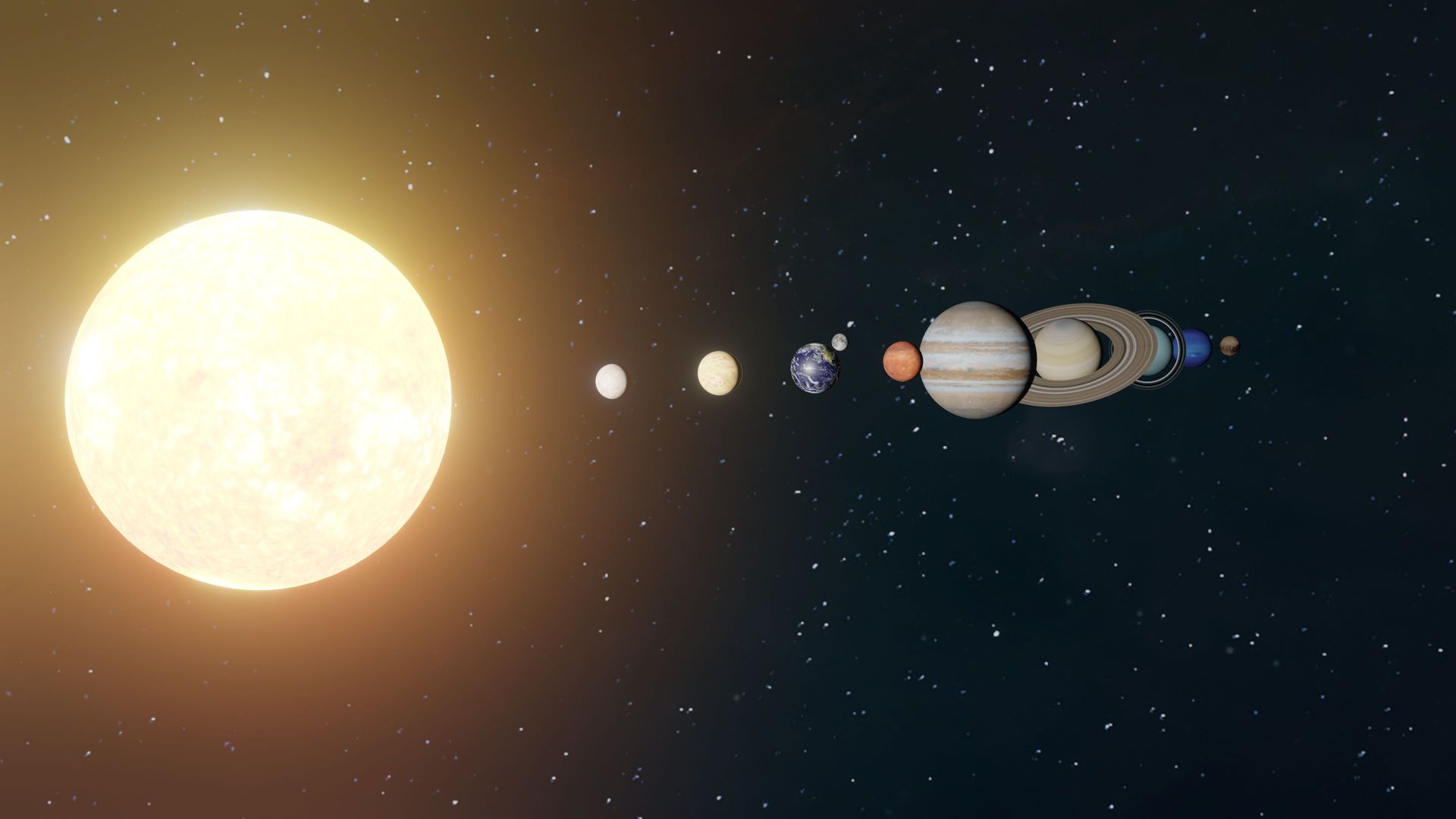
Johannes Kepler, working in the early 17th century, derived three empirical laws describing the orbits of planets around the Sun from the meticulous astronomical observations of Tycho Brahe. These laws were later explained theoretically by Newton's law of gravitation.
The first law states that planets travel in ellipses with the Sun at one focus of the ellipse — not at the center. The orbits of most planets in the solar system are nearly circular, but technically elliptical. Earth's orbit is only slightly elliptical; Mercury's and Pluto's are more pronounced.
The second law states that a line drawn from a planet to the Sun sweeps out equal areas in equal times. This means planets move faster when they are closer to the Sun and slower when they are farther away. Earth is closest to the Sun in early January (perihelion) and farthest in early July (aphelion), moving about 3% faster at perihelion than at aphelion. This is counterintuitive, because summer in the Northern Hemisphere (July) coincides with when Earth is actually farther from the Sun — seasons are caused by the tilt of Earth's axis, not its distance from the Sun.
The third law states that the square of a planet's orbital period is proportional to the cube of the semi-major axis of its orbit — in plain terms, planets farther from the Sun take longer to complete an orbit, and the relationship between orbital size and period follows a precise mathematical rule. Jupiter, about five times farther from the Sun than Earth, takes about 11.9 Earth years to complete one orbit. This can be calculated precisely from the third law.
Kepler's laws apply not just to planets but to any object in a gravitational orbit: moons around planets, artificial satellites around Earth, binary stars orbiting each other, and spacecraft on interplanetary trajectories. Mission planners at space agencies use these laws constantly. Sending a spacecraft from Earth to Mars requires planning a trajectory that accounts for both planets' positions at launch and arrival, and the precise timing is governed by Kepler's laws.
Credit: Tibo Geeraerts / Pexels
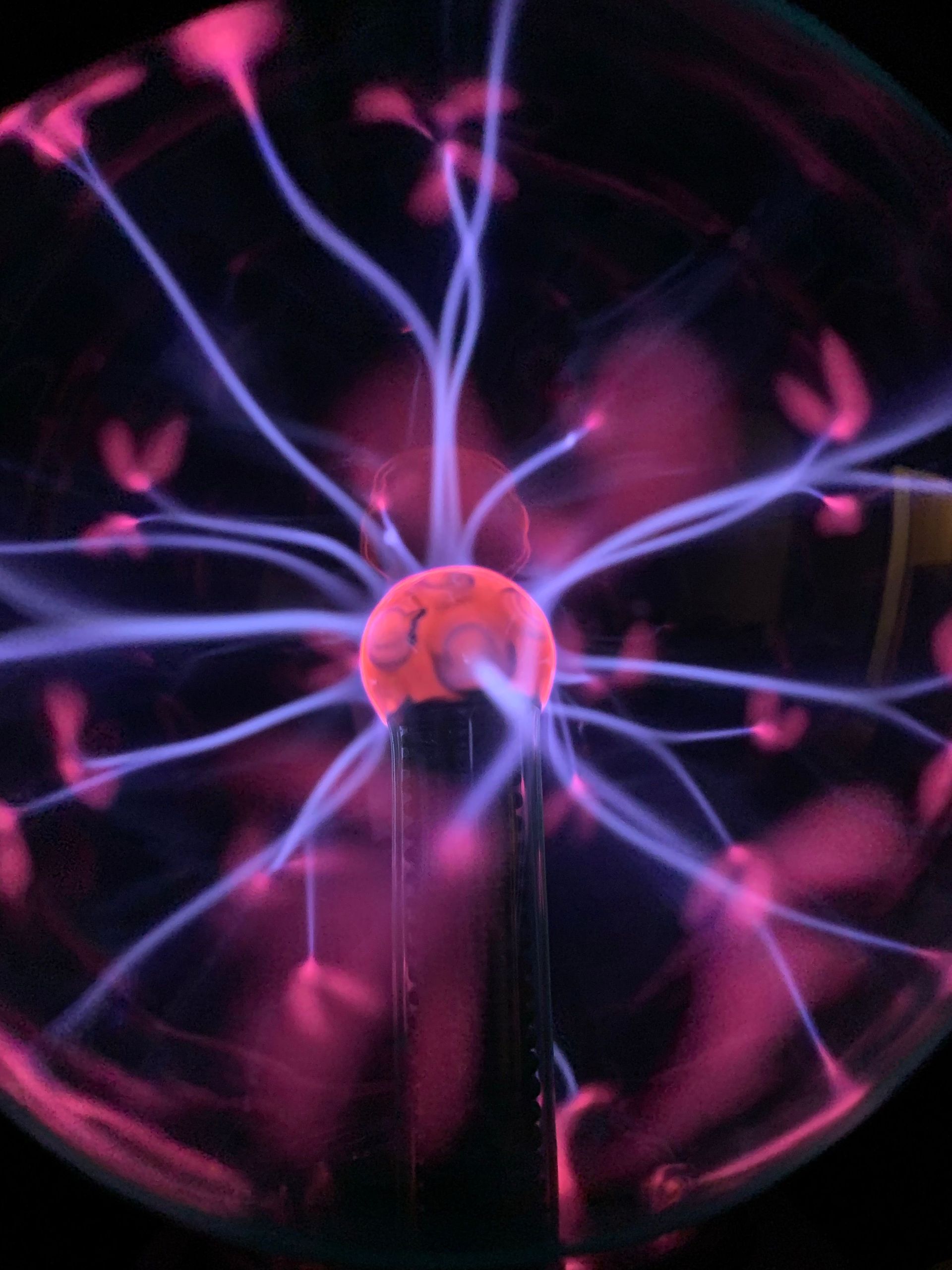
The Pauli exclusion principle, formulated by Wolfgang Pauli in 1925, states that no two identical fermions — a class of particles that includes electrons, protons, and neutrons — can simultaneously occupy the same quantum state. In an atom, this means no two electrons can have exactly the same set of quantum numbers.
The principle was derived to explain why electrons in atoms fill successive energy levels rather than all collapsing into the lowest available energy state. In a hydrogen atom with one electron, that electron occupies the lowest energy state. In helium with two electrons, both fill the lowest energy level — but they must have opposite spins to have different quantum numbers. In lithium with three electrons, the third must go into the next energy level, because the first level is now full. Each successive element adds electrons to progressively higher energy levels in a predictable pattern.
This "filling up" of energy levels is the basis of the entire periodic table. The periodic repetition of chemical properties — why sodium and potassium behave similarly, why neon and argon are both unreactive — follows directly from the pattern of electron filling dictated by the exclusion principle. An element's chemical behavior is determined by how many electrons are in its outermost shell, and the exclusion principle determines how many electrons each shell can hold.
The principle extends beyond atomic structure. Electrons in a solid metal can be thought of as forming a "sea" of electrons. By the exclusion principle, all these electrons cannot occupy the same quantum state — they must spread across a continuous range of quantum states with different momenta and energies. This distribution of electron energies is what allows metals to conduct heat and electricity the way they do. It is also what makes white dwarf stars stable: the electrons in a white dwarf resist compression not because of thermal pressure but because the exclusion principle prevents electrons from being squeezed into the same quantum state. This is called electron degeneracy pressure.
The solidity of ordinary matter itself depends in part on the Pauli exclusion principle. Atoms resist being pushed into each other because their electron clouds cannot overlap without forcing electrons into occupied quantum states. Without this resistance, matter would not have the solid, incompressible character that makes it useful as furniture, floors, and bones.

Credit: wal_ 172619 / Pexels
Werner Heisenberg's uncertainty principle, formulated in 1927, states that it is impossible to know simultaneously, with perfect precision, both the position and momentum of a particle. The more precisely the position is known, the less precisely the momentum can be known, and vice versa. This is not a limitation of measurement instruments — it is a fundamental feature of nature at the quantum scale.
The principle arises because, in quantum mechanics, particles are not tiny balls traveling along definite paths. They are described by wave functions — mathematical objects that give the probability of finding the particle at various locations. A wave that is localized in space — tightly confined, allowing a precise position measurement — must be built from many different wavelengths. Different wavelengths correspond to different momenta. So a precisely located particle necessarily has uncertain momentum. A particle with precisely defined momentum has a wavelength that extends across all of space — its position is completely undefined.
This is not an exotic edge case. It has direct physical consequences. Electrons confined to the small space of an atom have an uncertainty in their momentum, and therefore an average kinetic energy, that prevents them from falling into the nucleus. The hydrogen atom has a definite minimum size — not because electrons orbit at a fixed distance as in the old solar-system model, but because confining the electron to a smaller space would increase its momentum uncertainty, increasing its average kinetic energy until the total energy is minimized at a specific scale. The size of atoms — and hence all of chemistry — depends on the uncertainty principle.
The principle also explains why absolute zero temperature cannot actually be reached. Even at zero kelvin, a particle in a confined space has some irreducible uncertainty in momentum, and hence some irreducible energy — called zero-point energy. You cannot remove all the energy from a particle without allowing it to spread over all of space. Real physical systems at extremely low temperatures retain this residual quantum motion.
The principle is sometimes misinterpreted as saying that observing a system disturbs it, and that a better measurement technique might eliminate the uncertainty. This is incorrect. The uncertainty is inherent in the quantum state itself, not in the act of measurement. Two quantities like position and momentum are fundamentally incompatible: a state of well-defined position is not a state of well-defined momentum. The relationship is intrinsic to the mathematics of quantum theory.
