
How to tell your cat is close to giving birth — 7 signs to watch for
Nesting behavior, appetite changes, temperature drop, restlessness — the signs that labor is near, and the specific steps to prepare a safe space before it starts

Sherman Kwan / Unsplash
A cat's pregnancy lasts approximately 63 to 65 days, and for most of that period there is relatively little for an owner to actively do beyond ensuring good nutrition and a routine veterinary check. In the final week before labor, that changes: a pregnant cat begins to display a specific, recognizable sequence of physical and behavioral signs that indicate labor is approaching, and recognizing them gives an owner the lead time to prepare a safe, quiet space and to know when veterinary attention might be needed.
Most cats give birth without complications and without requiring human intervention beyond providing a calm environment; feline labor is, in the large majority of cases, something a cat's body manages instinctively and competently on its own. The value of recognizing the signs in this list is not primarily about intervening in the birth itself but about being prepared: having a whelping box ready, knowing what a normal labor timeline looks like, and knowing the specific signs that indicate a veterinary emergency rather than normal labor.
Each entry covers a specific sign, the typical timeframe before labor that it appears, and the corresponding preparation step an owner should take in response. A standard veterinary disclaimer applies throughout: any pregnant cat should be under the care of a veterinarian who has confirmed the pregnancy and ideally estimated a due date via ultrasound, and any signs of prolonged distress, straining without producing a kitten, or visible complications during labor warrant immediate veterinary contact rather than waiting to see if the situation resolves on its own.
Nesting behavior

Muhammed Zahid Bulut / Unsplash
In the final week before labor, most pregnant cats begin actively searching for and preparing a birthing location — investigating closets, the backs of cabinets, spaces under furniture, and any enclosed, dark, quiet area that feels secure. This nesting instinct is one of the earliest and most reliable pre-labor signs, and it typically becomes noticeable five to seven days before labor begins, though some cats display it earlier.
The behavior often includes the cat scratching or arranging bedding, towels, or clothing into a specific configuration within the chosen space, mirroring the den-preparation behavior of wild felids seeking a secure, protected location for birth. Cats may investigate several potential locations before settling on one, and some will change their chosen location more than once in the days before labor.
The correct preparation response is to provide a whelping box — a low-sided box lined with clean, washable bedding, placed in a quiet, low-traffic area of the house — well before labor is expected, ideally by the final one to two weeks of pregnancy. Introducing the box early allows the cat to become familiar with it and increases the likelihood that she chooses the prepared space rather than an inconvenient or inaccessible location of her own choosing, such as the back of a closet or beneath a bed.
Drop in body temperature

Jacalyn Beales / Unsplash
A pregnant cat's body temperature typically drops from the normal range of approximately 38.1 to 39.2°C (100.5 to 102.5°F) to below 37.8°C (100°F) in the 12 to 24 hours before labor begins — a physiological change driven by the hormonal shifts that precede parturition, specifically the drop in progesterone that triggers labor onset. This temperature drop is one of the most reliable and most precisely timed predictors of impending labor available to an attentive owner.
Monitoring temperature requires a digital rectal thermometer and daily temperature checks in the final week of pregnancy, a practice more commonly used by breeders monitoring planned litters than by owners of unplanned pregnancies, but one that provides the most specific available window for labor onset. A sustained drop below 37.8°C is a strong indicator that labor will begin within 24 hours.
For owners who are not comfortable taking a rectal temperature or who did not begin monitoring early enough to establish a baseline, this sign is less practically useful than the behavioral signs in this list, but it is worth knowing about specifically because it is the sign most likely to be used by a veterinarian assessing labor timing, and understanding it helps owners interpret veterinary guidance if they seek a consultation in the final days of pregnancy.
Decreased appetite

Jeremy Mowery / Unsplash
A noticeable decrease in appetite in the 24 to 48 hours before labor is common, reflecting both the physical crowding of the abdomen by the developing kittens (which reduces stomach capacity) and the hormonal changes associated with labor onset, which can produce mild gastrointestinal effects including reduced appetite and occasionally vomiting. A cat that has eaten normally throughout pregnancy and then shows a clear reduction in interest in food in the final day or two is displaying one of the more common and easily observed pre-labor signs.
The appetite decrease is typically mild to moderate rather than complete food refusal; a cat that stops eating entirely, shows signs of lethargy beyond what would be expected, or vomits repeatedly should be evaluated by a veterinarian rather than assumed to be displaying normal pre-labor behavior, since these can also indicate pregnancy complications unrelated to normal labor onset.
The preparation response to this sign is primarily to ensure fresh water remains available and easily accessible near the chosen nesting area, since a cat close to labor is less likely to travel far for food or water, and to avoid forcing food on a cat that has voluntarily reduced her intake — this decrease is a normal part of the process for most cats and does not typically require intervention.
Restlessness and excessive vocalization

Shawn Rain / Unsplash
In the final 12 to 24 hours before labor, many cats display a marked increase in restlessness: pacing, repeatedly entering and leaving the chosen nesting site, an inability to settle in any one location for long, and in some cats, an increase in vocalization that is more insistent or different in character from the cat's typical vocal patterns. This restlessness reflects the physical discomfort of early labor contractions, which begin before they are visibly obvious as labor to an observer.
Some cats become notably more affectionate and seek out their owner's attention and physical presence during this period, while others withdraw and prefer to be left alone in their chosen nesting location — both patterns are normal, and the correct response depends on reading the individual cat's preference rather than assuming one pattern is correct. A cat that is seeking proximity should be allowed to stay near her owner; a cat that is withdrawing to a chosen space should be given privacy and minimal disturbance.
The practical preparation at this stage is to ensure the nesting area is fully set up and accessible, to reduce household activity and noise near the chosen location if possible, and to begin monitoring more closely without directly interfering, since labor is now likely to begin within the next several hours.
Grooming the abdomen and mammary area
Yassin Mohammadi / Unsplash
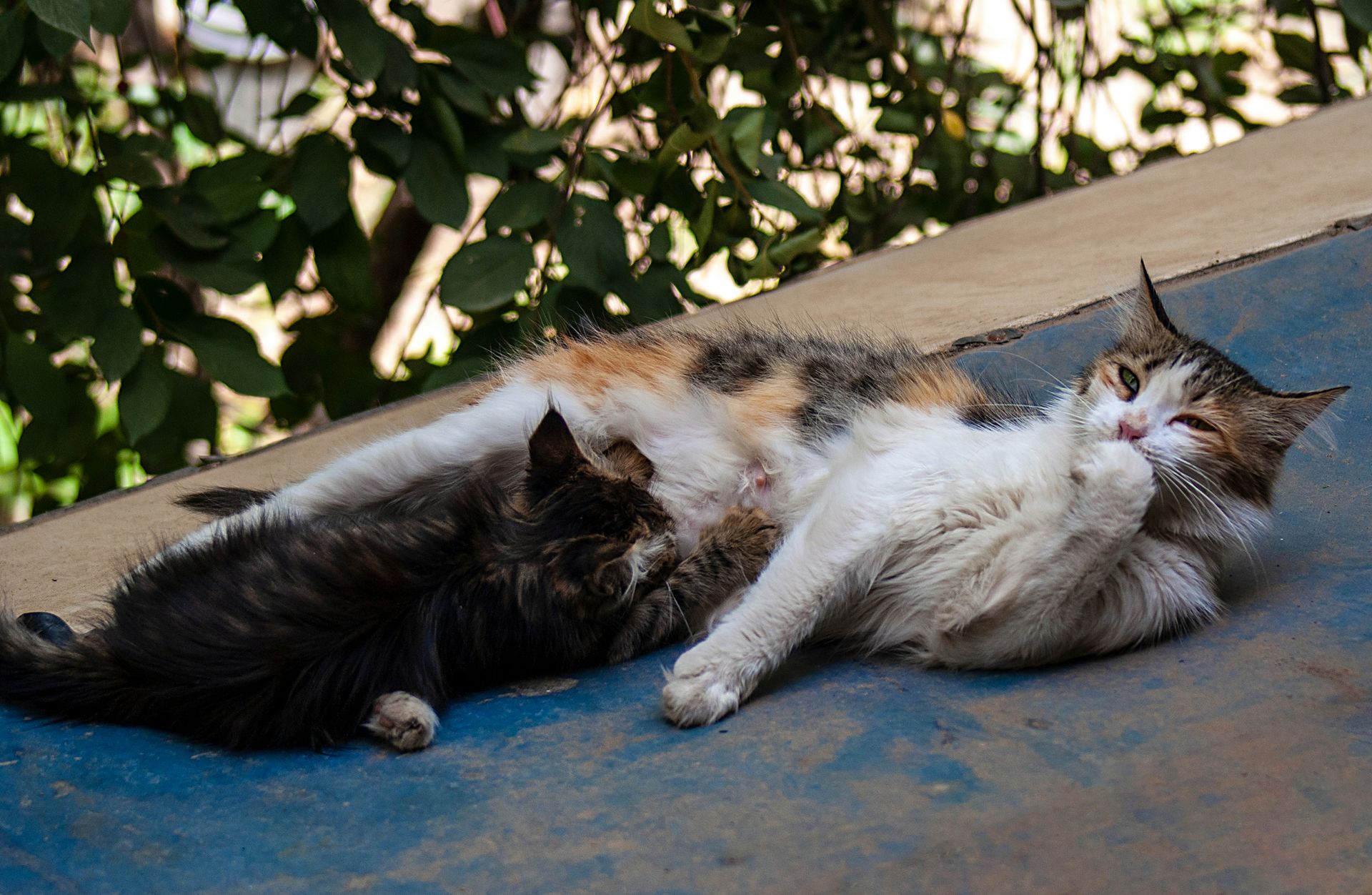
Increased grooming directed specifically at the abdomen, mammary glands, and genital area becomes noticeable in the final 24 hours before labor, and is understood as a preparatory behavior that also plays a practical role once kittens are born: the grooming keeps the birth area clean and stimulates the mammary glands, and the same licking behavior is what a mother cat uses immediately after birth to clean each kitten and stimulate its first breaths.
This grooming is often accompanied by visible enlargement of the mammary glands in the days leading up to labor, and in some cats, particularly those close to their due date, small amounts of clear or slightly milky fluid may be expressed from the nipples when gently checked — though owners should not routinely handle or express the mammary glands themselves, as this is not necessary and can cause the cat discomfort or stress.
The specific value of this sign for an owner is confirmatory rather than requiring a distinct preparation response: it typically co-occurs with the restlessness and nesting behaviors already described, and its presence alongside those other signs increases confidence that labor is genuinely imminent rather than the cat displaying an isolated behavior with a different cause.
Contractions become visible

Rio Lecatompessy / Unsplash
As labor progresses from its early, less visible stage into active labor, abdominal contractions become visibly apparent: the cat's abdomen tightens and relaxes in a rhythmic pattern, often accompanied by the cat adopting a specific posture — lying on her side, sometimes with mild straining — that is recognizably different from resting positions. This is the clearest and most unambiguous sign that labor has moved from the preparatory stage into active delivery, typically preceding the first kitten's birth by a period ranging from under an hour to several hours depending on the individual cat and whether this is a first litter.
The normal progression from visible contractions to the birth of the first kitten should not exceed approximately one to two hours of active straining; a cat that strains visibly and persistently for longer than this without producing a kitten, or that appears to be in significant distress, should be evaluated by a veterinarian promptly, as this can indicate dystocia (obstructed or difficult labor) requiring medical intervention.
The correct owner response at this stage is to observe from a reasonable distance without interfering in the process, to have the veterinarian's contact information (including an emergency clinic if outside normal hours) readily accessible, and to resist the urge to handle the cat or the emerging kittens unless the mother is showing signs of being unable to manage the birth herself — the majority of feline births require no human intervention beyond a calm, quiet environment.
Water breaking and the delivery of the first kitten
Picnu / Unsplash
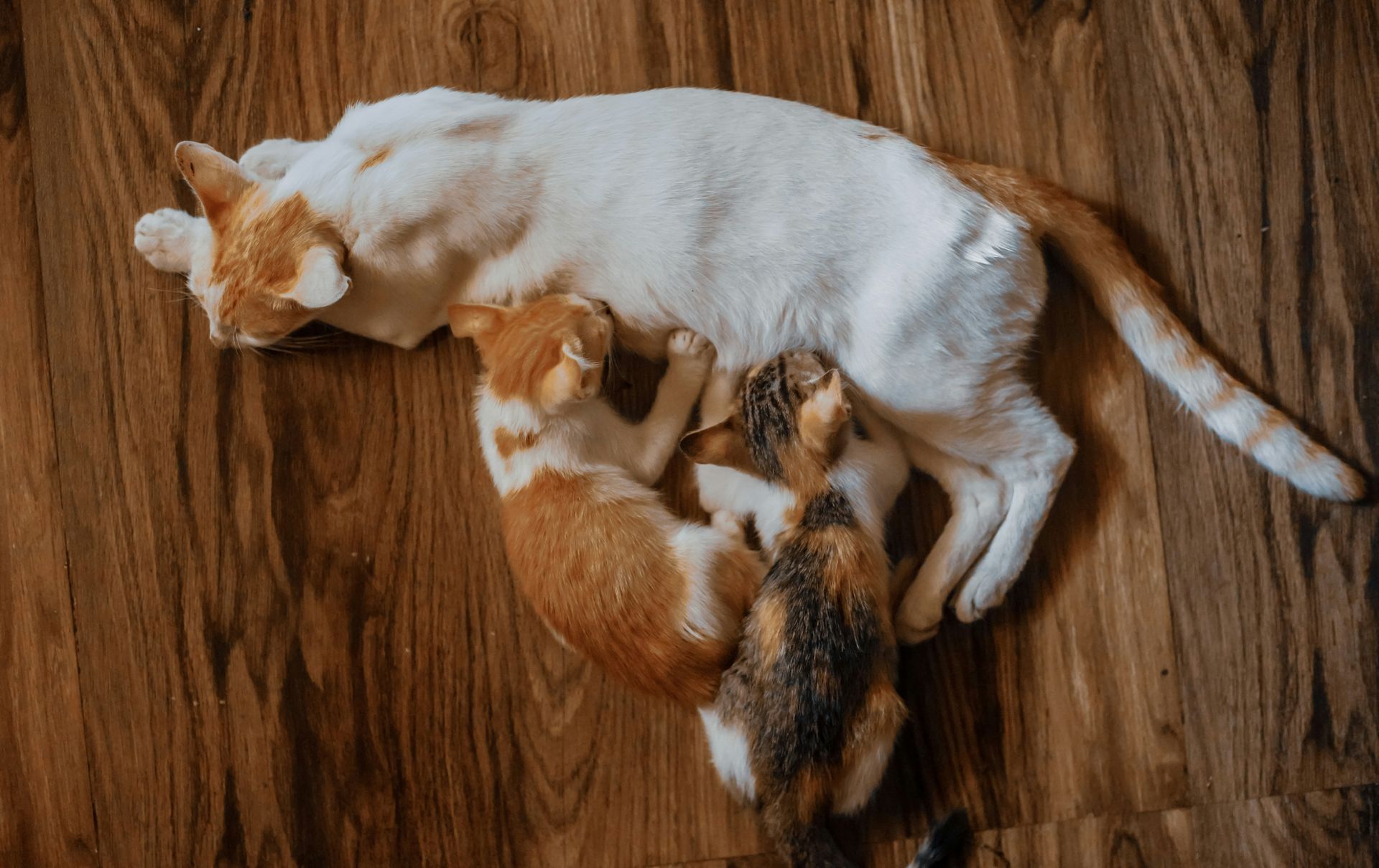
The rupture of the amniotic sac — visible as a discharge of clear to slightly cloudy fluid — typically precedes the birth of the first kitten by a short interval, often less than an hour, and is one of the final and most unambiguous signs that delivery is imminent. Each kitten is typically born within its own amniotic sac, which the mother cat breaks and removes through licking immediately after birth, followed by her severing the umbilical cord and consuming the placenta — behaviors that are entirely normal and serve both nutritional and cleanliness functions.
Kittens are typically born at intervals ranging from 15 minutes to an hour apart, though the interval can extend longer in some cases without necessarily indicating a problem, particularly if the mother appears comfortable and is resting between deliveries rather than showing signs of distress. A full litter typically takes two to six hours to deliver, though this varies considerably by litter size and individual cat.
The specific situations that warrant veterinary contact during this stage include: more than two to three hours of visible straining without producing a kitten, a kitten that becomes visibly stuck (partially delivered but not progressing) for more than a few minutes, greenish-black discharge before the first kitten is delivered (which can indicate placental separation and fetal distress), or the mother showing signs of severe pain, weakness, or collapse. Most owners will not need to intervene beyond providing a calm environment and quiet observation, but knowing these specific warning signs — and having emergency veterinary contact information prepared in advance — is the most valuable preparation an owner can make for the final stage of labor.