
From wheeled luggage to the can opener, these ordinary objects appeared decades or centuries after the technology to make them already existed
Credit: Elijah O'Donnell / Pexels
Every object on your desk looks inevitable in hindsight. The paper clip bends wire in the obvious way. The suitcase rolls because of course it does. The pencil carries its own eraser because who would want it any other way. But the historical record tells a stranger story. Many of the simplest, most useful objects in daily life arrived long after every material, tool, and technique needed to build them already existed. The can was invented nearly five decades before the can opener. Humans rode horses for thousands of years before anyone thought to hang a loop of metal from the saddle for their feet. Airline pilots and business travelers dragged heavy bags through terminals for decades after the wheel had been put on everything from tea carts to roller skates.
These gaps are not trivia. They reveal something about how invention actually works. New ideas rarely fail because the technology is missing. They fail because nobody asks the question, because the people who could build the thing do not experience the problem, or because the market rejects a good idea for reasons that have nothing to do with its merits. Mary Anderson patented the windshield wiper in 1903 and could not find a single manufacturer willing to license it. Sylvan Goldman built the first shopping cart in 1937 and had to hire actors to push carts around his stores because customers refused to touch them. The lag between possible and actual is where habit, pride, and inertia live.
This list collects 20 inventions that share one trait: each was technically achievable years, decades, or in some cases millennia before it appeared. Some were delayed by indifference, some by ridicule, some by the simple fact that the person holding the solution never met the person holding the problem. Together they make a case for a counterintuitive idea. The hardest part of inventing something is often not the engineering. It is noticing that the problem exists at all, and believing it deserves to be solved.

Credit: Gustavo Fring / Pexels
The wheel is roughly 5,500 years old. The modern suitcase dates to the late 19th century. The two were not combined into a commercial product until 1970, when Bernard Sadow, an executive at a Massachusetts luggage company, filed a patent for a suitcase with four casters and a towing strap after watching an airport worker glide a heavy machine across a terminal on a wheeled skid.
Sadow later recalled that department store buyers rejected the idea repeatedly. One common objection held that men would refuse to roll a bag because carrying luggage was a matter of masculine pride. Macy's $M eventually placed an order, and the rolling suitcase slowly caught on through the 1970s as air travel expanded and travelers spent more time walking through ever-larger terminals.
Even then, the design was not finished. Sadow's version towed flat on four small wheels and tended to fishtail. In 1987, Robert Plath, a Northwest Airlines pilot, built a better answer in his garage. He mounted two wheels and a rigid telescoping handle on an upright bag, creating what he called the Rollaboard. Plath sold it first to fellow flight crews. Passengers saw pilots and flight attendants wheeling compact bags through airports and wanted the same thing. His company, Travelpro, turned the design into the default form of carry-on luggage worldwide.
The delay is hard to explain with technology. Casters existed in the 19th century. Porters, redcaps, and skycaps existed too, which is part of the answer. For much of the 20th century, people who could afford air travel could also afford to have someone else carry their bags. When mass air travel arrived and porters faded, the problem finally belonged to everyone, and the solution appeared within a generation. The wheeled bag waited not for an inventor but for a customer.

Credit: cottonbro studio / Pexels
Canned food was invented to feed armies. In 1810, the British merchant Peter Durand received a patent for preserving food in sealed tin-plated iron containers, building on the French confectioner Nicolas Appert's work with sealed glass jars. Canning worked. The Royal Navy carried tinned provisions on long voyages within a few years, and Arctic expeditions relied on them.
Opening the cans was another matter. Early tins were heavy, thick-walled, and sealed with soldered lids. Instructions on some cans advised cutting around the top with a hammer and chisel. Soldiers stabbed them open with bayonets and knives, or smashed them against rocks. This state of affairs lasted for nearly half a century.
The first dedicated can opener did not arrive until 1858, when Ezra Warner of Waterbury, Connecticut, patented a lever-type device with a curved blade that punctured the lid and sawed around the rim. It was effective but left jagged edges, and it remained mostly a tool for grocers, who would open cans for customers at the counter. The familiar rotating cutting wheel came in 1870, from William Lyman, and the modern design with a serrated feed wheel gripping the rim appeared in 1925.
The gap between can and opener was not an oversight so much as a materials problem paired with a habit problem. Early cans were too thick for a small hand tool to cut, so no such tool seemed worth designing. Only when manufacturers switched to thinner steel in the mid-19th century did a compact opener become practical. The lesson runs through this whole list: an invention often waits on a quiet change elsewhere in the system. The opener needed the can to change first, and for decades nobody worked backward from the frustration of the person holding dinner in a sealed metal box.

Credit: Nothing Ahead / Pexels
Graphite pencils date to the 1560s, after a large deposit of pure graphite was discovered at Borrowdale in England. Rubber erasers came into use in the 1770s, when the English stationer Edward Nairne began selling cubes of natural rubber for rubbing out pencil marks, and the chemist Joseph Priestley described the material's ability to erase in 1770. For nearly a century afterward, the pencil and the eraser lived separate lives. Writers kept a loose lump of rubber on the desk, lost it, and bought another.
The combination arrived in 1858, when Hymen Lipman of Philadelphia patented a pencil with an eraser embedded in one end. The idea seems so obvious that it barely qualifies as an invention, and U.S. courts eventually agreed. Lipman sold his patent to an entrepreneur named Joseph Reckendorfer, who sued the pencil maker Faber for infringement. In 1875, the Supreme Court ruled in Reckendorfer v. Faber that the patent was invalid because it merely joined two known things without producing a new function. Each part did what it had always done.
That ruling became a landmark in patent law, but it also captures why the eraser-tipped pencil took so long. Combinations of existing objects rarely feel like inventions to the people best positioned to make them. Pencil makers made pencils. Rubber sellers sold rubber. Nobody owned the moment when a writer made a mistake.
The attached eraser also faced cultural resistance. Some European manufacturers declined to add erasers for decades, and a few educators argued that built-in erasers encouraged carelessness in students. The design won anyway, at least in the U.S., where the ferrule-mounted pink eraser became standard by the early 20th century. It took about 90 years to move the eraser 15 centimeters, from the desk to the end of the pencil.
Credit: Marek Ruczaj / Pexels
Straight pins are ancient, and so are their hazards. People fastened cloth with sharpened bone, thorn, and metal for thousands of years, accepting punctured fingers as the cost of held-together clothing. The Romans and Greeks used fibulae, brooch-like fasteners that guarded the point, but the design faded in Europe, and by the 19th century most households were back to plain straight pins.
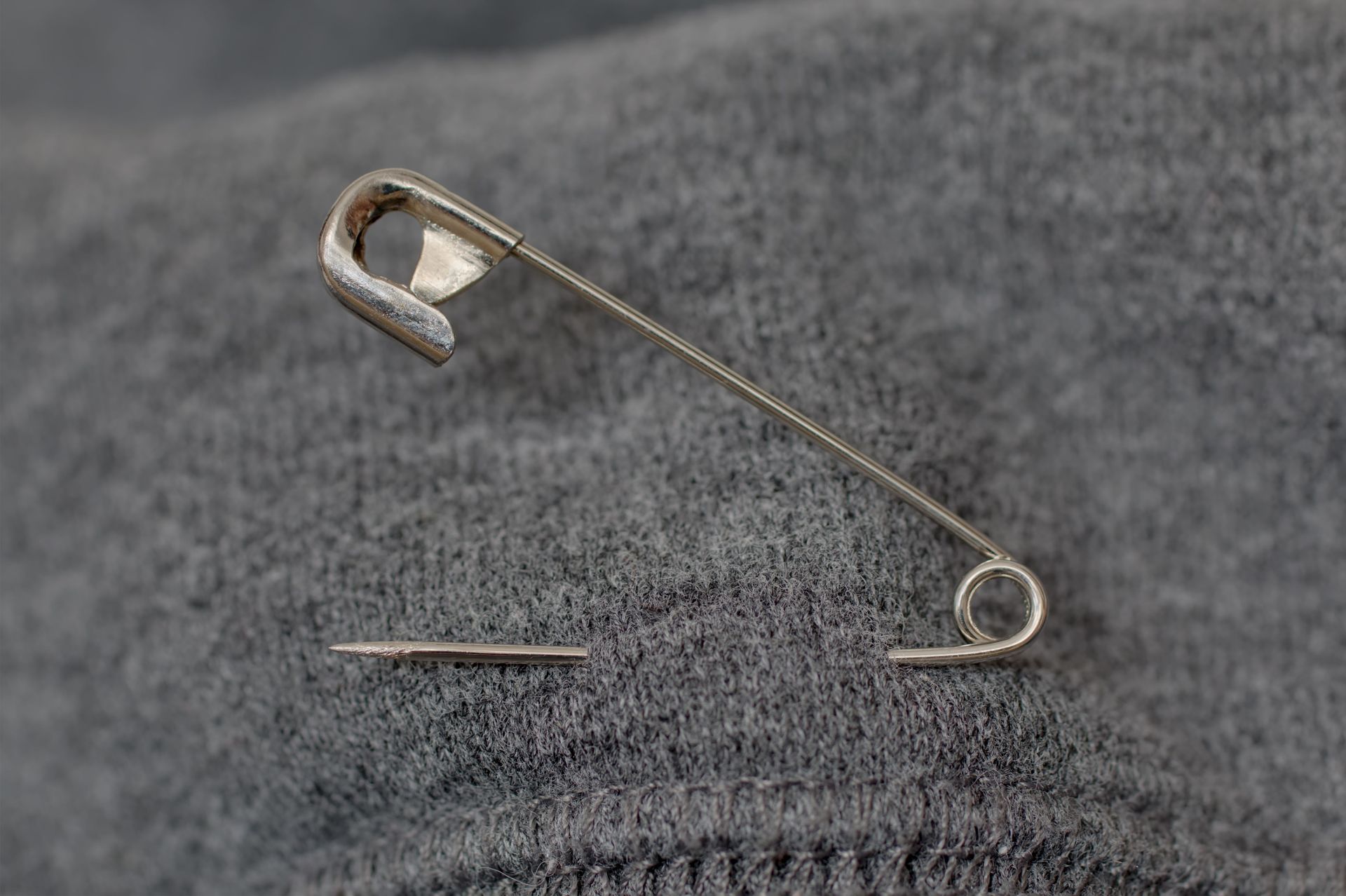
The modern safety pin was invented in a single afternoon in 1849 by Walter Hunt, a prolific New York mechanic who also built an early sewing machine and a repeating rifle. Hunt owed a friend $15. Twisting a piece of brass wire while thinking about the debt, he produced a pin with a coiled spring at one end and a clasp at the other that shielded the point. The coil did two jobs at once: it acted as a spring to hold the pin closed and kept the whole fastener as one piece of wire.
Hunt patented the design in April 1849 and sold the rights for $400, paying off his debt and keeping the change. The buyers went on to make a fortune. Hunt did the same thing with his sewing machine years earlier, declining to pursue it partly out of concern that it would put seamstresses out of work, a decision that left the field open for Elias Howe and Isaac Singer.
The safety pin's delay is a story about lost knowledge as much as missing imagination. The fibula shows the core idea existed more than 2,000 years before Hunt. What Hunt added was the integral spring coil, cheap one-piece manufacture, and a moment when mass-produced wire made the object nearly free. A guarded pin was achievable for millennia. It finally became universal only when it became disposable.
Credit: Cats Coming / Pexels
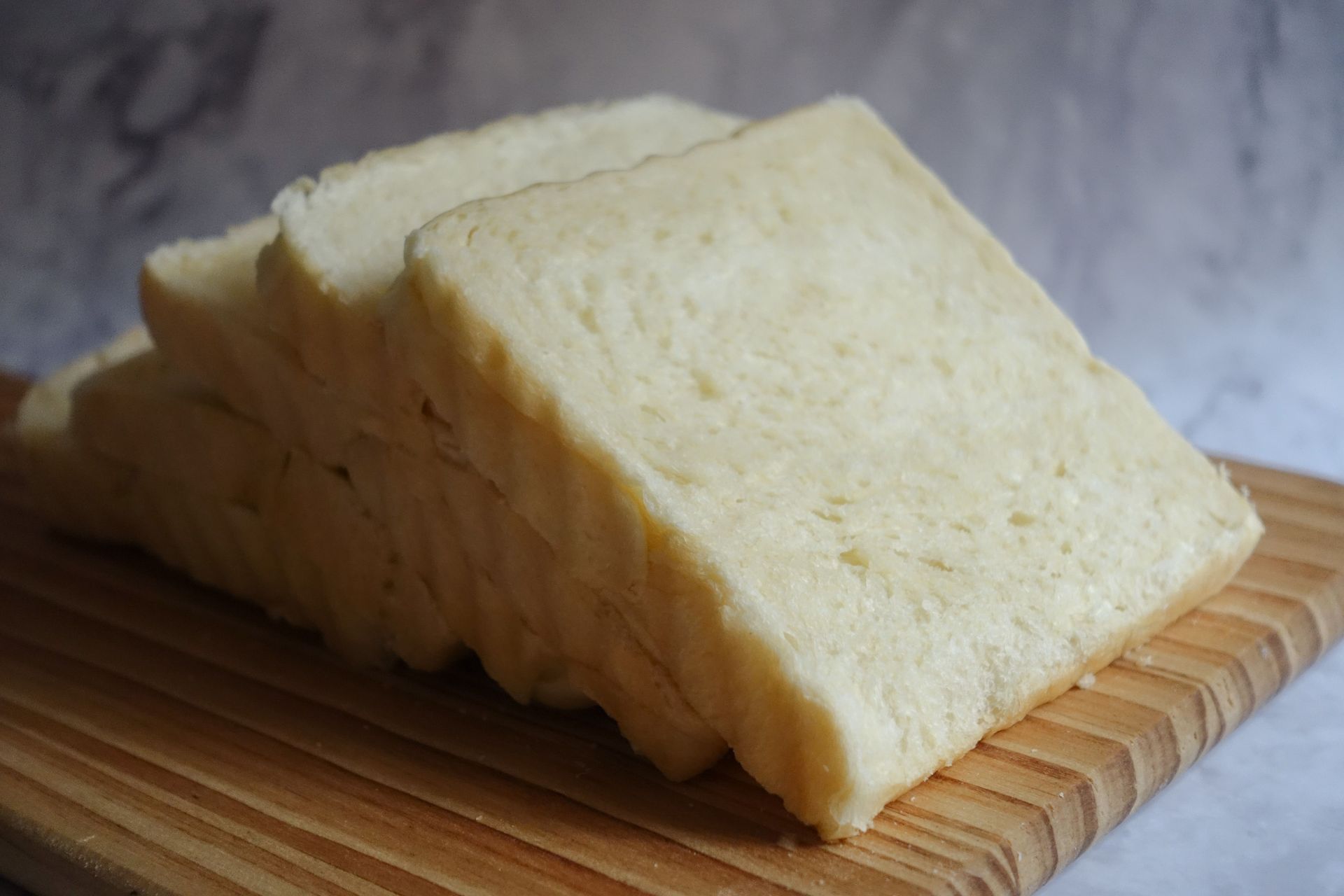
Bread is one of humanity's oldest prepared foods, with evidence of bread-making stretching back more than 10,000 years. Mechanically sliced bread went on sale in 1928. The gap between those dates is the reason "the best thing since sliced bread" works as a joke.
The delay was not for lack of trying by one man. Otto Frederick Rohwedder, a jeweler from Iowa, began working on a bread-slicing machine around 1912. A factory fire in 1917 destroyed his prototype and blueprints, setting him back years. Bakers he pitched were skeptical for a practical reason: sliced bread goes stale faster than a whole loaf, and they assumed customers would reject it. Rohwedder solved this by designing his machine to slice and then wrap the loaf, keeping it fresh.
The Chillicothe Baking Company in Chillicothe, Missouri, put Rohwedder's machine into service in July 1928 and advertised "the greatest forward step in the baking industry since bread was wrapped." Sales climbed quickly. Wonder Bread took sliced loaves national in 1930, and within a few years sliced bread dominated the American market. Standardized slices also drove up consumption of another product: the pop-up toaster, patented by Charles Strite in 1919, suddenly had a perfectly sized feedstock.
The U.S. government briefly banned sliced bread in January 1943 as a wartime conservation measure, reasoning that the heavier wax paper wrapping sliced loaves required could be saved. Public objection was loud and immediate, and the ban was rescinded within about two months.
Slicing bread requires a knife. That was never the obstacle. The obstacle was that freshness, wrapping, and retail habits all had to change together, and no single baker had a reason to move first. Rohwedder spent 16 years assembling that package. The bread itself had been waiting since the Neolithic.

Credit: Ulrick Trappschuh / Pexels
Self-service grocery stores appeared in 1916, when Clarence Saunders opened the first Piggly Wiggly in Memphis and let customers walk the aisles and pick their own goods. For the next two decades, shoppers carried wire or wicker baskets on their arms. The size of a grocery order was capped by the strength of the customer's grip.
Sylvan Goldman, who owned the Humpty Dumpty supermarket chain in Oklahoma City, saw that limit as a ceiling on his revenue. In 1936 he looked at a wooden folding chair and imagined a basket on the seat and wheels on the legs. Working with a mechanic named Fred Young, he built a folding metal frame that carried two wire baskets and rolled on four wheels. He introduced it in his stores in 1937.
Customers wanted nothing to do with it. Men reportedly felt the cart implied they were too weak to carry a basket. Some women said it reminded them of pushing a baby carriage. Goldman responded with staged demand: he hired models of various ages to push carts around his stores, filling them with groceries, while a greeter offered carts to entering customers. The seeded behavior took hold. Goldman patented his design, founded the Folding Basket Carrier Company, and became wealthy from cart sales and royalties. The modern one-piece nesting cart with a child seat came in 1946 from Orla Watson, whose telescoping design let carts slide into each other at the front of the store.
Wheels, wire, and baskets were all Victorian-era commodities. What delayed the cart was the store itself: until self-service shopping existed, customers had no reason to haul goods through aisles. Even then, the cart needed a second invention, social proof, before anyone would push it. Goldman understood that the hardware was the easy half.

Credit: Lucas Pezeta / Pexels
Mary Anderson, an Alabama real estate developer, visited New York City in the winter of 1902 and rode a streetcar through sleet. The driver kept the front pane of the split windshield open to see, letting freezing air pour in, and repeatedly stopped to wipe the glass by hand. Anderson sketched a solution on the spot: a rubber blade on a spring-loaded arm, operated by a lever from inside the vehicle, with a counterweight to keep the blade pressed against the glass.
She received a U.S. patent for the "window cleaning device" in 1903. Then she tried to sell it, and nobody bought. A Canadian firm she approached in 1905 declined, saying the device lacked commercial value. Some skeptics argued a moving blade would distract drivers. Anderson's patent expired in 1920 without earning her anything, just as automobile ownership in the U.S. began to surge. By 1922, Cadillac was fitting wipers as standard equipment, and mechanical wipers became universal soon after. Anderson, who died in 1953, never received money from the idea.
The pattern repeated decades later with the intermittent wiper. Robert Kearns, an engineering professor in Detroit, invented a wiper that paused between strokes, inspired partly by thinking about the blinking human eye, and patented the mechanism in the 1960s. He demonstrated it to Ford $F, which declined to hire him but later introduced intermittent wipers of its own. Kearns spent much of his life in patent litigation against Ford and Chrysler, winning verdicts in the early 1990s worth tens of millions of dollars.
The wiper needed rubber, a spring, and a lever, all of which predated the automobile. What it lacked, twice, was an industry willing to admit that an outsider had seen the problem first.

Credit: Magda Ehlers / Pexels
Humans domesticated horses on the Eurasian steppe roughly 5,500 years ago and were riding them in warfare well over 3,000 years ago. For most of that history, riders had nothing to stand on. Assyrian cavalry, Alexander the Great's Companion horsemen, and Rome's mounted legions all rode gripping with their legs, mounting by vaulting or stepping on a spear. A rider who leaned too far in combat simply fell off.
The stirrup, a loop hung from the saddle to support the foot, requires no advanced technology. Leather, rope, wood, or bronze would do, and all were available to Bronze Age societies. Yet the paired rigid stirrup appears in the archaeological record in China around the fourth century CE, with earlier single mounting stirrups slightly before that. Riders in India used a small toe loop somewhat earlier, but the full foot-supporting stirrup spread from China across Central Asia, reaching the Byzantine world and Europe by roughly the eighth century.
The consequences were large. Stirrups let a rider brace, stand, absorb shock, and deliver a lance thrust with the combined momentum of horse and rider without being thrown backward. Mounted archers gained a stable firing platform. The medievalist Lynn White Jr. argued in 1962 that the stirrup enabled shock cavalry and helped drive the rise of European feudalism, a claim historians have debated ever since. Even critics of that thesis agree the device transformed cavalry warfare.
Why the wait? One theory holds that expert riders, trained from childhood, did not feel the need, and cultures built around lifelong horsemanship saw no problem to solve. The stirrup may have emerged where riding had to be taught quickly to less practiced soldiers. The best users of a technology are often the last to notice what it lacks.

Credit: Mathias Reding / Pexels
Carrying loads is among the oldest human problems, and the wheel had been in use for thousands of years before anyone put a single one under a box with two handles. The wheelbarrow appears in China by the first or second century CE. Chinese tradition credits the third-century military strategist Zhuge Liang with a version used to move supplies, though depictions in Han dynasty tomb art suggest the device existed earlier. Chinese designs often placed a large central wheel directly under the load, letting one person move several hundred pounds along narrow paths.
Europe, despite inheriting Roman engineering, road-building, and heavy wagon technology, shows no clear evidence of the wheelbarrow until roughly the 12th or 13th century, when it turns up in manuscript illustrations at construction sites for castles and cathedrals. The European design put the wheel at the front and the load between wheel and operator, which carries less weight than the Chinese layout but dumps more easily, suiting short hauls of earth, stone, and mortar.
The economics were straightforward once the device existed. A wheelbarrow lets one laborer do work that previously required two people carrying a handbarrow or stretcher. On a medieval building site that ran on hired labor, halving the crew for hauling was a direct saving, and the tool spread quickly through construction and mining.
That is what makes the delay puzzling. Rome built aqueducts, cranes, and paved roads, and moved staggering quantities of material by human and animal muscle, yet apparently never combined a wheel with a hand barrow. Slave labor may have blunted the incentive to save workers. Whatever the cause, one of the simplest labor-saving machines ever devised waited more than a millennium after the technology for it was complete, then appeared independently at opposite ends of Eurasia.
Credit: Marek Ruczaj / Pexels
Buttons are ancient. Ornamental buttons made of shell appear at Indus Valley sites dating to roughly 2000 BCE, and ancient societies across Eurasia sewed buttons onto clothing for thousands of years. They just did not use them to fasten anything. For most of that history, buttons were decoration, jewelry sewn to cloth, while garments were actually held closed with pins, brooches, laces, and belts.
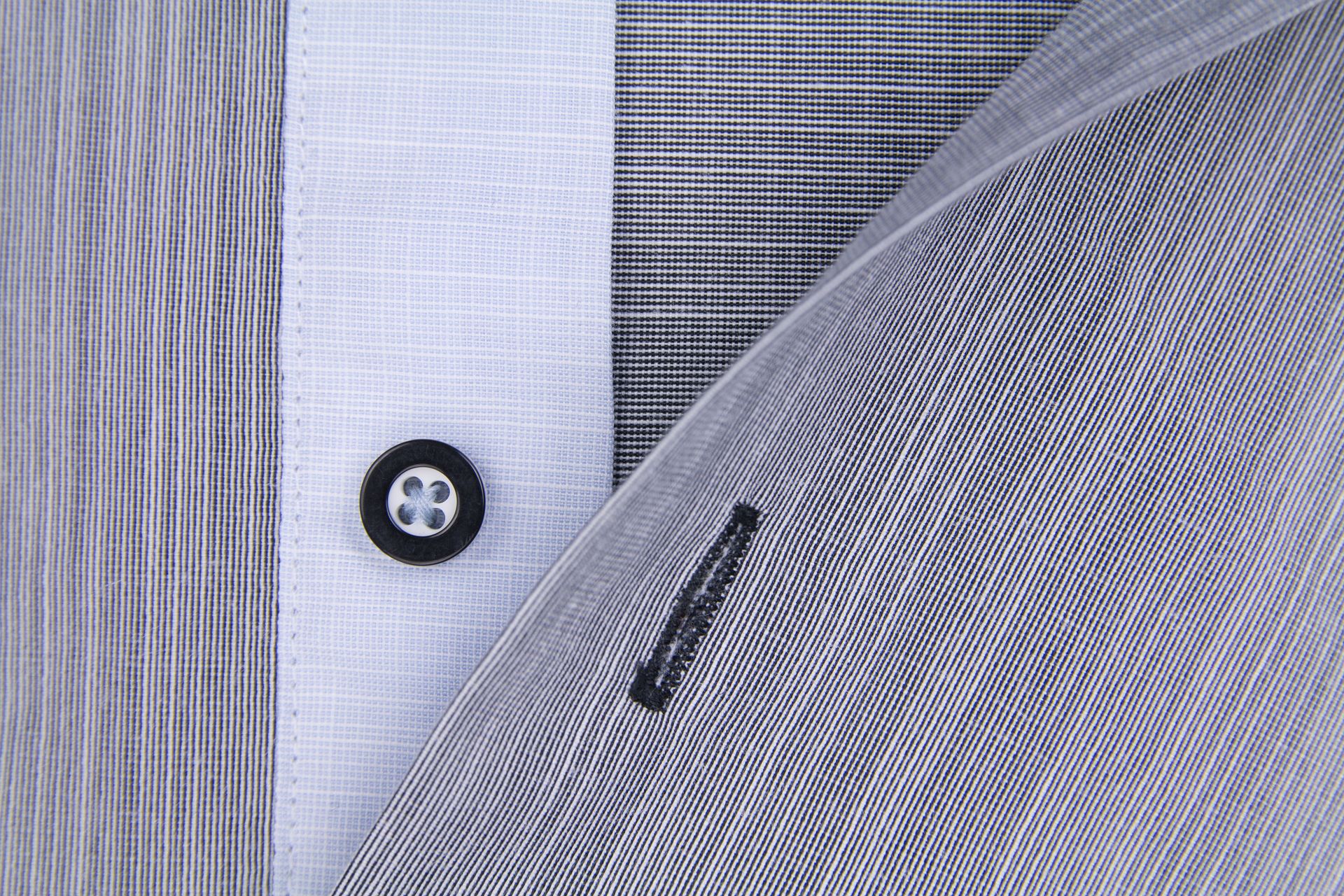
The functional buttonhole, a reinforced slit that lets a button pass through and hold two pieces of fabric together, emerged in Europe in the 13th century, likely spreading through Germany and then across the continent. The timing tracks a change in fashion: medieval European clothing was shifting from loose, draped garments that slipped over the head toward fitted tailoring that followed the body. A tight garment cannot be pulled on. It has to open, close, and hold, and the buttonhole solved that.
The effect on dress was immediate and lasting. Rows of closely spaced buttons let sleeves fit snugly at the wrist and bodices fit at the torso, and tailoring as a profession grew around what the fastening made possible. Buttons became so fashionable and so numerous on elite clothing that some governments passed sumptuary laws regulating them. Certain conventions born in that era persist, including the placement of buttons on opposite sides for men's and women's garments.
The buttonhole needed no new material and no new tool. Needle, thread, and cloth had existed for tens of thousands of years, and the button itself for at least three millennia. What was missing was the garment shape that made fastening necessary. It stands as one of the cleanest examples of a general rule: inventions do not appear when they become possible. They appear when something else makes them useful.
Credit: Markus Reiter / Pexels
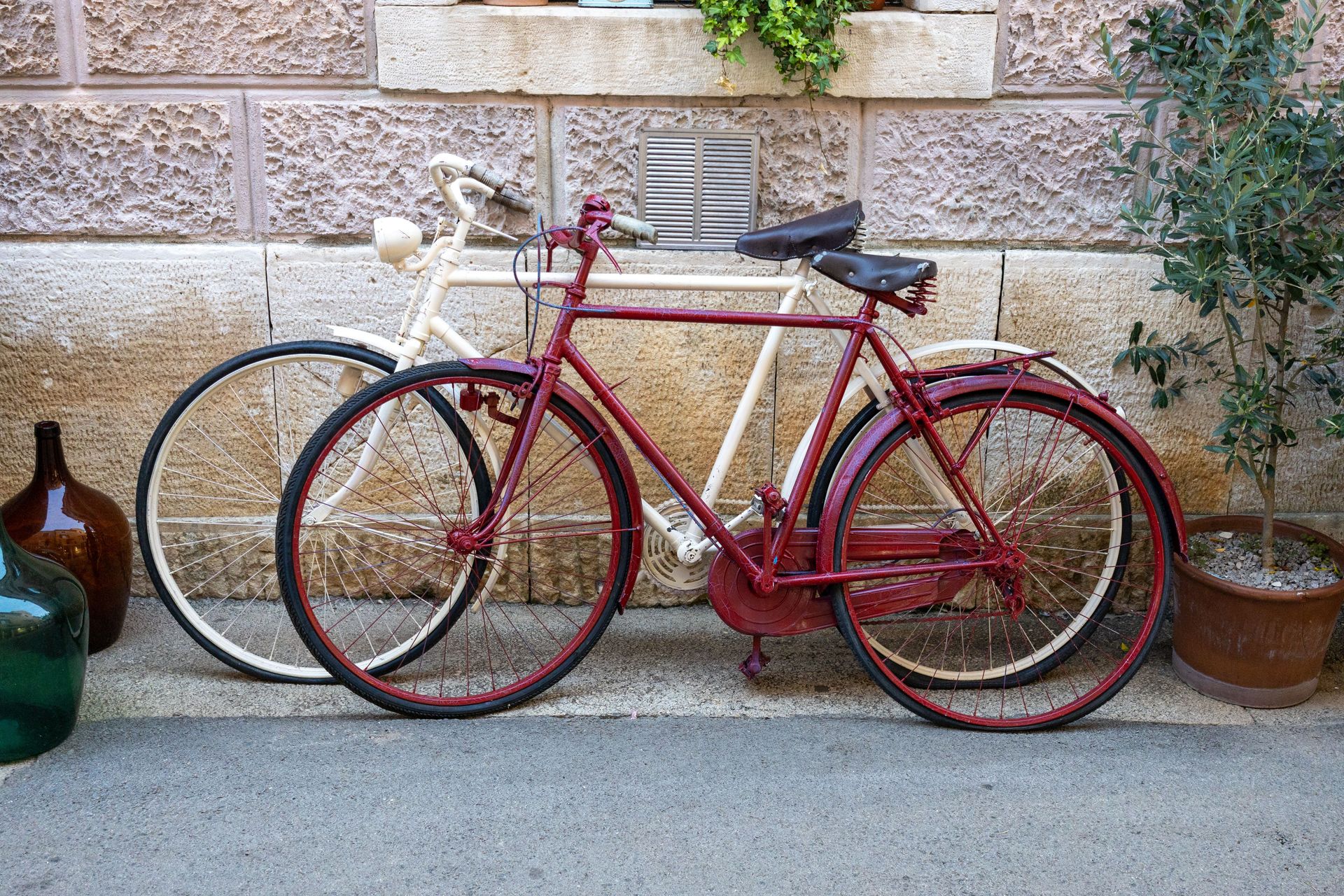
The bicycle looks like it belongs to the machine age, but almost nothing in it demanded one. A frame, two wheels, a steerable fork, and a saddle were all within the capability of medieval carpenters and blacksmiths. Wheels, axles, and bearings had existed for millennia. Yet the first two-wheeled, rider-balanced vehicle did not appear until 1817, when the German inventor Karl von Drais built his Laufmaschine, or running machine, a wooden two-wheeler the rider straddled and pushed along with the feet.
Drais built it partly in response to a crisis. The 1815 eruption of Mount Tambora in Indonesia caused the "year without a summer" in 1816, ruining harvests across Europe. Oats became scarce, horses were expensive to feed, and Drais explicitly pitched his machine as a horse substitute. The design spread as the "draisine" or "dandy horse" before fading as a fad.
Pedals came decades later. In the 1860s, Parisian makers including Pierre Michaux attached cranks to the front wheel, creating the velocipede, nicknamed the boneshaker for its ride on iron-tired wooden wheels over cobblestones. The high-wheeled penny-farthing followed in the 1870s, gaining speed by enlarging the driven wheel at the cost of frequent headfirst falls. The recognizably modern machine arrived in 1885 with John Kemp Starley's Rover safety bicycle, which used a chain drive to the rear wheel and two similar-sized wheels, and in 1888 with John Boyd Dunlop's pneumatic tire.
The long absence has a likely explanation beyond imagination: balance on two wheels is not obviously possible until someone demonstrates it, and pre-modern roads were rutted tracks hostile to any small-wheeled vehicle. Even so, a rideable two-wheeler was buildable for centuries. Nobody built one until horses failed.

Credit: DS stories / Pexels
The Post-it note was invented backward. In 1968, Spencer Silver, a chemist at 3M $MMM, was trying to develop a strong adhesive and instead produced a weak one: microscopic acrylic spheres that stuck lightly to surfaces, peeled away cleanly, and could restick. It was a solution without a problem. Silver spent years giving internal seminars at 3M promoting what he called his "solution without a problem," pitching ideas like a sticky bulletin board, and finding little traction.
The problem arrived in 1974. Art Fry, a 3M product developer who sang in a church choir in St. Paul, Minnesota, kept losing his place when the paper scraps he used as hymnal bookmarks fluttered out. He remembered Silver's adhesive and realized the answer was not a sticky board but sticky paper: a bookmark that would hold to a page and peel off without damage. Fry used 3M's policy of allowing employees time for self-directed projects to develop the product, and colleagues soon discovered a second use, writing notes on the slips and sticking them to documents and doors.
The market almost killed it anyway. A 1977 test launch under the name Press 'n Peel failed in several cities, apparently because consumers could not grasp the product from a description. In 1979, 3M flooded Boise, Idaho, with free samples in what became known as the Boise Blitz, and reorder rates were strong. Post-it Notes launched across the U.S. in 1980 and became one of 3M's signature products. The canary yellow color was reportedly an accident of whatever scrap paper was available in the lab next door.
The adhesive sat unused for six years, and the underlying need, a bookmark that stays put, was as old as books. The invention waited for one person to connect a nuisance in a choir loft to a failed experiment down the hall.
Credit: Pixabay / Pexels
Clothing fasteners barely changed for centuries. Buttons, hooks, and laces did the work, and a Victorian woman's boots could require a buttonhook and several minutes to close. The zipper, once it existed, reduced that to one second of motion. Getting it to exist took about 30 years of engineering and another 20 of persuasion.
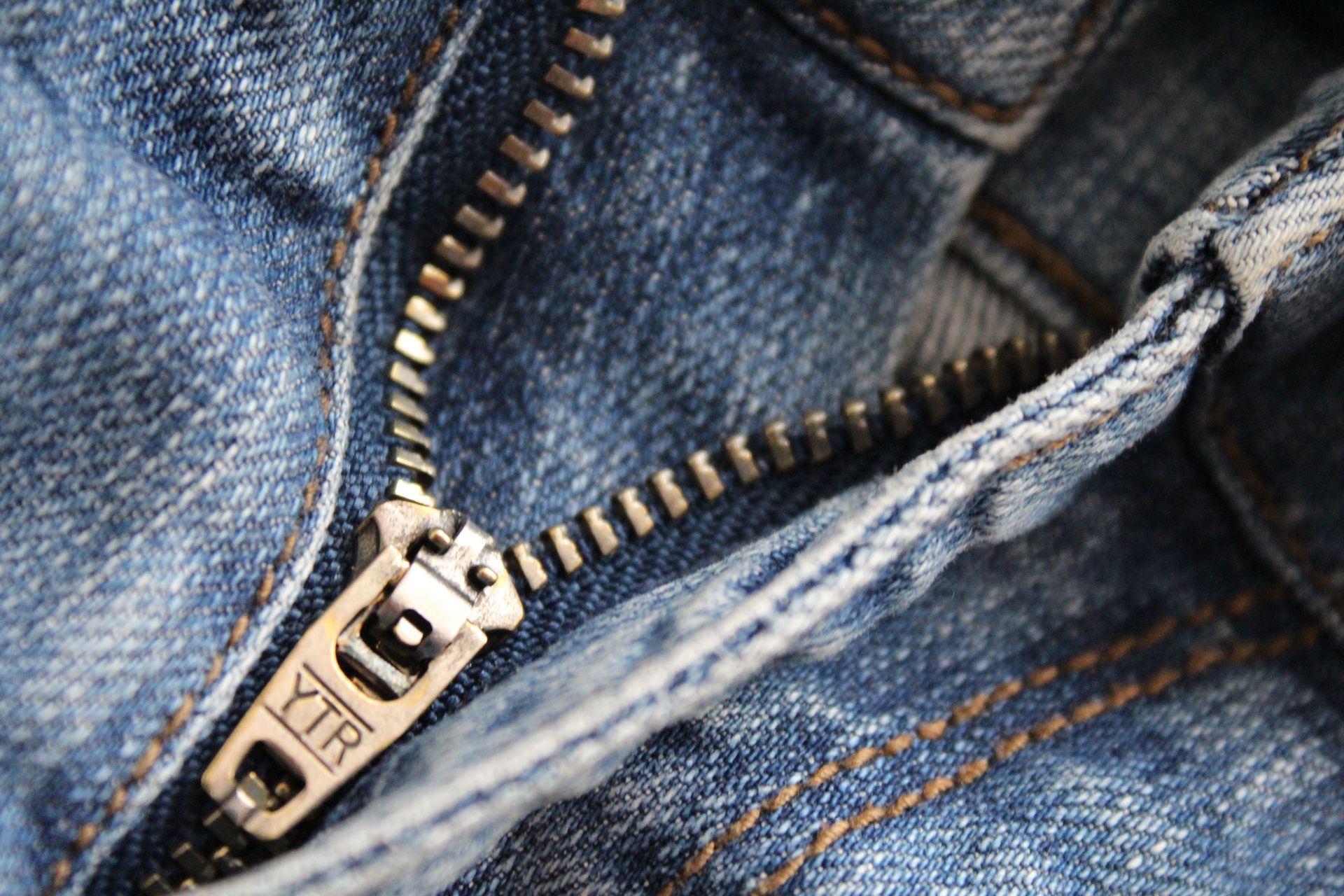
Whitcomb Judson, a Chicago inventor, patented a "clasp locker" in 1893, a chain of hooks and eyes closed by a slider, aimed at the shoe market. He showed it at the 1893 World's Columbian Exposition in Chicago. It sold poorly because it worked poorly, popping open and jamming. Judson's company hired a Swedish-born engineer, Gideon Sundback, who spent years reworking the mechanism. In 1913 Sundback abandoned hooks entirely and produced the "hookless fastener": interlocking metal teeth, cupped on one side and dimpled on the other, meshed by a slider, at roughly 10 teeth per inch. He also built the machinery to manufacture it, which mattered as much as the design.
Early customers were practical. The U.S. military used the fastener on gear and flight suits during World War I, and money belts with the fastener sold well to sailors whose uniforms lacked pockets. The name came in 1923, when B.F. Goodrich put the fastener on rubber galoshes and called the boot the Zipper, after the sound. Fashion resisted longer. Clothing makers doubted the device's reliability and its propriety. The zipper reached children's clothing in the early 1930s, marketed as promoting self-reliance in dressing, and won broad acceptance in men's trousers in 1937 after French designers endorsed the fly.
Nothing in a zipper exceeds 19th-century metallurgy. The delay was precision: thousands of tiny identical teeth must mesh flawlessly, and manufacturing at that tolerance, cheaply, was the real invention.
Credit: Leonid Altman / Pexels
The beverage can spent its first decades as a sealed vault. Flat-top beer cans arrived in 1935, and drinkers opened them with a separate tool, the church key, which punched triangular holes in the lid. Forget the tool and the can stayed shut. That arrangement lasted nearly 30 years.
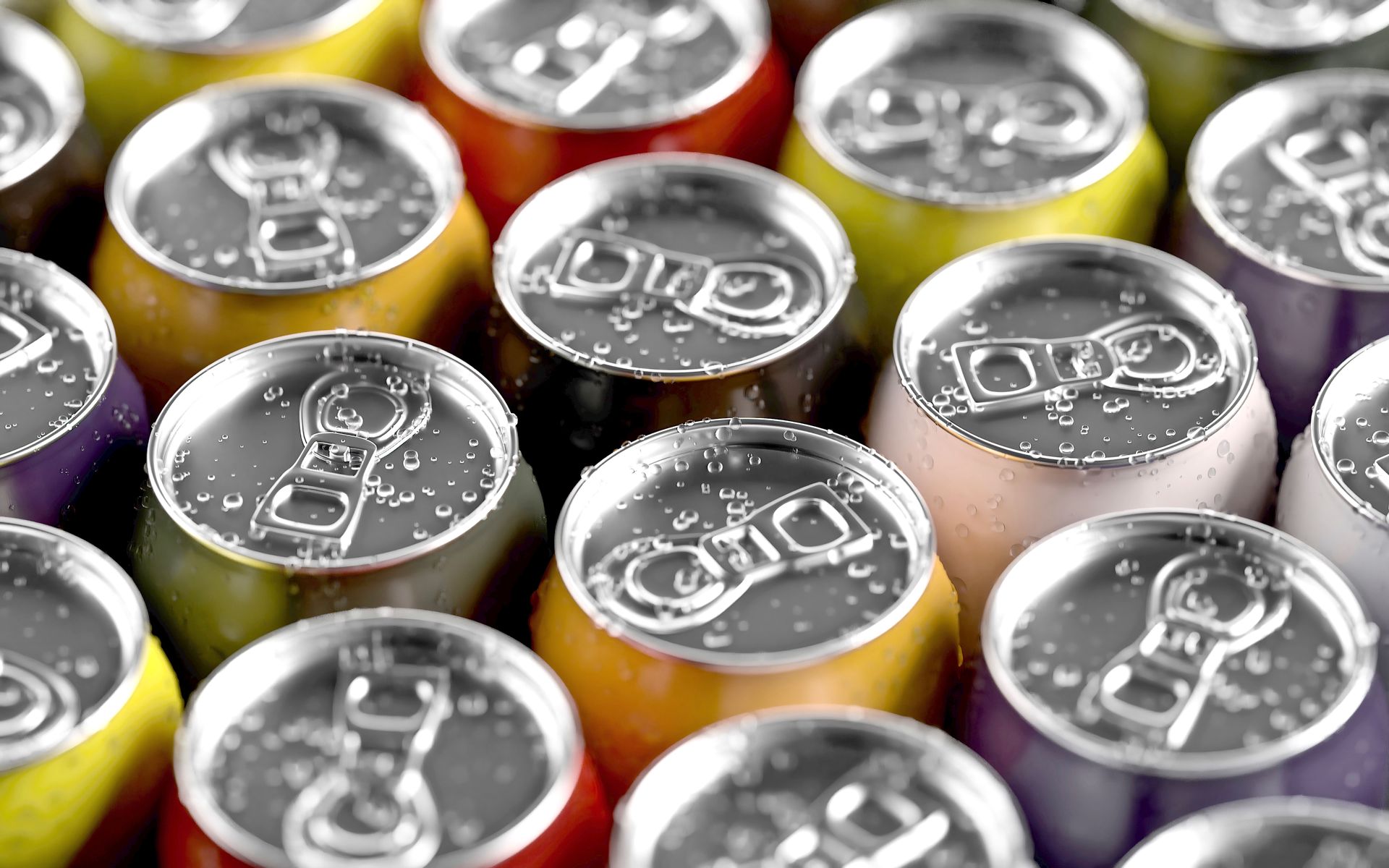
Ermal Fraze, who ran a machine tool company in Dayton, Ohio, confronted the problem at a 1959 picnic when he found himself without a church key and resorted to a car bumper to open a beer. He set out to build the opener into the can. His solution, patented in 1963, was the pull tab: a scored section of lid attached to a ring that levered up and tore away. Iron City Brewing in Pittsburgh adopted it, and pull tabs spread through the beer and soda industries during the 1960s.
The pull tab solved one problem and created another. Detached tabs went somewhere, and the somewhere was beaches, parks, lake bottoms, and bare feet. People dropped them into the can and occasionally swallowed them. Wildlife ingested them. The litter became notorious enough that it entered popular culture, and states began considering bans.
The fix took another decade. Daniel Cudzik, an engineer at Reynolds Metals in Richmond, Virginia, developed the stay-on tab, patented in the mid-1970s. His design used a rivet-mounted lever that pushes a scored panel down into the can, where it stays attached and swings out of the way. The stay-on tab, sometimes called the Sta-Tab, replaced pull rings across the U.S. beverage industry by the 1980s and remains the standard worldwide.
Each stage was mechanically simple: a score line, a rivet, a lever. The full sequence, from sealed can to self-opening can that keeps its own trash, took about 40 years and two separate acts of noticing.

Credit: Richard REVEL / Pexels
Loose paper accumulated for centuries before anyone bent a wire to hold it. Offices of the 18th and 19th centuries fastened documents with straight pins, which rusted and tore pages and stuck fingers, or with ribbon threaded through slits, or with wax. The pieces of the solution were sitting in plain sight: steel wire became cheap and uniform in the mid-19th century, and machines for bending it already made hooks, hairpins, and springs.
Wire fastener patents began appearing in the 1860s. Samuel Fay received a U.S. patent in 1867 for a bent-wire clip intended mainly for attaching tickets to fabric, and dozens of other designs followed. But the shape that conquered the world, the double-oval Gem clip, was never patented at all. It emerged from Britain's Gem Manufacturing in the late 19th century and was being produced by machine by the turn of the century. Its genius is entirely geometric: two nested loops of springy steel that slide over paper, grip through torsion, and release without damage, made from a single piece of wire in one machine operation.
A durable myth credits the Norwegian inventor Johan Vaaler with the paper clip. Vaaler did patent a wire clip in 1899 and 1901, but his design lacked the Gem's second full loop and worked less well, and the Gem was already on the market. The legend grew after his death, and during World War II Norwegians wore paper clips on their lapels as a quiet symbol of resistance and unity under German occupation, which cemented the national story.
The clip's late arrival tracks the arrival of its raw material. It waited not for an idea but for industrial wire, then appeared in a burst of near-simultaneous designs. When the last missing input shows up, obvious inventions tend to get invented by everyone at once.
Credit: Zulfugar Karimov / Pexels
For nearly all of human history, starting a fire meant either keeping one burning or working for it. Flint struck against steel showered sparks onto prepared tinder, a process that could take minutes and failed in damp weather. Households banked coals overnight to avoid the chore. Fire, the oldest technology, remained genuinely inconvenient into the 19th century.
The chemistry that changed this existed well before the product did. Phosphorus was isolated in 1669, and chemists spent the 18th century building ignition curiosities, including dangerous devices that dipped a chlorate-tipped splint into sulfuric acid. What did not exist was a safe, cheap stick that lit from friction alone.
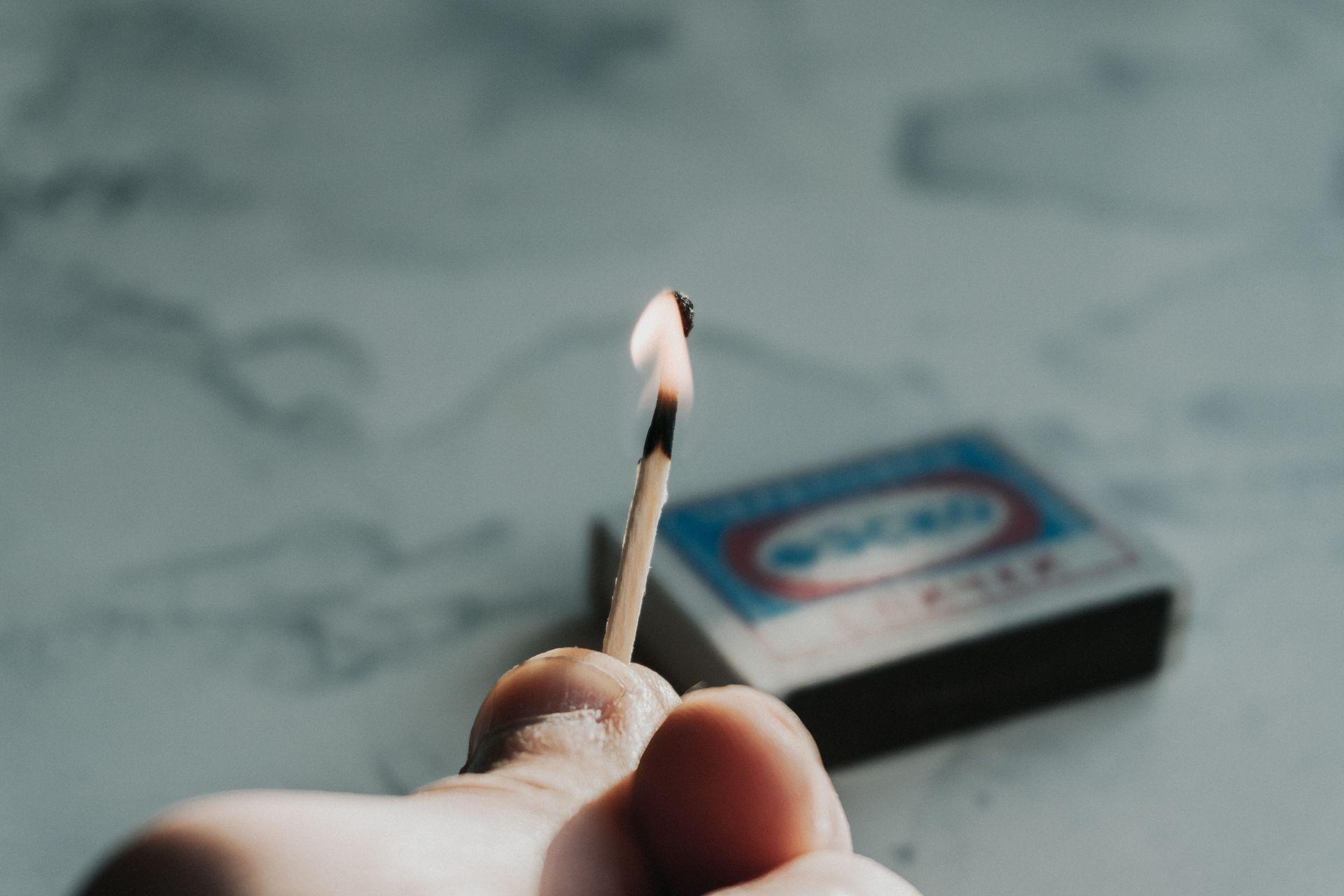
John Walker, a pharmacist in Stockton-on-Tees, England, got there in 1826, partly by accident. A wooden stick coated with a paste of antimony sulfide, potassium chlorate, and gum scraped against his hearth and burst into flame. Walker sold his "friction lights" from 1827, striking them by drawing the head through folded sandpaper. He declined to patent the invention, and imitators moved in quickly, including Samuel Jones of London, who sold his version under the name Lucifers.
Early matches were hazardous in two directions. They ignited unpredictably, throwing sparks, and later white phosphorus formulations poisoned match factory workers, causing the disfiguring necrosis of the jaw known as phossy jaw, a scandal that drove strikes and eventual bans, including an international convention in 1906. The safety match, developed in Sweden in the 1840s and 1850s by Gustaf Erik Pasch and the Lundström brothers, moved the reactive red phosphorus onto the striking surface of the box, so the match could ignite only there.
Fire on demand, in a pocket, for a trivial price arrived roughly 150 years after the necessary chemistry and hundreds of millennia after the need.

Credit: Roger Brown / Pexels
Physicians have listened to the body since antiquity. Hippocratic texts describe sounds in the chest, and by the 18th century doctors practiced direct auscultation, pressing an ear against the patient's chest to hear the heart and lungs. The method was awkward, often ineffective on heavier patients, and socially fraught when the patient was a woman.
The tool that fixed this required rolled paper. In 1816, the French physician René Laennec faced a young female patient with symptoms of heart disease and, reluctant to put his ear to her chest, rolled a sheet of paper into a tight cylinder and placed one end over her heart. He heard the heartbeat more clearly than he ever had with a bare ear. Laennec spent the next three years refining the idea into a hollow wooden tube about 25 centimeters long, coined the name stethoscope from the Greek for chest and observation, and in 1819 published a treatise matching the sounds he heard to diseases confirmed at autopsy.
The instrument transformed diagnosis. Laennec catalogued and named sounds still used in medicine, and his work turned tuberculosis, pneumonia, and heart conditions into things a physician could identify in a living patient with some precision. He died in 1826, of tuberculosis, at 45. The binaural stethoscope with two earpieces and flexible tubing, close to the modern form, was developed by George Cammann in New York in the early 1850s.
Nothing about the stethoscope waited on technology. A hollow tube conducts sound, wood and paper existed always, and the physics of amplification through a cylinder would have worked in ancient Alexandria. What was missing was the act of trying it, and for centuries the profession's answer to a diagnostic problem was simply to endure it. One embarrassed doctor and one sheet of paper ended a 2,000-year wait.

Credit: Lucas Albino / Pexels
Drinking straws are among the oldest tools archaeologists can identify. Sumerians used long tubes, some of precious metal, to drink beer from communal vessels around 5,000 years ago, filtering out solids floating in the brew. Rye grass stalks served the same purpose for centuries afterward, which is why the object is called a straw. The paper straw arrived in 1888, when Marvin Stone of Washington, D.C., patented a spiral-wound paper tube after growing tired of grassy flavor in his mint julep.
The bend took another half century. In the 1930s, Joseph Friedman sat in his brother's fountain shop, the Varsity Sweet Shop in San Francisco, watching his young daughter Judith struggle to drink a milkshake through a straight paper straw taller than her reach. The straw's rigid geometry forced her to stretch over the counter. Friedman took a straw, inserted a screw partway down, wrapped dental floss around the paper into the screw's threads, and removed the screw. The result was a corrugated hinge, a series of accordion folds that let the top of the straw bend to any angle and hold its position without pinching shut.
He patented the flexible straw in 1937 and, after failing to sell the idea to existing straw makers, founded the Flex-Straw Company to manufacture it himself in the late 1940s. The first big customers were not soda fountains but hospitals, where nurses realized bent straws let patients drink while lying down without spilling or sitting up. The bendy straw became a fixture of medical care before it became a fixture of children's birthday parties.
The straw had existed for five millennia. The fix for its one obvious flaw, rigidity, required a screw, some floss, and a parent watching a child fail to reach a milkshake.

Credit: Anna Shvets / Pexels
Surgery before anesthesia was a horror measured in speed. Patients were held or strapped down, dosed with alcohol or opium that dulled little, and operated on while conscious. The best surgeons were the fastest, and amputations were timed in seconds. Patients routinely chose death over the knife.
The strange part is that the escape had been sitting in laboratories for centuries. Diethyl ether was synthesized in the 16th century, and its preparation was described by the botanist Valerius Cordus around 1540. Nitrous oxide was isolated in 1772, and in 1799 the chemist Humphry Davy, after inhaling it extensively, noted in print that it appeared capable of destroying pain and might be used advantageously in surgical operations. Nobody in surgery acted on the suggestion for more than 40 years.
Instead, the gases became entertainment. Traveling lecturers staged laughing gas demonstrations, and medical students held "ether frolics," recreational inhalation parties. At those events, people injured themselves while intoxicated and felt nothing, in full public view. The evidence of painless injury was a party trick for decades.
The connection was finally made in the 1840s. Crawford Long, a Georgia physician who had attended ether frolics, removed a tumor from a patient under ether in 1842 but did not publish until years later. Horace Wells, a Hartford dentist, used nitrous oxide for tooth extractions in 1844, but a public demonstration failed. On October 16, 1846, the dentist William Morton administered ether at Massachusetts General Hospital while surgeon John Collins Warren removed a tumor from a patient's neck. The patient reported no pain, and Warren told the gallery, "Gentlemen, this is no humbug." News crossed the Atlantic within weeks, and ether was in use in London by December.
The chemistry waited 300 years. The observation waited in plain sight at parties. Painless surgery was late by any measure.
Credit: www.kaboompics.com / Pexels
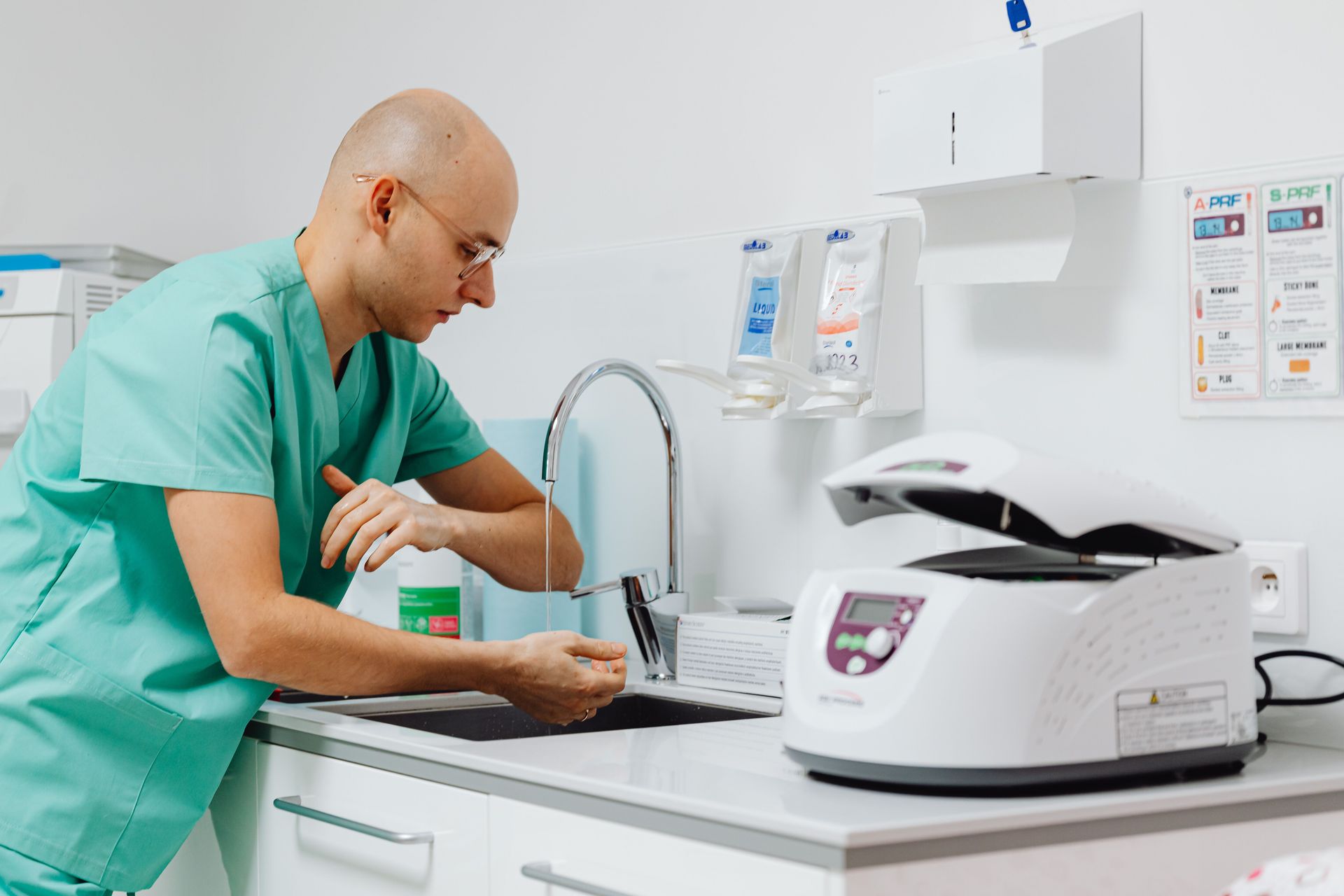
The final entry is not a gadget but a procedure, and its delay killed more people than any missing machine on this list. Physicians in the early 19th century moved directly between autopsies and childbirth wards without washing their hands. Germ theory did not exist, and doctors attributed hospital infections to miasmas, bad air, or the constitution of the patient.
Ignaz Semmelweis, a Hungarian physician working at the Vienna General Hospital's maternity clinic in the 1840s, noticed a brutal pattern. The clinic staffed by physicians and medical students, who performed autopsies, had a maternal death rate from puerperal fever several times higher than the adjacent clinic staffed by midwives, who did not. Women begged to be admitted to the midwives' ward. When a colleague died of an infection after being cut during an autopsy, with symptoms resembling puerperal fever, Semmelweis concluded that "cadaverous particles" were being carried on doctors' hands from the morgue to the delivery room.
In 1847 he required staff to wash their hands in a chlorinated lime solution before examining patients. Mortality in the doctors' clinic collapsed, falling to levels comparable to the midwives' ward. The intervention cost almost nothing and required no new science, only soap-adjacent chemistry that had existed for decades.
The medical establishment largely rejected him. His claims implied that physicians themselves were the vector of death, an accusation many found insulting, and his data preceded any theory explaining the mechanism. Semmelweis grew increasingly bitter and polemical, lost his position, and died in 1865 in a Viennese asylum, reportedly after a beating by guards. Vindication came within two decades, as Louis Pasteur's germ theory and Joseph Lister's antiseptic surgery supplied the missing explanation.
Handwashing needed no invention at all. It needed a profession willing to believe its own hands were the problem, and that took a generation and uncounted lives.