
20 solar system facts that completely change the mental image most people have
Standard solar system diagrams compress distances, exaggerate sizes, and leave out most of what's actually there — these 20 facts give you a more accurate picture
Zelch Csaba / Pexels
Almost every image of the solar system most people have seen is inaccurate in ways that matter. The standard diagram — sun on the left, planets arrayed in a neat row to the right, each one a visible disc with clearly defined rings and moons — compresses the distances between planets by a factor of thousands, inflates the size of the planets relative to the spaces between them by a similar factor, and omits the vast majority of the objects that actually exist in the solar system. It is a useful organizational chart and a misleading picture of what the solar system actually looks like.
The gap between the diagram and the reality is not a minor distortion. If you were to draw the solar system to scale on a piece of paper such that the sun was the size of a period at the end of a sentence, Neptune would be approximately 11 meters away, and the paper would need to be longer than a school bus. Most of the paper would be empty. The planets, at that scale, would be invisible to the naked eye. The actual solar system is almost entirely empty space, punctuated by objects so small relative to the distances between them that the familiar diagram's planets-in-a-row representation is a categorical misrepresentation of the spatial reality.
This list corrects that misrepresentation across 20 specific facts about the solar system whose content revises the mental image that most people form from standard educational diagrams and popular science illustrations. Some of the facts are about scale — how large or small or far away things actually are. Some are about the specific properties of individual planets and moons that diagrams cannot represent. Some are about the objects that standard diagrams omit entirely — the asteroid belt, the Kuiper Belt, the Oort Cloud, the interplanetary dust that fills the space between planets. Some are about the sun itself, whose representation as a stable yellow star does not capture the violence and complexity of its actual behavior.
Each fact is presented with enough context to make the revision to the mental picture specific rather than vague, and with the physical numbers that ground the fact in measurable reality rather than in impressionistic description.
The solar system is almost entirely empty space
The most fundamental misrepresentation in standard solar system diagrams is the apparent density of the system — the impression that the planets are relatively close together in a reasonably filled region of space. The reality is that the solar system is almost entirely vacuum, with the planets separated by distances so large relative to their own sizes that drawing them to scale produces an image that is nearly all empty paper.
The Earth's diameter is approximately 12,742 kilometers. The distance from the Earth to the Moon is approximately 384,400 kilometers — roughly 30 Earth diameters. The distance from the Earth to the Sun is approximately 150 million kilometers — roughly 11,700 Earth diameters. The distance from the Sun to Neptune, the outermost planet, is approximately 4.5 billion kilometers — 30 times the Earth-Sun distance, or approximately 350,000 Earth diameters.
A scale model that represents the Sun as a ball 20 centimeters in diameter — approximately the size of a grapefruit — would place Mercury at approximately 8 meters, Venus at 15 meters, Earth at 21 meters, Mars at 32 meters, Jupiter at 110 meters, Saturn at 200 meters, Uranus at 410 meters, and Neptune at 640 meters. Earth at this scale would be a ball approximately 1.8 millimeters in diameter — smaller than a pinhead. Jupiter, the largest planet, would be approximately 2 centimeters.
The standard diagram that places all eight planets on a single page, each visible as a clearly sized disc, achieves this by compressing the planetary distances by factors of tens to hundreds of thousands while maintaining the planetary sizes at a visible scale. The result is a diagram in which everything is visible and nothing is accurate — useful as an organizational aid and systematically misleading as a spatial representation.
Jupiter is larger than all other planets combined
Zelch Csaba / Pexels
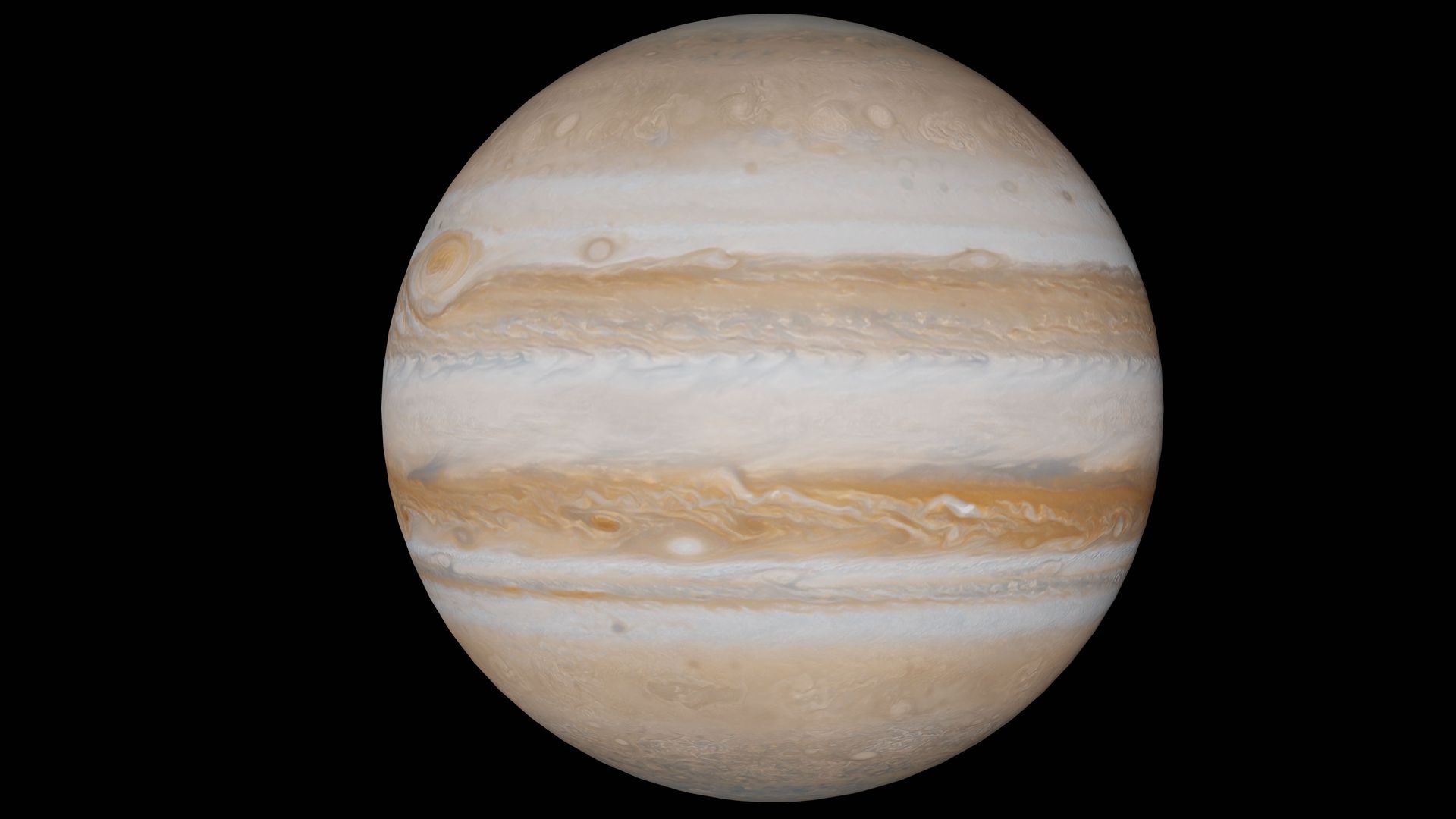
Jupiter's scale relative to the other planets is one of the facts most consistently underestimated from standard diagrams, where size comparisons are either absent or inconsistently applied. Jupiter has a mass of approximately 1.898 × 10²⁷ kilograms — roughly 2.5 times the combined mass of all other planets in the solar system, including Saturn. Its diameter is approximately 143,000 kilometers — 11 times Earth's diameter, meaning that more than 1,300 Earths could fit inside Jupiter by volume.
The implications of Jupiter's mass extend beyond its own properties. Jupiter's gravitational influence shapes the orbital dynamics of the entire solar system, particularly in the inner solar system. The asteroid belt between Mars and Jupiter — rather than having coalesced into a planet during the solar system's formation — remained fragmented partly because Jupiter's gravitational influence prevented the accretion of material in that region, repeatedly disrupting the orbits of planetesimals that might otherwise have merged.
Jupiter is also the solar system's most effective deflector of incoming objects. Comets and asteroids on trajectories toward the inner solar system are frequently captured, deflected, or destroyed by Jupiter's gravity, reducing the flux of impactors that would otherwise reach the Earth. The Shoemaker-Levy 9 comet, which broke into 21 fragments and impacted Jupiter in July 1994, was the most directly observed demonstration of this function — each fragment producing an impact scar larger than Earth's diameter.
Saturn's ring system, while spectacular, is thin in ways that diagrams do not suggest. The rings extend up to 280,000 kilometers from Saturn but are in most places less than one kilometer thick — a sheet of material whose thickness-to-width ratio is comparable to a sheet of paper a kilometer wide.
The sun contains 99.86% of all the mass in the solar system
The mass distribution of the solar system is more extreme than most people appreciate. The sun contains approximately 1.989 × 10³⁰ kilograms of mass — roughly 333,000 times the mass of Earth and approximately 99.86% of the total mass of the solar system. All planets, moons, asteroids, comets, and other objects combined account for approximately 0.14% of the solar system's total mass.
Of that 0.14%, Jupiter accounts for approximately 71% — meaning that Jupiter alone contains more than 0.1% of the solar system's total mass, and all other planets, moons, and smaller bodies together account for less than 0.04%. Earth, with a mass of approximately 5.97 × 10²⁴ kilograms, contains approximately 0.0003% of the solar system's total mass.
The sun's mass is the result of its composition: approximately 70% hydrogen and 28% helium by mass, the lightest elements, present in quantities that the sun's gravitational compression has heated to temperatures sufficient for nuclear fusion. The sun converts approximately four million tonnes of mass into energy every second through fusion — a rate that will continue for approximately another five billion years before the sun exhausts its hydrogen fuel and expands into a red giant.
The concentration of mass in the sun relative to the planets is what determines the structure of the solar system as a gravitational system. The sun's gravitational dominance means that all planetary orbits are nearly circular and nearly planar — the planets all orbit in approximately the same plane, the ecliptic, which is a consequence of the disk of gas and dust from which the solar system formed settling into the sun's equatorial plane under its gravitational influence.
Venus rotates backwards and a day there is longer than a year
Venus is the planet whose specific rotation properties most challenge the standard diagram's implicit assumption that planets behave in broadly similar ways. Venus rotates on its axis in the retrograde direction — clockwise when viewed from above the solar system's north pole, opposite to the direction of most planets — and so slowly that a single rotation takes approximately 243 Earth days. Venus orbits the sun in approximately 225 Earth days. A Venus day is therefore longer than a Venus year.
The consequence for a hypothetical observer on Venus — apart from the 467°C surface temperature and the crushing 92-bar atmospheric pressure that makes surface observation impossible — is that the sun rises in the west and sets in the east, approximately once every 117 Earth days (the synodic day, which is the time between one sunrise and the next, is shorter than the sidereal rotation period because Venus is also moving in its orbit during the rotation).
The cause of Venus's retrograde rotation is not definitively established. The leading hypotheses are a massive collision early in the solar system's history that tilted Venus's axis nearly 180 degrees (which produces the same retrograde rotation as a slow forward rotation combined with an upside-down orientation), or the combined effect of gravitational torques from the sun and the massive Venus atmosphere over billions of years. The question remains open.
Uranus has a different orientation problem: its axial tilt is approximately 98 degrees, meaning it is essentially rolling on its side in its orbit. During Uranus's 84-year orbit, each pole spends approximately 42 years in continuous sunlight and 42 years in continuous darkness — a seasonal cycle with no equivalent in the experience of any other planet.
Saturn's rings would fit between Earth and the Moon
Saturn's rings — the most visually dramatic feature of any planet in the solar system and the feature that most defines how Saturn appears in diagrams — extend approximately 282,000 kilometers from the planet's center, which means the outermost visible ring edge is roughly 73% of the way from Earth to the Moon. The entire ring system, if placed over Earth, would extend from Earth's surface to more than halfway to the Moon.
This scale comparison gives the rings a physical sense that the standard diagram does not. The rings are not decorative bands around a planet — they are a structure of continental dimensions, occupying a volume of space that dwarfs the Earth's entire orbital neighborhood.
The rings are composed primarily of water ice particles ranging in size from microscopic dust to boulders several meters across, with smaller amounts of rocky debris and trace organic compounds. The total mass of all ring material is estimated at approximately 1.5 × 10¹⁹ kilograms — roughly equivalent to the mass of a small moon like Mimas, or about 0.0025 times the mass of Earth's Moon.
The rings are geologically young by solar system standards — estimated to be between 10 million and 100 million years old, compared to the solar system's 4.6 billion year age — which means they did not exist for most of Earth's history. They most likely formed from the breakup of one or more of Saturn's moons, either by a collision with a comet or asteroid or by tidal disruption as a moon migrated too close to Saturn. The rings are also gradually disappearing: ring material is being lost to Saturn's upper atmosphere at a rate that suggests the rings may be gone within another 100 million years.
The Oort Cloud extends halfway to the nearest star
The standard diagram of the solar system ends at Neptune or, in more thorough versions, at the Kuiper Belt — the region of icy bodies beyond Neptune that includes Pluto and thousands of other trans-Neptunian objects extending to approximately 50 astronomical units from the sun. This represents a tiny fraction of the solar system's actual extent.
The Oort Cloud — the theoretical reservoir of comets that surrounds the solar system at distances between approximately 2,000 and 100,000 astronomical units from the sun — extends approximately halfway to Proxima Centauri, the nearest star. One astronomical unit is the Earth-Sun distance; 100,000 astronomical units is approximately 1.58 light-years, compared to the 4.24 light-year distance to Proxima Centauri.
The Oort Cloud has never been directly observed — no telescope has resolved individual Oort Cloud objects — and its existence is inferred from the properties of long-period comets, which have orbital parameters consistent with originating in a distant spherical reservoir. When gravitational perturbations from passing stars or the galactic tide nudge Oort Cloud objects onto trajectories toward the inner solar system, they become the long-period comets that occasionally appear in Earth's skies.
If the Oort Cloud is included in the definition of the solar system — and there is a reasonable argument that it should be, as its objects are gravitationally bound to the sun — then the solar system extends approximately halfway to the nearest star. The heliopause — the boundary of the sun's magnetic influence, where the solar wind meets the interstellar medium — is at approximately 120 astronomical units, which Voyager 1 crossed in 2012. The Oort Cloud begins at approximately 2,000 astronomical units, far beyond the heliopause and deep in interstellar space in terms of the solar wind, but still gravitationally bound to the sun.
Mars's largest moon is only 9 kilometers from being torn apart
Phobos — the larger of Mars's two small moons, a dark, irregularly shaped object approximately 27 kilometers in its longest dimension — is orbiting so close to Mars and descending at such a rate that it is within approximately 9,376 kilometers of Mars's Roche limit, the distance at which tidal forces would overcome the moon's structural integrity and disintegrate it into a ring system.
Phobos orbits Mars at an altitude of approximately 6,000 kilometers — closer to its planet than any other moon in the solar system — and is spiraling inward at approximately 1.8 centimeters per year. In approximately 30 to 50 million years, Phobos will either crash into Mars or disintegrate into a ring, depending on its internal strength. A moon on a death spiral at this proximity to its planet is one of the more specific and verifiable facts about the solar system that the standard diagram completely omits.
The origin of Phobos and Deimos — Mars's two small moons — is contested. The most common hypothesis has been that they are captured asteroids, which their spectral properties and irregular shapes are consistent with. A more recent hypothesis, supported by some numerical simulations, suggests they formed from the debris ejected by a giant impact on Mars, similar to the impact hypothesis for the Moon's formation, which would explain their nearly circular, equatorial orbits that are atypical for captured bodies.
Phobos completes three orbits of Mars per Martian day — it orbits faster than Mars rotates. From the Martian surface, Phobos rises in the west and sets in the east, completing its journey across the sky in approximately four hours. It is small enough in the Martian sky that it does not produce a total solar eclipse — only a partial one.
Europa likely has more liquid water than all of Earth's oceans
Europa — one of Jupiter's four large Galilean moons, discovered by Galileo in 1610 — has a water ice surface criss-crossed by a network of fractures, pressure ridges, and disrupted terrain that indicates an active subsurface ocean of liquid water beneath the ice shell. The ocean is estimated to be approximately 60 to 150 kilometers deep, with a volume of liquid water estimated at approximately two to three times the volume of all water in Earth's oceans combined.
The subsurface ocean is maintained by tidal heating — the flexing of Europa's interior by Jupiter's enormous gravitational field as Europa's elliptical orbit periodically brings it closer to and farther from Jupiter. The same mechanism that drives Io's extraordinary volcanism (the most geologically active body in the solar system) produces a more moderate but still significant heat source in Europa that maintains liquid water beneath an ice shell estimated to be between 15 and 25 kilometers thick.
The significance of Europa's ocean for astrobiology is substantial. Liquid water, chemical energy from the hydrothermal activity at the ocean floor, and the organic compounds delivered by cometary impacts constitute the basic requirements for the type of chemosynthetic life that exists at hydrothermal vents in Earth's deep ocean. Europa is considered one of the most promising candidates for extraterrestrial life in the solar system, and NASA's Europa Clipper mission, launched in 2024, is designed to characterize the ocean and assess its habitability.
Similar subsurface oceans are suspected or confirmed on several other moons: Ganymede and Callisto (also Galilean moons), Enceladus (Saturn), Titan (Saturn, under a hydrocarbon sea rather than water ice), and potentially several other icy moons of the outer solar system. The prevalence of subsurface oceans in the outer solar system has significantly expanded the number of environments in the solar system considered potentially habitable.
The asteroid belt is mostly empty
The asteroid belt — the region between Mars and Jupiter containing the majority of the solar system's asteroids — is typically depicted in diagrams as a dense ring of closely spaced rocks that spacecraft must navigate carefully. The reality is that the asteroid belt is almost entirely empty, and spacecraft that pass through it have never been in any meaningful danger of collision.
The total mass of all material in the asteroid belt is approximately 2.39 × 10²¹ kilograms — roughly 4% of the mass of the Moon, and less than the mass of Pluto. This mass is distributed across a volume of space so large that the average distance between objects in the belt is approximately 600,000 to 1 million kilometers — comparable to the distance between Earth and the Moon.
The largest objects in the belt — Ceres (the only dwarf planet in the inner solar system), Vesta, Pallas, and Hygiea — together account for approximately 51% of the belt's total mass. The millions of smaller objects that constitute the remainder are correspondingly tiny. The spacecraft that have passed through the asteroid belt — Pioneer 10 in 1972, Pioneer 11 in 1973, and the many subsequent missions to the outer planets — crossed it without incident because the probability of encountering an asteroid is negligible.
The asteroid belt's low total mass is itself surprising. Standard models of solar system formation suggest that significantly more material should have accreted in the Mars-Jupiter region. The leading explanation is that Jupiter's gravitational influence during the solar system's early history prevented accretion in that region and may have ejected large quantities of material from the solar system entirely — what is now the asteroid belt is estimated to be less than 0.1% of the material that originally occupied that region.
The sun's surface is cooler than its outer atmosphere
One of the most counterintuitive facts about the sun is the relationship between its surface temperature and the temperature of its outer atmosphere. The photosphere — the sun's visible surface — has a temperature of approximately 5,500 degrees Celsius. The corona — the sun's outer atmosphere, which extends millions of kilometers into space and is visible as a faint halo during total solar eclipses — has a temperature of approximately one to three million degrees Celsius: roughly 200 to 600 times hotter than the surface beneath it.
This temperature inversion — in which temperature increases with distance from the sun rather than decreasing — violates the naive expectation and was a major unsolved problem in solar physics for decades. The corona's extreme temperature requires an energy source that the sun's visible surface cannot directly provide, and the mechanism that heats it has been sought since the corona's temperature was first measured in the 1940s.
The leading current hypotheses involve two mechanisms. The first is wave heating: the sun's magnetic field is constantly disturbed by convective motion in the solar interior, producing waves — Alfvén waves — that propagate outward into the corona and dissipate their energy as heat. The second is nanoflare heating: the corona is continuously heated by innumerable small magnetic reconnection events — nanoflares — that release energy as magnetic field lines snap and reconnect. Both mechanisms may be operating simultaneously.
The Parker Solar Probe, launched in 2018 and making progressively closer passes of the sun, is designed to measure the corona directly at distances closer than any previous spacecraft and to test the competing heating hypotheses. At its closest approach, the probe passes within approximately 6.1 million kilometers of the sun's surface — closer than any previous human-made object.
Pluto is smaller than Earth's Moon
Zelch Csaba / Pexels
Pluto's demotion from planet to dwarf planet in 2006, when the International Astronomical Union adopted a formal definition of "planet" that Pluto did not meet, was the most publicized reclassification in the history of astronomy and the event that prompted many people to learn for the first time that Pluto's size relative to other solar system objects was significantly smaller than they had assumed.
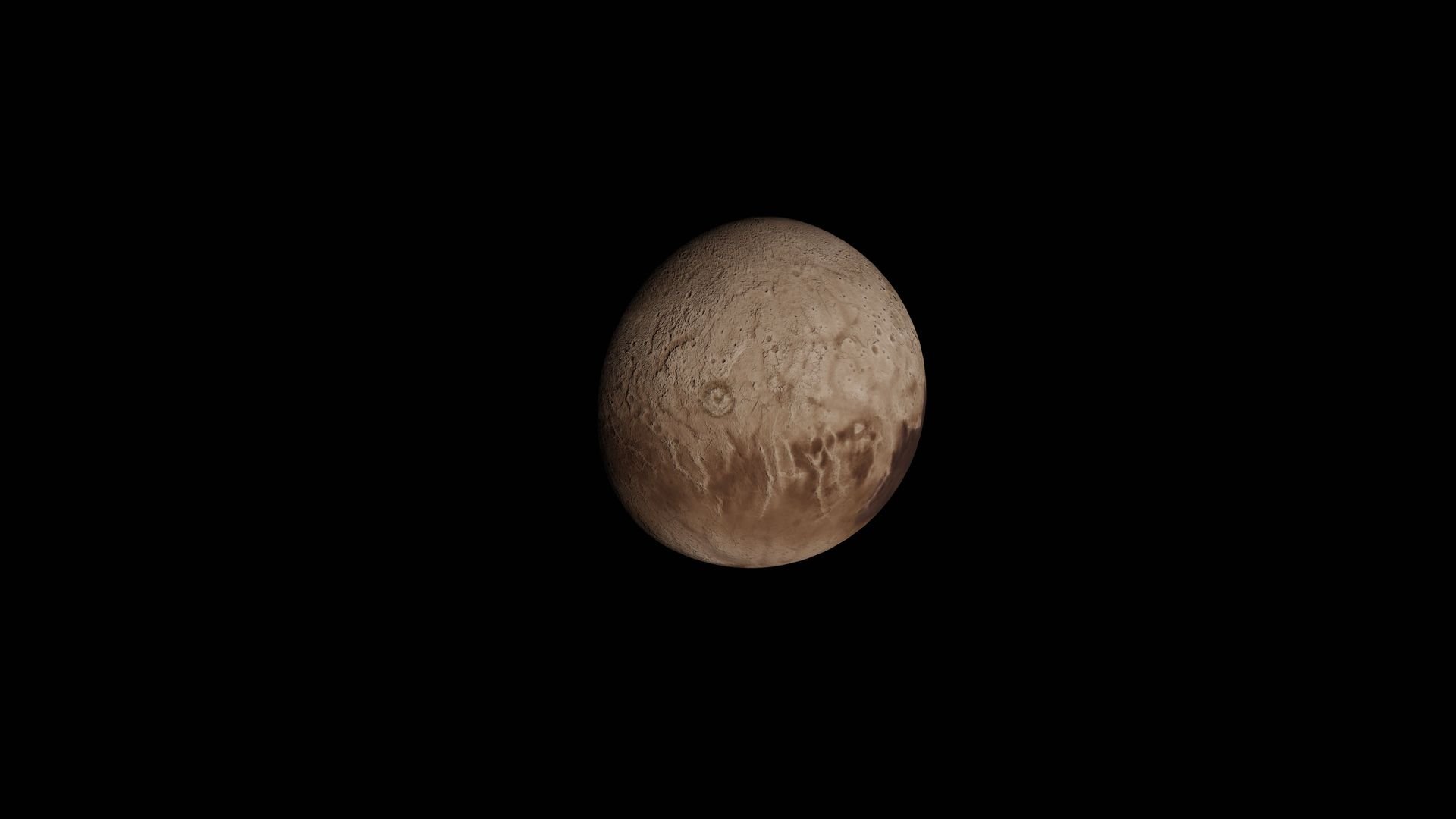
Pluto has a diameter of approximately 2,377 kilometers — smaller than Earth's Moon (3,474 kilometers), smaller than seven of the solar system's moons, and smaller than several other dwarf planets and large trans-Neptunian objects whose discovery in the early 2000s prompted the IAU's definitional discussion. Pluto's mass is approximately 0.0021 times Earth's mass — roughly 0.2% — making it significantly smaller relative to Earth than most people's mental image of a planet suggests.
The New Horizons flyby in July 2015, which produced the first close-range images of Pluto's surface, revealed a world of unexpected geological complexity: mountains of water ice reaching 3,500 meters, a nitrogen ice plain the size of Texas (informally named Tombaugh Regio and shaped roughly like a heart), possible cryovolcanism, and a thin but chemically complex atmosphere. The images corrected the assumption that a small, cold, distant object would be geologically dead.
Pluto's largest moon, Charon, has a diameter approximately half of Pluto's, making the Pluto-Charon system the closest thing to a double dwarf planet in the solar system. The two bodies orbit their common center of mass — the barycenter — which lies outside Pluto itself, in the space between them. Charon is tidally locked to Pluto, always showing the same face, and Pluto is tidally locked to Charon — the two bodies show each other the same face permanently.
A day on Mercury is longer than a year on Mercury
Zelch Csaba / Pexels
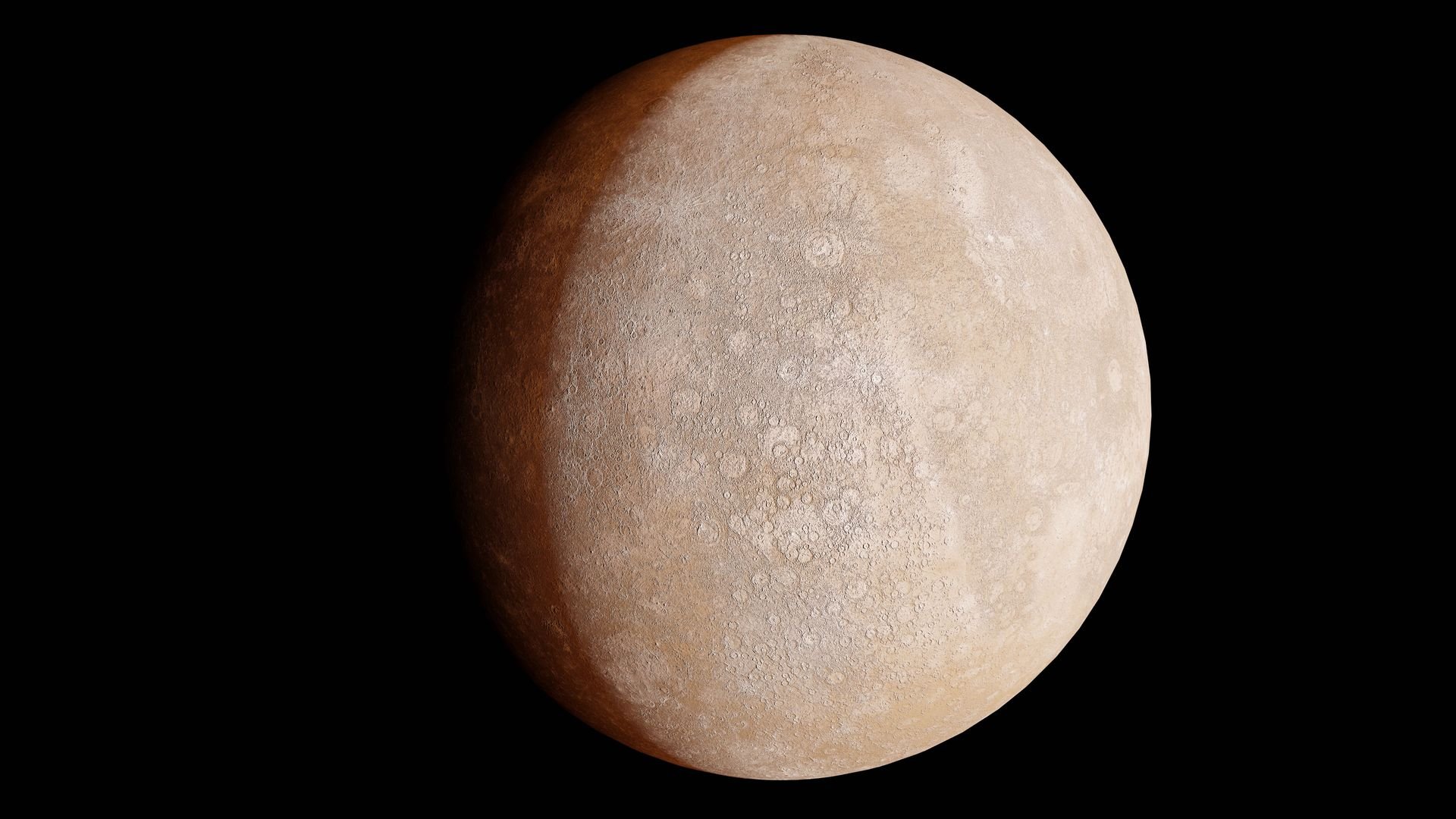
Mercury's rotation and orbit produce a relationship between its day and year that is unusual in the solar system and produces a specific quality of experience for a hypothetical surface observer. Mercury's sidereal rotation period — the time it takes to complete one rotation relative to the stars — is approximately 58.6 Earth days. Mercury's orbital period — one year — is approximately 88 Earth days. A Mercury year is therefore approximately 1.5 Mercury sidereal days.
However, the solar day on Mercury — the time between one sunrise and the next — is approximately 176 Earth days: two Mercury years. The solar day is longer than the orbital period because Mercury's orbital speed is fast enough relative to its rotation rate that the sun appears to move very slowly across the sky, requiring nearly two complete orbits before the sun returns to the same position.
The extreme proximity of Mercury to the sun — its average distance is approximately 0.39 astronomical units, compared to Earth's 1.0 — and its slow rotation produce surface temperature extremes that are the most dramatic of any planet: the sun-facing surface reaches approximately 430°C while the permanently shadowed craters at Mercury's poles, which receive no sunlight, may be cold enough to harbor water ice deposits. NASA's MESSENGER spacecraft confirmed the presence of ice in Mercury's polar craters in 2012.
Mercury has no moon, which is unusual for a rocky planet. The planet's iron core constitutes approximately 85% of the planet's radius — a disproportionately large core whose origin may involve a giant impact that stripped away much of the original mantle, or the effects of solar radiation on the early proto-Mercury that preferentially removed lighter silicate material.
The Great Red Spot is a storm that has lasted at least 350 years
T Keawkanok / Pexels
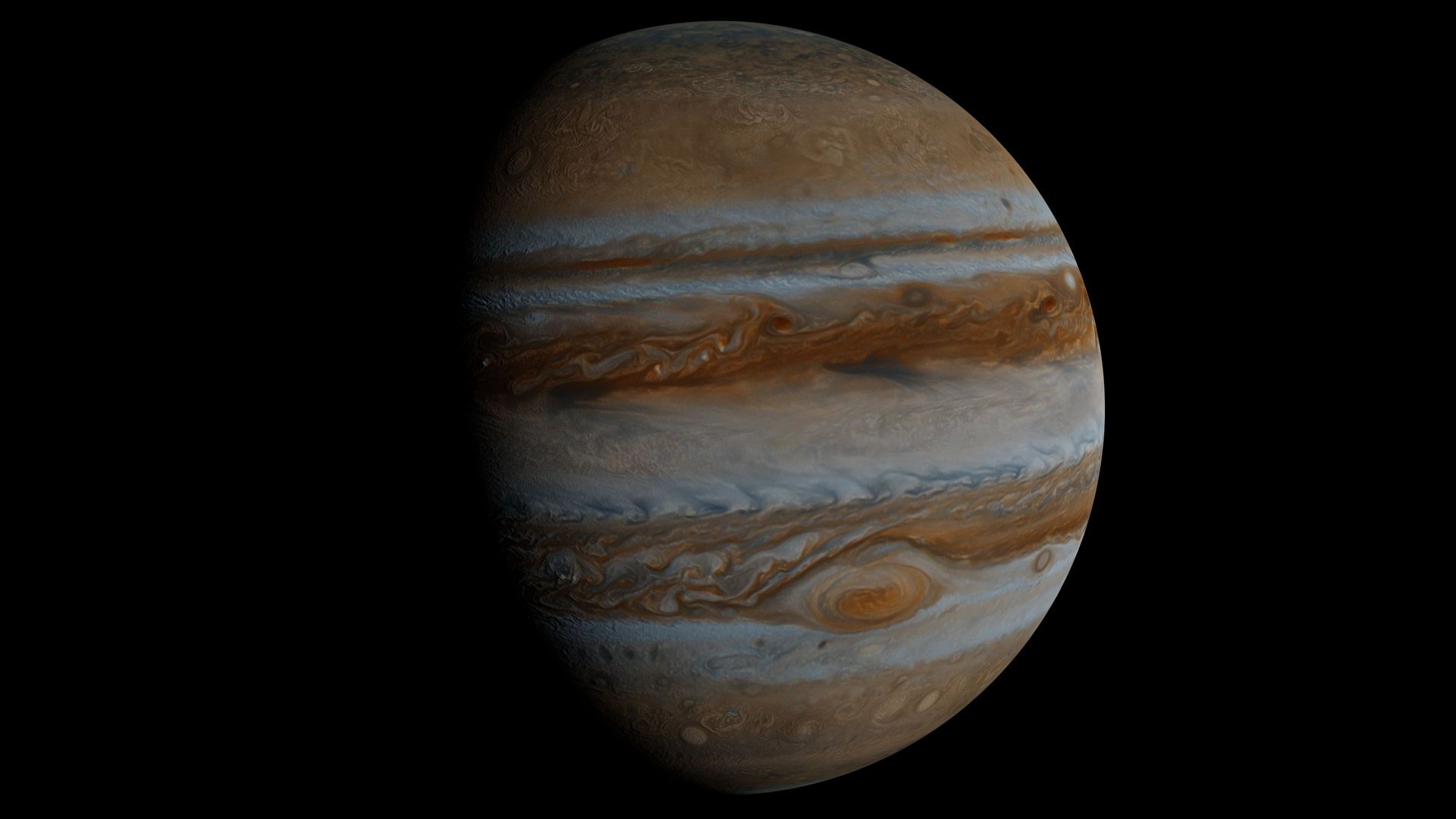
Jupiter's Great Red Spot — the oval feature visible in virtually every photograph of the planet, located in Jupiter's southern hemisphere — is a persistent anticyclonic storm whose maximum extent was approximately 40,000 kilometers in the 19th century (larger than three Earths side by side) and whose current extent is approximately 16,000 kilometers, a shrinkage that has been monitored and debated since the 1930s.
The storm has been continuously observed since at least 1831, and historical records suggest that an earlier feature observed in 1665 by Giovanni Cassini may be the same storm — giving it a continuous existence of at least 350 years and potentially nearly 400. The mechanism that sustains a storm of this longevity and scale is the subject of ongoing research: Jupiter's lack of a solid surface (which would generate friction that dissipates storm energy on Earth), the continuous energy input from Jupiter's internal heat, and the storm's interaction with adjacent jet streams are all thought to contribute.
The spot's shrinkage has accelerated since the 2010s, and some researchers have suggested that the feature may disappear entirely within decades. The shrinkage is accompanied by an increasing rotation rate — as the storm shrinks, it spins faster, like a figure skater pulling in their arms — and a change in shape from oval to more nearly circular. The mechanisms driving the shrinkage are not definitively established.
Jupiter has multiple smaller storms that have been observed forming, merging, and dissolving over the decades of continuous monitoring since the Voyager flybys in 1979. The atmosphere's banded structure — alternating light zones and dark belts driven by Jupiter's rapid 10-hour rotation — is itself a form of organized weather pattern that has no equivalent in the solar system's other planets.
Io has hundreds of active volcanoes
Io — the innermost of Jupiter's four large Galilean moons, slightly larger than Earth's Moon — is the most geologically active body in the solar system, with more than 400 active volcanoes on its surface producing a continuous turnover of material that resurfaces the entire moon on a geological timescale measured in thousands rather than millions of years. Io's surface contains no impact craters — the volcanic activity buries them faster than they can accumulate.
The heat source is tidal heating. Io's elliptical orbit, maintained by orbital resonances with the other Galilean moons, causes it to be alternately squeezed and stretched by Jupiter's gravity as it moves through its orbit — the tidal flexing generates internal heat at a rate that makes Io's heat flux approximately 40 times greater than Earth's. The interior is partially or fully molten, and the surface is continuously replenished by lava flows, volcanic plumes, and sulfur dioxide frost deposits.
The Voyager 1 spacecraft discovered Io's volcanism in 1979, when navigation engineer Linda Morabito noticed a circular feature in an image that turned out to be a volcanic plume 300 kilometers high. The discovery was not anticipated — Io was expected to be geologically dead, like Earth's Moon — and it fundamentally changed the understanding of tidal heating as an energy source for geological activity in icy and rocky moons throughout the outer solar system.
Io's largest known volcanic feature, Loki Patera, is a lava lake approximately 200 kilometers in diameter — larger than Lake Victoria — whose surface periodically overturns as the cooled crust sinks and is replaced by fresh magma in a cycle with a period of approximately 540 days that has been tracked from Earth-based telescopes.
Neptune has winds faster than any other planet
Zelch Csaba / Pexels
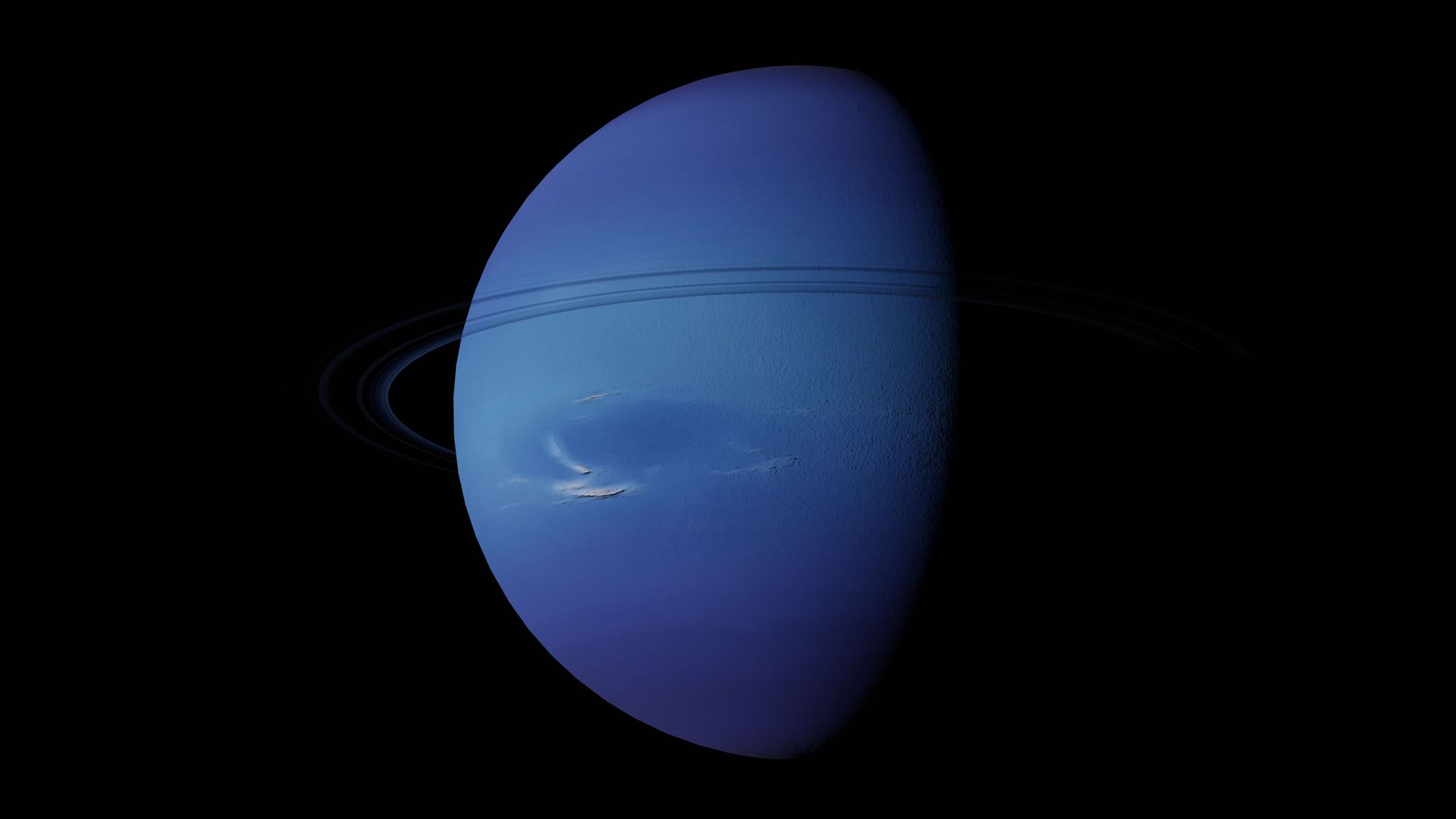
Neptune — the outermost planet, discovered mathematically in 1846 before being directly observed — receives only about 1/900th of the sunlight that Earth receives, yet has wind speeds of approximately 2,100 kilometers per hour in its upper atmosphere — the fastest winds of any planet in the solar system. The combination of extreme cold and extreme wind speed at Neptune's cloud tops (approximately -218°C) produces conditions unlike those of any planet in the inner solar system.
The source of Neptune's strong winds, despite its low solar energy input, is not fully understood. Neptune emits approximately 2.6 times more heat than it receives from the sun, indicating a substantial internal heat source — either residual heat from the planet's formation or gravitational energy from the slow differentiation of the planet's interior — that drives the atmospheric circulation. The internal heat production distinguishes Neptune and Jupiter (which emits 1.7 times more heat than it receives) from Uranus, which emits approximately the same amount of heat as it receives and whose atmosphere is correspondingly much less active.
Voyager 2's 1989 flyby of Neptune, which produced the only close-range images of the planet in existence, revealed a Great Dark Spot — an anticyclonic storm comparable in relative size to Jupiter's Great Red Spot — that had disappeared by the time Hubble Space Telescope observations were made in 1994. Unlike Jupiter's persistent storm, Neptune's dark spots appear to be transient, forming and dissipating on timescales of years rather than centuries.
Neptune's largest moon, Triton, orbits the planet in the retrograde direction — opposite to Neptune's rotation — at an inclination that makes it almost certainly a captured Kuiper Belt object rather than a body that formed in place. Triton's retrograde orbit means it is spiraling inward due to tidal forces and will eventually be destroyed in approximately 3.6 billion years.
Enceladus has geysers that feed Saturn's rings
Enceladus — a small moon of Saturn, approximately 500 kilometers in diameter — was one of the most surprising discoveries of the Cassini mission, which operated at Saturn from 2004 to 2017. The moon has a subsurface ocean beneath an ice shell approximately 20 to 25 kilometers thick, and geological activity in that ocean drives geysers of water vapor and ice particles from fractures near the south pole that spray material into Saturn's E ring — the outermost broad ring — continuously replenishing the ring with material from the moon's interior.
The plumes, discovered by Cassini in 2005, extend hundreds of kilometers above the surface. Cassini made multiple passes through the plume material and detected water vapor, ice particles, sodium chloride, silica nanoparticles, carbon dioxide, methane, molecular hydrogen, and complex organic molecules — a chemical inventory that indicates hydrothermal activity at the ocean floor, where hot water interacts with rock in the same general way that hydrothermal vents on Earth's ocean floor operate.
The molecular hydrogen in the plumes is particularly significant: it indicates that hot rock is reacting with water in a chemical reaction (serpentinization) that also occurs at Earth's hydrothermal vents and provides the chemical energy source for chemosynthetic life in Earth's deep ocean. Enceladus is considered, alongside Europa, the most promising candidate for extraterrestrial life in the solar system.
Enceladus's geyser activity is one of the few examples of active geological communication between a moon's interior and a planet's ring system, and it demonstrates that Saturn's rings are not static structures but dynamic systems continuously replenished and modified by the moons embedded in or adjacent to them.
The solar system formed from the remnants of an older star
The elements that compose the solar system — including the carbon, oxygen, iron, and calcium in every human body — were not created in the sun. They were synthesized in earlier generations of stars that lived and died before the solar system formed approximately 4.6 billion years ago, and the sun formed from the cloud of gas and dust enriched by those stellar deaths.
Hydrogen and helium — the two lightest elements, constituting approximately 98% of the sun's mass — were produced in the Big Bang approximately 13.8 billion years ago. All heavier elements — carbon, nitrogen, oxygen, iron, and everything on the periodic table beyond helium — were produced in the nuclear furnaces of stars and distributed into the interstellar medium when those stars died, either as planetary nebulae (for stars of roughly solar mass) or as supernovae (for more massive stars).
The iron in Earth's core, the calcium in human bones, the oxygen in the atmosphere — all were processed through at least one and likely multiple previous stellar generations before being incorporated into the cloud of gas and dust that collapsed to form the sun and planets. The solar system is, in this precise sense, made of star stuff — a phrase that Carl Sagan used and that reflects a physically verifiable fact about the origin of every atom of which the solar system is composed.
The isotopic composition of the solar system's material — the specific ratios of different isotopes of elements like oxygen and nitrogen — preserves a record of the specific stellar populations that contributed material to the presolar cloud. Analysis of presolar grains — microscopic mineral inclusions in meteorites that formed in other stellar systems and survived the formation of the solar system intact — provides direct physical evidence of the specific types of stars whose material was incorporated.
Mars' tallest volcano is nearly three times the height of Everest
Olympus Mons — the largest volcano in the solar system, located on the Tharsis plateau of Mars — is approximately 22 kilometers tall from its base to its summit, nearly three times the height of Mount Everest above sea level (8.8 kilometers). Its base diameter is approximately 600 kilometers — an area roughly the size of France — and its caldera at the summit is approximately 80 kilometers wide and 3 kilometers deep.
The scale of Olympus Mons relative to anything on Earth is a consequence of two Martian properties. The first is lower gravity: Mars's surface gravity is approximately 38% of Earth's, which allows volcanic edifices to grow much taller before their weight causes the underlying crust to deform. The second is the absence of plate tectonics: Earth's crust moves continuously over mantle hot spots, producing chains of volcanic islands (like Hawaii) as the plate moves over the hot spot. Mars's crust does not move in the same way, allowing magma to continuously build up in one location over billions of years, producing a single massive edifice rather than a chain.
The Tharsis plateau on which Olympus Mons and three other large volcanoes sit — Arsia Mons, Pavonis Mons, and Ascraeus Mons, each comparable in height to Olympus Mons — is itself a colossal volcanic structure approximately 5,000 kilometers wide and 12 kilometers high, whose mass is so great that it has visibly deformed the Martian lithosphere, tilting the crust around it.
Whether Olympus Mons is currently extinct or merely dormant is not established. The most recent evidence of volcanic activity on Mars dates to as recently as 25 million years ago — geologically very recent — and some researchers believe that Mars may still be volcanically active at low levels.
The sun moves through the galaxy
The solar system is not stationary. The sun — along with all of its planets, moons, asteroids, and comets — is orbiting the center of the Milky Way galaxy at approximately 230 kilometers per second, in an orbit that takes approximately 225 to 250 million years to complete. The last time the solar system was at its current position in the galaxy, the Triassic period was just beginning, dinosaurs had not yet appeared, and the supercontinent Pangaea was still intact.
The solar system also bobs up and down relative to the plane of the galaxy — oscillating through the galactic midplane approximately every 30 million years, a cycle that has been proposed as a contributing factor in periodic increases in cometary bombardment of Earth when the solar system passes through the denser regions near the galactic plane.
At the solar system's level within the galaxy — approximately 26,000 light-years from the galactic center, in the Orion Arm — the density of stars is approximately 0.14 stars per cubic parsec. The nearest known star, Proxima Centauri, is 4.24 light-years away, and the nearest stars to the sun have changed over geological time as the sun's galactic orbit has carried it through different stellar neighborhoods.
The direction of the solar system's current motion through space — the solar apex — is toward the constellation Hercules, at approximately 20 kilometers per second relative to the local standard of rest (the average motion of nearby stars). This local motion is distinct from the orbital motion around the galactic center, which is approximately ten times faster, and from the motion of the Milky Way itself through the universe, which is hundreds of kilometers per second relative to the cosmic microwave background.
Titan has rivers and lakes, but not of water
Titan — Saturn's largest moon and the second largest moon in the solar system, slightly larger than the planet Mercury — is the only moon with a dense atmosphere and the only body in the solar system besides Earth known to have stable liquid on its surface. The liquid is not water. Titan's surface temperature of approximately -179°C is far too cold for liquid water; instead, Titan has rivers, lakes, and seas of liquid methane and ethane, distributed primarily across its polar regions.
The Cassini mission mapped Titan's surface through its opaque orange haze using radar, revealing a world of striking Earthlike topography: river channels, deltas, lakes of various sizes, and two large polar seas — Kraken Mare and Ligeia Mare — with a combined area comparable to Earth's Caspian Sea and Black Sea. The rivers carved into Titan's water-ice bedrock by liquid methane erosion produce drainage patterns visually indistinguishable from those carved by liquid water on Earth, reflecting the fact that the same physics governs fluid flow regardless of the specific fluid.
The methane cycle on Titan mirrors Earth's water cycle. Methane evaporates from the surface and seas, rises through the atmosphere, condenses into clouds, and falls as methane rain. Cassini observed active methane rain near Titan's equator during its mission. The source of Titan's atmospheric methane — which is photochemically destroyed and should be depleted on timescales of tens of millions of years without a replenishment mechanism — is unknown, with cryovolcanism (eruptions of water-ammonia mixtures from the interior) as the leading hypothesis.
NASA's Dragonfly mission, a rotorcraft lander scheduled to arrive at Titan in 2034, will fly between sites on Titan's surface to study its complex organic chemistry — Titan's atmosphere produces a range of organic molecules including tholins, complex organic compounds whose chemistry is relevant to understanding the origin of life — and to investigate whether the moon's subsurface water ocean (inferred but not directly confirmed) or its surface chemistry offers conditions relevant to prebiotic chemistry.