
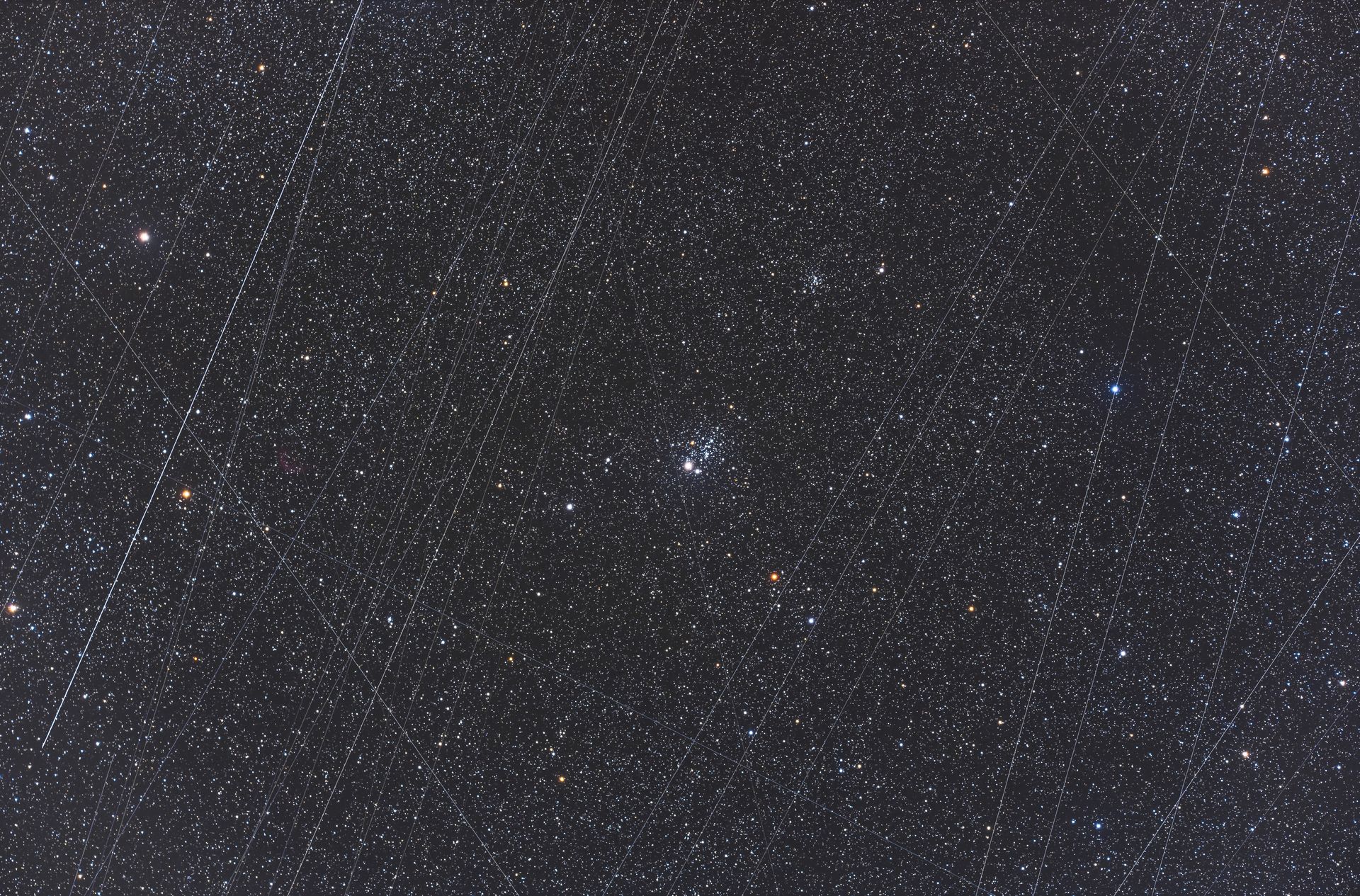
The case for building AI data centers in space rests on an appealing logic: solar power is stronger in space, permitting battles vanish, and launch costs keep falling. What it tends to skip past is the environment those data centers would inhabit. Low-Earth orbit isn't empty. It's a junkyard moving at 17,500 miles per hour, and every year the mess gets worse.
About 44,870 objects are now tracked by space surveillance networks, according to the European Space Agency's Space Debris User Portal. Of those, only about 9,300 are active satellites. The rest is debris: spent rocket stages, dead spacecraft, fragments from explosions and collisions. Those are just the objects large enough to track. ESA's debris model estimates 1.2 million objects between one and 10 centimeters in size, and 140 million smaller than one centimeter. A one-centimeter fragment at orbital velocity carries enough energy to destroy a satellite.
In 2024 alone, several major fragmentation events added more than 3,000 new tracked objects to the orbital population, according to ESA. Even without any additional launches, the number of space debris objects will keep growing. Fragmentation events add new debris faster than debris can naturally re-enter the atmosphere. SpaceX, Google $GOOGL, and others are considering launching thousands more large satellites in this environment.
A crowded orbit getting more crowded
Doubling the number of objects in a given orbital band increases collision risk by about four times, according to the ESA. That relationship is what makes the scenario NASA scientists Donald J. Kessler and Burton G. Cour-Palais described in their 1978 paper so dangerous. Above a certain density threshold, collisions generate fragments that cause further collisions, creating a self-sustaining cascade. NASA has warned that some experts believe low-Earth orbit is already at critical mass at altitudes between 900 and 1,000 kilometers.
The proposals on the table would concentrate new mass in the most congested orbital bands. Google's Project Suncatcher envisions clusters of 81 satellites flying in formation within a one-kilometer radius, with neighboring spacecraft separated by as little as 100 to 200 meters, at an altitude of about 650 kilometers. That's in one of the most crowded shells in low-Earth orbit. At about 550 kilometers altitude, the ESA's 2025 report shows that the number of debris objects capable of destroying a satellite has grown to roughly match the number of active satellites at that height.
SpaceX has filed with the FCC for an orbital data center constellation of up to one million satellites in low-Earth orbit — on top of the roughly 10,400 Starlink communications satellites already in orbit — with FCC authorization for 15,000 Gen2 satellites in total and an application pending for about 15,000 more. Starlink alone accounts for about 75% of all active maneuverable satellites in Earth orbit, and the operational burden is already showing. Its satellites executed about 300,000 collision-avoidance maneuvers in 2025, a 50% increase from 2024. Each satellite now performs up to 40 maneuvers per year. Every maneuver burns propellant, shortens operational life, and introduces trajectory uncertainty for other operators.
The stakes of getting it wrong
Data center satellites would be different from communications satellites in a critical way. They'd be larger, carry more mass, and fly in tight formations that compress the margin for error. Analysis by space scientist Mojtaba Akhavan-Tafti found that when satellites fly less than a few hundred meters apart, a single impact or maneuvering failure could destroy one node and throw debris into its neighbors, turning a local accident into a chain reaction within the formation. A dense array such as Suncatcher could encounter debris larger than a grain of sand every five seconds.
The regulatory framework offers little guardrail. The U.N.'s space debris mitigation guidelines aren't legally binding, and there's no international cap on constellation size, no global enforcement mechanism for debris mitigation, and no authority with the mandate to say no to a filing for a million satellites. The FCC adopted a five-year deorbit rule in 2022 that requires operators to remove spacecraft from low-Earth orbit within five years after mission completion, but that addresses end-of-life disposal, not the scale of what gets launched. A National Space Society analysis submitted to the U.N. found that voluntary compliance "is insufficient to address the orbital debris issue and is not likely to stabilize its population growth. Only strong national or international regulation can correct this market failure."
The ESA's 2025 report calls for active debris removal, not just mitigation, to prevent collisions from compounding into a chain reaction that makes certain orbits unusable. The orbital data center thesis depends on solving heat dissipation, radiation hardening, latency, maintenance logistics, and launch economics. Those are engineering problems with engineering solutions. The debris problem is different. It's a commons problem, regulated by a framework built for an era when a few hundred satellites occupied the sky. Adding thousands of large, high-value satellites to already-stressed orbital bands raises the risk for everything else in orbit.
