
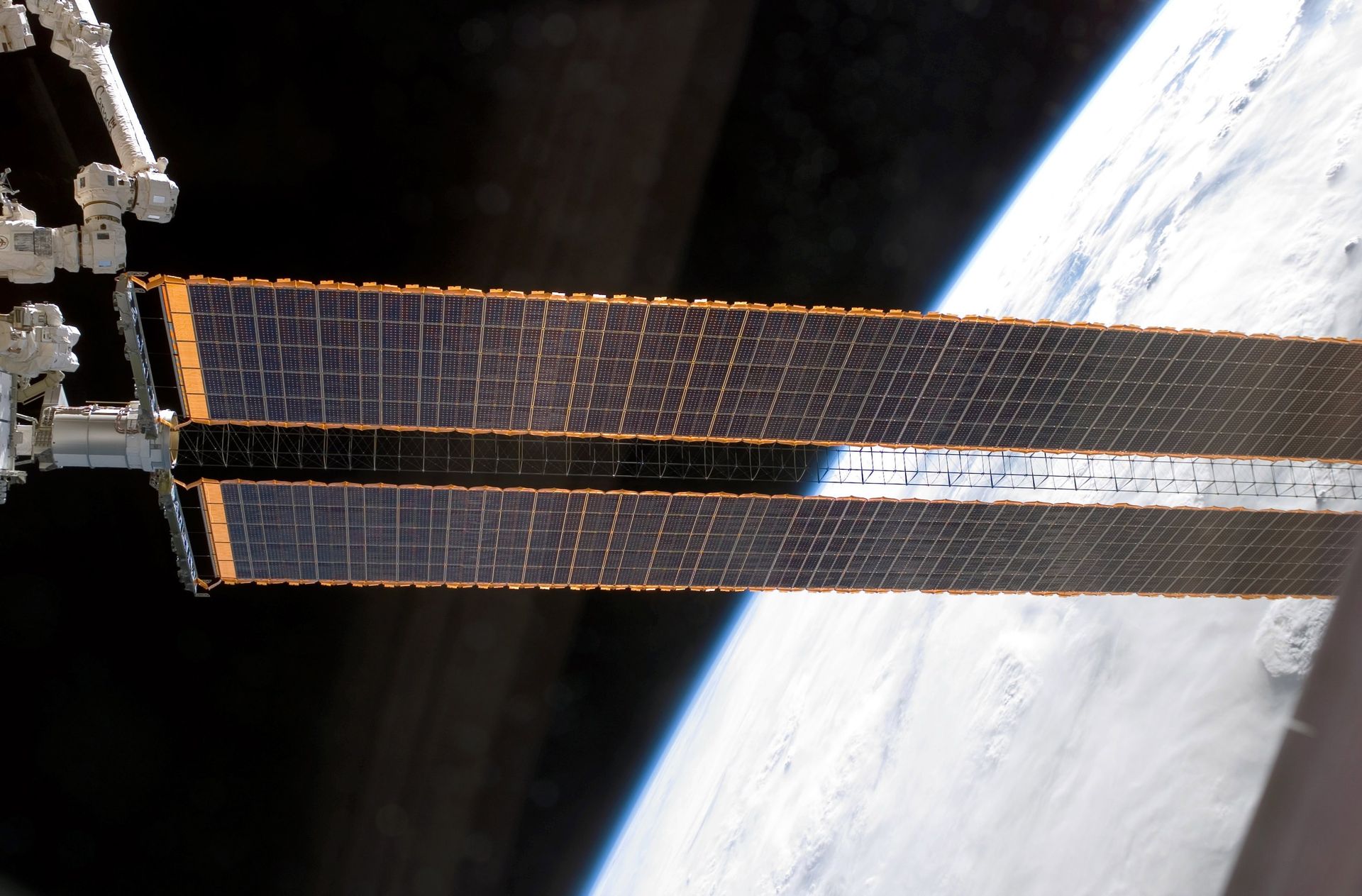
The case for building AI data centers in space rests on a single claim: that solar panels in orbit generate dramatically more power than panels on the ground. Google $GOOGL's Project Suncatcher team has put the multiplier at up to eight times. Startups pitching investors on space-based computing have used the same number.
The claim compares a panel in near-continuous sunlight against one that contends with night, clouds, heat and seasonal variation across a full year. A solar farm that looks productive on a clear afternoon delivers far less when averaged across 12 months.
In the best-case orbital scenario, the eightfold multiplier holds. In a more typical comparison, it lands closer to five. The true cost of getting those panels into orbit has to be justified against a more modest power advantage.
Start with the sun
The sun delivers a fixed amount of energy to anything in its path at Earth's distance. NASA's Goddard Space Flight Center and the NOAA Total Solar Irradiance Climate Data Record put the number at 1,361 watts per square meter, which translates as the maximum possible input before anything gets in the way. Nothing does in space, but on the ground, the atmosphere takes its cut, absorbing and scattering roughly 25% to 30% of the sun's energy before it can even reach a panel. Under ideal conditions — a clear sky, sea level, the sun directly overhead — about 1,000 watts per square meter arrives at the surface. That's the best a ground panel can receive.
Most of the time, conditions aren't ideal. The real comparison must account for nightfall, clouds, and panel orientation over a full year. That's where the ground figure falls away sharply.
The U.S. Energy Information Administration tracks the gap using a measure called capacity factor — the ratio of what a plant actually produces to what it would produce if it ran at full power around the clock. For utility-scale solar in the U.S., it averaged about 25% from 2014 through 2017. Arizona led at 29.1%. California, home to 37% of national capacity, came in at 28.4%.
A 25% capacity factor means a solar farm rated at 1,000 watts produces, on average, 250 watts over a full year. Night alone accounts for roughly half of that loss. Clouds, dust, rain, snow, panel angle and seasonal variation take the rest. The Topaz Solar Farm in California, a 550-megawatt facility, illustrates how much real-world performance can drift: its 26.6% capacity factor from 2015 through 2018 fell to 19.8% between January 2023 and December 2025.
Heat compounds the losses in ways that are easy to overlook. A typical crystalline silicon panel loses 0.3% to 0.5% of its efficiency for every degree Celsius above 25°C, according to 8MSolar. On a hot day where panel temperatures reach 60°C, that translates to a 10% to 15% drop in output. The sunniest locations, which look best on paper, are often the hottest — and heat quietly erodes the advantage that sunshine creates.
Where the multiplier holds and where it doesn't
A solar panel in orbit has one significant advantage over one on the ground: it can stay in sunlight almost continuously. The right orbit positions the panel so that it tracks the boundary between Earth's day and night sides rather than passing through both. At 600 to 800 kilometers above Earth, that boundary is stable enough to sustain near-constant exposure across a full year.
The multiplier shifts depending on what the orbital panel is being compared against. A desert farm in Arizona, with a 29% capacity factor and favorable temperatures, produces a much smaller multiplier than a cloudy northern installation operating at 15%. The orbital panel is the same in both cases. The ground condition is what moves the number between five and eight times.
The orbital side contends with its own losses. Even the best orbits experience brief eclipse periods around winter solstices, and batteries remain essential to bridge them. Panels in space also degrade from radiation exposure, though NASA measurements of the International Space Station's solar arrays found degradation running below predicted levels, broadly comparable to the median 0.5% annual decline NREL documented for ground installations.
If the power must be beamed to the ground, losses multiply. A 1975 NASA-JPL experiment tested whether microwave transmission could carry solar power from space to Earth — the most plausible method for doing so — and achieved 54% end-to-end efficiency. Nearly half the energy collected in orbit was lost before reaching the surface, cutting the effective power advantage roughly in half for any application requiring ground delivery.
For orbital data centers, the power is consumed where it's generated. That's the scenario where the multiplier matters most, and where the five-to-eight times range withstands scrutiny.
