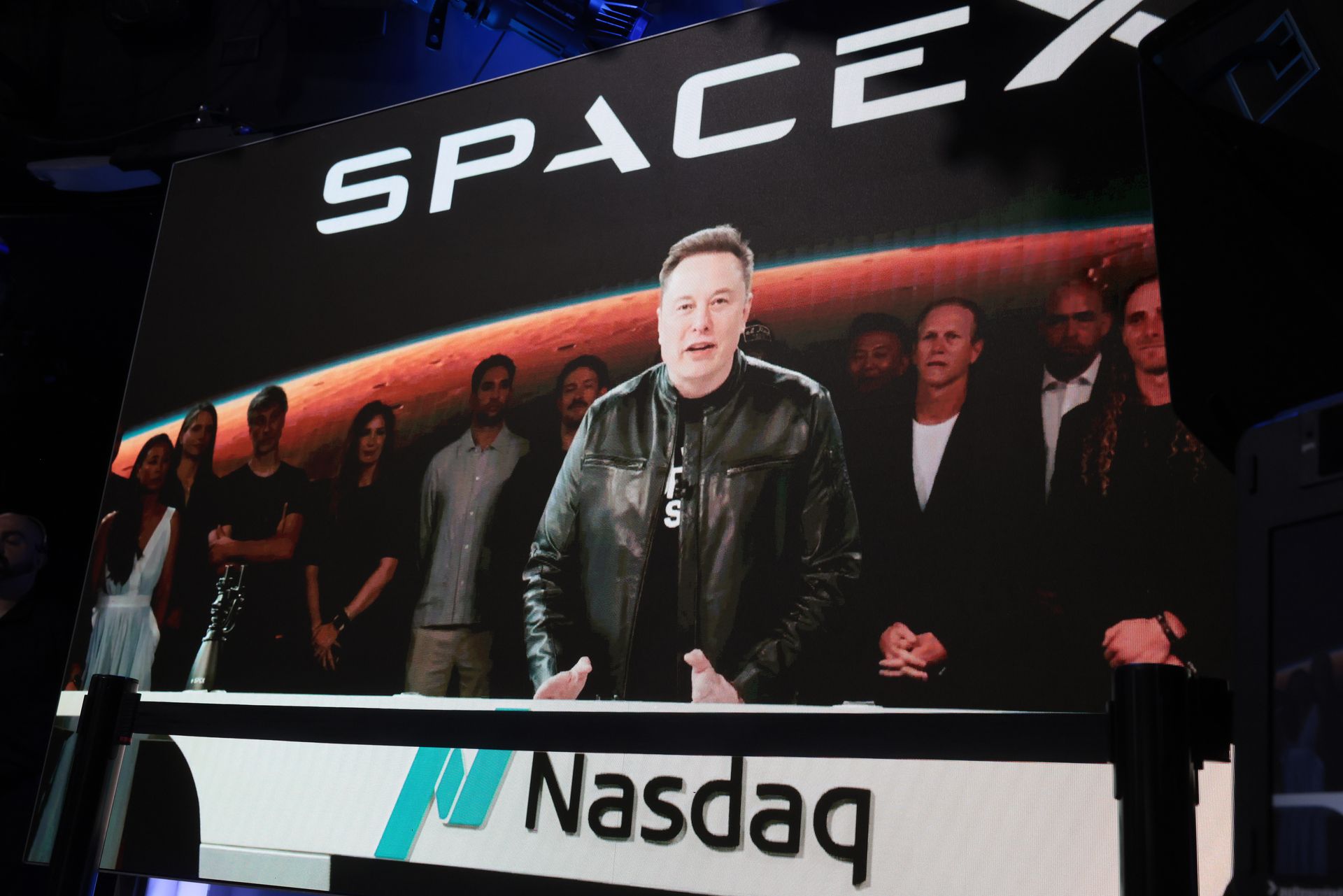
Shares of SpaceX shed 7% on Thursday, capping a rough end to a shortened trading week after an explosive post-IPO run left the stock well above its opening price.

The post-IPO run-up had drawn scrutiny from analysts concerned about whether SpaceX's fundamentals could eventually support its valuation
Spencer Platt / Getty Images
Shares of SpaceX shed 7% on Thursday, capping a rough end to a shortened trading week after an explosive post-IPO run left the stock well above its opening price.
Wednesday had already brought a 5% loss, marking the start of a two-session slide that reversed some of the gains accumulated since the Nasdaq $NDAQ debut. SpaceX priced its IPO at $135 per share, and the stock had risen more than 40% through Tuesday's close before losing ground in the final two sessions of the week.
By the end of trading on Wednesday, the company's total valuation had settled at $2.52 trillion, trailing Amazon $AMZN by a narrow margin. At its peak on Tuesday, the company's valuation had surpassed both Amazon and, briefly, Microsoft $MSFT, placing it among the four most valuable publicly traded companies in the United States. The IPO raised $75 billion, surpassing Saudi Aramco's 2019 offering to set a record.
Also on Wednesday, SpaceX announced the appointment of Roelof Botha to its board of directors as an independent director, effective immediately. A seat on the audit committee is part of his role. SpaceX noted in the filing that Botha's background spans multiple public company boards and includes substantial audit committee work; he also has a prior connection to Musk, having joined PayPal $PYPL's finance division when Musk was running the company.
With more than 82% of voting power concentrated in his hands and a personal stake valued at over $1 trillion, Musk holds near-total authority over the company, leaving investors who bought shares at the IPO with few levers to push back on his direction. Musk serves as chairman, CEO, and technology chief.
The post-IPO run-up had drawn scrutiny from analysts concerned about whether SpaceX's fundamentals could eventually support its valuation. In 2025, the company recorded $18.7 billion in revenue but posted a net loss of $4.9 billion, with losses continuing into 2026 with an additional $4.28 billion through the first quarter. On Sunday, a post from Musk on X $TWTR floated the possibility that annual revenue could hit $1 trillion by 2030, with Musk writing the company "might be able to reach approximately" that figure.
Peter Boockvar, chief investment officer at One Point BFG Wealth Partners, said on CNBC's "Squawk Box Asia" that investors are "trading the story, they're trading the action, they're trading the excitement, they're trading Elon Musk, but at some point the rubber meets the road in terms of the fundamentals having to match up with that excitement." He added that closing the gap between price and performance "is going to take at least a couple of years."
Join 500,000+ readers who start their day with Quartz.
By subscribing, you agree to our Terms of Service and Privacy Policy.