
The Supreme Court on Friday struck down some of President Donald Trump's sweeping tariffs, dealing a significant blow to his second-term agenda that he quickly vowed to reverse.
The court said the president does not have unilateral authority to impose import taxes. The U.S. government may still be obligated to issue refunds
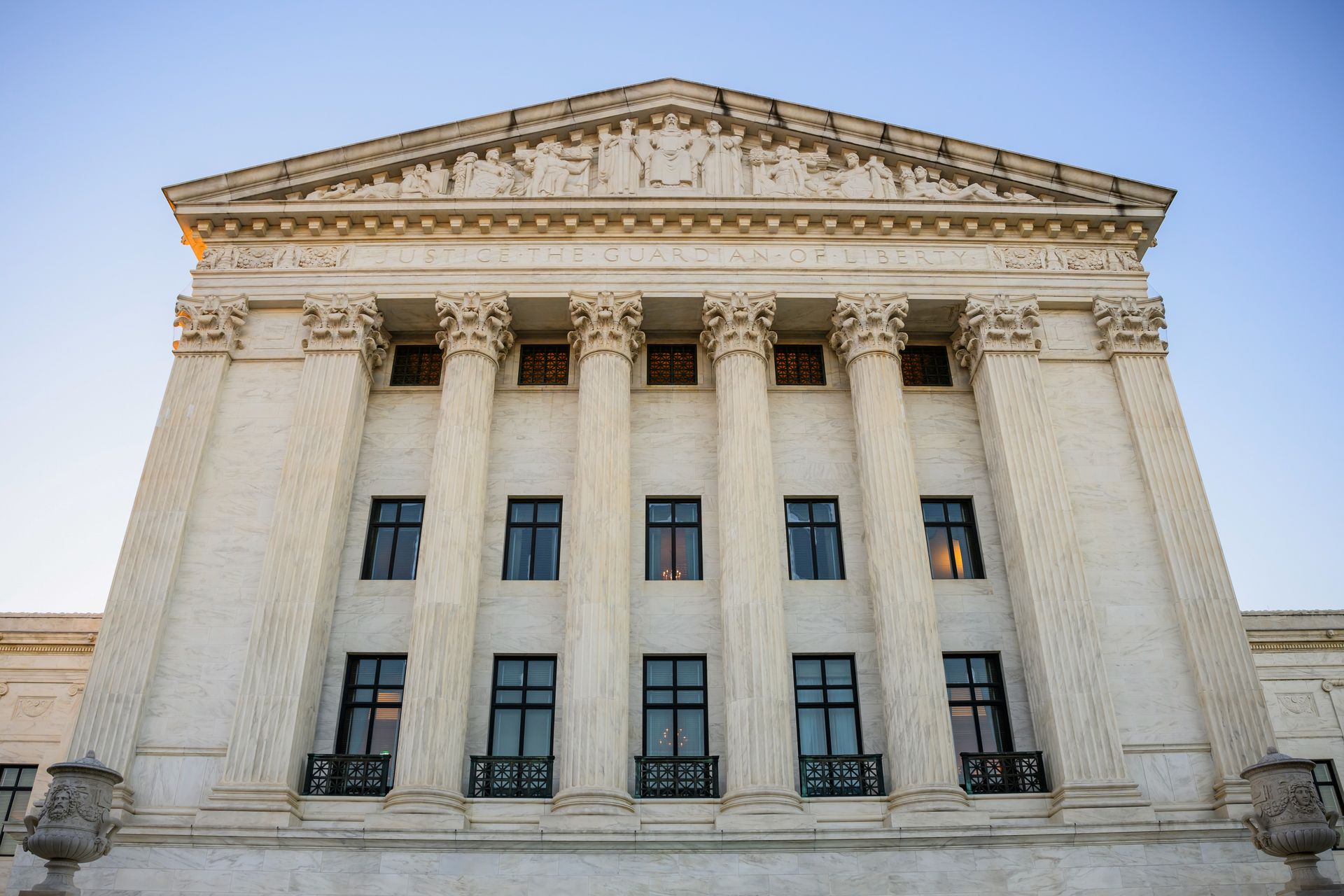
The US Supreme Court in Washington, DC, US, on Tuesday, Nov. 4, 2025.(Pete Kiehart/Bloomberg via Getty Images)
The Supreme Court on Friday struck down some of President Donald Trump's sweeping tariffs, dealing a significant blow to his second-term agenda that he quickly vowed to reverse.
In the 6-3 decision on "Learning Resources, Inc. v. Trump" issued Friday morning, the high court said the president does not have unilateral authority to impose import taxes. In the majority opinion from Chief Justice John Roberts, it was made clear that tariffs are another form of taxation. The power to tax, the opinion said, belongs to Congress as the legislative branch.
At issue were the so-called "Liberation Day" tariffs that Trump imposed last April, citing emergency authority drawn from the International Emergency Economic Powers Act, or IEEPA. The law had never been applied to collect import taxes before, and Trump's extraordinary application of its legal authorities generated multiple court challenges from scores of businesses that eventually came before the Supreme Court.
“It is also telling that in IEEPA’s half century of existence, no President has invoked the statute to impose any tariffs, let alone tariffs of this magnitude and scope," Roberts said in the majority opinion. "The President must 'point to clear congressional authorization' to justify his extraordinary assertion of that power. He cannot."
The U.S. government may still be obligated to issue refunds, but the Supreme Court punted on the matter for now. In the dissenting opinion from Supreme Court Justice Brett Kavanaugh, he argued a chaotic situation awaited the U.S. government if it is obligated to refund the tariffs it collected under IEEPA.
"The Court says nothing today about whether, and if so how, the Government should go about returning the billions of dollars that it has collected from importers," Kavanaugh wrote. "But that process is likely to be a 'mess.'"
The Yale Budget Lab said in a new analysis that the government had collected $142 billion in tariff revenue through 2025 under IEEPA. Over 1,000 companies lined up to challenge the Trump administration's tariff policy in court, including major corporations like Costco $COST and the tire company Goodyear.
About one-third of Trump's tariffs will remain in effect. The White House has also applied import taxes under separate legal authorities on lumber, furniture, steel, aluminum, and more.
Later in the day, Trump announced he intended to revive his collapsed tariff regime through a series of unilateral moves. He started off by announcing a 10% tariff through Section 122, a separate legal authority that the high court didn't address in the ruling. It goes into effect on Monday.
The high court's decision was somewhat anticipated. During oral arguments in November, conservative and liberal justices alike expressed skepticism that IEEPA granted the president sweeping ability to impose tariffs at will.
Nonetheless, the decision was viewed as a critical test in preserving the separation of powers critical for American government to function as designed. Jacob Jensen, a trade expert at the right-leaning American Action Forum, described it as "one of the most consequential decisions for trade law, tariffs, and executive authority in the modern era."
For months, Trump kept up pressure on the Supreme Court to rule in his favor, arguing that anything but a supportive decision would set back his efforts to shrink the persistent trade deficit and secure new trade deals with foreign governments.
"Without tariffs … the whole country would be bankrupt,” the president said in a Thursday economic speech in Rome, Georgia. “And I have to wait for this decision! I’ve been waiting forever. And the language is clear: I have the right to do it as president.”
In the late 1990s, the U.S. government provided $750 million in tariff refunds to importers after the Supreme Court struck down a harbor maintenance tax which had been applied to thousands of companies. The refunds then were much smaller then compared to what's at stake now. It still took the federal government several years to return the tinier sum.
During a Friday press conference following the tariff decision, Trump addressed the Supreme Court leaving aside tariff refunds for lower courts.
"They take months and months to write an opinion and they don't even discuss that point," Trump said. "I guess it has to get litigated for the next two years."
Treasury Secretary Scott Bessent poured cold water on the idea of tariff refunds. "I got a feeling the American people won't see it," he said at a Dallas Economic Club event.
Join 500,000+ readers who start their day with Quartz.
By subscribing, you agree to our Terms of Service and Privacy Policy.