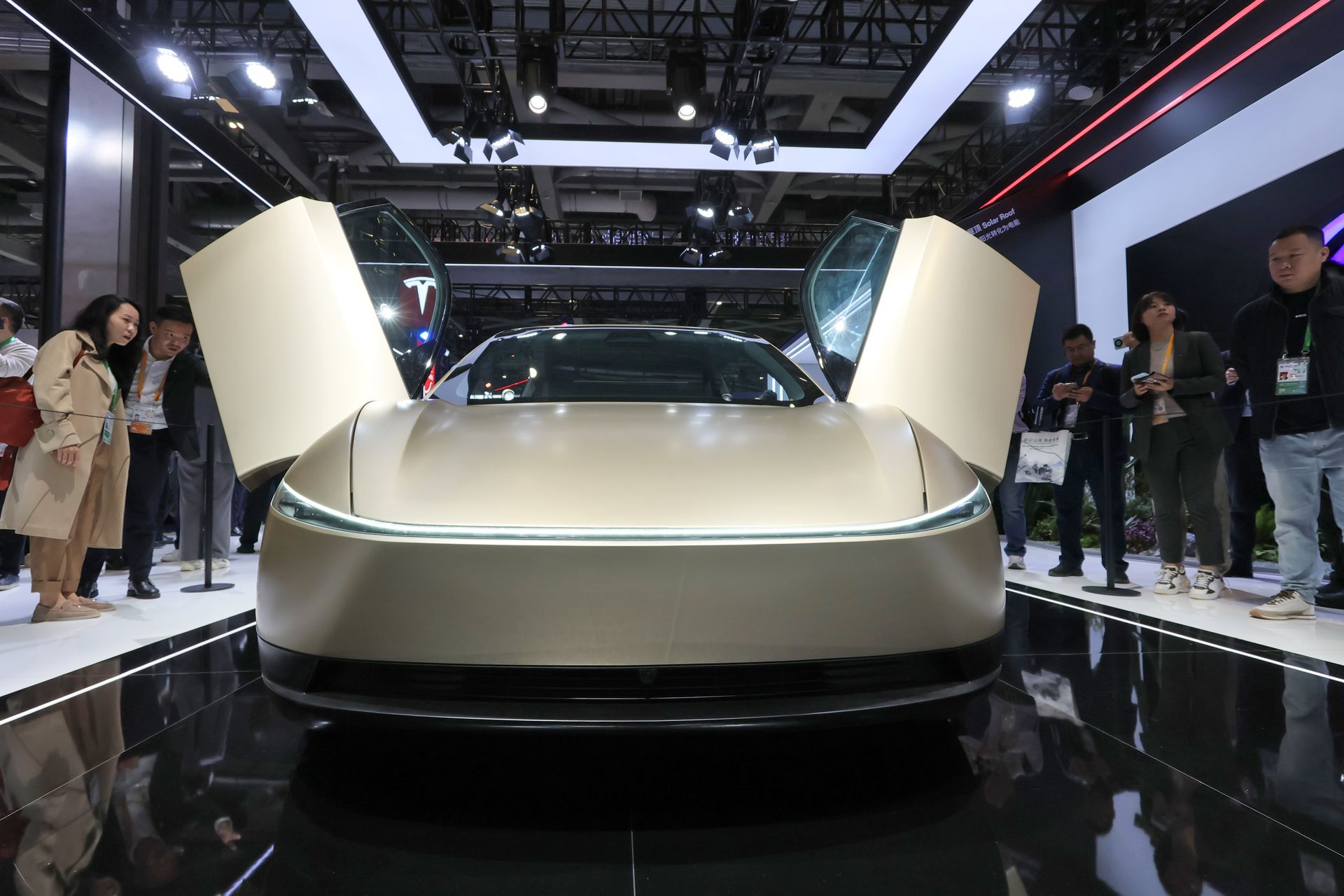
Tesla $TSLA has begun manufacturing its Cybercab robotaxi at its Giga Texas facility, CEO Elon Musk confirmed during the company's Q1 2026 earnings call and on his social media platform X $TWTR.

CEO Elon Musk confirmed the launch on Tesla's Q1 2026 earnings call, though he warned initial output will be slow before ramping late in the year
VCG / Getty Images
Tesla $TSLA has begun manufacturing its Cybercab robotaxi at its Giga Texas facility, CEO Elon Musk confirmed during the company's Q1 2026 earnings call and on his social media platform X $TWTR.
On the earnings call, Musk cautioned against high near-term expectations, invoking the classic S-curve pattern of new-product manufacturing. "Whenever you have a new product with a completely new supply chain, new everything, it's always a stretched out S-curve," he said. "You should expect that initial production of Cybercab and Semi will be very slow, but then ramping up and going kind of exponential towards the end of the year." He added that material revenue from the vehicle is unlikely before at least 2027.
The two-seat, two-door Cybercab is designed to operate without a steering wheel or pedals. Although a single prototype came off the line back in February, volume production only got underway this month. Alongside the driverless configuration, Tesla has been assembling a version that retains a steering wheel.
Electrek reports that, unlike competitors like Waymo and Cruise, Tesla’s Cybercab does not need a federal regulatory exemption to increase production. Normally, vehicles that do not meet all Federal Motor Vehicle Safety Standards need a special NHTSA exemption, which is limited to 2,500 vehicles per year. Tesla VP of Vehicle Engineering Lars Moravy said the Cybercab avoids this limit because it was designed to meet all federal safety standards from the start. This lets Tesla self-certify the car like any other automaker. Drone footage of the Giga Texas factory has shown compliance stickers on finished Cybercabs, which means they meet federal safety, bumper, and theft-prevention rules without needing a special exemption, according to Electrek.
The Cybercab is intended to anchor Tesla's ride-hailing network, which the company launched in Austin and has since expanded to Dallas and Houston. Investors were told this week that the ride-hailing network is expected to reach Phoenix, Miami, Orlando, Tampa, and Las Vegas before the midpoint of the year.
The vehicle's commercial viability hinges on software that Tesla has not yet completed. A timeline of "probably Q4" for unsupervised Full Self-Driving to reach customers was offered by Musk on the call. Safety data cited by Electrek show the supervised robotaxi fleet averaging a crash every 57,000 miles — roughly four times more frequently than the human driver benchmark of one incident per 229,000 miles. Musk did not dispute the software's shortcomings, pointing to edge cases in which the cars freeze up or enter repetitive loops rather than proceeding.
A significant management exodus has also hit the program: Electrek reports that vehicle program manager Victor Nechita, infrastructure director Thomas Dmytryk, and assembly leader Mark Lupkey have all left since February, stripping the Cybercab of every original program manager who shepherded it into production.
Tesla stock is down about 17% so far this year.
Join 500,000+ readers who start their day with Quartz.
By subscribing, you agree to our Terms of Service and Privacy Policy.