
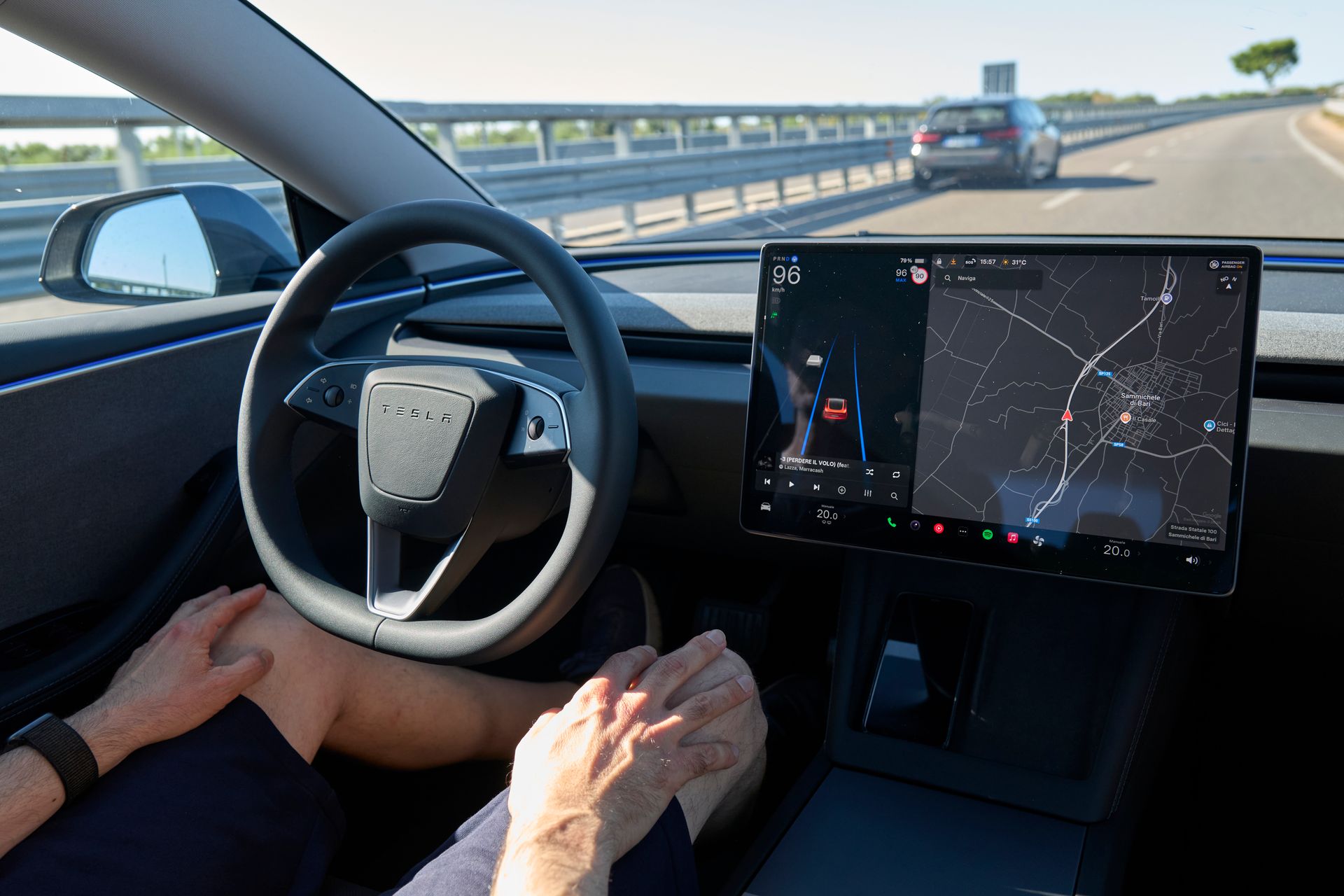
Tesla $TSLA announced Wednesday that its Full Self-Driving system is now available in China, ending years of regulatory delays that had left the company's most advanced driver-assistance technology out of one of its most important markets.
The company's FSD (system is now available in China, where Tesla has been losing market share to domestic rivals
NurPhoto / Getty Images
Tesla $TSLA announced Wednesday that its Full Self-Driving system is now available in China, ending years of regulatory delays that had left the company's most advanced driver-assistance technology out of one of its most important markets.
A post on X $TWTR confirmed China's inclusion among the 10 markets where FSD (Supervised) has been made available. Tesla's China website lists the technology under the name "intelligent assisted driving" on its Model 3 sedan at a one-time fee of 64,000 Chinese yuan ($9,409).
The launch comes one week after Tesla CEO Elon Musk traveled to Beijing as part of a U.S. business delegation accompanying President Donald Trump's summit with Chinese leader Xi Jinping.
Chinese buyers had until now been limited to Autopilot and Enhanced Autopilot — earlier, less capable driver-assistance offerings — with FSD itself remaining out of reach pending regulatory clearance. Musk had projected regulatory approval before the end of 2024, but the timeline slipped repeatedly. As recently as Tesla's first-quarter earnings call, CFO Vaibhav Taneja said the company was still awaiting approval.
Drivers cannot treat the system as truly autonomous. A human must remain attentive and ready to intervene at all times, making the "Full Self-Driving" label something of a misnomer. Stricter Chinese rules obligating carmakers to accurately describe the limits of their driver-assistance software prompted Tesla to retire the FSD branding in the country the previous year.
In the lead-up to Thursday's announcement, Tesla posted urgent job listings for autopilot test engineers, data labelers, and real-world test operators in cities spread across China, with openings in nine markets that included Shanghai, Beijing, Wuhan, and Guangzhou. Underpinning those efforts is infrastructure Tesla has been building for years: a dedicated data center in Shanghai and a collaboration with Baidu on mapping.
Tesla is launching FSD in China at a time when competition from local companies is increasing. Companies like Xiaomi and Xpeng now include advanced urban driving features in their cars at no extra cost. Robotaxi operators such as Pony.ai and Baidu’s Apollo Go are also advancing fully autonomous driving. This competition has affected Tesla’s market share, which has dropped to about 6% in 2025 from a peak of 16% five years ago, according to the South China Morning Post.
Tesla’s FSD plans are not limited to China. The company also faces challenges in the U.S., where about 4 million vehicles with older hardware will need computer and camera upgrades before they can use unsupervised Full Self-Driving.
Join 500,000+ readers who start their day with Quartz.
By subscribing, you agree to our Terms of Service and Privacy Policy.