Spencer Platt/Getty Images
A version of this article originally appeared in Quartz’s members-only Weekend Brief newsletter. Quartz members get access to exclusive newsletters and more. Sign up here.
Humanity has been promised a flying car for about as long as it has had cars in general. The dream has shown up in science fiction, world's fair exhibits, and a steady stream of prototypes that made headlines and then quietly disappeared.
The gap between the promise and the product has always been the same story. The technology wasn't good enough. The regulations weren't ready. The money wasn't there.
All three are currently moving in the right direction. That doesn't mean your commute is about to leave the ground. But it does mean the industry is closer to delivering us the future that has been promised to us for years.
The vehicles at the center of today's moment are called eVTOLs, short for electric vertical takeoff and landing aircraft. They are not planes, which need runways, or helicopters, which are loud, fuel-hungry, and mechanically complex. They are not cars that sprout wings.
Instead, they look something like an oversized camera drone, lifted by multiple rotors powered by electric motors, quiet enough to blend into city noise, and designed to carry a handful of passengers on short urban hops.
Their landing footprint is small enough to fit in a parking lot or a rooftop, which is the whole point. The promise is not just faster travel but travel that picks you up closer to where you actually are and drops you closer to where you actually need to be.
What makes this generation different from the prototypes that came before is the underlying technology. Electric motors are lighter and more efficient than combustion engines. Battery technology has improved enough to make those short hops feasible. And the regulatory environment, historically glacial, has started moving.
The FAA's new eVTOL Integration Pilot Program, unveiled in March, selected eight projects spanning 26 states. It's a formal acknowledgment that these aircraft are legitimate enough to warrant real-world testing before full certification.
The companies at the center of this moment fall into a few rough categories. On the larger end are air taxi companies building vehicles meant to carry several passengers on commercial routes, operated by licensed pilots.
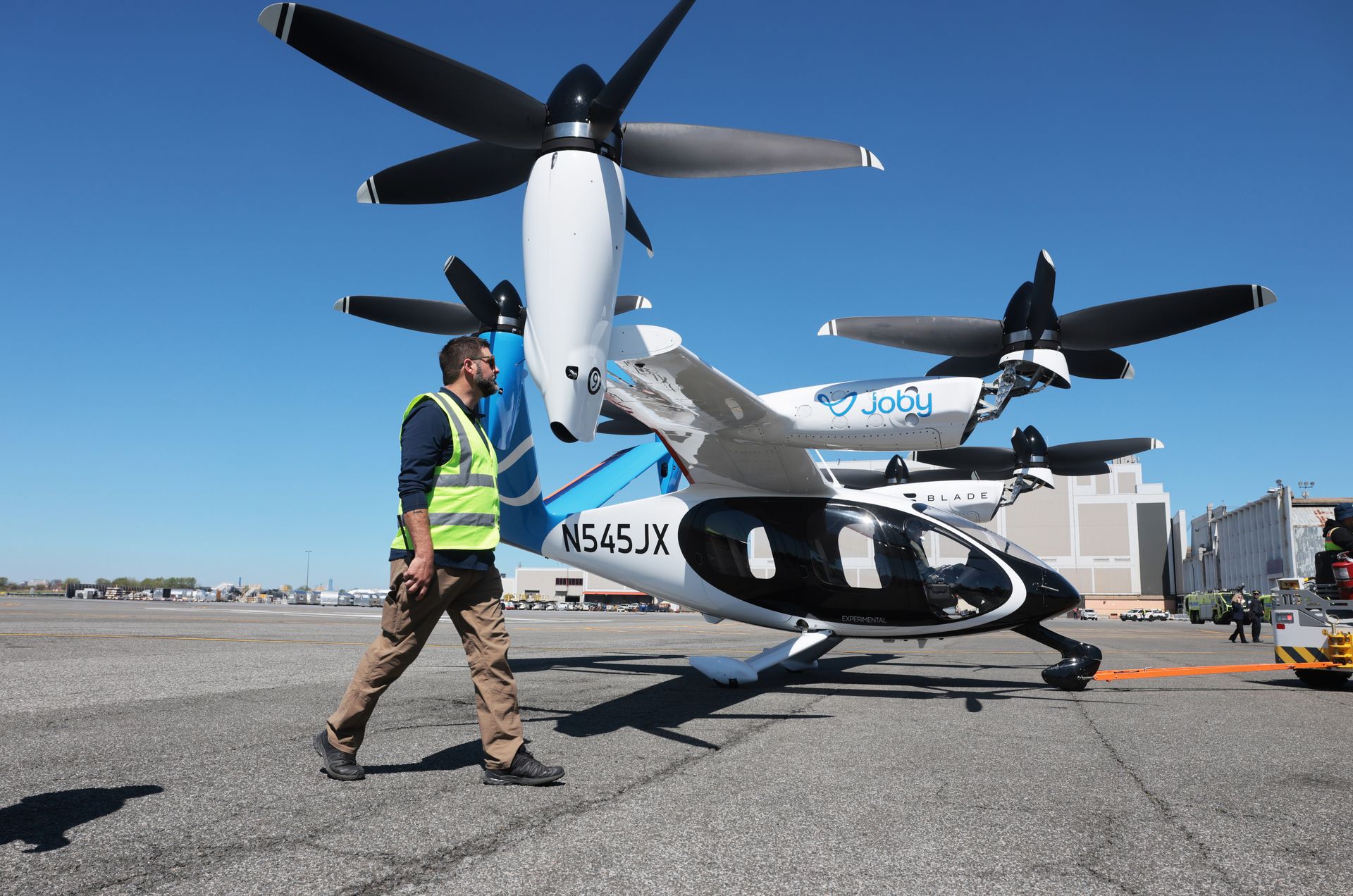
Joby Aviation, backed by Toyota $TM, Uber $UBER, and Delta Air Lines, has become the most closely watched. It completed a series of point-to-point demonstration flights in New York City in April and was named a partner in five of the eight federal pilot projects. Archer Aviation, its biggest domestic rival, just ramped up a factory in Georgia.
At the other end of the spectrum are smaller vehicles built for individual consumers. Pivotal, a California company, is already selling a consumer version called the Helix for $190,000. The company says most people can learn to fly it in a few days, roughly comparable to getting a driver's license, though regulations keep it out of cities and battery technology limits trips to around 20 minutes.
Partnerships with airlines have also begun to take shape. Joby has a formal agreement with Delta to eventually connect passengers from city centers to airports. The vision of being dropped at the terminal from a rooftop, skipping traffic entirely, is more concrete than it has ever been.
Even with functioning aircraft, regulatory momentum, and billions in backing, eVTOLs face stubborn problems that engineering alone cannot solve.
Certification by the FAA, the key threshold for commercial passenger service in the United States, has taken longer than almost everyone predicted. No company has crossed that line yet, and the first approvals are expected to be at least a year out.
Part of the issue is that the safety stakes are unusually high. Airlines have learned through decades of experience that a single high-profile accident can reshape public perception and regulatory posture overnight. A nascent industry with no proven safety record, operating novel aircraft in dense urban airspace, faces that risk acutely.
Even some of the industry's early boosters are having second thoughts. United Airlines CEO Scott Kirby, who in 2021 signed a conditional order for 200 eVTOL aircraft, said in March that he now opposes flying the vehicles near crowded hub airports, citing airspace safety concerns.
Infrastructure is where the vision runs into the community board. The vertiports needed to support commercial service don't exist at scale, and building them will require convincing cities, property owners, and residents to accept low-flying aircraft buzzing overhead and landing nearby.
New York City is working to electrify its existing heliport network, and a vertiport recently opened near Los Angeles's Century Plaza, but those are beachheads, not a system. The broader buildout required to support routine urban air taxi service will depend as much on zoning boards and community opposition as on anything the FAA decides.
What the industry has now, more than at any previous moment, are real aircraft making real flights in real cities. That's the clearest sign yet that the gap between fantasy and product is measurable in years, not decades.
