
Kampus Production / Pexels
When Amazon $AMZN launched in 1995, it appeared to be a new kind of thing — a bookstore that existed only online, without physical inventory in a storefront, without a cash register, without a salesperson. It was new in those specific respects. In almost every other respect, it was the beneficiary of a century of infrastructure that had been built by other industries for other purposes, and without which no online transaction would have been possible.
The parcel delivery network that brought the book to the door had been built by the postal service and by private couriers over a hundred years. The credit card that paid for it had been invented in 1950 and had spent four decades building the trust, the fraud detection systems, and the merchant acceptance network that made a transaction between strangers feel safe. The relational database that stored the inventory and the customer record had been theorized in 1970 and implemented through the 1970s and 1980s. The encryption standard that protected the payment had been developed by mathematicians working on entirely different problems. The container shipping system that moved the books from warehouse to distribution center had been built in the 1960s to serve the needs of the manufacturing economy.
E-commerce is not a technology. It is the convergence of dozens of technologies, legal frameworks, logistics systems, financial instruments, and consumer behaviors, each of which had to reach a sufficient level of development before the whole system could function. Pull out any single element — the parcel network, the payment rail, the encryption, the consumer trust, the search engine, the product database — and the system fails. The genius of the companies that built e-commerce was partly in the technology they developed and partly in the recognition that the rest of the infrastructure had finally reached the point where the assembly was possible.
This list covers 20 of the essential preconditions — the inventions, the decisions, the standards, and the systemic developments that had to exist before a stranger could sell a book to another stranger across the internet, payment included, delivery guaranteed. Several of them are obvious. Several are not obvious at all. Together they tell the story of how the apparently sudden arrival of online commerce was actually the slow convergence of a century of prerequisite work.
1 / 20

Startup Stock Photos / Pexels
The internet — the global network of interconnected computers that transmits data using the TCP/IP protocol suite — is the obvious prerequisite, but its history as a precondition for e-commerce is more specific and more interesting than its general reputation as a military communications project suggests. The internet's evolution from ARPANET (the U.S. Defense Department's packet-switching network, operational from 1969) to the commercial internet of the early 1990s required specific decisions that were not inevitable and that took decades to make.
The critical decision was the opening of the internet to commercial traffic. ARPANET and its successors operated under an Acceptable Use Policy that prohibited commercial activity — the network was funded by the federal government for research and educational purposes, and using it to sell things was explicitly prohibited. The National Science Foundation Network (NSFNET), which served as the internet's backbone through the late 1980s and early 1990s, maintained this prohibition. Commercial use was permitted only on private networks connected to but not traversing the NSFNET backbone.
The transition began in 1991 when the NSF began allowing commercial entities to connect to the internet through commercial internet service providers, and was effectively completed with the privatization of the NSFNET backbone in 1995 — the same year that Amazon $AMZN launched. The decision to privatize and commercialize the internet backbone, made by a relatively small number of policy officials and network engineers, was the specific gate that commercial internet activity had to pass through, and it passed through only months before the first significant e-commerce companies appeared.
2 / 20

Lisa from Pexels / Pexels
The internet existed for two decades before e-commerce was possible because the internet without the Web was a command-line environment accessible only to researchers, academics, and technically sophisticated users. Tim Berners-Lee's invention of the World Wide Web — the system of hypertext documents linked by URLs and rendered by web browsers, first proposed in 1989 and publicly released in 1991 — was the specific layer of internet architecture that made the internet accessible to ordinary people without technical training.
Berners-Lee invented the Web while working at CERN, the European physics laboratory, as a solution to the specific problem of sharing research documents across different computer systems used by researchers at different institutions. The Web's three core components — HTML (the document format), HTTP (the transfer protocol), and URLs (the addressing system) — were all designed for document sharing rather than for commercial transactions. The shopping cart, the checkout process, the product page — none of these were in Berners-Lee's original design, and the Web had to be extended with dynamic content technologies (CGI scripts, server-side processing) before these commercial functions were possible.
Crucially, Berners-Lee and CERN chose not to patent the Web, making it available as an open standard that anyone could implement without licensing fees. This decision — made without the commercial context that might have produced a different outcome — was the specific reason that the Web could spread as rapidly as it did and that no single company could control the infrastructure on which e-commerce was subsequently built.
3 / 20

Bastian Riccardi / Pexels
The World Wide Web's potential as a medium accessible to ordinary people was unlocked specifically by the graphical web browser — software that rendered HTML documents as visual pages with images, formatting, and clickable links rather than as raw text. The first widely used graphical browser, Mosaic, was released by Marc Andreessen and Eric Bina at the National Center for Supercomputing Applications (NCSA) in 1993. Netscape Navigator, developed by Andreessen after he left NCSA, followed in 1994 and became the dominant browser of the early commercial web.
Before the graphical browser, using the Web required comfort with command-line interfaces and the discipline to navigate by typing URLs rather than clicking links. Mosaic's innovation was the inline image — displaying images within the text of a web page rather than as separate files that had to be opened independently — and the intuitive point-and-click navigation that made web pages legible to anyone who could use a mouse.
The browser also introduced the concept of the web page as a visual space that could be designed — that had layout, typography, color, and structure — rather than merely a document that had content. This transition from document to designed page was the specific precondition for the product page, the shopping cart, and the checkout flow that e-commerce required. A commerce experience built on command-line text would have found no mass-market audience.
Netscape's decision to add SSL (Secure Sockets Layer) encryption to Navigator in 1994 was the specific browser decision most directly relevant to e-commerce: it provided the secure transmission of payment information that made online transactions viable.
4 / 20

Markus Spiske / Pexels
SSL — Secure Sockets Layer, the encryption protocol that protects data transmitted between a web browser and a web server — was developed by Netscape and first implemented in Netscape Navigator in 1994, with a publicly released version in 1995. Its successor, TLS (Transport Layer Security), is the protocol that the padlock symbol in modern browsers represents. Without encryption, any payment information entered into a web page — credit card numbers, billing addresses, bank account details — would be transmitted as readable text across the internet, accessible to anyone with the ability to intercept network traffic.
The specific cryptographic foundations of SSL were not invented for commerce. Public-key cryptography — the mathematical framework underlying asymmetric encryption, in which a public key encrypts data that only the corresponding private key can decrypt — was developed by Whitfield Diffie and Martin Hellman in 1976 and independently by Ron Rivest, Adi Shamir, and Leonard Adleman (RSA) in 1977, as contributions to pure cryptography research. The RSA algorithm, in particular, was developed as a theoretical demonstration of public-key cryptography's properties rather than as a commercial product.
The specific innovation of SSL was the application of public-key cryptography to the practical problem of securing web transactions — the engineering work of implementing the theoretical framework in browser and server software and making it operable at the speed required for commercial transactions. The padlock that appears in the browser address bar when a transaction is encrypted is the visible surface of a mathematical infrastructure that had to be theorized, implemented, standardized, and widely deployed before a credit card number could be safely transmitted across the internet.
5 / 20

Ivan S / Pexels
The credit card — the payment instrument that allows a consumer to make a purchase against a credit line, with the merchant receiving payment from the card network and the consumer settling with the issuing bank — is so fundamental to e-commerce that its absence makes the entire system inconceivable. Without a payment instrument that works for card-not-present transactions (transactions where the card is not physically present at a point of sale), e-commerce would have required either cash on delivery or bank transfer — neither of which provides the friction-free, reversible, consumer-protected payment experience that e-commerce depends on.
Diners Club issued the first modern credit card in 1950, and American Express $AXP followed in 1958. Visa $V began as BankAmericard in 1958 and was franchised nationally as Visa in 1976; MasterCard emerged from the InterBank Card Association in 1966. By the time the internet was commercialized in the early 1990s, the credit card infrastructure had been operating for three to four decades: the card networks, the merchant acquiring banks, the issuing banks, the authorization systems, and the fraud detection mechanisms that made payment possible.
The specific adaptation required for e-commerce was the card-not-present transaction protocol — the rules, liability frameworks, and fraud detection systems for transactions where the card could not be physically verified. The higher fraud rates of card-not-present transactions required the development of address verification systems, CVV codes, and eventually 3D Secure authentication. All of this adaptation happened within existing credit card infrastructure rather than requiring the construction of new payment rails.
6 / 20

Artem Podrez / Pexels
E-commerce without delivery is a catalogue business — it can take orders but cannot fulfill them. The parcel delivery infrastructure that moves purchased goods from warehouse to doorstep — the network of sorting facilities, delivery vehicles, route optimization systems, and last-mile logistics that makes next-day delivery possible — predates e-commerce by decades and was built to serve the mail-order retail industry, the pharmaceutical distribution industry, and the business-to-business shipping market.
UPS was founded in 1907 as a messenger service, evolved into a parcel delivery company through the 1920s and 1930s, and by the 1990s operated one of the most sophisticated logistics networks in the world. FedEx $FDX, founded in 1971, introduced the hub-and-spoke air cargo model that made overnight delivery viable. The United States Postal Service had been delivering parcels since 1913. The infrastructure these organizations had built was available to e-commerce companies from their first day of operation.
The specific logistics innovations required to serve e-commerce — the package tracking systems that tell customers where their order is, the high-volume residential delivery capability that handles individual consumer orders rather than business shipments, and the returns infrastructure that processes the returned goods that e-commerce generates at higher rates than physical retail — were developed by these organizations in direct response to the demands of e-commerce rather than as preconditions for it. But the underlying network — the trucks, the planes, the sorting facilities, the route systems — was inherited.
7 / 20

Panumas Nikhomkhai / Pexels
The relational database — the data storage system organized around tables of related records, manipulated through the SQL query language — is the foundational information architecture of e-commerce and of virtually every digital application that stores and retrieves structured data at scale. Without relational databases, there is no product catalogue, no customer record, no order history, no inventory management, and no transaction log.
Edgar Codd, an IBM $IBM mathematician, published the theoretical foundations of the relational model in 1970 in a paper titled "A Relational Model of Data for Large Shared Data Banks." The first commercial relational database management systems followed in the late 1970s: Oracle $ORCL was founded in 1977 and released its first product in 1979; IBM's DB2 followed in 1983. By the early 1990s, relational databases were the standard data management infrastructure for large organizations and were available in open-source form (MySQL, PostgreSQL) by the mid-1990s — just in time for the first wave of e-commerce companies to build on them without the licensing costs of commercial database software.
The specific requirement that relational databases satisfied for e-commerce was the ACID properties — Atomicity, Consistency, Isolation, Durability — that ensure that a transaction either completes fully or not at all, that no two simultaneous transactions corrupt each other's data, and that completed transactions survive system failures. These properties, which seemed academic when Codd theorized them in 1970, became the specific technical requirements that prevented an e-commerce transaction from deducting payment without processing the order, or processing the order twice, or losing the record of a completed transaction.
8 / 20

Lee Hanson / Pexels
E-commerce sells products that the buyer cannot touch, smell, or examine in person, which makes the photograph the primary instrument of product representation — the specific visual argument that the product is worth the price asked. The quality, standardization, and volume of product photography required by e-commerce at scale was not achievable with film photography's cost structure, turnaround time, or storage requirements. Digital photography — specifically the commercially viable digital camera of the mid-1990s onward — was a specific precondition for the product catalogue at scale.
The first professional-quality digital cameras were introduced in the early 1990s — the Kodak DCS series, adapted from Nikon film camera bodies, was available from 1991. Consumer digital cameras became widely available from 1996 onward. The specific advantages for product photography were immediate: no film processing cost or delay, immediate review and retake capability, direct digital output that could be uploaded to a website without scanning, and the ability to produce large volumes of images at a cost structure that made photographing thousands of products economically feasible.
The standardization of product photography — the white background, the multiple angles, the zoom capability — that characterizes contemporary e-commerce product pages was itself an innovation developed by early e-commerce companies in response to the need to substitute visual representation for physical examination. Amazon $AMZN's early investment in systematic product photography standards was a specific competitive decision; the underlying digital photography technology that made the system possible was borrowed from adjacent industries.
9 / 20

Wolfgang Weiser / Pexels
The shipping container — the standardized steel box, 20 or 40 feet long, that locks onto ships, trains, and trucks without reloading its contents — is the infrastructure that made global supply chains possible, and global supply chains are what allow e-commerce companies to source products from manufacturing facilities anywhere in the world and sell them to consumers anywhere else. Without containerization, the labor cost of transferring goods between transport modes would have prevented the global sourcing model that e-commerce (and modern retail generally) depends on.
Malcom McLean, an American trucking entrepreneur, developed the modern shipping container and demonstrated its economic advantages in 1956 when he loaded 58 containers onto a converted tanker in Newark and shipped them to Houston. The cost of loading a ship by conventional means in the mid-1950s was approximately $5.83 per ton; McLean's container loading cost was $0.16 per ton. The economic argument was immediate and overwhelming.
Containerization spread through the global shipping industry through the 1960s and 1970s, requiring the construction of new container ports, the standardization of container dimensions through the International Organization for Standardization (ISO), and the development of container-handling equipment. By the 1980s, the global container shipping network had made the sourcing of manufactured goods from low-cost production locations in East Asia economically viable for retailers and manufacturers in Europe and North America — a precondition for the global product sourcing that e-commerce inherited.
10 / 20

Kampus Production / Pexels
The willingness to pay for something before receiving it, from a merchant you have never met, with no physical guarantee that the product will arrive — is a level of transactional trust that is not natural to human psychology and that had to be built over decades of mail-order retail before it was available to e-commerce.
Mail-order retail in the United States dates to Montgomery Ward's first catalogue in 1872 and Sears Roebuck's first catalogue in 1888. These companies spent a century building the consumer confidence in remote purchase — through money-back guarantees, through reliable fulfillment, through the development of dispute resolution mechanisms, and through the accumulation of the institutional reputation that made the mail-order promise credible. By the time e-commerce arrived, a significant proportion of the American consumer population had experience with remote purchasing through catalogue shopping and was not encountering the concept for the first time.
The specific trust deficit that e-commerce had to overcome beyond catalogue shopping was the digital medium itself — the unfamiliarity of entering a credit card number into a website, the absence of a telephone operator to take the order and confirm the details, and the novelty of the merchant entity with no physical address or storefront. This trust gap was addressed through a combination of technical measures (SSL, which provided visible security indicators), regulatory measures (consumer protection laws extending to online transactions), and the social proof of early adopters whose positive experiences circulated through personal networks.
11 / 20

Pixabay / Pexels
A product catalogue of any significant size is useless without a mechanism to navigate it — without the ability to find, within potentially millions of products, the specific product being sought. The search engine was the specific navigation technology that made large-scale product discovery possible, both within individual e-commerce sites and across the web.
The first web search engines appeared in 1993 and 1994 — Archie, Gopher, and then the first true web crawlers. By 1995, Yahoo, AltaVista, and Lycos had established the search engine as a primary navigation tool for the web. Google $GOOGL, founded in 1998, introduced the PageRank algorithm that ranked results by the quality and quantity of links pointing to them, producing significantly more relevant results than keyword-frequency approaches and establishing search as the dominant mode of web navigation.
The internal search engine — the product search within an individual e-commerce site — was a separate development, initially crude and subsequently sophisticated, that allowed product discovery within a specific retailer's catalogue. Amazon $AMZN's internal search engine, which learned from purchase behavior and review data to improve product ranking, became one of its most significant competitive advantages: the ability to surface the most relevant product from millions of options in response to a specific query.
The SEO industry — the discipline of optimizing product pages for search engine visibility — is the commercial consequence of search being the primary product discovery mechanism, and it reflects how fundamentally the existence of search engines shaped the economics of e-commerce.
12 / 20

Rafael Minguet Delgado / Pexels
Electronic Data Interchange — the standardized electronic transmission of business documents (purchase orders, invoices, shipping notices) between organizations — was developed in the 1960s and 1970s for the needs of the transportation and manufacturing industries, and became the standard mechanism for business-to-business transaction communication before the internet existed. EDI was the first electronic commerce, in the broad sense of computer-mediated commercial transactions, and the infrastructure, standards, and organizational experience it produced were direct precursors to consumer e-commerce.
The transportation industry developed EDI in the 1960s to communicate cargo manifests and booking information between shipping companies, railroads, and customs authorities — organizations that needed to exchange large volumes of structured transaction data rapidly and accurately. The manufacturing industry adopted EDI in the 1970s for supply chain communication: the just-in-time manufacturing systems of the automotive industry required real-time purchase order and shipping confirmation communication between manufacturers and suppliers that EDI made possible.
By the 1980s, EDI was the standard for business-to-business commercial communication in most industries, and the ANSI X12 standard (North American) and EDIFACT standard (international) had produced the interoperability that allowed different organizations' EDI systems to communicate. The organizational experience of managing electronic transactions — the authorization, confirmation, record-keeping, and dispute resolution processes — was directly applicable to consumer e-commerce, and many of the companies that operated EDI systems in the 1980s were the same companies that built e-commerce infrastructure in the 1990s.
13 / 20

Polina Tankilevitch / Pexels
The Universal Product Code — the barcode first used commercially in a Marsh supermarket in Troy, Ohio, on June 26, 1974, when a packet of Wrigley's chewing gum was scanned — is the information infrastructure that made automated inventory management possible, and automated inventory management is the specific precondition for the product catalogue at scale that e-commerce requires.
Before the barcode, retail inventory management was manual: stock was counted by hand, recorded on paper or in early computer systems by keyboard entry, and the accuracy of inventory records was limited by the speed and error rate of human data entry. The barcode, by encoding product identity as a machine-readable pattern that could be scanned at the point of sale, automated the inventory deduction that occurred with each purchase and made real-time inventory tracking economically feasible.
The e-commerce requirement — knowing, at the moment a customer adds a product to a virtual shopping cart, whether that product is in stock and available to ship — depends entirely on accurate real-time inventory data. A product catalogue without accurate inventory data is a customer disappointment machine: products listed as available that are actually out of stock, orders accepted that cannot be fulfilled. The barcode's contribution to the accuracy of inventory management, accumulated across two decades of retail adoption between 1974 and the mid-1990s, was a specific precondition for the reliable product availability representation that e-commerce requires.
14 / 20

Erik Mclean / Pexels
The route optimization software that determines how a delivery vehicle should sequence its stops to minimize travel time and fuel cost — and the digital mapping data that the software requires — is infrastructure whose development predates e-commerce and whose sophistication determines the economics of e-commerce delivery.
The first digital mapping systems were developed for military purposes in the 1960s and 1970s, and the geographic information systems (GIS) that automated routing calculations were developed for logistics planning in the 1970s and 1980s. UPS deployed its first computerized routing system in the 1980s and has invested continuously in its ORION route optimization system (which the company estimates saves 100 million miles of driving annually) since. The GPS satellite network, made available for civilian use at full accuracy in 2000, provided the real-time positioning data that made dynamic route optimization possible.
Without efficient route optimization, the economics of e-commerce delivery — delivering individual parcels to residential addresses at a cost that the consumer is willing to pay — would not be viable. The last-mile delivery cost, which is the most expensive component of the logistics chain, is managed through the route density that volume provides and the efficiency that optimization software extracts from that density. Both are infrastructure contributions that e-commerce inherited rather than developed.
15 / 20

Daniel Wells / Pexels
The telephone network — the infrastructure of copper cables, switching exchanges, and long-distance transmission systems that connected American households and businesses through the 20th century — is the physical infrastructure on which the early internet ran, and on which e-commerce was conducted through dial-up connections for its first decade of commercial existence.
Dial-up internet access — the connection of a personal computer to an internet service provider through a standard telephone line using a modem — was the primary consumer internet access method from the mid-1980s through the early 2000s. The speed and reliability of the early e-commerce experience was determined by the capacity of the telephone network and the modem technology available, and the inconvenience of dial-up connection speeds was one of the primary barriers to early e-commerce adoption.
The telephone network's role as internet infrastructure is a specific example of the repurposing of existing infrastructure for new uses: the telephone companies that had spent the 20th century building a voice communication network found that network being repurposed as a data network, and their decisions about how to price and manage this repurposing — whether to resist internet traffic on telephone lines, how to price data versus voice — were specific decisions that shaped the availability and cost of internet access for e-commerce users.
16 / 20
Ruben Boekeloo / Pexels
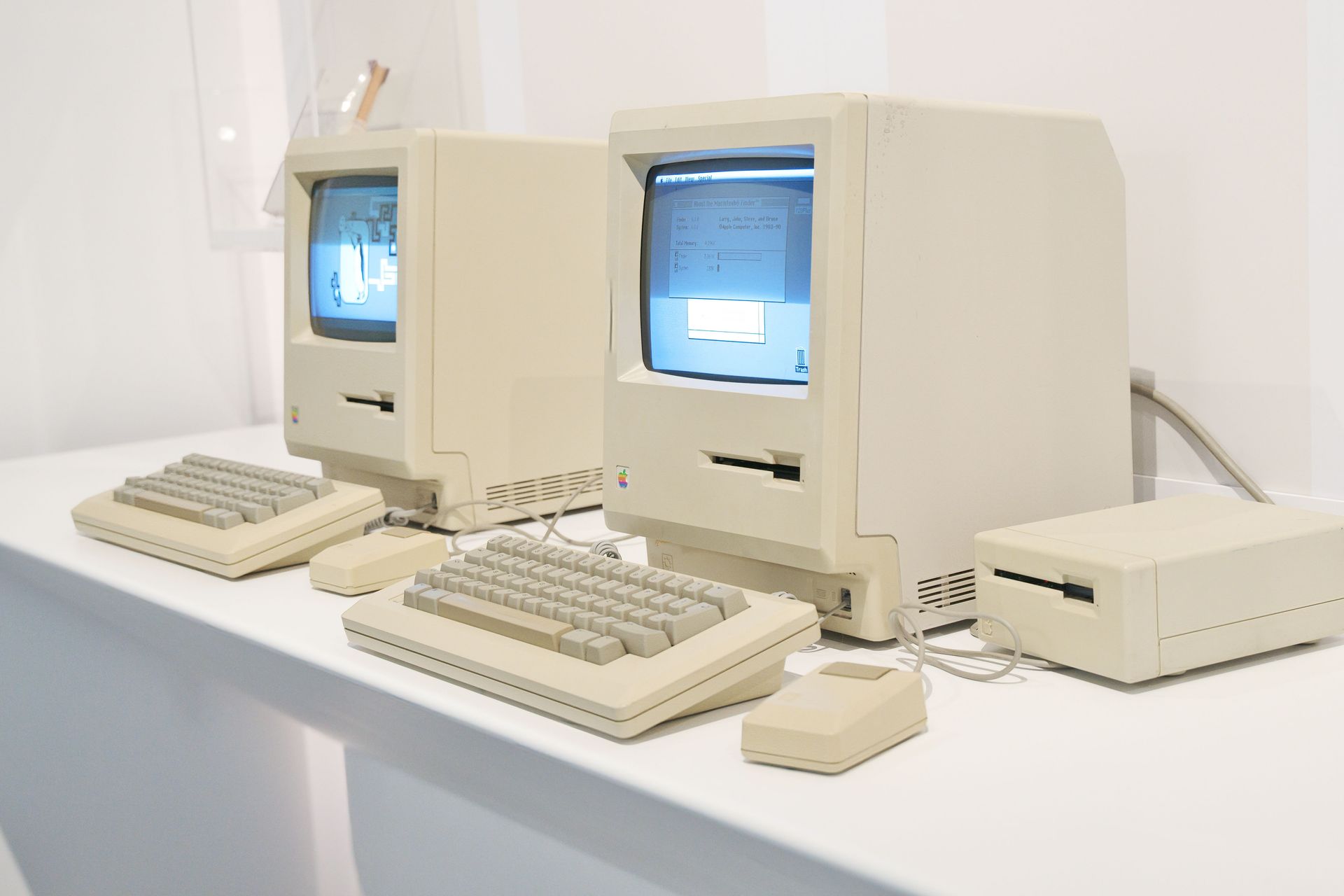
The personal computer — the desktop and laptop computers that connected households and offices to the internet — is the access device without which consumer e-commerce is impossible. The PC industry, built by Apple $AAPL, IBM $IBM, Compaq, Dell $DELL, and their successors through the 1980s and into the 1990s, produced the installed base of consumer computing devices that the internet needed in order to be a consumer medium rather than a professional or academic one.
The IBM PC, introduced in 1981, and its DOS and Windows successors established the personal computer as a household and office appliance in the United States through the 1980s. By 1994, approximately 30% of American households owned a personal computer. By 2000, the figure had risen to approximately 51%, and the trajectory was continuing upward. This installed base was the consumer population for early e-commerce — the segment of the population that already had the device and the internet connection required to make a purchase.
The specific decisions in the PC industry that shaped e-commerce's accessibility were the decisions that reduced PC prices: the competition among PC manufacturers that drove prices from the $3,000 to $4,000 range of early IBM PCs to the $1,000 to $1,500 range of late-1990s PCs, the introduction of productivity-focused consumer machines by Compaq, Dell, and Gateway, and the economic model of the mail-order PC (itself a form of early e-commerce, with Dell's build-to-order model predating Amazon $AMZN's launch).
17 / 20

RDNE Stock project / Pexels
The willingness of consumers to make card-not-present transactions online depends on the confidence that unauthorized use of their payment information will be detected and reversed — a confidence that requires active fraud detection systems on the part of the card networks and issuing banks. Without anti-fraud infrastructure that makes the e-commerce transaction safe from the consumer's perspective, the adoption rate would have been significantly lower than it was.
The credit card fraud detection systems that existed before e-commerce were designed primarily for point-of-sale transactions, where the physical card was present. The e-commerce transaction — where neither the card nor the cardholder was physically verifiable — required new fraud detection approaches based on transaction pattern analysis: detecting purchases that were inconsistent with a cardholder's normal spending pattern, purchases at unusual locations, or unusual purchase sequences.
The fraud detection infrastructure built by Visa $V, Mastercard $MA, American Express $AXP, and the major issuing banks through the 1990s and 2000s was a direct investment in making e-commerce viable. The chargeback mechanism — the consumer's right to dispute a transaction and receive a refund from the issuing bank — was the specific consumer protection guarantee that made online purchase reversible in the event of fraud or non-delivery, reducing the risk that consumers faced in trusting online merchants they had never met.
18 / 20

Marcial Comeron / Pexels
The legal framework that protects consumers in e-commerce transactions — the right to a refund for non-delivery, the right to return goods not as described, the prohibition of deceptive pricing and fraudulent marketing, and the consumer's right of redress against merchants — had to be extended to cover the specific circumstances of online commerce before e-commerce could reach its full potential.
In the United States, the Fair Credit Billing Act (1974), the Electronic Fund Transfer Act (1978), and the Federal Trade Commission's Mail Order Rule (1975) provided the foundational consumer protection framework that e-commerce inherited. The specific extension of these protections to online transactions — clarifying that the Mail Order Rule applied to internet transactions, extending truth-in-advertising requirements to online marketing, and establishing the consumer's right to chargeback for unauthorized online transactions — required regulatory actions and court decisions through the late 1990s and 2000s.
The European Union's Distance Selling Directive (1997) and its successor the Consumer Rights Directive (2011) were the specific legal frameworks that gave European consumers the right to a 14-day cooling-off period for online purchases, the right to accurate product description, and the right to free return for non-conforming goods. These protections were a direct enabler of e-commerce adoption in Europe by reducing the consumer risk of purchasing from an online merchant without the ability to physically inspect the goods.
19 / 20

Meet Patel / Pexels
The software infrastructure of e-commerce — the web servers, the database systems, the programming languages, the content management systems, and the e-commerce platforms — is built predominantly on open-source software whose development was funded not by the companies that profited from it but by the collective effort of programmers who chose to share their work under licenses that permitted free use and modification.
The Apache web server, first released in 1995, served the majority of web traffic for most of the following decade and remains one of the most widely deployed web server software packages globally. MySQL, the open-source relational database released in 1995, became the database of choice for e-commerce applications that could not afford Oracle $ORCL's licensing costs. Linux, the open-source operating system kernel developed by Linus Torvalds from 1991, became the dominant operating system for web servers. PHP, Perl, Python, and Ruby — all open-source programming languages — became the primary languages for web application development.
The economic significance of open-source software for e-commerce development was the specific elimination of software licensing costs that would otherwise have made web application development accessible only to well-capitalized organizations. A startup founding team in 1997 could build an e-commerce application on Linux, Apache, MySQL, and PHP — the LAMP stack — at zero software licensing cost. The same stack built on proprietary alternatives would have required significant upfront investment that would have prevented many of the companies that built the early e-commerce ecosystem from starting.
20 / 20

Liza Summer / Pexels
The delivery of a parcel to a specific residential address depends on a standardized addressing system — a consistent format for expressing geographic location as a deliverable address that is legible to postal workers, couriers, and, increasingly, automated sorting systems. The ZIP code system in the United States, introduced by the U.S. Postal Service in 1963, and its international equivalents (the UK postcode system introduced in the 1950s and 1960s, Canada's postal code system from 1971) were the specific addressing standardizations that made large-scale parcel sorting and routing computationally tractable.
Before standardized postal codes, addresses were expressed in formats that varied by region, by carrier, and by the preferences of the sender — creating sorting and routing problems that required human judgment at every step. The ZIP code — Zone Improvement Plan code — was introduced specifically to allow postal workers and automated sorting machines to route mail based on a numeric code rather than requiring the reading and interpretation of full address text. The five-digit ZIP code (expanded to ZIP+4 in 1983 to identify a specific block face or delivery route) provided the geographic granularity required for efficient parcel routing.
E-commerce's address capture and validation systems — the checkout flow that asks for street address, city, state, and ZIP code, validates the combination against a postal database, and returns a standardized format for the logistics system to act on — directly depend on the underlying postal code system whose consistency makes validation possible. The specific e-commerce problem of address error — the customer who enters an incorrect address and whose parcel cannot be delivered — is managed through address verification services that compare entered addresses against postal authority databases, a service that requires the standardization those databases represent.
