Andrew Harnik/Getty Images
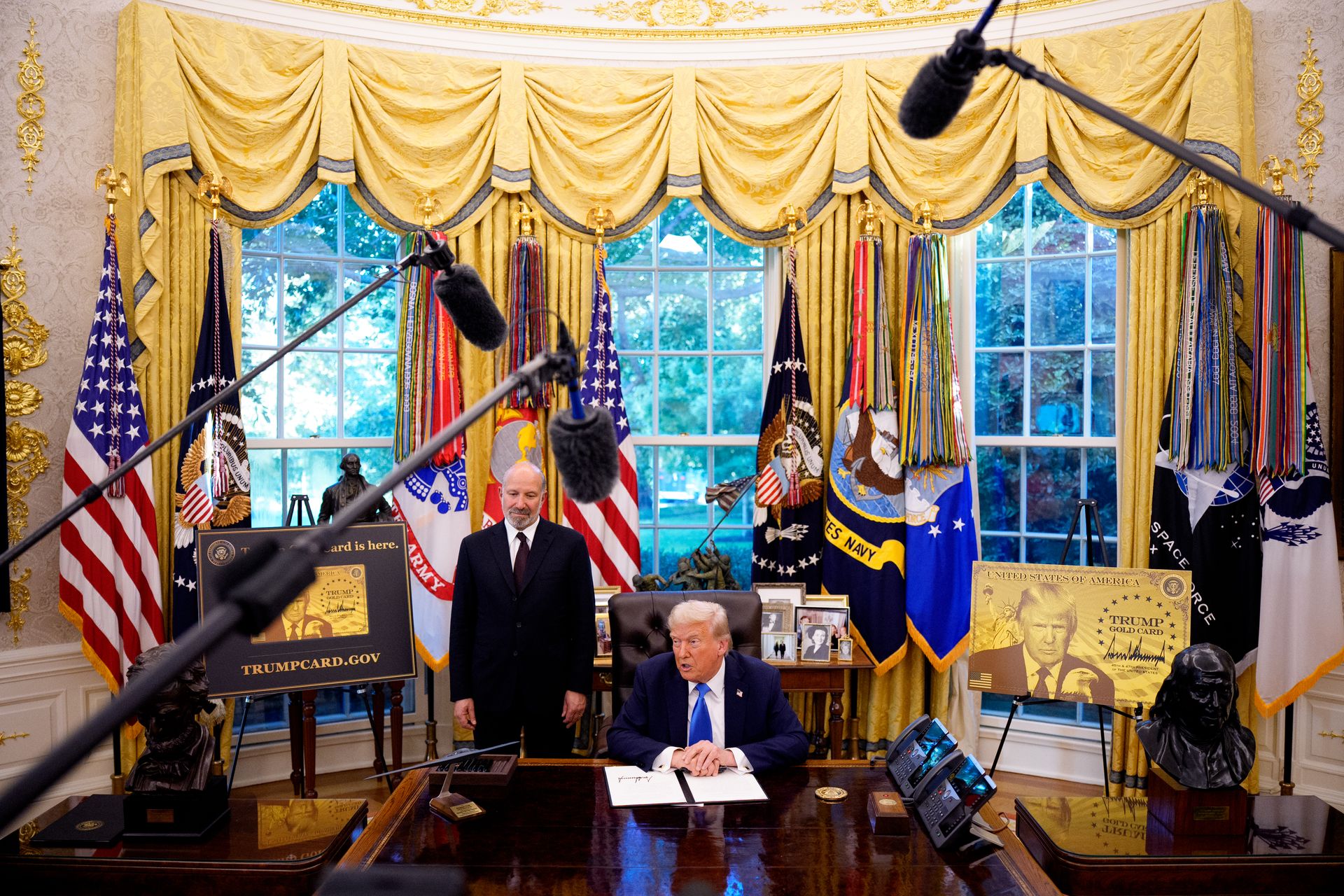
When Commerce Secretary Howard Lutnick stood beside President Donald Trump in the Oval Office last week to announce a $100,000 fee on H-1B visas, the rollout was as chaotic as the policy itself. Lutnick on Friday initially described the charge as an annual levy, sparking fears that existing visa holders would need to pay to remain in the country. By the next day, the White House had walked that back, saying the fee would apply only once, and only to new applicants.
But the damage was already done. Immigration lawyers stayed up into the wee hours rerouting flights for clients abroad. Tech giants quietly hustled foreign employees back to the U.S. before the new rules could take effect. And on Reddit $RDDT, moderators of the r/humanresources forum pinned a post labeled “not legal advice” with urgent instructions: pause all international travel, build rosters of visa holders, and prepare talking points for managers. One template email — apparently borrowed in part from Microsoft $MSFT’s own version — urged H-1B workers to stay put in the U.S. “for the foreseeable future.”
That HR professionals were resorting to Reddit for guidance underscored just how incoherent the White House rollout has been. It also underscores the human picture — a real-time internet snapshot of the chaos as it unfolded.
But to get an even clearer picture requires hearing from H-1B visa holders themselves. The H-1B program was created in 1990 to ensure the U.S. could attract global talent, and today, some 700,000 people are living in the U.S. on H-1B visas. It’s the main pathway for high-skilled foreign professionals, from software engineers to rural doctors to come to the U.S.
Sanjay — not his real name — is one such individual. Speaking of the moment he got the news, he said, “My heart sank.” A software engineer working for a West Coast startup, he’d recently been looking to purchase a home in his adopted country.
“The H-1B visa for me used to represent a fair and balanced social contract between the U.S. and skilled foreign nationals like myself,” he told Quartz. “Skilled workers provided valuable expertise to U.S. companies big and small. We paid more than our fair share in taxes (in significant amounts, because H-1B salaries, contrary to popular misinformation, are higher than average American salaries), and paid into Social Security (even when we are not eligible for Social Security benefits).”
In return, Sanjay said, they would have their chance to work for an innovative company and have their chance at the American Dream. "But, sadly," he said, "it feels that the U.S. government, especially the current administration, is not living up to its end of the bargain.”
He explained that being an H-1B visa holder is already challenging enough without the recent changes. For starters, you have to convince an American company to sponsor you. There are five times as many applicants as available visas, and they're allocated by a lottery system.
Sanjay has decided to move forward with his plans to buy a home, but he’s remains worried about the proposed changes. “It is alienating when you cannot put down any roots because your presence is temporary," he said. "The anxiety and fear that comes with knowing that your stay in the country can be taken away at any point with a single signature on some executive order is heartbreaking.
Sanjay said this was how he felt on Friday. "As stated in the initial announcement, the order would have been an effective travel ban for all existing H-1B visa holders in the country. I know of many friends who urgently cancelled their travel plans.”
Even after clarifications, Sanjay remains skeptical. “Contradictory statements made by government officials do not help," he said.
The White House has cast the new fee as a way to “protect American workers,” arguing that companies exploit H-1Bs to undercut wages. But immigration advocates say the new fee would reshape the H-1B program in ways that work against U.S. interests.
“A fee of this size would significantly change the dynamics,” said Jorge Loweree, managing director at the American Immigration Council. “It would likely reduce the number of petitions filed, especially from smaller businesses. Consequently, the program could shift even more heavily toward large corporations that can absorb the cost, or jobs will be shipped overseas.”
Loweree argues the policy undermines decades of U.S. leadership in innovation. “People who helped build Silicon Valley, who developed lifesaving medicines, who powered U.S. leadership in tech, came through this program," he said.
There are also legal questions. Congress authorized immigration agencies to collect fees that recover the costs of administering programs. “By unilaterally adding such a steep fee, the president is overriding Congress’s authority and violating the law,” Loweree said. That, he added, creates more chaos and uncertainty for workers and companies alike.
For employers, the timing may be especially poor. Each spring, companies enter a lottery for 85,000 H-1B slots. Applicants who win typically start work in October. Under Trump’s order, the $100,000 fee will apply to the 2026 cycle, which is already underway.
That has executives weighing their options now. Large firms may absorb the cost or lobby for industry-wide exemptions. Startups and universities likely cannot. Rural hospitals — already struggling to recruit doctors — may be especially hard hit. Some companies are considering moving operations abroad, especially to Canada and Europe, where immigration pathways are more predictable. Others are bracing for lawsuits, though a recent Supreme Court ruling narrowed judges’ ability to block federal policies nationwide.
In the short term, HR departments and H-1B visa holders are left improvising. Sanjay, the startup engineer, struck a philosophical note. “You can either live in constant fear,” he said, “or choose to be defiant and thrive despite the circumstances.”
He added that he is not a fan of companies that abuse H-1B visas either. “However, you do not throw the baby out with the bathwater," he said. "It will more likely concentrate power in the top companies who can afford to pay — while adversely affecting startups like the one I work at.”
