
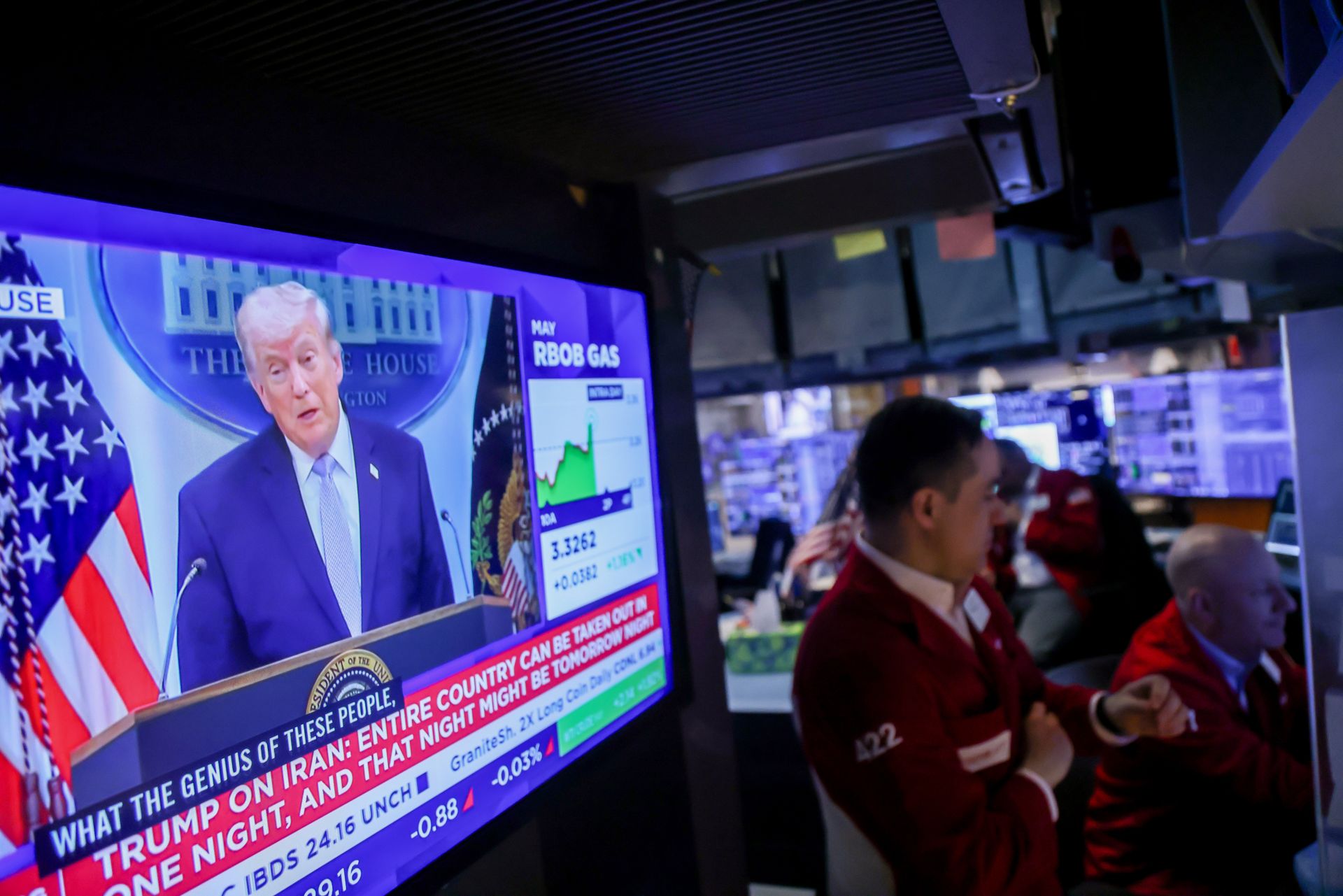
President Donald Trump said he was surprised by how well the stock market held up during the war with Iran, telling CNBC's "Squawk Box" on Tuesday that he had expected the S&P 500 and the Dow Jones Industrial Average to fall by 20%.
"I thought they'd be down ... a very substantial amount," Trump said. "When it was down more a couple of weeks ago, I was surprised. I thought it would be down much more, and I thought the oil would be much higher, and I'm very happy to say that it wasn't."
Trump said he had anticipated oil reaching $200 a barrel. Crude oil futures briefly topped $112 a barrel, but the surge reversed after the U.S. struck a ceasefire agreement with Iran. Oil stood at about $90 a barrel at the time of the interview.
"If you would have told me that oil is at 90 [dollars] as opposed to 200 I would be frankly surprised," Trump said.
As of this week, the Dow sits within striking distance of the all-time peak it reached in February. Markets dropped in the early weeks of the war before recovering. But at the pump, AAA data shows prices above $4 a gallon, running roughly 87 cents ahead of where they stood 12 months earlier.
The war has set off a pattern of extreme market volatility, driven in large part by presidential statements. Trump's social media posts have moved trillions of dollars in market value in a matter of hours. A Truth Social post in late March claiming "very good and productive conversations" with Iran sent the S&P 500 up 2.6% before Iran's foreign ministry denied any contact had taken place, wiping out roughly $1 trillion in gains.
The ceasefire is set to expire Wednesday evening. Trump said Tuesday he expects to resume bombing Iran if a deal is not reached, telling CNBC that the U.S. military is "raring to go." A delegation led by Vice President JD Vance was set to depart for Pakistan to pursue a second negotiating session, according to CNN, even as Tehran's officials insisted publicly that no such talks were in the offing.
The Strait of Hormuz remains largely closed to commercial traffic. Before the war broke out, the waterway handled more than 100 vessel crossings daily. Volume has since collapsed to a small fraction. In a statement released Tuesday, CRU Group, which monitors commodity markets, warned that restricted passage through the strait is expected to persist into June at the earliest, sustaining turbulence in energy pricing.