
For the vast majority of Americans, the tariff refund check won't be in the mail. Don't expect a check at all.
Americans shouldn't expect a tariff refund since most companies elected to raise prices, and it's hard to calculate a precise figure for individuals
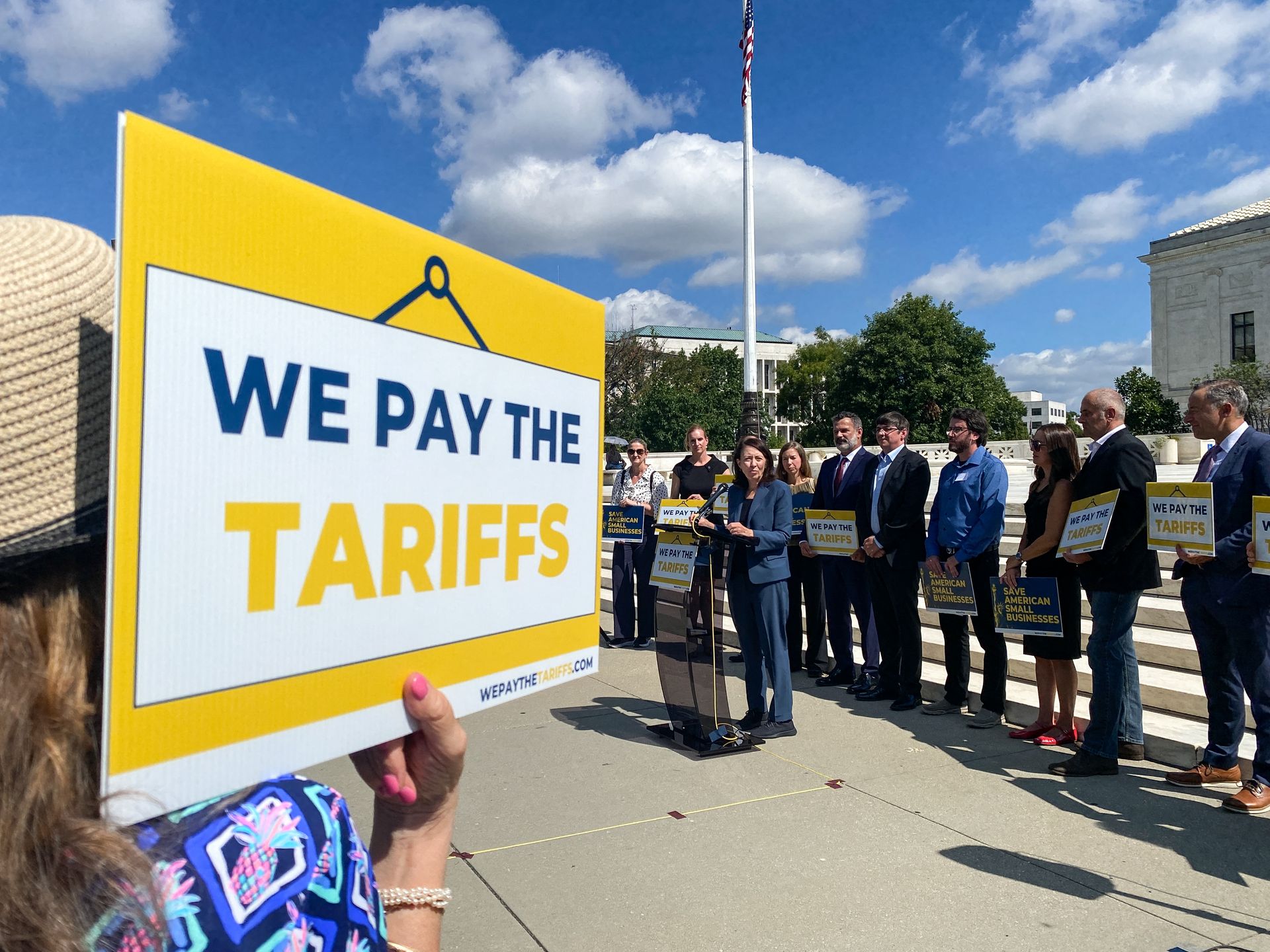
A Democratic senator and small business owners hold a news conference to discuss the impacts of tariffs on businesses, outside the Supreme Court in Washington, DC, on September 18, 2025. (BEIYI SEOW/AFP via Getty Images)
For the vast majority of Americans, the tariff refund check won't be in the mail. Don't expect a check at all.
The U.S. government proceeded this week to launch a new digital portal designed to refund $166 billion in tariffs that the Supreme Court decided were illegal two months ago. Now the businesses that paid up are getting in a queue that's managed by U.S. Customs and Border Protection.
There is a catch: Chances are you don't qualify for a refund.
The release of the portal underscores the reality that most Americans won't ever get refunded for the extra cash they forked out in the past year while shopping for furniture, buying a car or new toys for their children.
As an example, tariffs significantly added to sticker prices for autos. Imported vehicles experienced a spike in prices ranging from $5,000 to $8,900 per unit. Even domestic autos cost an extra $1,600 to $2,000 per vehicle due to the steel and aluminum inputs, according to Kelley Blue Book. Even then, that money probably won't flow back to the customers who paid it.
When President Donald Trump first applied tariffs in the spring of last year, companies that bought and sold imported goods had multiple options to blunt the financial shock. It included reducing staff or accepting thinner profit margins. Many elected to simply raise prices and pass on the cost to their customers. At that point, it gets harder to calculate a precise figure for individuals.
Recent Federal Reserve research shows that the vast majority of the tariffs fell on Americans, and not foreigners as the Trump administration has claimed.
Consumers are now growing frustrated that companies will reap the benefit of refunds while they're stuck with nothing. Some firms like FedEx $FDX and UPS have stated they will provide direct refunds to customers since they were often handed the tariff bill for their imported goods. In those cases, certain customers of parcel companies can receive refunds.
Costco $COST is among the few major companies that have indicated they will provide discounts to their customers, using whatever refunds it secures from the federal government.
Still, that didn't prevent Costco from getting hit with a class-action lawsuit regarding the refunds in March. "The consumer, for all intents and purposes, pays the tariff," a group of lawyers wrote in a legal filing detailing the challenge.
Companies also have a tricky calculation in claiming refunds from the Trump administration, which has at times tried to discourage them from doing so. On Thursday, Trump suggested he thought it would be "brilliant" if all the businesses entitled to refunds didn't pursue them.
Chief executives are also facing pressure from Democratic lawmakers pushing them to share refunds with American families.
"From higher prices for everyday goods to uncertainty for small businesses, the blanket tariffs functioned as a hidden tax on American families," a group of 15 House Democrats wrote in a letter to the CEOs of Walmart $WMT, Amazon $AMZN, Home Depot $HD and more. "The question of how refunds are distributed is one of corporate accountability and economic fairness."
Join 500,000+ readers who start their day with Quartz.
By subscribing, you agree to our Terms of Service and Privacy Policy.