
President Donald Trump on Friday threatened to cancel a meeting with Chinese President Xi Jinping next week and proceeded to prepare 100% tariffs on China, ending an economic ceasefire with Beijing and escalating trade tensions anew.
Stocks posted their worst one-day performance since the spring following a string of combative comments from Trump toward the Chinese government
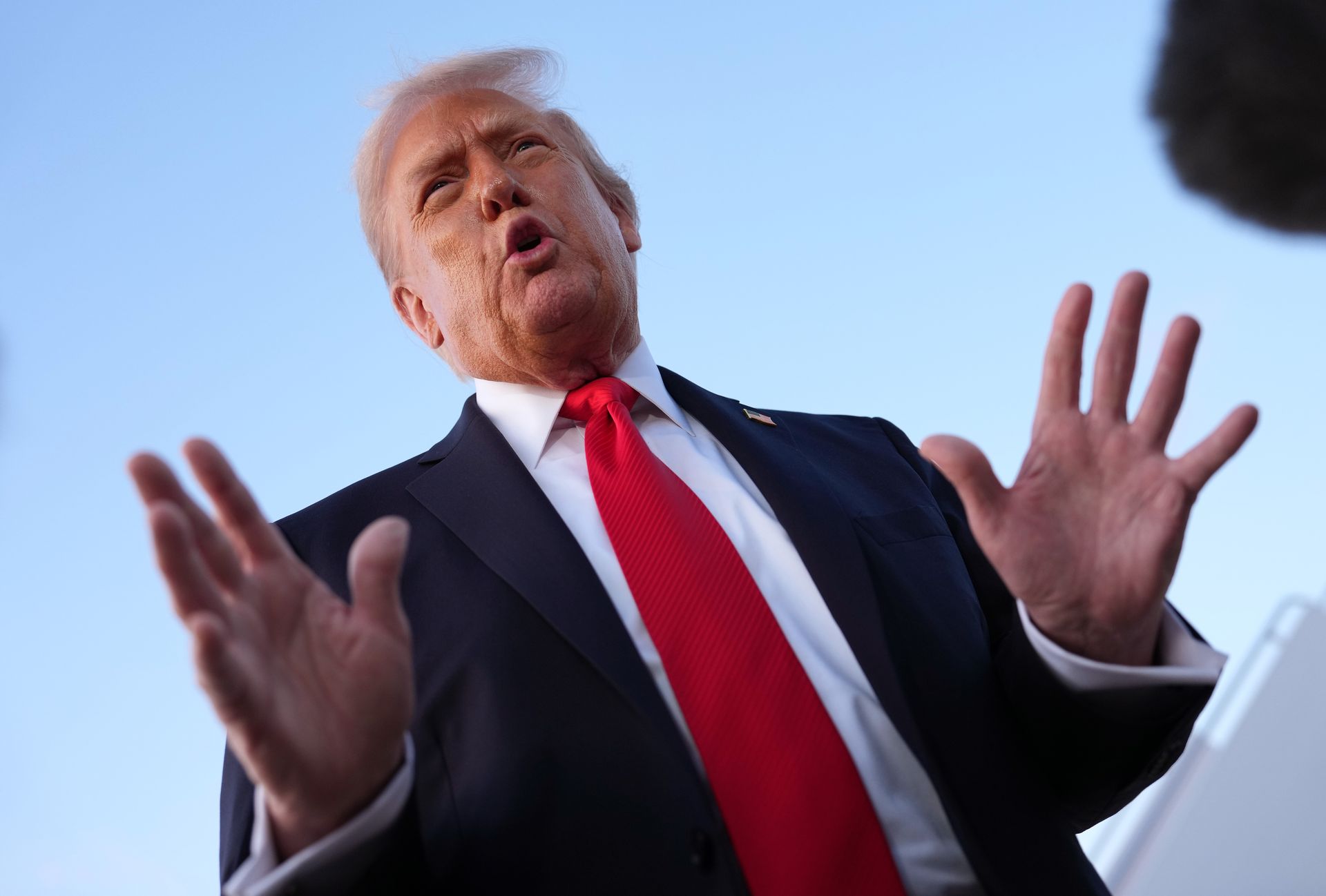
President Donald Trump speaks to reporters after stepping off Air Force One on September 7, 2025 at Joint Base Andrews, Maryland. (Kevin Dietsch/Getty Images)
President Donald Trump on Friday threatened to cancel a meeting with Chinese President Xi Jinping next week and proceeded to prepare 100% tariffs on China, ending an economic ceasefire with Beijing and escalating trade tensions anew.
The president announced the latest spate of tariffs shortly after financial markets closed for the day. Major indexes had posted their worst one-day performance since the spring following a string of combative comments from Trump toward the Chinese government earlier in the day.
Trump was scheduled to meet Xi later this month on the sidelines of the Asia-Pacific Economic Cooperation Summit in South Korea. Now its uncertain whether that leg of his foreign trip will materialize as planned.
"I was to meet President Xi in two weeks, at APEC, in South Korea, but now there seems to be no reason to do so,” Trump initially posted on social media.
The president cited a new Chinese restrictions on rare earth exports that make up critical components in U.S. smartphones, military hardware, autos, and more. The export controls will take effect on Dec. 1, which he assailed as "a moral disgrace" that upends global commerce.
"It is impossible to believe that China would have taken such an action, but they have, and the rest is History," Trump said. The White House did not immediately respond to a request for comment.
Stocks plunged throughout Friday. The Dow Jones Industrial Average fell by about 900 points. The S&P500 shed 183 points, or nearly 3% of its value with investors unnerved about new tariffs roiling the global economy.
But those market jitters didn't spread to shares in rare-earth producers. The rare earth mining company MP Materials climbed 6 points, or 8%. The Trump administration took a 15% stake in the firm back in July.
For its part, Beijing said the latest clampdown on rare-earth exports was meant to strengthen its national security.
Analysts, though, believed the Chinese government was attempting to gain the upper hand in ongoing trade negotiations that often veer between export controls, tariffs, soybean boycotts and other tit-for-tat maneuvers. There's little incentive for either side to blink as Washington and Beijing try to gain the upper hand on the other.
The Chinese government enacted and later removed identical rare-earth export restrictions in May as part of an interim accord that reset trade negotiations, putting them on a more positive footing.
Still, progress on a sweeping deal has been limited. The U.S. and China still maintain double-digit tariffs imposed on each other. The U.S. has kept a 30% tariff while China put in place a 10% import tax.
On Friday, Beijing had separately announced that a new fee will be charged on American vessels docking in Chinese ports starting Oct. 14. It will amount to 400 yuan per net ton, or $56.
The Department of Commerce did not immediately respond to a request for comment. Earlier this year, the Trump administration announced a similar fee — on Chinese ships docking in the U.S., totaling $50 per net ton — that takes effect on the same day.
Join 500,000+ readers who start their day with Quartz.
By subscribing, you agree to our Terms of Service and Privacy Policy.