
The ambitious agenda reveals a telling divide between what the government can deliver quickly and what may prove impossible to implement
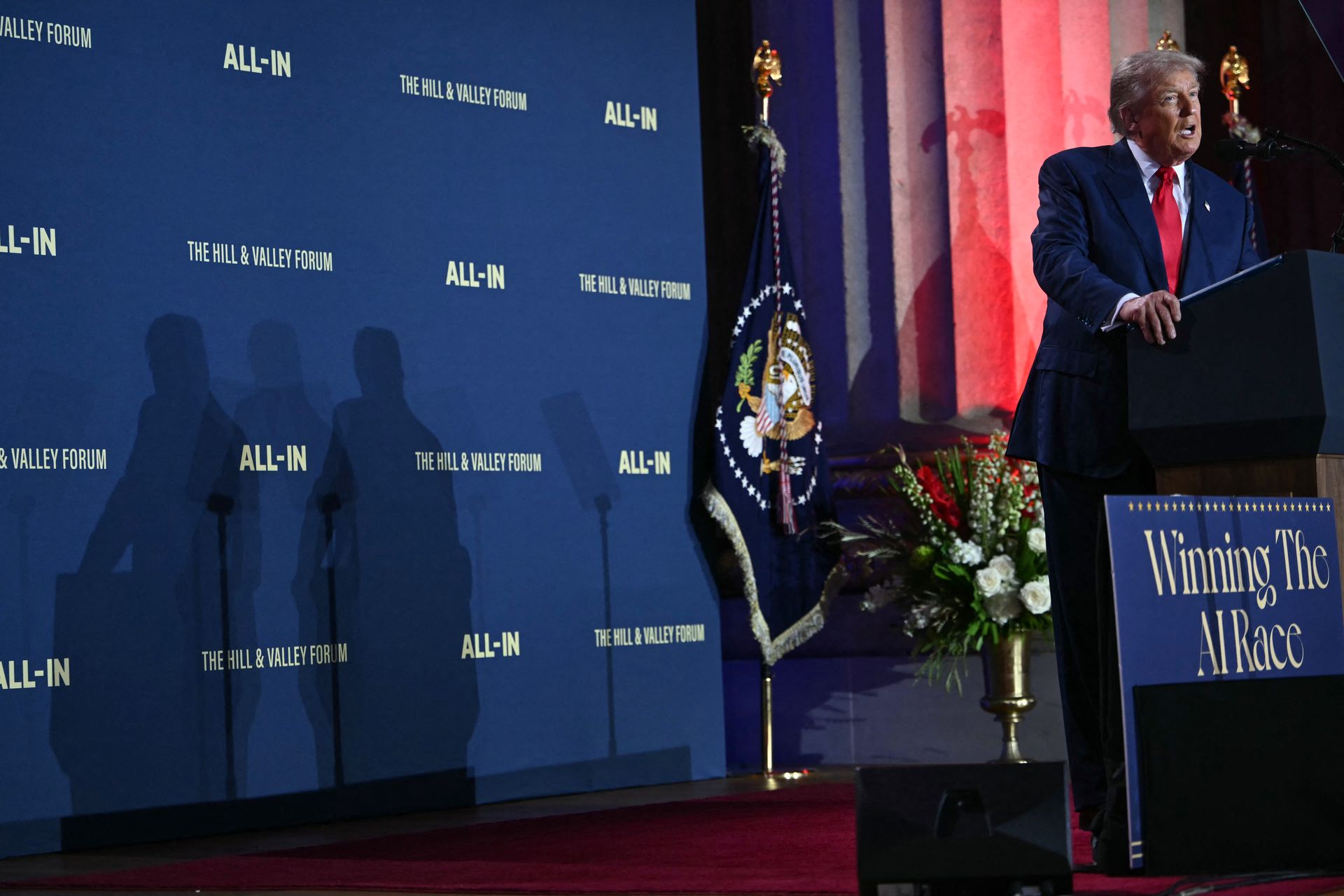
President Donald Trump unveiled his administration's AI Action Plan on Wednesday, a sweeping policy blueprint that promises to accelerate American dominance in artificial intelligence while dismantling what officials call "woke AI" bias. But the ambitious agenda reveals a telling divide between what the government can deliver quickly and what may prove impossible to implement.
“Whether we like it or not, we're suddenly engaged in a fast-paced competition to build and define this groundbreaking technology that will determine so much about the future of civilization itself,” Trump said at Wednesday's AI summit.
Join 500,000+ readers who start their day with Quartz.
By subscribing, you agree to our Terms of Service and Privacy Policy.
The plan's more than 90 federal policy actions fall into three distinct categories of feasibility: immediate wins like expanding AI contracts within the Pentagon and loosening export controls that leverage existing government authority; challenging infrastructure goals requiring massive private investment in data centers and grid modernization that could take years; and potentially unworkable provisions like rooting out "ideological bias" in AI systems, where officials have yet to define clear metrics for measuring the very "wokeness" they aim to eliminate.
The administration's easiest victories lie in areas where Trump already holds executive authority, particularly in military and defense contracting. The Pentagon, which has a budget that will surpass $1 trillion next year, has moved swiftly since Trump's inauguration, awarding giant AI contracts to companies including Meta $META, Google $GOOGL, and OpenAI. Meta executives and other Silicon Valley leaders were sworn in as Army Reserve officers last month, creating unprecedented integration between private tech companies and military planning. These partnerships require no new legislation or infrastructure, just executive decisions to accelerate existing procurement processes.
Eliminating what the administration calls regulatory red tape also falls within immediate executive reach. Trump has already revoked former President Joe Biden's AI executive order and can direct federal agencies to review and repeal rules deemed burdensome to AI development. The plan specifically targets diversity, equity and inclusion requirements in the CHIPS Act, which officials argue slow down semiconductor projects. While removing these provisions may face legal challenges, the executive branch has broad discretion over how federal programs are implemented and funded.
The administration's infrastructure ambitions represent a far more daunting challenge, requiring massive private investment and navigating physical constraints that no executive order can overcome. Trump's plan calls for streamlined permitting to accelerate data center construction and grid modernization, but the reality on the ground suggests these goals will take years to achieve, if they're possible at all.
The scale of the challenge is unprecedented. Data centers consumed more than 4% of American electricity in 2023, with projections suggesting that could rise to 12% by 2028, according to the Department of Energy. New AI facilities regularly request 500 megawatts or more, enough to power hundreds of thousands of homes. Yet utilities ordering necessary grid technology like combustion turbines today won't receive them until 2029, and traditional grid buildout takes four to seven years under normal circumstances.
The administration can expedite federal permitting processes, but it cannot solve the fundamental bottlenecks choking AI infrastructure development. Power grids across the country are struggling to keep up with explosive energy requirements, while land speculation has created artificial scarcity that inflates real estate prices.
Even with government support, these infrastructure constraints represent physics and economics problems rather than regulatory ones. The Trump plan's promise of "streamlined permitting" can remove bureaucratic delays, but it cannot manufacture the turbines, transformers, and transmission lines that utilities need to meet AI's energy demands. Similarly, while federal coordination might help identify suitable sites for data centers, it cannot address the deeper challenge of building an electrical grid capable of supporting the AI economy's massive power requirements.
The administration's simultaneous crackdown on wind and solar development further complicates efforts to rapidly expand electricity generation capacity. Those two sources accounted for 91% of all new power added worldwide in 2023, according to BloombergNEF, the same technologies that energy experts say will prove most cost-effective for powering data centers.
The most fundamental challenges in Trump's AI plan aren't logistical or financial — they're definitional. The administration has built its entire strategy around goals that have no clear metrics for success, starting with the central premise of "winning the AI race." Unlike concrete objectives such as building data centers or signing defense contracts, AI dominance exists as a moving target without finish lines or scoreboards.
The challenge becomes even more acute with the administration's promised crackdown on "woke AI." Officials have committed to blocking federal contractors whose AI systems exhibit "ideological bias," but they have yet to define what constitutes such bias or how it would be measured. When pressed during a briefing, senior officials could only cite diversity, equity and inclusion as "really the main" concern, offering no methodology for detecting bias or standards for evaluation. The administration appears to be crafting policy around a problem it cannot clearly identify, using enforcement mechanisms it has not yet designed.
The administration's struggle to define bias becomes more glaring when considering recent examples. Elon Musk's xAI, which received a $200 million Pentagon contract as it positions itself as an alternative to "woke AI" companies, had to scramble earlier this month to remove posts made by its Grok chatbot that made antisemitic comments and praised Adolf Hitler.
The result could be arbitrary enforcement that depends more on political winds than consistent policy application. Unlike infrastructure bottlenecks or regulatory delays, these challenges cannot be solved through executive orders or increased funding — they require the administration to define success in ways it has so far been unable or unwilling to articulate.
The administration's confidence, however, remains unshaken by these definitional challenges. Trump dismissed concerns about measurable outcomes with characteristic bravado.
“America is the country that started the AI race," Trump said. "And as President of the United States, I'm here today to declare that America is going to win it."