How unmanned systems are rapidly redefining how goods, intelligence, and force move across the world
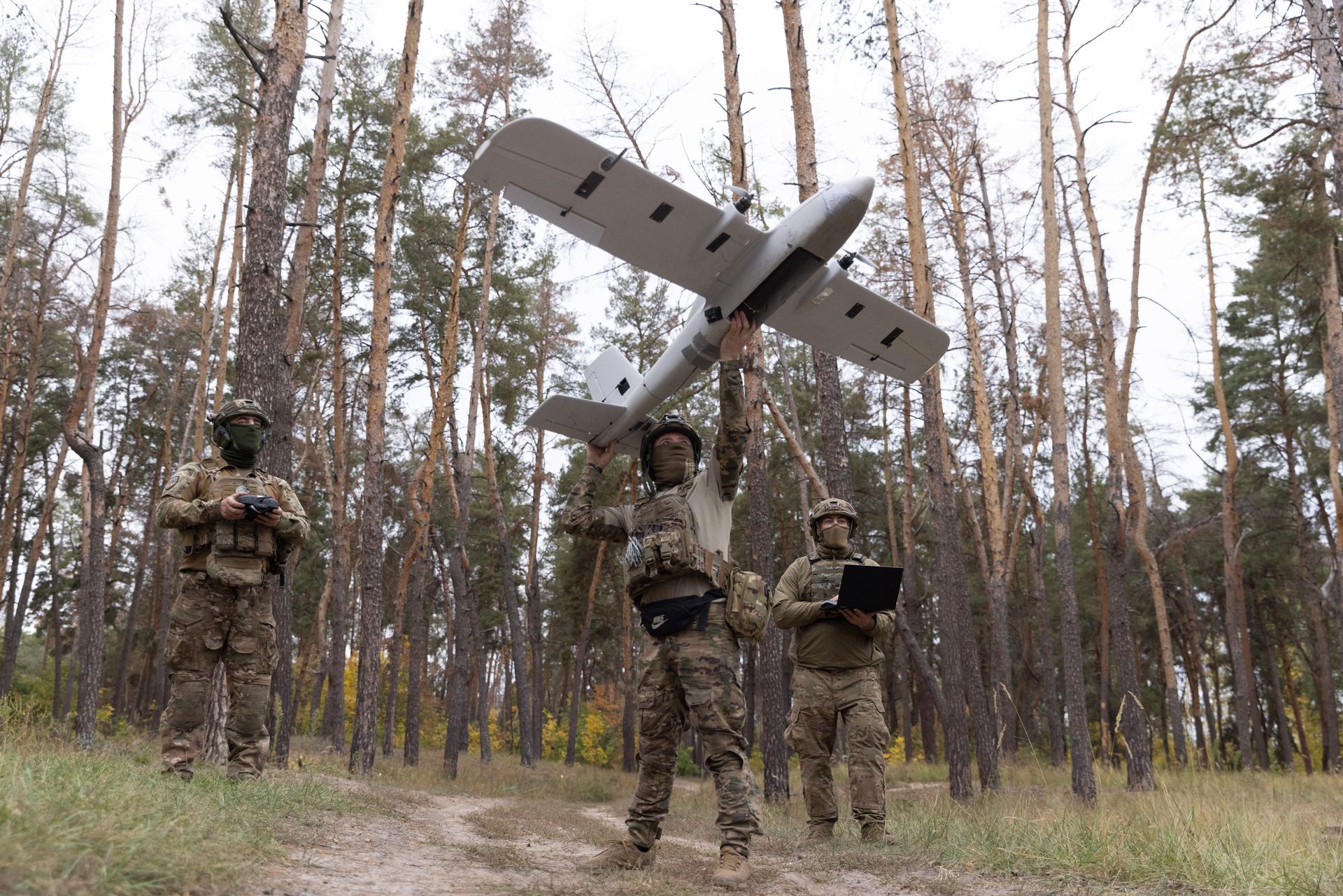
Photo by Yevhen Titov/Global Images Ukraine via Getty Images
A version of this article originally appeared in Quartz’s members-only Weekend Brief newsletter. Quartz members get access to exclusive newsletters and more. Sign up here.
Last December, north of Kharkiv, Ukraine's 13th National Guard Brigade sent roughly 50 aerial drones and a fleet of unmanned ground vehicles toward a Russian position. No infantry. No soldiers within miles of the fighting. When it was over, Ukrainian troops moved in to find Russian corpses.
Join 500,000+ readers who start their day with Quartz.
By subscribing, you agree to our Terms of Service and Privacy Policy.
It was the latest in a series of signals to every defense ministry, venture capital fund, and logistics company on the planet that drones had become something different. Not a gadget. Not a supplement to conventional warfare. A primary instrument of power.
The money has followed. The Pentagon's proposed budget for fiscal year 2027 includes $53.6 billion specifically for drone and autonomous warfare technologies, more than the entire defense budgets of Ukraine, South Korea, or Israel.
The global market for drones as a service is currently valued at somewhere between $6 and $8 billion with some projections putting it above $150 billion by the end of the decade.
Before Russia launched its full-scale invasion in 2022, military drones were expensive, complicated, and operated almost exclusively by superpowers with multibillion-dollar defense budgets. Ukraine changed the economics almost overnight.
Faced with a larger, better-equipped adversary, Ukraine turned to cheap, mass-produced unmanned systems out of necessity. From almost zero at the start of the war, it produced up to 4 million drones last year and is on track to make 7 million this year.
That knowledge is now in demand far beyond eastern Ukraine. Iran's drone campaign has battered its neighbors for weeks, hitting hotels, airports, and energy infrastructure across the Persian Gulf. They had been stopping these attacks with Patriot missiles, at $4 million each. Ukrainian interceptor drones can do the same job for around $15,000.
Saudi Arabia signed a 10-year strategic defense partnership with Ukraine in March. Qatar followed. The UAE ordered 5,000 Ukrainian interceptors. Kuwait and Bahrain are reportedly next in line. Norway, which shares a border with Russia, is putting up $1.5 billion for Ukrainian-designed drones built on Norwegian soil.
That speed has rattled even the most established players. Startups are winning contracts once reserved for Lockheed and Boeing $BA. Anduril, Shield AI, Skydio, and dozens of smaller companies have raised billions on the premise that the era of the $100 million fighter jet is giving way to the era of the $500 expendable drone.
Legacy defense contractors are structurally trapped. Billion-dollar backlogs in tanks and artillery don't leave much room to cannibalize your own business model, and NATO's procurement bureaucracy means even small design changes can take years to certify. Startups don't have that problem — they were built for this war, not the last one.
The commercial world is watching and drawing its own conclusions.
Amazon $AMZN has been testing drone deliveries for more than a decade. The slow, expensive, FAA-tangled process looked for a long time like a technology in search of a market.
Now, with manufacturing costs plummeting and autonomous flight software maturing under the pressure of actual warfare, the calculus is shifting. Amazon is running active drone delivery operations in five U.S. states and recently launched its first U.K. service, delivering packages within a 7.5-mile radius of its fulfillment center in under two hours. A facility in Pontiac, Michigan, averages more than 100 deliveries a day.
"The certainty is people have never told us they want their stuff slower," Amazon's vice president of Prime Air told the BBC.
The spillover is already visible in how the industry talks about itself. Drones-as-a-service companies are pitching subscription-based fleets to construction firms mapping job sites, energy companies inspecting pipelines, and hospitals moving blood supplies.
It’s not moving as fast as the Ukrainian front lines. Urban delivery is hard. High-rise buildings are not compatible with the current generation of delivery drones. Residents in Bloomfield Township, Michigan, turned out at a local meeting to complain about noise and privacy. A machine that feels like liberation in a war zone feels like surveillance in a suburb.
But those objections are being raised about a technology that did not exist as a viable commercial product five years ago. The innovation that made it viable enough to debate happened in the skies over eastern Ukraine.
What tends to follow wars is a long, strange process of normalization. Radar became air traffic control. The internet became Amazon. GPS became Uber $UBER. The drone is now on that list, accelerated by war and a world that iterates faster than it ever has.
