These 20 documented encounters put icons from different worlds in the same room, and the details are stranger than any fiction writer would dare invent
-600x397.jpg)
Credit: Marion Doss / Wikimedia Commons (CC BY-SA 2.0)
History tends to file its famous names into separate drawers. Presidents go in one, painters in another, boxers and mystics and movie stars each in their own. The filing system is a lie. The famous have always sought each other out, and the world of the notable has always been smaller than it looks. When two icons from different drawers ended up in the same room, someone usually wrote it down — in a letter, a memoir, an FBI memo or a White House photo log.
This list collects 20 of those documented encounters. The standard for inclusion is simple: the meeting has to be real, verifiable and genuinely odd. That rules out the popular myths. Marilyn Monroe never met Albert Einstein, no matter what the internet says. Adolf Hitler never shook Jesse Owens' hand, and the famous snub story is more complicated than the legend. What remains is stranger than the fabrications. The king of rock and roll really did show up unannounced at the White House gate with a handwritten letter. The father of psychoanalysis really did spend an afternoon being sketched by a surrealist who considered him a personal saint. A six-year-old performer really did charm Queen Victoria while a showman coached him on royal etiquette.
These meetings matter for a reason beyond trivia. Each one is a snapshot of two worlds colliding — entertainment and politics, science and religion, comedy and high literature. The conversations that resulted often changed what came after. Charlie Chaplin's talk with Mahatma Gandhi shaped one of his most political films. Mark Twain's admiration for a deaf-blind teenager helped fund an education that produced one of the century's most famous authors. David Bowie walked out of an interview with a Beat novelist and started cutting up his lyrics with scissors.
Every entry below stands on documented evidence: photographs, contemporaneous letters, published interviews or firsthand accounts from the participants themselves. Where the record is thin or disputed, that is noted. What follows is history's version of an impossible dinner party — except every seat at the table was actually filled.
Credit: Marion Doss / Wikimedia Commons (CC BY-SA 2.0)
On December 21, 1970, Elvis Presley arrived at the northwest gate of the White House with a handwritten letter for the president. He had composed it hours earlier on American Airlines stationery during a flight from Los Angeles to Washington. In the letter, Presley offered his services in the fight against drug abuse and asked to be made a "Federal Agent at Large." He requested a badge from the Bureau of Narcotics and Dangerous Drugs, which he collected as part of a personal hobby of acquiring law enforcement credentials.
Nixon's aides saw an opportunity. Egil "Bud" Krogh, a young staffer, pushed the meeting through, and by early afternoon Presley was standing in the Oval Office. He wore a purple velvet suit, a white shirt with a high collar and a belt buckle roughly the size of a dessert plate. Nixon wore a gray suit. The contrast is preserved in the official White House photographs, which later became the most requested images in the history of the National Archives — more requested than the Constitution or the Bill of Rights.
The conversation, reconstructed from Krogh's memo and later accounts, was as strange as the visit. Presley told Nixon that the Beatles had been a force for anti-American sentiment. He showed off his cufflinks and photographs of his family. At one point he told the president he was "on your side" and gave him a Colt .45 pistol as a gift, which the Secret Service had intercepted at the gate and logged before the meeting.
Presley got his badge. He left the White House as an honorary federal narcotics agent, an irony historians have noted ever since, given his own dependence on prescription drugs, which contributed to his death in 1977. Neither man mentioned the meeting publicly at the time. It surfaced later through the memo trail, and the photograph of the handshake — the president and the king, each slightly baffled by the other — became one of the most reproduced images of the 20th century.
In February 1964, two publicity machines collided in a Miami Beach boxing gym. The Beatles were in Florida for their second appearance on The Ed Sullivan Show, days after the broadcast that introduced them to a record American television audience. Cassius Clay, who had not yet announced his conversion and name change to Muhammad Ali, was training at the 5th Street Gym for his title fight against heavyweight champion Sonny Liston.
The band had reportedly wanted to meet Liston, the fearsome favorite, but the champion refused. Their handlers steered them to Clay instead, the 22-year-old challenger most sportswriters expected to lose badly. On February 18, a week before the fight, the four musicians were ushered into the gym and, by several accounts, briefly locked in a dressing room while they waited, growing irritated.
Then Clay arrived, and the mood flipped. Photographer Harry Benson captured what followed: Clay pretending to knock down all four Beatles with a single punch, the band toppling in a row like dominoes, Clay standing over them in mock triumph. The images ran worldwide. The five men clowned for the cameras as if they had rehearsed, two acts of the 1960s recognizing each other's talent for spectacle on sight.
The exchange of wit is part of the record too. Clay looked the band over and joked that they were not as dumb as they looked. John Lennon, never one to lose a verbal exchange quietly, shot back that Clay might be dumber than he looked. Clay laughed. Privately, he later asked a reporter who the musicians actually were, suggesting the meeting meant less to him in the moment than it did to history.
Seven days later, Clay stopped Liston in seven rounds and shocked the boxing world. Within weeks he was Muhammad Ali. The Beatles went on to conquer everything else. Benson's photographs remain the only record of the brief window when both phenomena were still underdogs in America.
The only meeting between the Beatles and Elvis Presley took place on August 27, 1965, at Presley's rented mansion on Perugia Way in the Bel Air neighborhood of Los Angeles. The Beatles were in the middle of their American tour, days after their concert at Shea Stadium in New York. The summit was brokered by the two most powerful managers in music, Colonel Tom Parker and Brian Epstein, after months of negotiation over who would visit whom. Presley, as the elder statesman, did not travel. The Beatles came to him.
No photographs were taken. No recordings were made. Both camps agreed to keep cameras and journalists out, which means the most famous meeting in rock history survives only in the conflicting memories of the people in the room. That secrecy has fed decades of argument about what actually happened.
The broad outlines are agreed upon. The Beatles arrived around 10 p.m. and were visibly nervous, starstruck by the man whose records had made them want to play music in the first place. Presley, by most accounts, was watching television with the sound off while playing a bass guitar. After an awkward silence, he reportedly told his guests that if they were just going to sit and stare at him, he was going to bed. The ice broke, guitars came out, and some form of informal jam session followed, though the participants later disagreed about how much music was actually played and which songs.
John Lennon later said the evening disappointed him, and his feelings about Presley soured further after learning of Presley's 1970 comments to President Nixon about the band. Paul McCartney has described the night more warmly, recalling his amazement at watching Presley play bass. The two acts never shared a room again. Presley never met them individually afterward, making the undocumented night in Bel Air a genuine one-off.

Credit: Allan warren / Wikimedia Commons (CC BY-SA 3.0) (left)
Credit: Photocolorization / Wikimedia Commons (CC BY-SA 4.0) (right)
Salvador Dalí regarded Sigmund Freud as something close to a prophet. The surrealists had built their movement on Freud's theories of dreams and the unconscious, and Dalí had tried repeatedly to meet him in Vienna without success. The meeting finally happened on July 19, 1938, in London, where the 82-year-old Freud was living in exile after fleeing Nazi-annexed Austria. The writer Stefan Zweig, a mutual acquaintance, arranged the visit and accompanied Dalí to Freud's home.
Dalí came prepared. He brought his painting "Metamorphosis of Narcissus," completed the previous year, hoping to demonstrate that surrealism was a serious application of psychoanalytic ideas rather than a stunt. While Freud examined the canvas, Dalí studied Freud, sketching the old man's head on a piece of paper. The drawing survives, rendering Freud's skull in looping lines that Dalí compared to a snail — a shape he claimed to have fixed on after seeing Freud's cranium.
The encounter was lopsided. Dalí, then 34, spoke intensely and watched his hero for any sign of approval. Freud, ill with the jaw cancer that would kill him the following year, observed the painter with clinical curiosity. According to Zweig's account and Freud's own follow-up letter, the visit changed Freud's mind about the movement he had inspired. He had previously dismissed the surrealists, but he wrote to Zweig afterward that the young Spaniard, with his candid, fanatical eyes and undeniable technical mastery, had made him reconsider his opinion.
Freud also delivered a line that Dalí repeated for the rest of his life. He observed that in classic paintings he looked for the unconscious, but in Dalí's work he looked for the conscious. Dalí treated the remark as both a verdict and a riddle. Freud died in September 1939. Dalí kept the sketch, one of the last portraits of the founder of psychoanalysis made from life.
When Mahatma Gandhi traveled to London in the autumn of 1931 for the Round Table Conference on India's constitutional future, requests for meetings poured in from politicians, journalists and celebrities. One name on the list meant nothing to him: Charlie Chaplin. Gandhi had never seen a film and did not know who the world's most famous comedian was. Told that Chaplin came from a poor family in south London and was beloved by working people everywhere, Gandhi agreed to meet him.
The meeting took place on September 22, 1931, at the modest home of Dr. Chuni Lal Katial, an Indian physician, in Canning Town in London's East End. Crowds packed the street outside. Inside, the encounter paired the most famous man in entertainment with the most famous man in politics, both of them global icons who had built their images on simplicity — the Tramp's shabby suit and the Mahatma's homespun cloth.
Chaplin, by his own account in his autobiography, opened with a pointed question. He asked Gandhi why he opposed machinery, arguing that machines could free people from drudgery if the benefits were shared. Gandhi answered that India's circumstances were different. Machinery under colonial economics had made India dependent on Britain, destroyed village industries and stripped millions of their livelihoods. His campaign for homespun cloth was a fight for self-sufficiency, not a rejection of progress for its own sake.
Chaplin later wrote that he received an object lesson in tactical politics and came away with a clearer understanding of Gandhi's position. The conversation stayed with him. Film historians have long connected it to "Modern Times," Chaplin's 1936 film about a factory worker ground down by industrial machinery, which Chaplin himself linked to his thinking about mechanization. After their talk, Chaplin stayed to watch Gandhi conduct his evening prayers, sitting quietly on the floor of a small house in the East End.
Credit: Library of Congress / PICRYL (left)
Credit: Banca dati di Immagini per la Didattica / Wikimedia Commons (CC BY-SA 2.5) (right)
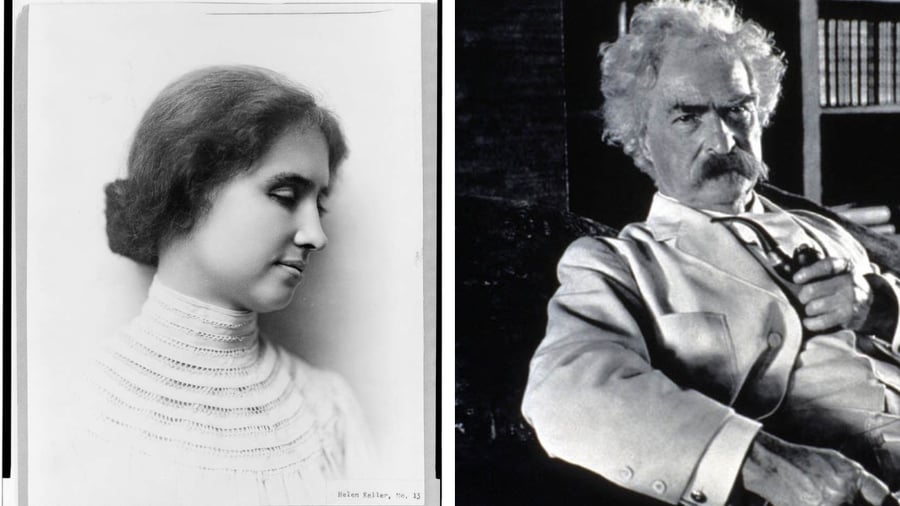
Mark Twain met Helen Keller in the winter of 1894–95 at a Sunday gathering in the New York home of the critic Laurence Hutton. Keller was 14, already nationally famous as the deaf-blind girl who had learned language through her teacher Anne Sullivan. Twain was nearing 60, the most celebrated writer in America and, privately, a man sliding toward bankruptcy. The two connected immediately. Keller "listened" to Twain by resting her fingers on his lips as he spoke, and she later wrote that she could feel the twinkle in his eye through his handshake.
Twain was not sentimental about Keller, which is partly why she treasured him. She recalled that he never made her feel pitied. He treated her as a mind, told her stories, swore freely in her presence and let her follow the smoke rings from his cigar with her hands. Keller wrote that Twain regarded her deafness and blindness as mere incidents, and that with him she never felt like a curiosity.
The friendship had practical consequences. When Keller's family could not afford to send her to college, Twain intervened. He wrote to Emily Rogers, wife of his friend and financial rescuer Henry H. Rogers of Standard Oil, urging the couple to fund Keller's education. They did. Rogers' money carried Keller through Radcliffe College, from which she graduated with honors in 1904, becoming the first deaf-blind person to earn a bachelor of arts degree.
Twain's admiration was on the record. He ranked Keller among the most extraordinary figures of his era and compared her impact to that of history's great conquerors, an assessment Keller quoted for the rest of her life. The two remained friends until Twain's death in 1910. Keller visited him at his Connecticut home in his final years, and her published recollections of him remain among the warmest portraits of Twain ever written.
Credit: Banca dati di Immagini per la Didattica / Wikimedia Commons (CC BY-SA 2.5) (left)
Credit: Yousuf Karsh / Colorisation : Madelgarius / Wikimedia Commons (CC BY-SA 4.0) (right)
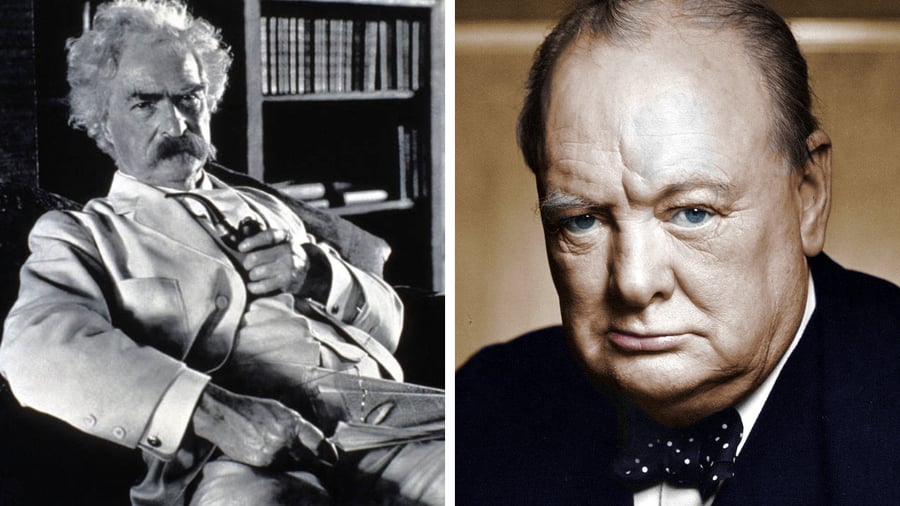
On December 12, 1900, a 26-year-old Winston Churchill stood before an audience at the Waldorf-Astoria hotel in New York, about to lecture on his adventures in the Boer War, including his celebrated escape from a prisoner-of-war camp. The man chosen to introduce him was Mark Twain. The pairing put the era's most famous humorist on stage with a young war correspondent and newly elected member of Parliament who was still building his name.
The introduction is famous because Twain used it to needle his guest. Twain opposed the Boer War as an act of imperial aggression, just as he opposed the American war in the Philippines, and he said so. He introduced Churchill by noting his mixed parentage — an English father and an American mother — and declared him the perfect blend. But he framed the compliment inside a critique, remarking that England and America were now kin in sin, each fighting an unjust war. The barb was delivered with enough charm that the audience laughed and Churchill took the stage anyway.
The two had met privately before the lecture and argued about the war in a friendly way. Churchill later recalled that Twain was gentle but immovable, and by Churchill's own account the older man got the better of the exchange. Before they parted, Churchill asked Twain to sign copies of his books. Twain inscribed one volume with advice that has been quoted ever since: it is noble to be good, and nobler to teach others to be good, and less trouble.
The evening captured both men in transition. Twain, in his last decade, had become America's anti-imperialist conscience. Churchill was at the start of a career that would make him the embodiment of the empire Twain criticized. They never met again, but Churchill quoted the encounter for decades, apparently untroubled by having served as the punchline.
Credit: SKOTCONV / Wikimedia Commons (CC BY-SA 4.0) (left)
Credit: Manjappabg / Wikimedia Commons (CC BY-SA 3.0) (right)
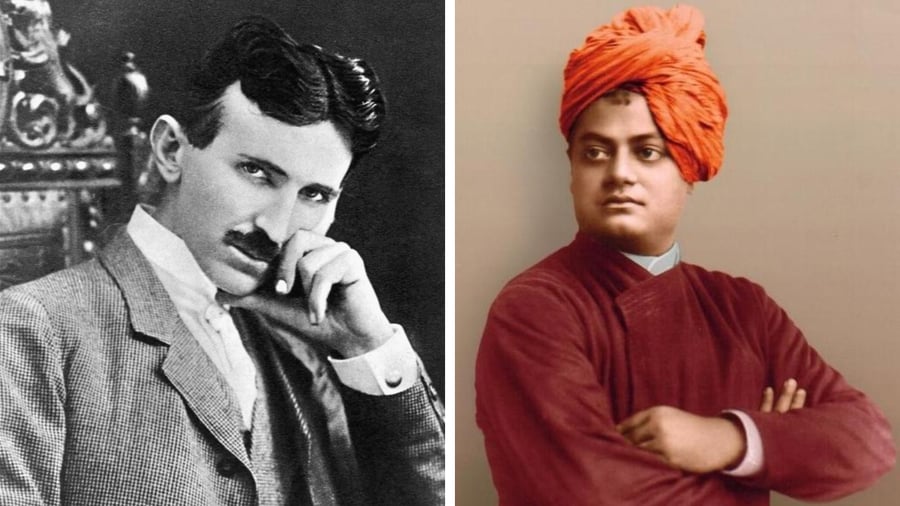
In early 1896, New York's fashionable circles brought together an unlikely pair: Nikola Tesla $TSLA, the Serbian-American inventor then at the height of his fame after the triumph of alternating current, and Swami Vivekananda, the Indian monk who had electrified the 1893 World's Parliament of Religions in Chicago with his address on Hinduism. The connection ran through the theater. The French actress Sarah Bernhardt was performing in New York in the play "Iziel," a drama with an Indian theme, and a gathering connected to the production put the scientist and the monk in the same room.
The two men found common ground quickly. Vivekananda had been lecturing in America on Vedanta philosophy, including the ancient Sanskrit concepts of prana and akasha — roughly, energy and primordial matter — and the idea that matter and force were ultimately one. Tesla, who was then deep in speculation about the nature of energy, told the monk that he believed he could demonstrate mathematically that what we call matter is simply potential energy. The claim thrilled Vivekananda, who saw in it a possible scientific vindication of Vedantic cosmology.
The evidence for the meeting comes primarily from Vivekananda's own correspondence. In a letter written in February 1896, he described meeting Tesla, recounted the inventor's interest in the Vedantic ideas and reported Tesla's promise to show him the mathematical demonstration the following week. Vivekananda wrote that if Tesla succeeded, the foundations of Vedantic cosmology would be established on the surest of ground.
The demonstration never materialized. Tesla did not produce the proof, and the mathematical unification of matter and energy waited nine more years for a Swiss patent clerk named Albert Einstein. But the meeting left traces in both men's thinking. Tesla later used Sanskrit terms in his writings on energy, and Vivekananda continued to cite Western science as a partner to Indian philosophy rather than an enemy of it.
Credit: United Artists / Wikimedia Commons (CC BY-SA 4.0)
Credit: Ellie Koczela / Wikimedia Commons (CC BY-SA 4.0)
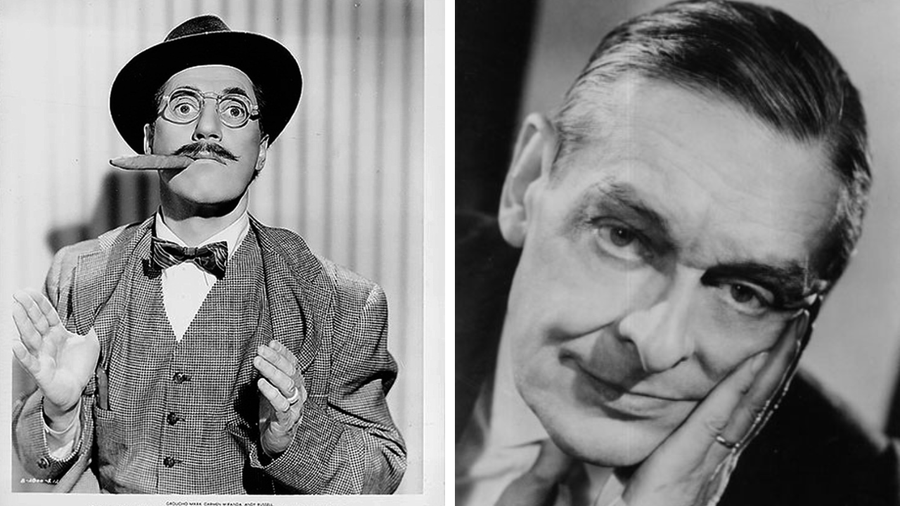
The friendship between Groucho Marx and T.S. Eliot began with fan mail — from Eliot. In 1961, the author of "The Waste Land," Nobel laureate and the most imposing figure in English-language poetry, wrote to the comedian asking for a signed photograph. Groucho sent one. Eliot wrote back requesting a different one: he wanted Groucho in character, with the cigar and the greasepaint mustache. Groucho complied, and Eliot hung the portrait in his office alongside images of W.B. Yeats and Paul Valéry.
The correspondence continued for three years, warm and slightly absurd on both sides. Eliot addressed the comedian as Groucho and signed himself Tom. Groucho, a voracious reader with a lifelong insecurity about his lack of formal education, was flattered and baffled in equal measure. The letters were later published in "The Groucho Letters," preserving the whole exchange.
The dinner finally happened in June 1964 at Eliot's home in London, with their wives present. Groucho prepared as if for an examination. By his own account, written in a letter to his brother Gummo that has become the standard record of the evening, he reread "Murder in the Cathedral," "The Waste Land" and other works, ready to discuss literature with the master.
The evening refused to follow the script. Groucho tried to steer the conversation to "King Lear" and Eliot's criticism. Eliot wanted to talk about the Marx Brothers. The poet quoted lines from "A Night at the Opera" and asked about "Animal Crackers" and "Duck Soup." Groucho pressed on with Shakespeare; Eliot countered with Groucho's own movies. Each guest had come to worship at the other's altar, and neither would accept the tribute.
Groucho reported to Gummo that Eliot was a nice man and a good host, and that the evening was a success despite the comic stalemate. Eliot died seven months later, in January 1965.
Harry Houdini and Arthur Conan Doyle should never have been friends, and eventually they weren't. Doyle, creator of the hyper-rational Sherlock Holmes, was by 1920 the world's most prominent advocate of spiritualism, convinced that the living could communicate with the dead. Houdini, the world's most famous escape artist, had spent years exposing fraudulent mediums, using his knowledge of stage trickery to unmask their methods. Grief connected them anyway. Doyle had lost his son; Houdini mourned his mother with an intensity that never faded. The two met in England in 1920 and struck up a genuine friendship built on mutual curiosity.
Doyle believed Houdini himself possessed supernatural powers and could dematerialize to escape his restraints — a theory Houdini found maddening, since he insisted his effects were pure technique. Houdini, for his part, kept hoping to find one genuine medium, if only to reach his mother.
The friendship broke in Atlantic City in June 1922. The Doyles invited Houdini to a private séance in their hotel suite, where Lady Doyle, who practiced automatic writing, produced pages of messages supposedly channeled from Houdini's mother, Cecilia Weiss. Houdini sat through it politely, but the session convinced him of the opposite of what the Doyles intended. The messages were written in fluent English, a language his Hungarian-born mother barely wrote. Lady Doyle had marked the page with a cross, an unlikely gesture from the wife of a rabbi. And the séance fell on what Houdini noted was his mother's birthday, which the messages never mentioned.
When Houdini later said publicly that he had experienced nothing genuine, Doyle felt betrayed, and the dispute spilled into newspapers. The former friends attacked each other in print for years. Houdini escalated his anti-medium crusade, testifying before Congress in 1926. When he died that October, Doyle suggested the spirits may have had a hand in it.
On March 4, 1905, spectators at Theodore Roosevelt's inaugural parade in Washington watched an extraordinary sight roll up Pennsylvania Avenue: Geronimo, the Apache leader whose name had terrified the American Southwest for decades, riding on horseback in full regalia alongside five other Native American chiefs. Geronimo was nearly 80 and had been a prisoner of war of the U.S. government since his surrender in 1886, held first in Florida, then Alabama, then at Fort Sill in the Oklahoma Territory.
His presence in the parade was itself a statement, though of what remains debated. The government presented the chiefs as symbols of a pacified frontier. Geronimo, who by then had become a national celebrity — selling autographs and appearing at the 1904 World's Fair in St. Louis — understood the value of visibility. The crowd's response was loud. Some observers noted that the old Apache drew cheers rivaling those for the president himself.
Days after the parade, Geronimo got what he had actually come for: an audience with Roosevelt. Speaking through an interpreter, he made a direct appeal. He asked the president to let him and his people return to their homeland in Arizona. He described the Apaches' longing for the mountains where they had been born and said he wanted to die in his own country.
Roosevelt refused. He told Geronimo, bluntly, that the wounds of the Apache wars were too fresh, that Arizonans still harbored bitter feelings and that returning the Apaches would risk violence. Geronimo remained a prisoner of war at Fort Sill until his death in 1909, having never seen Arizona again. His grave remains at Fort Sill to this day, still on the grounds of the post where he was held. He dictated his autobiography in his final years and dedicated it to Roosevelt — a gesture that carried both respect and, unmistakably, a final unanswered appeal.
In September 1960, Fidel Castro arrived in New York to address the United Nations General Assembly and immediately turned his accommodation into political theater. After a dispute with the Shelburne Hotel in midtown Manhattan, Castro and his delegation decamped to the Hotel Theresa in Harlem, the storied "Waldorf of Harlem" at 125th Street and Seventh Avenue. The move was a calculated embrace of Black America, and crowds gathered outside around the clock.
Malcolm X $TWTR, then the most prominent minister of the Nation of Islam, was part of a Harlem welcoming committee, and late on the night of September 19 he was invited up to Castro's suite. The meeting lasted roughly half an hour, conducted through an interpreter, with a small number of journalists and aides present. A famous photograph shows the two men leaning toward each other in conversation, Castro in his fatigues, Malcolm in a dark suit.
Accounts from reporters present, including the New York Citizen-Call, recorded fragments of the exchange. Malcolm told Castro that Harlem's people were not fooled by the hostile press coverage of the Cuban revolution. Castro spoke about racial discrimination, telling Malcolm that the revolution had fought to end it in Cuba, and praised Harlem's welcome. Malcolm, careful about the Nation of Islam's official political neutrality, kept his statements measured, but the symbolism needed no elaboration: the leader of a revolution against U.S. influence sitting with the sharpest critic of American racial hypocrisy, in the capital of Black America.
The meeting alarmed U.S. officials and delighted the international press. Days later, Castro delivered a marathon address to the U.N. while world leaders including Nikita Khrushchev trekked uptown to visit him at the Theresa. Malcolm and Castro never met again — Malcolm was assassinated in 1965, blocks from the hotel where they had talked, at the Audubon Ballroom in Washington Heights.
Credit: Wikimedia Commons / PICRYL (left)
Credit: User:T1980 / Wikimedia Commons (CC BY 3.0)
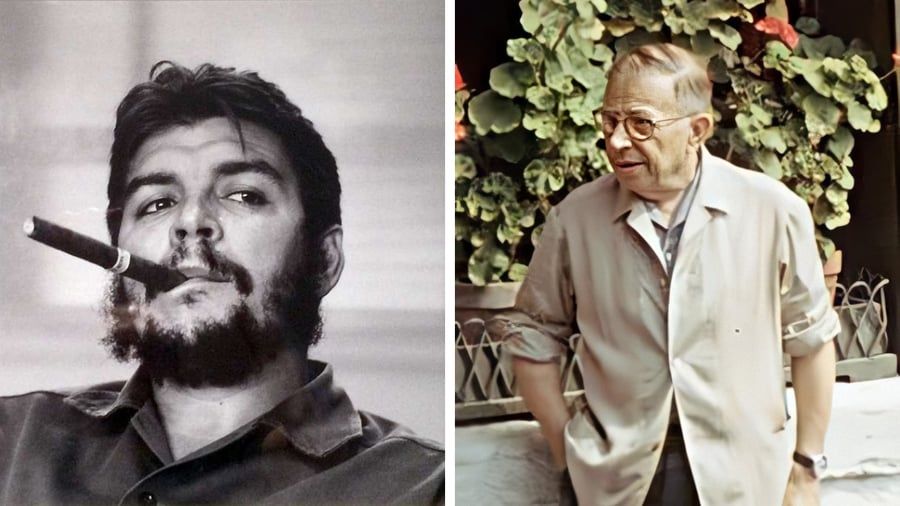
In the early months of 1960, Jean-Paul Sartre and Simone de Beauvoir — the most famous intellectual couple in the world — traveled to Cuba to see the revolution for themselves. The trip, arranged with the cooperation of the new government, gave the French philosophers extensive access to the island's leadership, including Fidel Castro. Its most memorable encounter, though, took place around midnight in an office at the National Bank of Cuba, where the revolution's most improbable banker kept his hours.
Ernesto "Che" Guevara, the Argentine physician turned guerrilla commander, had been appointed president of Cuba's central bank months earlier. He worked through the night, and visitors adapted to his schedule. Sartre and Beauvoir arrived at his office late and talked with him into the small hours, discussing the revolution's economics, its relationship to Marxist theory and its plans for Cuban society. Beauvoir later described the visit in her memoirs, recording her impressions of the young comandante managing a national currency from behind a desk piled with work, still in his fatigues.
Sartre came away deeply impressed. He wrote a series of enthusiastic dispatches about Cuba under its new government for the French press, later collected in book form, portraying the revolution as a new model unburdened by Soviet-style bureaucracy. His verdict on Guevara became one of the most quoted character judgments of the century. After Guevara's death in Bolivia in 1967, Sartre described him as the most complete human being of the age — a line that has adorned posters and biographies ever since.
The admiration did not survive the decade intact. Sartre later broke publicly with the Cuban government over its treatment of dissident writers, signing protest letters in the early 1970s during the Padilla affair. But the midnight meeting at the bank remained a fixed point in the mythology of both men: existentialism's chief philosopher taking notes on the revolution's chief icon.
On October 29, 1956, two of the most photographed women alive met for the first and only time, and they turned out to be exact contemporaries. Marilyn Monroe and Queen Elizabeth II were both 30 years old — born weeks apart in 1926 — when they shook hands at the Empire Theatre in London's Leicester Square $SQ. The occasion was the Royal Command Film Performance, an annual charity gala at which the monarch met a receiving line of film stars before a premiere. That year's film was "The Battle of the River Plate."
Monroe was in England for an extended stay, filming "The Prince and the Showgirl" opposite Laurence Olivier at Pinewood Studios. Her time in the country had been a sensation and an ordeal: the British press tracked her constantly, and the production with Olivier was strained. The royal gala offered a different kind of stage. Monroe wore a gold lamé gown with a deep neckline that generated its own news coverage, and she practiced her curtsy beforehand.
Newsreel footage preserves the moment. Monroe curtsies, the queen smiles, and the two women exchange words as the line moves along. Monroe later recounted the substance of the brief conversation: the queen noted that they were neighbors, since Monroe was living near Windsor during the film shoot, and asked how she was finding it. Monroe replied warmly about the area. She also met Prince Philip and other royals in the line.
Monroe described the queen afterward in glowing terms, calling her warm. The two never met again. The photographs of the encounter — Hollywood's most famous blonde bowing to Britain's young monarch, two 30-year-old women who each spent their lives as public property — have circulated continuously ever since, a reliable fixture of retrospectives on both women, endlessly recaptioned and reprinted across seven decades.
On May 14, 1984, the White House South Lawn hosted a scene with no precedent in presidential history: Michael Jackson, at the absolute peak of "Thriller"-era fame, standing beside Ronald and Nancy Reagan while thousands of staffers and invited children screamed as if at a concert. Jackson wore a sequined military-style jacket, aviator sunglasses and a single white glove. The president of the United States opened his remarks by welcoming him to the White House and joking about the young crowd's enthusiasm.
The occasion was official business. Jackson had allowed his hit "Beat It" to be used in a public service campaign against drunk driving, and the administration presented him with a Presidential Public Safety Communication Award in recognition. Reagan's speech praised Jackson as proof of what a person could accomplish through a life of dedication, noting his clean-living image and his appeal to young people whom the anti-drunk-driving campaign needed to reach.
Jackson's own remarks lasted seconds. He thanked the president and first lady, said he was very honored and stepped back from the microphone — a brevity that contrasted with the scale of the spectacle around him. Behind the scenes, the visit had its share of negotiation. Accounts from White House staff describe Jackson retreating from a crowded holding room full of adult fans among the staff, and being coaxed out for the ceremony.
The image of the meeting endured because of what it said about both men's command of stagecraft. Reagan, the former actor, understood the value of borrowing the biggest star in the world for an afternoon. Jackson, then selling records at a pace no artist had matched, understood that the White House lawn was simply another venue. The photographs — the single glove raised beside the presidential seal — became shorthand for the entire decade.
Credit: BANCADATI Indire - Elmar J. Lordemann / Wikimedia Commons (CC BY-SA 2.0 de ) (left)
Credit: Chuck Patch / Wikimedia Commons (CC BY-SA 2.0) (right)
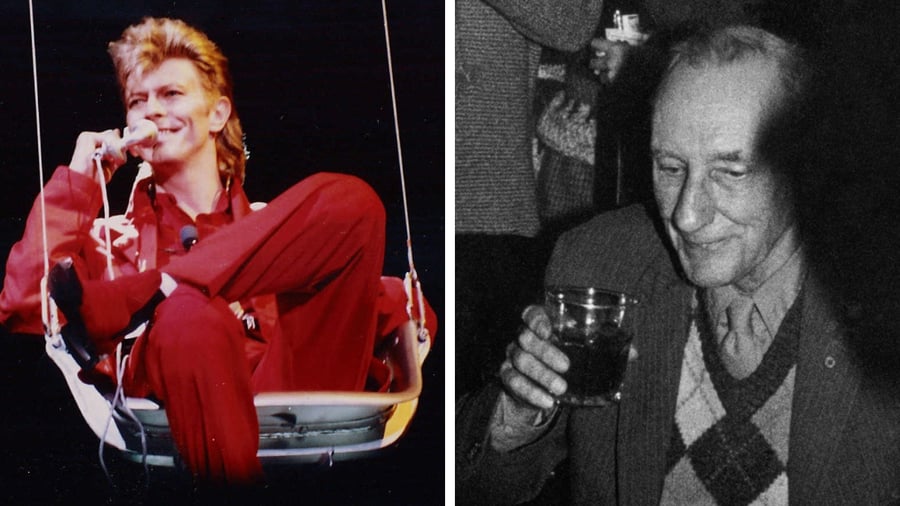
In November 1973, Rolling Stone engineered a summit between two generations of the avant-garde. The magazine's A. Craig Copetas brought William S. Burroughs, the 59-year-old author of "Naked Lunch" and godfather of the Beat movement, to David Bowie's home in London for a conversation between the novelist and the 26-year-old rock star who had just killed off his Ziggy Stardust persona. The interview ran in February 1974 under the headline "Beat Godfather Meets Glitter Mainman."
Preparation was uneven in both directions. Bowie had read little Burroughs beyond "Nova Express." Burroughs had listened to only a couple of Bowie songs, including "Five Years." Neither man let the gaps slow him down. Over a dinner Bowie served, they ranged across fame, sex, media, science fiction and the mechanics of creating art, with Bowie delivering an elaborate explanation of the Ziggy Stardust storyline — including plot details, such as the black hole beings called the infinites, that appear nowhere on the album itself. The published conversation remains a primary source for anyone trying to decode that record.
The meeting's real legacy was methodological. Burroughs, with the painter Brion Gysin, had popularized the cut-up technique: slicing written text apart and rearranging the fragments to produce new meanings. Bowie seized on it. He began cutting up his own lyric drafts with scissors, and the technique shaped the writing on "Diamond Dogs," released in 1974 — an album steeped in a dystopian atmosphere partly inspired by Burroughs' novel "The Wild Boys." Bowie used cut-ups intermittently for the rest of his career, later demonstrating a computerized version of the process in the 1990s.
The two stayed on friendly terms in the years afterward. The 1973 conversation is still cited as a model of the celebrity interview format: two artists interrogating each other as equals, with the journalist mostly staying out of the way.
Credit: Wikimedia Commons / PICRYL (left)
Credit: Eric Koch / Anefo / Wikimedia Commons (CC BY-SA 3.0 nl) (right)
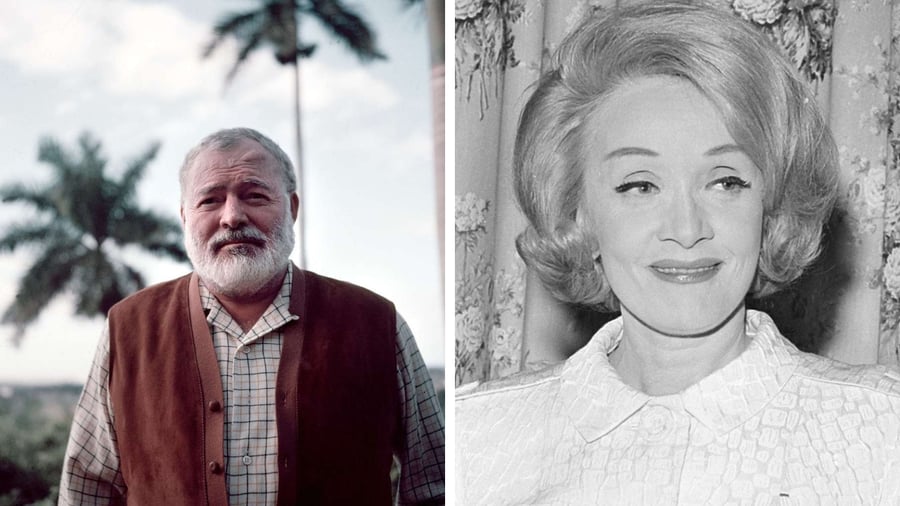
Ernest Hemingway and Marlene Dietrich met in 1934 aboard the ocean liner Île de France, crossing the Atlantic. The story of the meeting, told by both of them over the years, begins with arithmetic. Dietrich approached a dinner table in the ship's salon, counted the seated guests and found she would make 13 — a number she, superstitious, refused to join. Hemingway rose and offered to be the 14th. The novelist and the film star fell into conversation, and one of the most durable friendships in 20th-century celebrity began.
For the next three decades they sustained an intense, flirtatious correspondence, exchanging letters filled with affection and mutual performance. Hemingway called her "my little Kraut." Dietrich called him "Papa," as his intimates did. Both later insisted the relationship was never consummated, and Hemingway offered a much-quoted explanation: the timing never worked, because whenever he was free, she was entangled, and vice versa. He described them as victims of unsynchronized passion.
The friendship had real substance beneath the theater. Dietrich, a fierce opponent of the Nazi regime who became a U.S. citizen and spent World War II entertaining Allied troops close to the front lines, sought Hemingway's counsel on career and personal decisions, and he took her seriously as a performer and a person. Hemingway wrote admiringly of her courage and her voice, and in a 1952 Life magazine tribute he praised her judgment, saying that if she had nothing but her voice, she could break your heart with it.
Their letters, later archived and partially published, document the whole arc — from the shipboard meeting through Hemingway's decline. Dietrich kept his photograph and letters until her own death in 1992, 31 years after Hemingway's suicide. She said no man she knew had ever interested her more, and she guarded his memory for the rest of her long life.
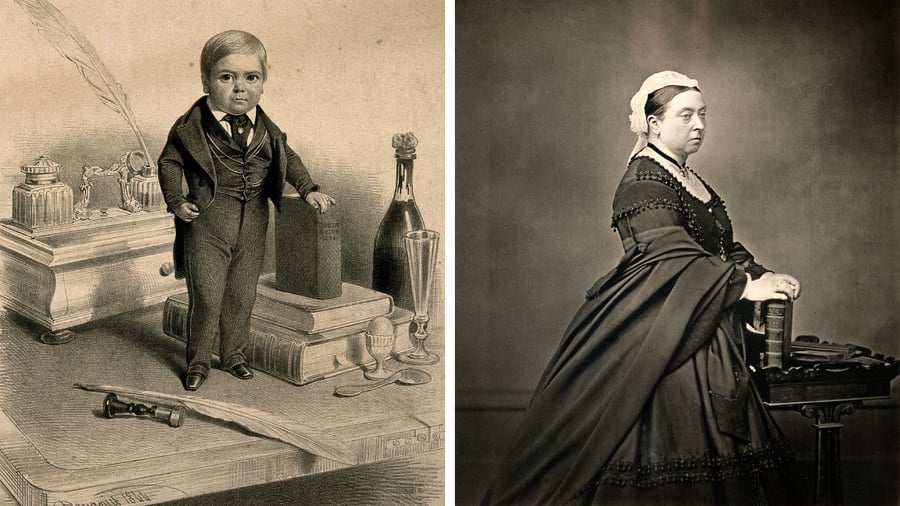
In 1844, the American showman P.T. Barnum brought his star attraction to Europe: Charles Stratton, a performer from Bridgeport, Connecticut, billed as General Tom Thumb. Stratton was a proportionate dwarf who stood roughly 25 inches tall, sang, danced and performed impersonations of figures such as Napoleon. He was also, in fact, six years old, though Barnum advertised him as 11 to make his poise seem even more improbable. Barnum's ambition for the London engagement was specific: an audience with Queen Victoria, whose endorsement would guarantee the tour's success.
Barnum maneuvered his way to an invitation, and in March 1844 he and Stratton were received at Buckingham Palace. Barnum coached the boy on royal protocol but largely let his natural showmanship run. Stratton greeted the assembled royals with a cheerful salutation to the "ladies and gentlemen," performed his songs, dances and imitations, and answered the queen's questions with a confidence that delighted the room. Victoria recorded the visit in her journal, describing the little man's intelligence and liveliness.
The evening produced its signature comic incident during the exit. Court etiquette required guests to back out of the royal presence rather than turn away. Stratton's short legs could not keep pace with Barnum's backward strides, so the boy alternated: he would turn, run a few steps to catch up, then spin around and resume walking backward. The queen's spaniel, excited by the running child, began barking and chasing him, and Stratton fended off the dog with his small cane while the court dissolved into laughter.
Victoria was charmed enough to invite Stratton back twice more, and other European royals followed her lead. The royal seal of approval made Tom Thumb an international phenomenon and made Barnum's fortune. Stratton performed for Victoria again as an adult, and his 1863 wedding to Lavinia Warren later dominated American front pages even in the middle of the Civil War.
Credit: Wikimedia Commons / PICRYL
Credit: Library of Congress / PICRYL
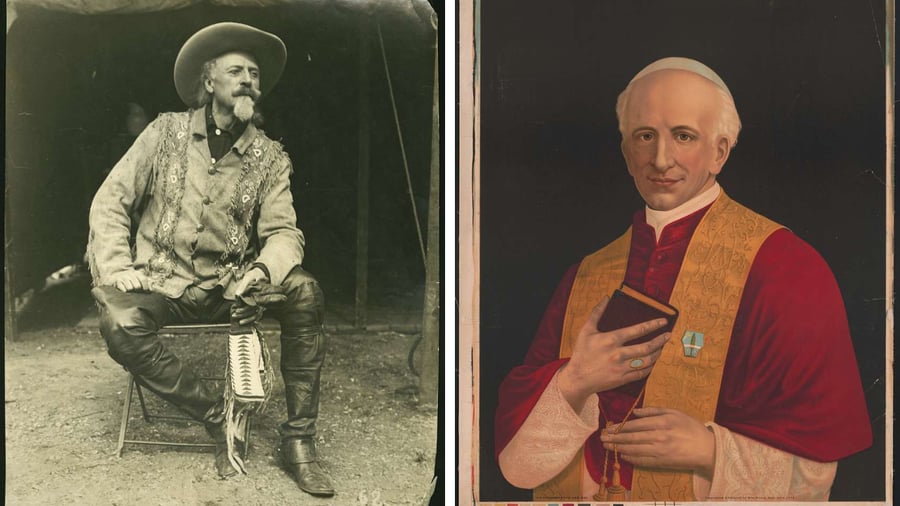
In the winter of 1890, Buffalo Bill Cody's Wild West show — a traveling spectacle of cowboys, sharpshooters and roughly 100 Lakota performers — set up in Rome as part of a European tour. The visit coincided with the anniversary celebrations of Pope Leo XIII's coronation, and Cody, never one to miss a promotional opportunity, secured an invitation for his entire company to attend the papal celebration at the Vatican on March 3, 1890.
The scene that followed was one of the strangest in Vatican history. The Wild West troupe — cowboys in their working clothes and Lakota performers in full regalia, including face paint and feathered headdresses — filed into the Vatican and took positions among the assembled dignitaries, diplomats and clergy waiting for the pontiff. Contemporary press accounts described the crowd's astonishment at the sight of American frontier performers standing beneath Renaissance frescoes.
When Leo XIII was carried through on the sedia gestatoria, the ceremonial portable throne, he passed directly by the Wild West contingent. Cody bowed. The Lakota members of the company, many of whom were Catholic converts or familiar with Catholic missionaries from the reservations, knelt as the pope passed, and Leo XIII paused to raise his hand in blessing over them. Newspapers on two continents ran the story, which was precisely the outcome Cody had engineered.
The moment carried more weight than the publicity framing suggested. The Roman audience saw exotic showmanship, but many of the Lakota performers approached the event on their own terms, as people familiar with Catholic missions on the reservations encountering the head of that church in person. Later that same year, after the troupe's return to the U.S., the massacre at Wounded Knee in December 1890 would devastate Lakota communities, and several Wild West performers subsequently worked as intermediaries in its aftermath. The photographs and engravings of the Vatican encounter survive in show archives and press illustrations of the period.
Credit: Hans van Dijk for Anefo / Wikimedia Commons (CC BY-SA 3.0)
Credit: FDR Presidential Library & Museum / Wikimedia Commons (CC BY 2.0)
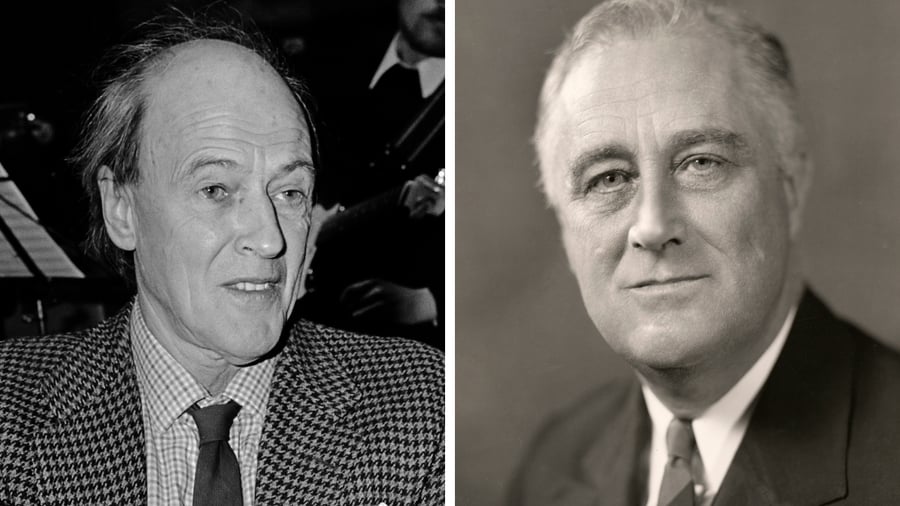
Before he wrote "Charlie and the Chocolate Factory" or "Matilda," Roald Dahl was a fighter pilot and a spy. Invalided out of combat flying after a crash in the Libyan desert, the young Royal Air Force officer was posted to Washington in 1942 as an assistant air attaché at the British Embassy. His real work went further: Dahl became part of British Security Coordination, the intelligence network run by William Stephenson that worked to influence American opinion and keep the U.S. committed to the war in Europe.
Dahl's assets were charm, height, a uniform and a gift for storytelling, and he deployed them across Washington society. His most valuable connection was Eleanor Roosevelt. The first lady had read a piece of Dahl's early writing about gremlins — the mythical creatures RAF pilots blamed for mechanical failures, later the subject of his first children's book, developed with Walt Disney $DIS — and reportedly enjoyed it, opening a social door. Dahl became a repeat guest of the Roosevelts, dining at the White House and, more valuably for his handlers, spending weekends at Hyde Park, the president's Hudson Valley estate.
There Dahl got sustained, informal access to Franklin D. Roosevelt himself. He watched the president mix cocktails, listened to his unguarded table talk about the war, politics and personalities, and was once driven around the estate by Roosevelt at alarming speed in his hand-controlled Ford $F. Dahl wrote up what he heard and passed the reports to British intelligence, giving London an unofficial channel into the president's thinking.
Dahl later spoke and wrote about the strangeness of the arrangement: a junior officer in his 20s gossiping with the most powerful man on earth, then reporting it all to a foreign — if allied — intelligence service. The Hyde Park weekends gave the future children's author material no fiction could improve.
