
Seasonally adjusted initial jobless claims came in at 215,000 for the week ending July 4, the Labor Department reported Thursday — a decline of 2,000 from the prior week's figure, which was revised upward to 217,000.
The 4-week moving average also fell, to 218,750, as continuing claims held at a historically low 1.81 million
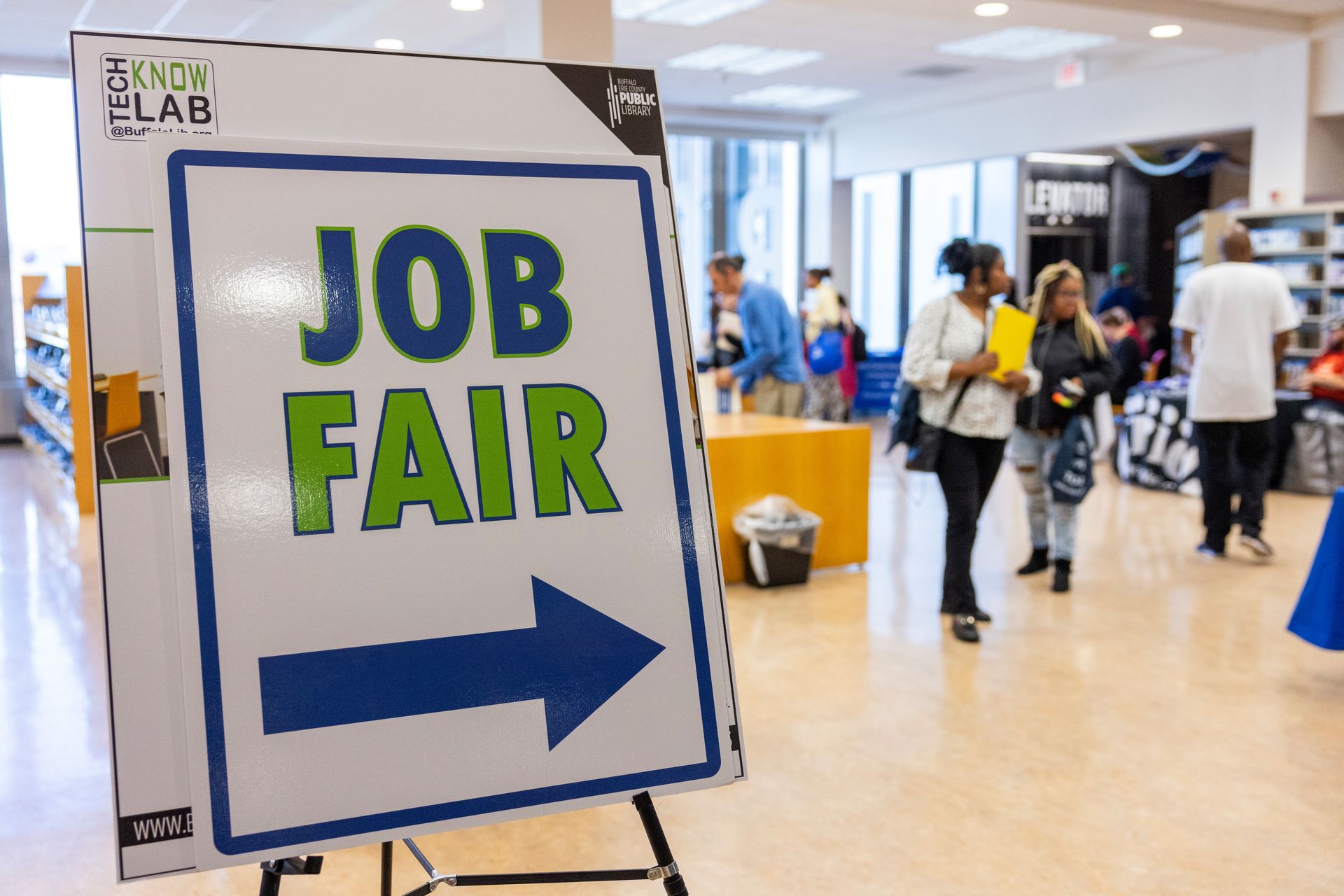
A sign at a NYS Department Of Labor job fair at the Downtown Central Library in Buffalo, New York, US, on Wednesday, Aug. 27, 2025. (Lauren Petracca/Bloomberg via Getty Images)
Seasonally adjusted initial jobless claims came in at 215,000 for the week ending July 4, the Labor Department reported Thursday — a decline of 2,000 from the prior week's figure, which was revised upward to 217,000.
Analysts surveyed by FactSet had forecast 220,000 new applications. Economists surveyed by The Wall Street Journal had expected 218,000. A Bloomberg survey of economists had called for 217,000.
At 218,750, the four-week moving average dropped by 3,750 — a measure that helps iron out volatility in the weekly numbers. For the week ending June 27, continuing claims edged up to 1.81 million — an 8,000 increase that still leaves the total at a level considered historically low.
On an unadjusted basis, initial claims climbed close to 10,000, according to Bloomberg, with California accounting for nearly all of that increase. The comparable unadjusted total a year earlier was 241,361.
The data point to a labor market that has cooled but remains stable. Economists and analysts treat weekly unemployment filings as a near-immediate gauge of labor market health, since the numbers reflect how many workers employers are actively letting go.
That report comes on the heels of a disappointing June jobs report, in which employers added just 57,000 nonfarm payroll positions — far below the 115,000 analysts had projected. Although the unemployment rate ticked down from 4.3% to 4.2%, much of that improvement reflected people exiting the labor force altogether rather than finding work. Downward revisions to April and May left the two-month combined total 74,000 jobs below what had originally been reported.
The subdued claims figures reflect a reluctance among employers to shed staff despite a broader pullback in hiring activity. The phrase "low-hire, low-fire" has been used to capture current conditions, as weekly filings have remained anchored — generally running between 200,000 and 250,000 — ever since the post-pandemic recovery took hold, according to the Associated Press.
Verizon $VZ, UPS, Amazon $AMZN, Disney $DIS, Starbucks $SBUX, and Walmart $WMT are among the employers that have announced headcount reductions in recent months. Microsoft $MSFT announced earlier this week that its Xbox video game division would be among the areas affected by a broader round of layoffs totaling 4,800 positions — approximately 2.1% of the company's global headcount.
Join 500,000+ readers who start their day with Quartz.
By subscribing, you agree to our Terms of Service and Privacy Policy.