
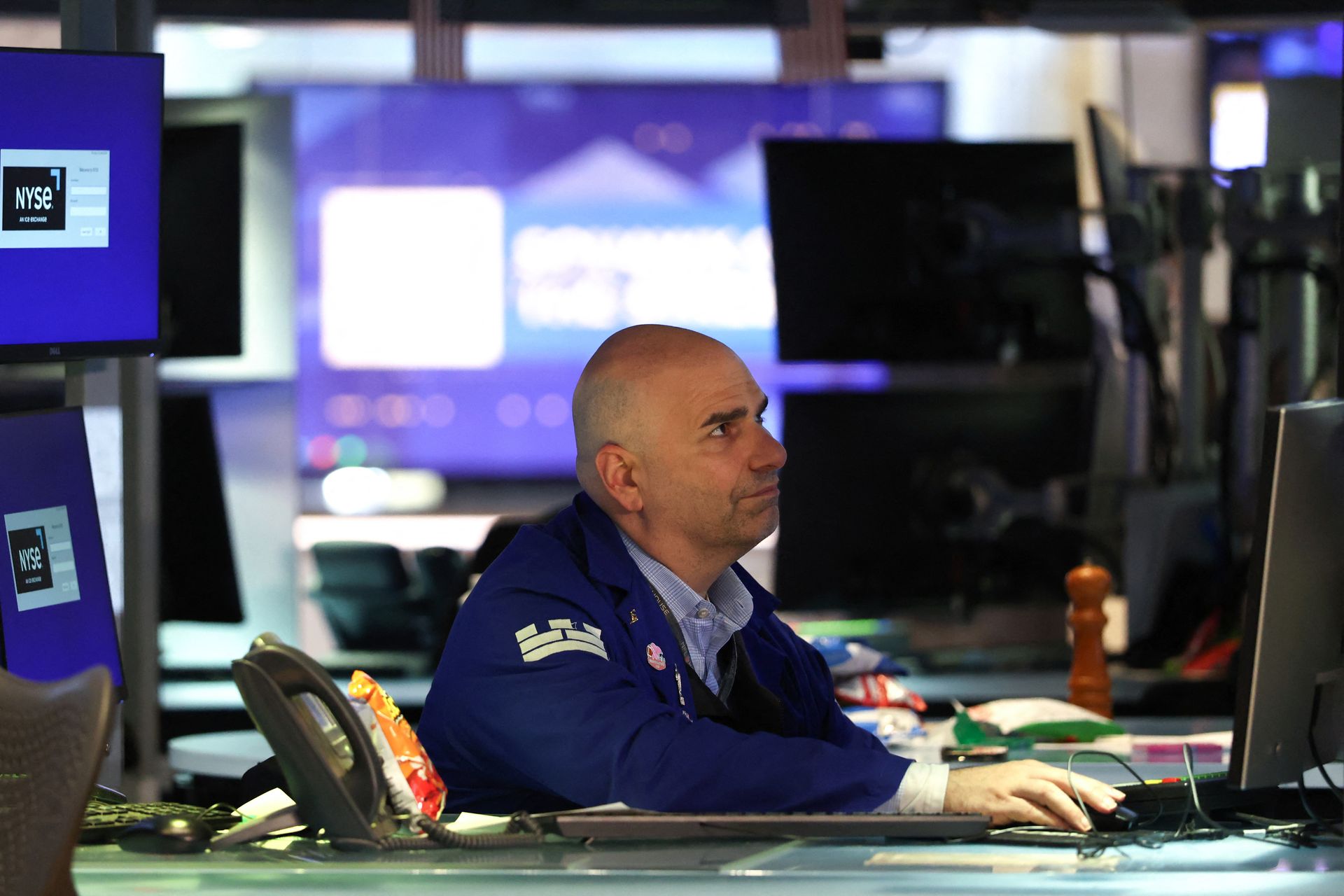
U.S. stock futures pointed to losses at Monday's open, with investors rattled by the ongoing war in the Middle East, climbing oil prices, and bond yields that remain near multi-year highs following a turbulent end to last week.
Futures tied to the S&P 500 and Nasdaq $NDAQ-100 were each off about 0.3%, while Dow Jones Industrial Average futures dropped roughly 0.6%. The moves follow a record-setting week that ended badly on Friday, when the S&P 500, Dow, and Nasdaq Composite posted their worst single-day losses since March 27, according to MarketWatch.
Both major oil benchmarks gained roughly 1%, with Brent crude fetching around $110 a barrel and West Texas Intermediate changing hands at above $106. The yield on the 10-year Treasury note hovered around 4.58%, after touching 4.62% earlier in the session — its highest level in months.
Tensions over the war in the Middle East, now in its 80th day, are driving much of the anxiety, according to The Wall Street Journal. President Donald Trump, on Sunday, warned Iran in a social media post to agree to a peace deal quickly, writing that if it did not, "there won't be anything left of them." The Associated Press reported Sunday that Israel was working with the U.S. on possibly resuming airstrikes against Iran, according to MarketWatch.
Losses in futures contracts moderated after remarks by Iranian foreign ministry spokesperson Esmaeil Baqaei, who said a new U.S. proposal had drawn a response from Tehran and that back-channel contact was still active "through the Pakistani mediator."
Rising energy costs tied to the Iran conflict have stoked fears that persistently high inflation could leave the Federal Reserve and its global peers with little choice but to lift borrowing costs. "What didn't make sense was major indices rallying to ATH [all-time high] levels while investors KNEW inflation was going to become a problem as Middle East tensions dragged on," Ipek Ozkardeskaya, a senior analyst at Swissquote, said according to MarketWatch. "Strong AI earnings and solid guidance outweighed the risks, while CEOs of non-tech companies increasingly warned that the energy crisis was starting to eat into consumers' purchasing power."
In a note cited by CNBC, Yardeni Research president Ed Yardeni argued that current conditions have made any pivot toward rate cuts untenable, saying the economy no longer justifies even a bias toward easing.
Retail sales in China rose just 0.2% in April, far below economist forecasts of a 2% gain and the softest reading in more than three years, according to China's National Bureau of Statistics. Industrial production rose 4.1% year-on-year, below a forecast of 6%. Hong Kong's Hang Seng and Japan's Nikkei each fell about 1%.
On the corporate front, investors are awaiting earnings from Nvidia $NVDA on Wednesday, along with results from Target $TGT on Wednesday and Walmart $WMT on Thursday. A filing of SpaceX's IPO prospectus is also anticipated within the next few days, according to The Wall Street Journal.