
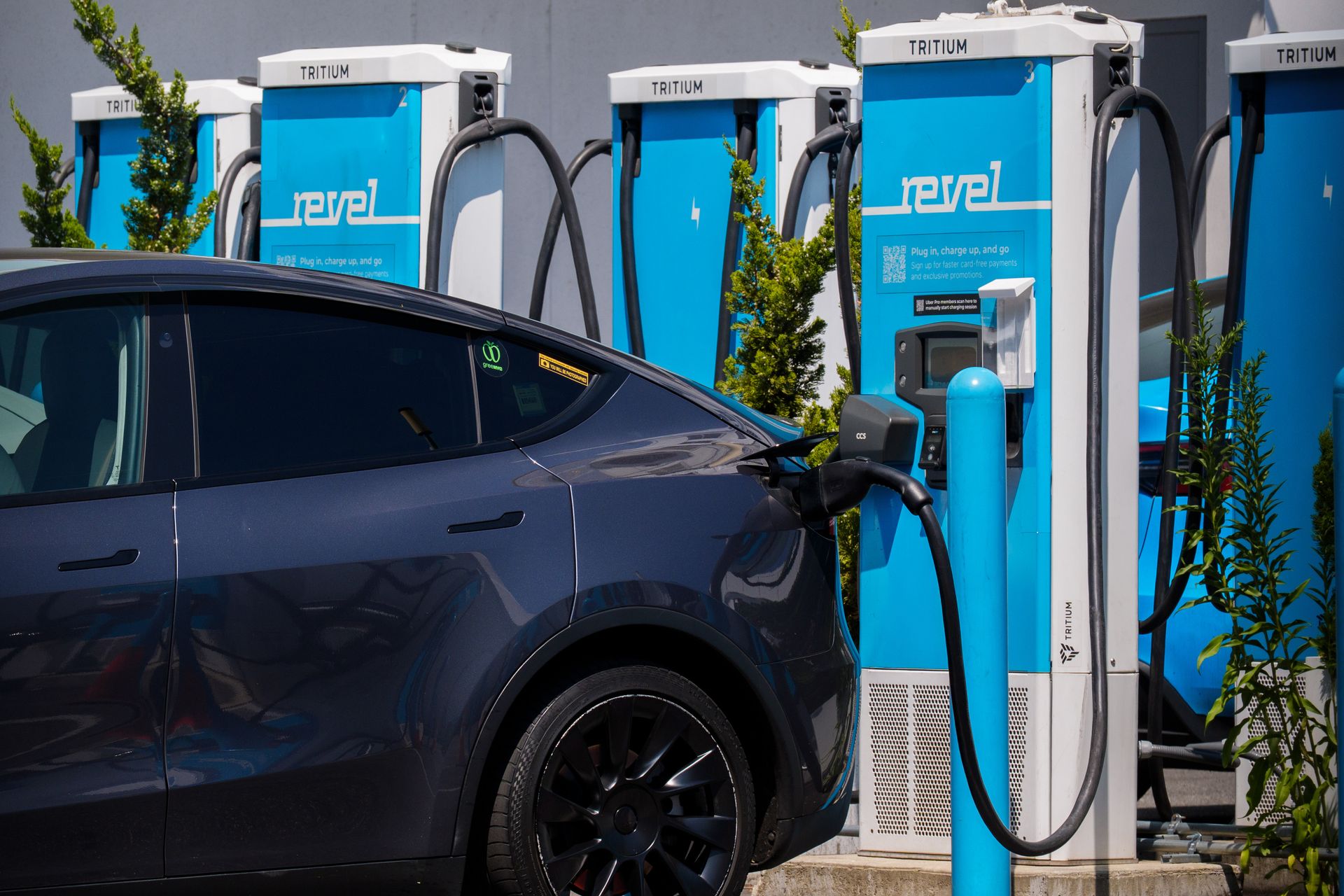
Voltera and Revel Transit have agreed to combine their businesses to build and operate fast-charging networks for autonomous vehicles, electric fleets, and ride-hail operators in dense U.S. cities, the companies said.
The combined company will operate under the Voltera brand and expects to have more than 1,000 charging stalls across 11 major U.S. markets
Bloomberg / Getty Images
Voltera and Revel Transit have agreed to combine their businesses to build and operate fast-charging networks for autonomous vehicles, electric fleets, and ride-hail operators in dense U.S. cities, the companies said.
According to the companies, the deal would put more than 1,000 charging stalls — spanning sites already in service and those still in development — under the Voltera name across 11 major U.S. metro areas. Financial terms were not disclosed.
Revel CEO Frank Reig will lead the combined company. Current Voltera CEO Brett Hauser will step down from his role after the deal closes and remain with the organization in a senior commercial advisory capacity, the companies said.
"Bringing these teams together is the natural next step to deliver greater scale and stronger solutions in the key markets where fleet and autonomous vehicle customers need reliable infrastructure the most," Frank Reig said in a statement.
On the strategic rationale, the companies said Voltera's project pipeline and existing client base would be paired with the urban presence and day-to-day operating know-how that Revel has built. Rather than pursuing broad geographic expansion, the companies said they intend to direct capital toward a targeted cluster of dense urban markets, using a disciplined approach that emphasizes locations where fleet and autonomous vehicle customers are most active.
The merged business also laid out a broader commercial vision, saying it sees potential revenue streams outside its core robotaxi and ride-hail focus — among them stationary battery storage, energy management, charging for conventional commercial fleets, and bundled fleet services.
On the ownership side, EQT — which already held equity in Voltera before the deal — is set to emerge as the majority owner of the new entity. A minority position will be held by Global Infrastructure Partners, the BlackRock $BLK-affiliated fund that had been Revel's lead financial backer.
"The electrification of urban mobility is one of the most capital-intensive infrastructure buildouts of this decade, and the operators who move first in the right markets, and with the right assets, will define the category," EQT partner Erwin Thompson said in a statement.
The announcement follows Bloomberg's reporting that Revel made a strategic exit from New York-based ride-hailing — a business it was losing money on — about nine months ago, redirecting its focus to charging infrastructure. Uber $UBER has since become a significant commercial partner, with the company having committed to directing its drivers to Revel's charging stations, Bloomberg reported.
Charger scarcity remains one of the most frequently cited obstacles to broader EV uptake, and that pressure is poised to intensify as autonomous ride services push further into commercial deployment nationwide, Transport Topics reported.
Join 500,000+ readers who start their day with Quartz.
By subscribing, you agree to our Terms of Service and Privacy Policy.