
20 ways your environment is making decisions for you without telling you
The physical world around you shapes what you choose, what you eat, how you feel, and how you think in ways that bypass conscious awareness entirely

Greta Hoffman / Pexels
The feeling of making a free choice is not the same thing as making a free choice. The sequence of options you encounter, the size of the container your food comes in, the temperature of the room you are sitting in, the color of the walls around you, the music playing in the background, the weight of the object in your hand — each of these alters your behavior in specific, documented, measurable ways that your conscious decision-making process is entirely unaware of. You did not decide to eat more because the plate was larger. You did not decide to feel more trusting because someone handed you a warm drink. You did not decide to think more creatively because the ceiling was high. Your environment decided for you, and you experienced the result as a preference.
This is not a fringe claim. It is the central finding of four decades of environmental psychology, behavioral economics, and cognitive science research, some of which has produced findings that are among the most replicated in psychology. Brian Wansink's work on portion size and eating behavior, while controversially replicated in some specifics, established a research tradition whose core findings — that people eat more when containers are larger, regardless of hunger — have been confirmed across dozens of independent studies. The default option effect, in which whichever choice is presented as the default is the choice most people make, is as well-established as any finding in behavioral science.
The mechanism through which most of these effects operate is the architecture of attention and cognitive load. The conscious deliberative system — what Daniel Kahneman calls System 2 — is effortful and slow. Most decisions, including ones that feel deliberate, are actually made by the faster, automatic System 1 that processes environmental cues unconsciously and produces responses before System 2 has the opportunity to evaluate them. The environmental cue has already shaped the choice by the time the person experiences themselves as choosing.
Each entry in this list covers a specific environmental influence, the documented mechanism, the evidence quality, and — where it exists — the specific magnitude of the effect. Several of these effects are large enough to be commercially significant, which is why the retail, hospitality, and food industries invest heavily in understanding and deploying them. Understanding them yourself is the prerequisite for deciding whether to let them operate or to consciously override them.
Plate and container size

Burst / Pexels
The amount of food people serve themselves and subsequently eat is strongly influenced by the size of the plate, bowl, or container from which they serve, independent of hunger level. This is one of the most consistently replicated findings in the food behavior literature: people consistently serve themselves larger portions from larger dishes and eat more from larger containers, and they consistently underestimate this effect when asked to predict their behavior.
The mechanism is calibration to a reference frame: people use the plate size as a reference point for what constitutes a normal serving, and the absence of an objective reference creates dependence on the relative cue. A portion of pasta that fills a smaller plate looks complete and satisfying; the same portion on a larger plate looks inadequate, triggering additional serving. The person's hunger level influences total eating but is not the primary determinant of how much is served at the initial serving stage.
The commercial implication is visible in the food service industry's standard practice of serving different-sized portions on differently sized plates to influence perceived value: a smaller portion on a small plate reads as a complete meal in a way that the same portion on a large plate does not. Home kitchens that switch to smaller plates — a common behavioral intervention for caloric management — consistently show reduced caloric intake without increased subjective hunger.
Room temperature

Vitaly Gariev / Pexels
Room temperature influences mood, cognitive performance, interpersonal warmth, and food preference in specific and documented ways. The relationship between temperature and social warmth — warmer rooms producing warmer interpersonal behavior — has been demonstrated across multiple studies. John Bargh's research found that people who held a warm cup of coffee briefly rated a stranger as having a warmer personality than people who held a cold cup, demonstrating the specific embodied cognition pathway by which physical temperature influences social judgment.
For cognitive performance, research has found an optimal temperature range of approximately 21 to 22°C for most cognitive tasks, with performance declining both above and below this range. Above approximately 26°C, mathematical reasoning and complex cognitive tasks show measurable impairment; below approximately 18°C, the physical discomfort of cold activates stress responses that compete with cognitive resources. The temperature of the office affects the productivity of the people in it in ways that are rarely considered when HVAC systems are set.
For food preference, cold environments increase preference for calorie-dense foods — a thermogenic response in which the body's need for fuel to maintain core temperature is translated into food preference. Restaurant environments that are cooler than comfortable produce measurably higher food consumption than environments at comfortable temperatures.
Background music tempo and volume

Nara Nokay / Pexels
Background music tempo influences eating speed, spending behavior, and perceived wait time in commercial environments in ways that are consistently deployed by retailers and restaurateurs. The foundational research by Ronald Milliman in the 1980s found that slow background music in a restaurant produced slower eating, longer table occupation, and higher bar sales than fast background music — the slower tempo created a more leisurely pace that extended the dining experience and increased incidental spending.
The music tempo effect operates through the synchronization of behavior to rhythm: people unconsciously match their movement and activity pace to environmental rhythm cues. Slow music produces slow eating; fast music produces fast eating. Supermarkets that play slow music show higher total sales because customers move through the store more slowly and spend more time — and therefore more money — than customers in high-tempo environments.
Music volume interacts with taste perception: research by Charles Spence at Oxford found that higher volume music reduces the ability to taste sweetness and saltiness, because the acoustic environment competes with sensory processing resources. Airlines serve food at altitude in a noise environment (engine noise, approximately 85 decibels) that reduces sweetness and saltiness perception, which is partly why airline food tastes worse than the same food on the ground.
Default options

Pixabay / Pexels
The default option effect — the finding that whichever option is presented as the default (the pre-selected choice, the opt-out rather than opt-in, the first option in a list) is chosen significantly more often than the same option presented as a non-default — is one of the largest and most practically significant effects in behavioral science. Organ donation rates vary by a factor of five or more between countries with opt-in systems (where donation requires active registration) and opt-out systems (where non-donation requires active registration), with the default option explaining most of the variance.
The mechanism is the combination of loss aversion (changing from the default requires accepting the psychological cost of a loss) and cognitive laziness (choosing the default requires no effort). Neither effect requires the person to consciously evaluate the default favorably; the default wins in the absence of strong contrary preference because it is the path of least resistance.
The commercial deployment of default options is pervasive: software that pre-selects all marketing email subscriptions; retirement plans that pre-select specific funds; website checkout processes that pre-select express delivery; streaming services that autoplay the next episode without requiring confirmation. Each default represents a decision made for the user that the user experiences as their own choice.
Ambient lighting

Novkov Visuals / Pexels
Ambient lighting intensity influences the intensity of emotional experience, risk-taking behavior, and negotiation outcomes in specific and documented ways. Bright light amplifies the emotional intensity of whatever is being felt — both positive and negative emotions are experienced more intensely under bright light than under dim light, according to research published in the Journal of Environmental Psychology.
The practical implication for decision-making: important decisions that require emotional calibration — negotiations, difficult conversations, decisions under ambiguity — are systematically affected by the lighting environment in which they occur. Research by Alison Jing Xu and Aparna Labroo found that bright light increased the intensity of perceived spiciness in food, the perceived aggressiveness of a fictional character, and the stated intensity of interpersonal feelings — suggesting that bright light acts as a general amplifier of cognitive processing intensity.
Dim lighting, by contrast, reduces cognitive effort and produces more relaxed, less deliberative decision-making — which is why restaurants that want customers to spend more time and make less price-conscious decisions consistently use low lighting, while banks and insurance offices use bright lighting to signal transparency and trigger more careful financial deliberation.
Order effects in menus and lists
Atlantic Ambience / Pexels
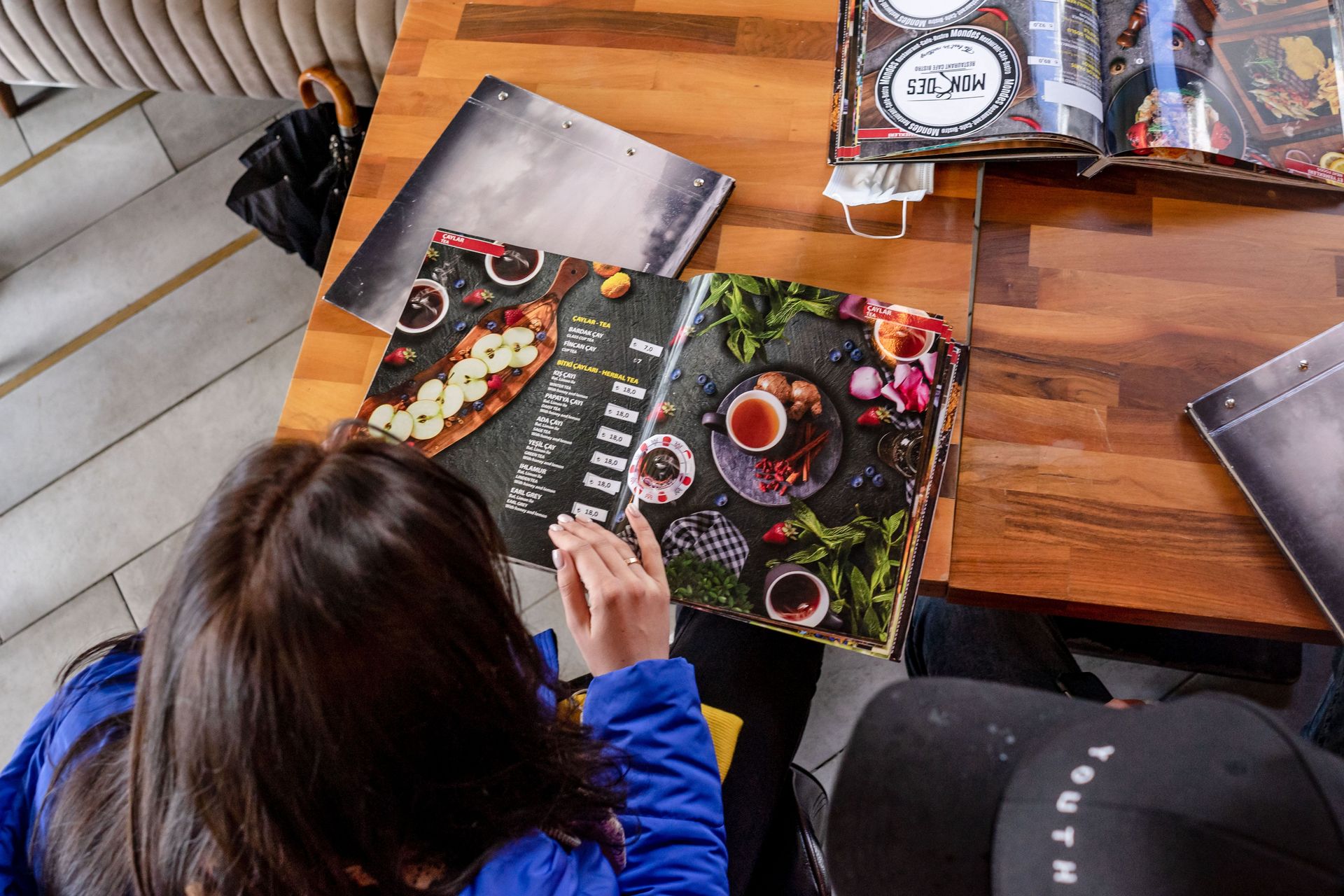
The position of an option in a list or menu significantly influences the probability that it will be chosen, independent of the option's actual quality or price. Two consistent effects have been documented: the primacy effect (the first option in a list receives disproportionate attention and selection) and the recency effect (the last option receives slightly elevated attention). In the middle of a long list, options are systematically underselected relative to their quality.
Restaurant menus exploit this extensively: the most profitable dishes are positioned in the upper-right corner of a two-page menu (the zone of highest visual attention), in anchoring positions at the top of sections, and adjacent to high-price items that make moderately-priced items appear more reasonable by comparison. The menu item that appears after a $95 dish seems more affordable than the same item appearing first in the section.
The order effect extends to any sequential presentation of options: candidates whose names appear first on a ballot receive slightly more votes; products listed first in an online search receive disproportionate clicks; job applicants interviewed first receive different ratings than equally qualified applicants interviewed later in a session. The order is environmental information that should be irrelevant to the choice and consistently is not.
Scent

Hồng Quang Official / Pexels
Environmental scent influences purchasing behavior, mood, memory encoding, and social trust in specific and well-documented ways. The olfactory system is the only sense with direct projections to the limbic system (the brain's emotional and memory processing regions) without an intermediate thalamic relay, which is why scent has a uniquely strong and immediate connection to emotional memory and emotional state.
Retail environments that use pleasant ambient scents show measurably higher sales, longer dwell time, and more positive evaluations of products than unscented environments — an effect that has been replicated across supermarkets, clothing stores, casinos, and car dealerships. The scent does not need to be related to the product: a floral scent in a clothing store increases purchases of unrelated items because the pleasant emotional state it produces generalizes to the evaluation of everything in the environment.
Fresh bread scent in supermarkets — specifically engineered by some retailers by installing bread-baking operations near the entrance — increases overall purchase amounts by activating a multisensory food-positive state that increases the willingness to spend. The new car smell that car buyers describe as part of what makes a car feel new is a specific scent product applied during manufacturing to produce exactly the emotional response it produces.
Cognitive load from environment

Vitaly Gariev / Pexels
The cognitive demands imposed by a complex or disorganized environment reduce the quality of subsequent decisions by depleting the mental resources available for deliberative reasoning. Ego depletion — the finding that self-control and deliberative reasoning are diminished after periods of sustained cognitive effort — applies to environmental cognitive demands as well as task-based ones.
Research on decision fatigue has found that judges make significantly worse parole decisions (defaulting more often to denial, the safe default) later in the day and before meal breaks, when cognitive resources are depleted. The depletion is not necessarily from making difficult legal decisions; it accumulates from the continuous cognitive effort of managing attention, maintaining social composure, and processing environmental complexity throughout the day.
A cluttered, noisy, or visually complex environment imposes continuous low-level cognitive demands that accumulate into meaningful cognitive load reduction. The clean, minimalist office or bedroom is not merely aesthetically preferable; it reduces the environmental cognitive tax that cluttered environments impose, leaving more cognitive resources available for actual decision-making.
Color

Mathias Reding / Pexels
Color influences purchasing behavior, perceived taste, product evaluation, and physiological arousal in ways that are heavily researched by the retail and food industries and almost entirely invisible to consumers. Red and yellow environments increase heart rate and stimulate appetite — the specific combination used by fast food restaurant interiors to encourage rapid eating and high food consumption. Blue environments reduce appetite and increase trust.
The Pepsi challenge experiments — blind taste tests in which Pepsi consistently outperformed Coke, while Coke consistently outperformed Pepsi in branded tests — demonstrate the color effect in brand evaluation: the red of the Coca-Cola $KO brand activates positive emotional associations that change the sensory experience of drinking the product. The color was doing part of the tasting.
In medicine, the color of a pill influences its perceived efficacy: blue pills are more effective sedatives and red pills are more effective stimulants than the same compounds in white pill form, according to research on placebo-color interactions. The color is pharmacologically inert and behaviorally active. In retail, products in red packaging are perceived as more aggressive and exciting; products in green packaging are perceived as more natural and healthy — perceptions that influence purchase regardless of the actual product content.
Proximity and accessibility

Jimmy Liao / Pexels
The physical distance between you and an option — how far you would have to reach, how many steps you would have to take, how many clicks you would have to perform — is one of the most powerful determinants of whether you choose it, independent of your preference for it. The behavioral economics concept of "choice architecture" is largely built around this finding: making healthy food more accessible in cafeterias, placing staircase signage at the most visible entry points, putting healthy options at eye level in refrigerators — these interventions consistently shift behavior without changing preferences or providing any new information.
Google $GOOGL's internal research on food accessibility found that placing M&Ms in opaque containers rather than clear ones reduced consumption by 3.1 million calories across the company's New York office over seven weeks. The M&Ms were in exactly the same location, available for exactly the same effort to obtain; the opacity of the container removed the visual accessibility cue that drove unconscious reaching.
The proximity effect applies to digital behavior: options that require fewer clicks receive dramatically more engagement than options requiring more clicks, independent of the options' actual value. The single click that separates one-click purchasing from standard checkout produces large differences in purchase completion rates, not because one click is meaningful effort but because the marginal friction is enough to interrupt the automatic behavioral sequence.
Social density and crowding

Mico Medel / Pexels
The number of people in an environment influences risk-taking behavior, creativity, and purchasing decisions in specific and documented ways. Crowded environments activate threat-related neural processing that increases conformity (the tendency to follow what others are doing), reduces creative risk-taking, and increases preference for familiar options over novel ones — a suite of responses that reflects the evolutionary logic of crowded environments as high-competition, high-monitoring contexts.
Research by Rui (Juliet) Zhu and Joan Meyers-Levy found that high-ceiling rooms increased abstract, creative thinking relative to low-ceiling rooms — a finding they attributed to the sense of freedom and expansiveness associated with high spaces. Conversely, crowded spaces trigger concrete, detail-focused thinking appropriate to high-competition environments where precision matters more than abstraction.
In retail, moderate crowd density increases purchases (social proof effect — if others are buying, the environment is signaling that buying is appropriate), while high crowd density decreases purchases (threat response overrides purchasing behavior). The optimal retail crowd density for maximizing purchase probability is a specific design target for large retail environments that is managed through staffing, display layout, and store flow design.
Time pressure

ahmed akeri / Pexels
Perceived time pressure — the feeling of having insufficient time for a decision — shifts decision-making toward heuristic processing (fast, automatic, rule-based) and away from deliberative processing (slow, effortful, evidence-weighing), reliably producing decisions that are more conformist, more risk-averse, and less considered than decisions made without time pressure.
The specific environmental mechanism: countdown clocks on e-commerce websites ("sale ends in 02:14:37"), queue lengths at checkout that create urgency to complete a transaction before reconsidering, "last item" and "limited availability" displays — these are environmental time pressure generators that shift decision mode from deliberative to heuristic without the person being aware that a mode shift has occurred.
Research in medical contexts has found that physicians under time pressure make significantly different diagnostic decisions than the same physicians given additional time, defaulting to common diagnoses and standard treatments rather than considering less common alternatives. The time pressure is not communicating information about the quality of the diagnosis; it is communicating a demand characteristic that changes the cognitive process producing the diagnosis.
Mirror placement

Max Vakhtbovych / Pexels
The presence and placement of mirrors in an environment influences eating behavior, product evaluation, and prosocial behavior in specific and documented ways. Research by Brad Bushman and colleagues found that people eating in front of mirrors consumed significantly less unhealthy food than people eating without mirrors — attributed to the self-awareness that mirrors trigger, which activates self-regulatory processes that the absence of a mirror does not.
The mechanism is self-discrepancy activation: mirrors make self-aware the gap between how we are behaving and how we want to be, triggering the inhibitory processes that reduce behavior inconsistent with self-concept. The mirror does not provide information; it provides self-monitoring. The behavioral consequence — reduced unhealthy eating — is a byproduct of the self-monitoring activation rather than a deliberate choice.
In retail, mirrors in fitting rooms influence willingness to pay: people trying on clothing in front of a mirror that shows the full body are more likely to purchase than people using a fitting room without a full-length mirror, because the visual feedback of wearing the item activates ownership psychology. The technology of "virtual try-on" in e-commerce attempts to replicate this mirror effect digitally for exactly the same reason.
Framing of identical information

RDNE Stock project / Pexels
The way information is framed — the specific words and reference points used to describe an option — influences choices between options that are mathematically identical, a finding so robust and so practically important that it is the foundation of most consumer marketing language. "95% fat-free" and "5% fat" describe the same product and produce measurably different purchase rates; "mortality rate of 10%" and "survival rate of 90%" describe the same outcome and produce different choices.
The mechanism is reference point dependence: people evaluate options relative to a reference point, and the framing establishes the reference point before the evaluation begins. A loss from the reference point (5% fat) is experienced more negatively than an equivalent gain above it (95% fat-free), even though the nutritional reality is identical. Kahneman and Tversky's prospect theory established that losses weigh approximately twice as heavily as equivalent gains in human psychological evaluation — and framing exploits this asymmetry.
Political language, financial product descriptions, public health messaging, and consumer marketing all deploy framing to direct choices toward preferred outcomes. "Death tax" and "estate tax" describe the same policy and produce different support rates. "Junk bonds" and "high-yield bonds" describe the same instruments and produce different investor behavior. The framing is doing political and financial work that the underlying information alone does not do.
Physical posture and body state

Funkcinės Terapijos Centras / Pexels
Your current physical posture and body state influence your cognitive processes, confidence level, and decision-making in specific ways — the embodied cognition pathway described in the room temperature entry operates not only through temperature but through the full range of physical experience. Sitting upright versus slumping influences self-reported confidence and the quality of ideas generated in brainstorming tasks; walking versus sitting influences the creativity of thinking; cold versus warm hands influence social judgment.
The environmental mechanism: furniture design, workspace layout, and the physical demands of an environment dictate posture and movement patterns that then feed back into cognitive state. A workstation that forces a hunched, cramped posture produces not only the physical discomfort and musculoskeletal consequences described in the posture piece but the specific cognitive and emotional consequences of the slumped posture state.
Research on "power posing" — the Amy Cuddy work on expansive posture and confidence — has been controversial in its specific hormone claims but has generated considerable evidence that posture influences mood, confidence, and behavior through pathways that do not require hormone changes, specifically through the proprioceptive feedback that different body positions provide to the brain.
Ecological validity of commitments

Werner Pfennig / Pexels
The environment in which a commitment is made influences how binding that commitment feels and how likely it is to be honored. Commitments made publicly, in formal environments, in writing, and in the presence of witnesses are systematically more likely to be honored than identical commitments made privately, informally, verbally, and unwitnessed — a finding that reflects the environmental amplification of social accountability.
Robert Cialdini's research on commitment and consistency established that people who make public commitments show significantly higher follow-through rates than people who make private ones, because the public commitment creates a social environment that activates the consistency motivation — the desire to be seen as consistent with past behavior. Environmental formality amplifies this: signing a document in a formal office setting creates a stronger commitment than checking a box on a website, even if the legal content is identical.
This effect is commercially deployed in "signing ceremonies" for contracts, in health behavior commitments made in front of family members, and in the specific design of financial product agreements that require handwritten signatures at a branch location rather than digital acceptance online — the environmental formality of the branch and the physical act of handwriting amplify commitment psychology in ways that serve the financial institution's interest in contract adherence.
Social comparison cues
Mathias Reding / Pexels
The presence of visible information about how your behavior compares to peers' behavior shifts your own behavior toward the peer norm, even when the comparison is with anonymous strangers. The behavioral utility bills produced by Opower (now Oracle $ORCL Utilities Analytics) that showed households their energy use compared to similar nearby households reduced energy consumption by an average of 2 to 3% — an effect achieved entirely through social comparison information, without any incentive or additional instruction.
The mechanism is the norm-based motivation described in social proof: people use the behavior of comparable others as a reference point for appropriate behavior, and visible deviation from the norm activates correction motivation. When your energy use is above average, the below-average comparison triggers conservation behavior. When it is below average, the above-average comparison triggers relaxation of conservation effort — which is why Opower added "Great!" emoji markers to below-average bills to prevent the boomerang effect of positive comparisons.
The commercial deployment of social comparison is pervasive in fitness apps (your friends' step counts), financial apps (average savings rates for your income level), and social media (like counts as social comparison for content quality). Each display creates a normative reference point that your behavior adjusts toward, without your awareness that an adjustment is occurring.
Object weight and texture

AI25.Studio Studio / Pexels
The physical weight and texture of objects you handle influence your judgments of unrelated matters — a phenomenon called embodied cognition in which physical sensations are translated into cognitive and evaluative states through the same neural pathways that process social warmth, importance, and seriousness. Heavier objects are perceived as more important, more credible, and more serious than lighter objects of identical content.
Research by Josh Ackerman, Christopher Nocera, and John Bargh found that people who evaluated job candidates while holding heavier clipboards rated the candidates as more serious and better qualified than people holding lighter clipboards; people who sat in harder chairs during a negotiation were less willing to compromise than people sitting in soft chairs, because hardness activated a rigidity schema that generalized to the negotiation; and people who handled rough textures rated social interactions as more difficult than people who handled smooth textures.
These effects are not trivial in magnitude: the chair hardness effect on negotiation outcome is commercially significant, which is why negotiation training sometimes considers the physical environment of negotiations. The weight effect on perceived credibility is exploited in product design — premium products are made heavier to signal quality even when the weight difference is functionally irrelevant. The pen you sign a document with, the business card you hand someone, the presentation materials you provide all carry weight-and-texture signals that influence how seriously their content is taken.
Anchor pricing

Tima Miroshnichenko / Pexels
Anchor pricing — the presentation of a high-price reference point before or alongside the target price — shifts willingness to pay for a product upward by establishing a psychological reference point that makes the actual price seem more reasonable than it would in isolation. A wine listed for $25 on a menu where the most expensive bottle costs $85 seems moderately priced; the same $25 wine on a menu where the most expensive bottle costs $35 seems expensive — the anchor price has done the evaluation work before the customer consciously compares prices.
Dan Ariely's research demonstrated that arbitrary anchors — numbers with no logical relationship to the product — influence willingness to pay. Participants who wrote down the last two digits of their Social Security number before bidding on auction items showed a systematic relationship between the Social Security digit and their bid, with higher Social Security numbers producing higher bids for identical items. The anchor was meaningless as price information and behaviorally significant.
The retail and real estate industries deploy anchoring extensively: the original price shown next to the sale price ("was $120, now $79") anchors the evaluation on the $120 even when the "was" price was never a real transaction price; the luxury item displayed at the entrance of a store anchors the evaluation of all subsequent items; and the mortgage broker who presents the total loan amount before the monthly payment anchors the evaluation on a number that makes the monthly payment seem small by comparison. The anchor arrives first, shapes the reference frame, and the actual decision follows in a context the anchor has already defined.
Social proof displays
RDNE Stock project / Pexels
The visible behavior and apparent preferences of others around you provides one of the most powerful environmental cues for your own behavior — a mechanism called social proof that operates automatically and unconsciously across virtually every domain of human choice. Hotel towel reuse programs that display the percentage of guests on that floor who reused their towel show significantly higher reuse rates than programs that provide only an environmental rationale, because the social proof of peer behavior is a more powerful motivator than the abstract environmental argument.
The mechanism is evolutionary: in environments where information is limited and stakes are high, using others' behavior as a proxy for what is safe and appropriate is an efficient heuristic. The behavior of peers provides evidence about what is correct, safe, or socially acceptable that is more immediately credible than abstract reasoning.
Online environments deploy social proof pervasively: product review counts (100,000 reviews are more persuasive than 10, independent of the review content), "bestseller" labels, "most popular" default sorting, and the live display of other people's purchasing behavior ("12 people are viewing this item right now") are all social proof cues that shift purchasing behavior in documented ways.