Things that disappeared from the 90s once felt permanent, from phone books to fax machines, and here's exactly what replaced each one today
-900x506.png)
Credit: Stu pendousmat at English Wikipedia / Wikimedia Commons (CC BY-SA 3.0) (Left) | Canva Images (Right)
Thirty years ago, in 1996, daily life ran on objects and habits that have since vanished almost without anyone marking the moment. The things that disappeared from the 90s didn't go all at once. Fax machines gave way to email over a decade or more, video rental stores lost ground to streaming step by step, and printed phone books quietly stopped landing on doorsteps once search engines made them redundant. What links this list isn't that these items were niche or short-lived. Each one was mainstream: a fax machine sat in nearly every office, a Rolodex sat on nearly every desk, and a paper road atlas rode in the glove compartment of nearly every car. Their disappearance says less about any single product failing and more about how fast a habit gets replaced once a cheaper, faster, or more convenient option shows up.
This list covers 15 of those items, what made them mainstream in the mid-1990s, and the specific technology or service that replaced each one. Some replacements arrived within a few years, such as email replacing the fax machine in most general offices. Others took closer to two decades to fully take hold, such as smartphones finally pushing pagers and answering machines out of daily use. A few of these items still exist in small pockets: fax machines remain standard in parts of health care and law, and a single Blockbuster store still operates in Oregon. But as a mainstream, everyday fixture of American life, each item on this list has been replaced.
Reading through all 15 is also a quick way to measure how much daily life has changed since the mid-1990s, item by item, without relying on vague nostalgia. Each entry names the object, the period it faded, and the specific product or service that took its place.
-900x506.png)
Credit: Canva Images
Printed Yellow Pages directories once arrived on every doorstep each year, and search engines like Google $GOOGL have replaced them as the default way to find a business. In the mid-1990s, a phone book split into a white pages section for residential numbers and a yellow pages section organized by business category was standard household equipment, usually kept in a kitchen drawer or by the phone. Finding a plumber, a pizza restaurant, or a dentist meant flipping through alphabetized categories printed in small type, then dialing a number from a landline.
The decline started once home internet use became common in the late 1990s and accelerated once search engines matured in the 2000s. Google, founded in 1998, eventually became the default way to search for a business, complete with reviews, hours, and directions built into the results. Local directory sites and apps such as Yelp added crowd-sourced reviews a printed book could never offer, since a listing couldn't be updated between annual print runs.
Phone companies didn't stop printing directories overnight. Regional phone companies and independent publishers kept delivering thinner books through the 2000s and into the 2010s, and in some U.S. states residents can still opt out of delivery or request a copy. But the book stopped being something people actually used to find information well before that. A number in a printed directory could be months or years out of date, while a Google Business Profile updates in real time.
What replaced the phone book wasn't a single product but an entire category working together: search engines, mapping apps, and review platforms. A search for a business now returns its phone number, address, hours, photos, and customer ratings in one result, something no printed directory could match. The core function of the Yellow Pages, connecting a person with a local business, still exists. It just moved from a book delivered once a year to a search box that updates constantly.
Credit: Stu pendousmat at English Wikipedia / Wikimedia Commons (CC BY-SA 3.0) (Left) | Canva Images (Right)
Video rental chains like Blockbuster have been replaced by streaming services, and the shift took less than 15 years to go from dominant to nearly extinct. In the mid-1990s, Blockbuster operated thousands of stores across the U.S. and several other countries, and a Friday night trip to pick a VHS tape or, later, a DVD was a routine part of family life. Late fees for returning a movie past its due date were a running joke and a real source of revenue for the chain.
Netflix $NFLX started as a DVD-by-mail service in 1997, letting customers rent movies without visiting a store or worrying about a return deadline. Blockbuster had a chance to buy Netflix outright in the early 2000s and passed on the deal. Netflix later moved into streaming starting in 2007, and other services including Hulu, Amazon $AMZN Prime Video, and eventually Disney $DIS+ followed with their own on-demand libraries.
Blockbuster filed for bankruptcy protection in 2010 as rental store visits kept declining, and corporate-owned stores closed in stages over the following years. A single franchise location in Bend, Oregon has stayed open and become something of a tourist stop, now recognized as the last operating Blockbuster in the world.
What replaced video rental wasn't just Netflix specifically but the entire concept of on-demand streaming. Instead of driving to a store, browsing physical shelves, and returning a disc, a viewer now picks a title from a phone, tablet, or smart TV and starts watching within seconds. Physical media hasn't disappeared completely, since some collectors still buy Blu-rays and specialty retailers still sell used DVDs, but the mainstream habit of visiting a rental store to pick out a movie for the night is gone. The clerk recommending a title based on what a customer had rented before has been replaced by a recommendation algorithm doing largely the same job automatically.
Credit: Credit: Mk2010 / Wikimedia Commons (CC BY 4.0)(Left) | Credit: Torsten Dettlaff / Pexels (Right)
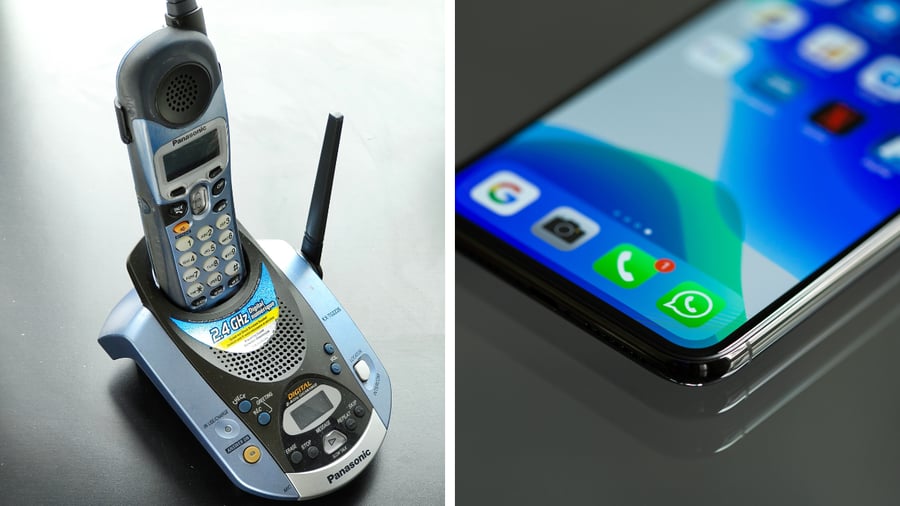
Standalone answering machines that recorded phone messages on cassette or digital tape have been replaced by voicemail built into cell phone service and smartphones. In the mid-1990s, a household landline typically had a boxy answering machine sitting next to it, often with a small cassette tape inside that recorded an outgoing greeting and any messages callers left. Checking messages meant pressing a play button on the machine itself or, for some models, calling in remotely with a code.
Answering machines became common in U.S. homes through the 1980s and 1990s once the technology grew affordable enough for mass adoption, and by the mid-1990s a large share of households owned one. The device solved a real problem: before it existed, a call that wasn't picked up simply went unanswered, with no way to know who had called or what they wanted.
Cell phones changed the equation twice over. First, mobile phones with built-in voicemail meant a message could be left directly on the carrier's system rather than a physical machine at home. Second, as more people carried a phone at all times, fewer calls went unanswered at a fixed home line, since most calls started reaching people directly instead. Smartphones added visual voicemail, letting a person see a list of messages and choose which to play first, something a tape-based machine couldn't offer.
Answering machines didn't vanish because voicemail was dramatically better technology. They vanished because the landline itself stopped being the primary way most people communicated. A message left today usually arrives as a voicemail notification on a phone carried in a pocket, a text message, or increasingly no message at all, since a missed call shows up automatically in a phone's call log. The physical machine with its blinking light indicating waiting messages has been replaced by a small badge on a phone's screen.
Credit: Canva Images
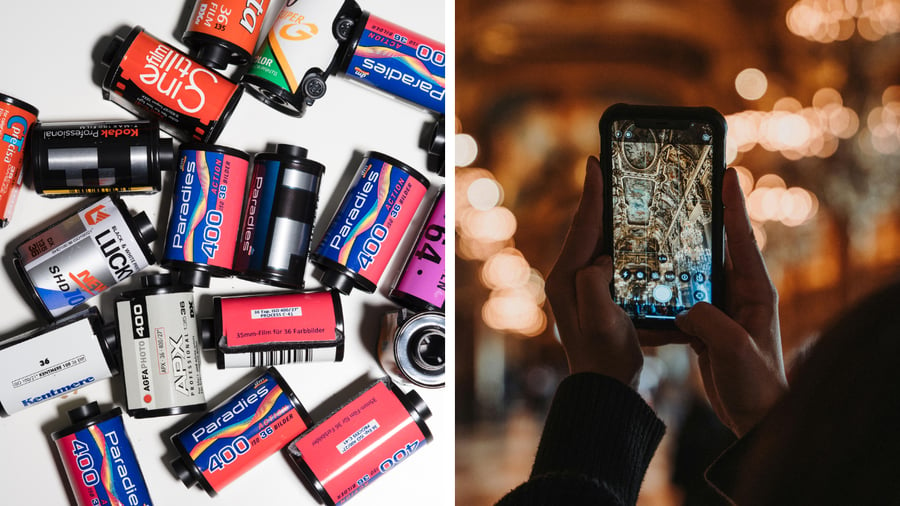
Film cameras and drugstore photo processing have been replaced by digital cameras and smartphone cameras that show a photo instantly instead of days later. In the mid-1990s, taking pictures meant loading a roll of 35-millimeter film into a point-and-shoot camera, shooting a limited number of exposures per roll, and dropping the film off at a pharmacy, grocery store, or dedicated photo shop for developing. One-hour photo counters, common in drugstores and standalone kiosks, printed physical photographs that customers picked up later the same day or the next.
Digital cameras existed in the 1990s but were expensive and lower quality than film for most consumers, so film remained the mainstream choice through the decade. That changed through the 2000s as digital camera prices dropped and image quality improved, letting people see a photo immediately on a screen and delete a bad shot instead of paying to develop it.
The bigger shift came once camera phones became standard. Early camera phones appeared in the early 2000s, and by the time smartphones became widespread in the late 2000s and 2010s, a phone's camera was good enough for most everyday photography needs. Eastman Kodak, the company most associated with consumer film, filed for bankruptcy protection in January 2012 as film sales collapsed, a milestone that marked how thoroughly digital photography had taken over.
What replaced film wasn't a single device but a shift in behavior. Photos are no longer rationed to 24 or 36 exposures per roll, since a phone can hold thousands of images. There's no waiting period between taking a picture and seeing it, and no cost per print unless someone chooses to order one. Sharing a photo with family used to mean handing over a physical print or mailing a copy. Now it means sending a file instantly, something a one-hour photo counter was never built to do.
Credit: Canva Images
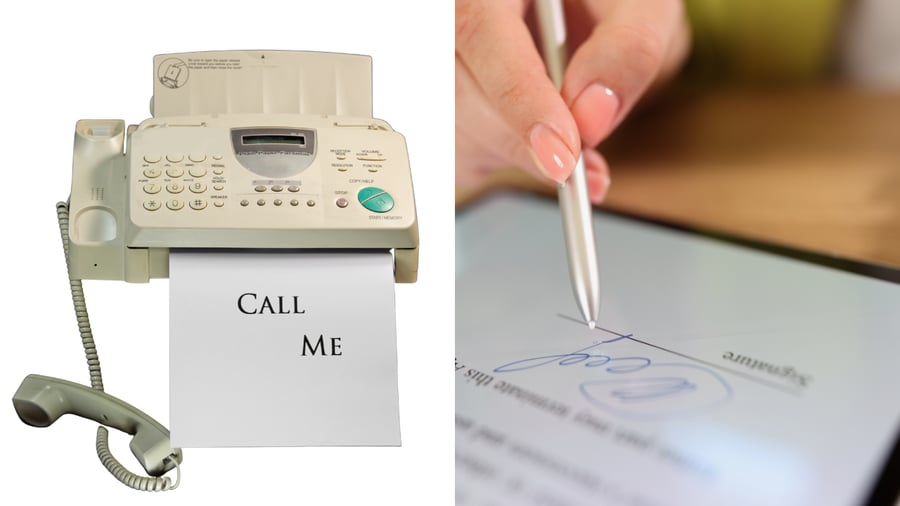
Fax machines in general offices have been replaced by email attachments, PDFs, and electronic signature software. In the mid-1990s, a fax machine sat in most business offices and many homes, used to send contracts, forms, and documents over a phone line by transmitting a scanned image rather than the physical paper itself. Sending a multi-page document could take several minutes, and a busy signal or a jammed machine on either end was a common frustration.
Email became widespread in offices through the second half of the 1990s, but faxing didn't disappear immediately because email lacked a reliable way to prove a document had been sent or received, and because a faxed signature carried legal weight before digital signatures were common or accepted. Over the 2000s, scanning documents to PDF and emailing them became faster and cheaper than faxing for most everyday business needs.
Electronic signature services such as DocuSign, which launched in 2003, gave documents a legally recognized way to be signed without printing anything at all, closing one of the last gaps that had kept fax machines in use. Cloud storage and file-sharing tools added another layer, letting people share a document directly rather than sending a static image of it back and forth.
Fax hasn't disappeared everywhere. Health care providers and law offices still use fax in the U.S. because of specific regulatory and security requirements tied to patient records and legal filings, and fax numbers remain listed on many hospital and government forms for that reason. But as a general-purpose office tool used by nearly every business to send routine paperwork, the fax machine has been replaced. A document that once required a dedicated machine, a phone line, and a wait for confirmation now moves as an email attachment or a signed PDF, arriving in seconds instead of minutes.
-900x506.png)
Credit: Credit: Credit: Canva Images (Left) | Credit: Caleb Oquendo / Pexels (Right)
Paper road maps and folding atlases have been replaced by GPS navigation apps such as Google $GOOGL Maps and Waze. In the mid-1990s, planning a road trip meant unfolding a paper map or flipping through a spiral-bound atlas, often published by Rand McNally, to trace a route by hand before leaving and figure out a detour if something went wrong. Gas stations commonly sold or gave away folded state and city maps at the counter.
Standalone GPS navigation devices began reaching consumers in the late 1990s and became mainstream through the 2000s, letting drivers enter a destination and get spoken turn-by-turn directions instead of reading a map while driving. Companies such as Garmin and TomTom built dedicated hardware for this, mounted on a car's dashboard or windshield.
Smartphones made dedicated GPS units largely unnecessary once mapping apps became standard features. Google Maps launched in 2005, and Waze, which added real-time traffic and crowd-sourced hazard reports before Google acquired it in 2013, pushed navigation further by rerouting a driver automatically around traffic rather than requiring a person to plan around it in advance.
What replaced the paper map wasn't just a digital version of the same thing. A folding atlas showed static roads that didn't change once printed, while a navigation app updates constantly, accounting for traffic, closures, and the fastest route at that specific time of day. Getting lost and having to stop for directions, once a common part of any unfamiliar drive, has become rare enough that many younger drivers have never experienced it. Paper maps haven't vanished completely; some hikers, boaters, and drivers in areas with unreliable cell service still carry one as backup. But for the mainstream act of finding a route, the atlas in the glove compartment has been replaced by an app most drivers now check before they even start the engine.
Credit: Canva Images (Left) | Credit: Nirzar Pangarkar / Wikimedia Foundation / Wikimedia Commons (CC BY-SA 4.0) (Right)
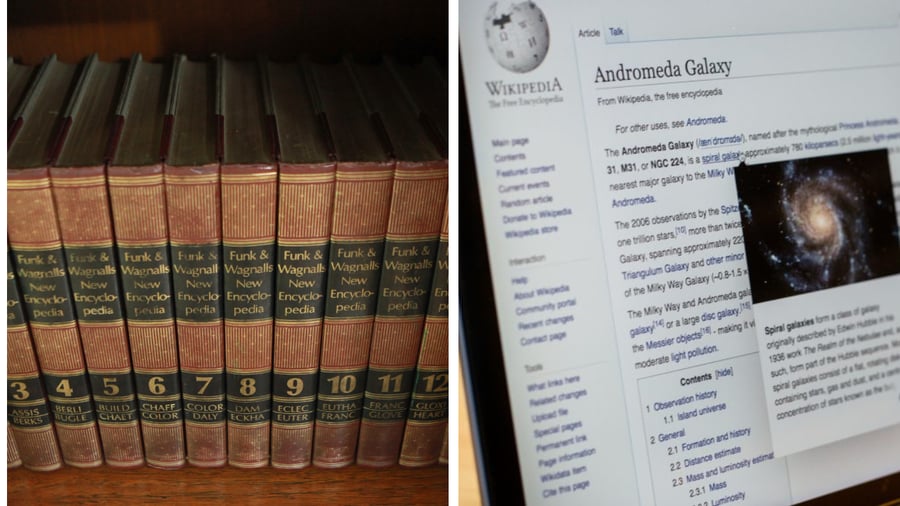
Multi-volume print encyclopedia sets have been replaced by Wikipedia and other online reference sites. In the mid-1990s, a set of encyclopedias such as Encyclopaedia Britannica or World Book, often two dozen or more heavy volumes arranged on a shelf, was a common household purchase and a standard research tool for school reports. Door-to-door and mail-order encyclopedia sales were a significant business through the decade, with families sometimes paying for a set in installments.
CD-ROM encyclopedias such as Microsoft $MSFT Encarta, released in 1993, offered an early digital alternative bundled with video and audio clips a printed page couldn't include, and Encarta briefly outsold print encyclopedias before the broader internet made even a CD-ROM feel limited. Wikipedia launched in 2001 and grew into the largest general reference work in history, built collaboratively rather than by a fixed team of contributors.
Encyclopaedia Britannica announced in 2012 that it would stop printing physical volumes after 244 years, focusing entirely on its digital products, a decision that marked how completely the format had shifted. The company had already seen print sales fall for years as households turned first to CD-ROMs and then to free online sources instead of paying for a bound set.
What replaced the printed encyclopedia is free, constantly updated, and searchable instantly rather than requiring a person to know which volume covered a given letter. A Wikipedia article can be revised the same day a news event happens, something no printed volume could ever do, and it links out to related topics instantly instead of requiring a reader to physically pull another volume off the shelf. Specialized print reference books still exist for some subjects, and some households keep an old encyclopedia set for nostalgia. But the mainstream role encyclopedias once played, as the default first stop for looking something up, now belongs almost entirely to the internet.

Credit: Canva Images
Travel agents for booking a standard vacation have been replaced by online travel sites such as Expedia $EXPE, Travelocity, and Google $GOOGL Flights. In the mid-1990s, booking a flight, hotel, or package vacation typically meant calling or visiting a local travel agency, where an agent used a specialized reservation system to check availability and issue paper tickets. Airlines paid travel agents a commission for each booking, which is part of what made the service free or low-cost for most travelers.
That business model changed starting in 1995, when Delta Air Lines capped and then cut commissions paid to travel agents, and other major airlines followed within a couple of years. At the same time, the early internet made it possible for a traveler to search flight availability directly. Expedia launched in 1996 as a Microsoft $MSFT project, and Travelocity launched the same year, giving consumers a way to book flights and hotels themselves without an agent's help.
Airline ticketing shifted from paper tickets to electronic tickets through the late 1990s and 2000s, removing another reason travelers needed an agent to physically issue and mail a ticket. Sites such as Kayak and Google Flights later added the ability to compare prices across many airlines at once, a task that used to require an agent's specialized access.
Travel agents haven't disappeared entirely. They remain common for complex trips such as multi-country tours, cruises, honeymoons, and corporate travel, where an agent's expertise can still add real value. But for the mainstream task of booking a standard flight or hotel room, most travelers now go directly to an airline's website or a booking platform rather than calling an agency. The paper folder of tickets an agent once handed a customer has been replaced by a confirmation email and a mobile boarding pass.
Credit: Canva Images
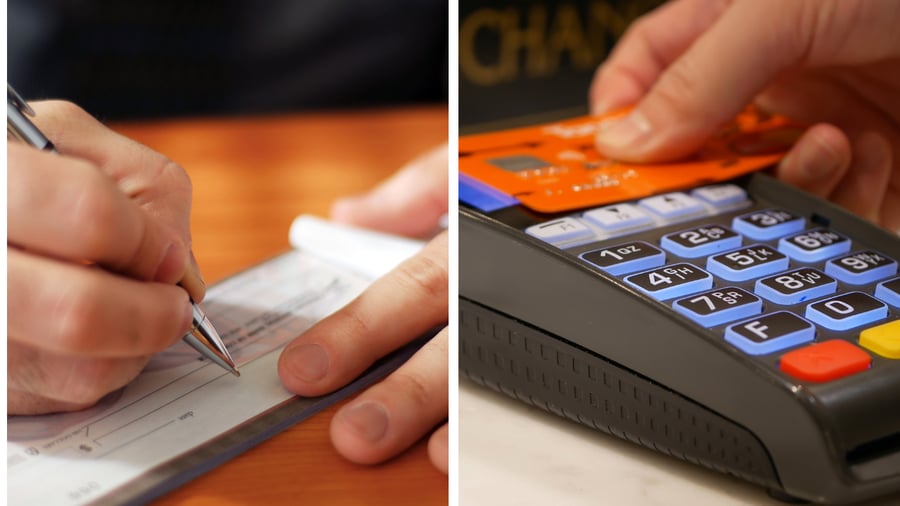
Personal checks for everyday retail purchases have been replaced by debit cards and mobile payment apps such as Venmo and Zelle. In the mid-1990s, writing a check at a grocery store, gas station, or department store checkout was routine, and many stores kept a machine at the register specifically to verify a customer's identity and check-writing history before accepting one. A cashier might ask for a driver's license and take a few minutes to process a single check.
Debit cards existed in the 1990s but weren't yet the default payment method for most retail purchases, since many stores still processed them slowly or didn't accept them at all. That changed through the late 1990s and 2000s as card networks upgraded processing speed and retailers adopted point-of-sale systems that could handle a debit transaction in seconds rather than minutes.
Peer-to-peer payment apps added another layer starting in the 2010s. Venmo, launched in 2009, and Zelle, launched in 2017 as a bank-backed alternative, let people send money directly to friends or family for shared expenses like splitting a dinner bill, a task that once might have involved writing a personal check to reimburse someone.
Checks haven't disappeared completely. They remain common for paying rent, certain bills, and transactions between individuals or small businesses where an electronic option isn't set up, and cashier's checks are still used for large purchases such as buying a car or a home. But for the mainstream act of paying for groceries or everyday purchases at a register, checks have been replaced almost entirely by cards and apps. A transaction that once required a checkbook, a pen, and a wait for verification now happens with a tap or a swipe in a couple of seconds.
Credit: Canva Images
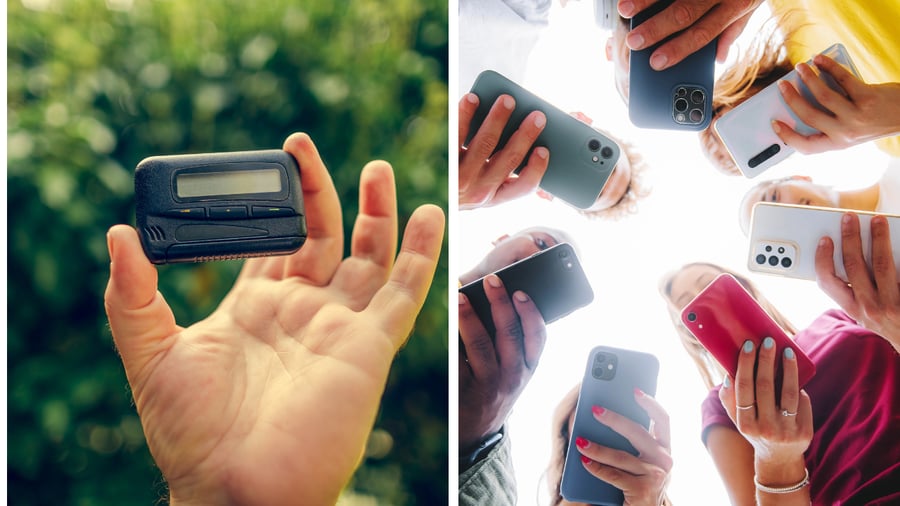
Pagers and beepers have been replaced by mobile phones, which made it possible to both receive a message and immediately call or text back from the same device. In the mid-1990s, a pager clipped to a belt or carried in a pocket was common among doctors, contractors, and other professionals who needed to be reachable, and it also became a status symbol among teenagers, who used numeric codes to send short messages.
A pager could only receive a message, typically a phone number to call back or a short numeric code, since most models in the 1990s had no way to send a reply. Getting paged meant finding the nearest available phone, often a payphone, to call back and find out what the message was about.
Cell phones became affordable enough for mainstream, non-business use through the second half of the 1990s and into the early 2000s, and once a phone could both receive and answer a call from the same device, the core advantage of a pager disappeared. Text messaging, which became widely used in the U.S. in the early 2000s, gave people an even more direct replacement for the short numeric messages pagers were built around.
Pagers didn't vanish everywhere. Hospitals in particular kept using them for years after most consumers switched to cell phones, because paging networks operate on dedicated frequencies that tend to work more reliably inside buildings with thick walls and during emergencies when cell networks get overloaded. Some hospital staff still carry pagers today for that reason. But as a mainstream consumer device carried by ordinary professionals and teenagers, the pager has been replaced entirely by the cell phone, which now handles calling, texting, and far more, all from a single device that fits in the same pocket a pager once did.
Credit: Canva Images (Left) | Credit: Brett Jordan / Unsplash (Right)
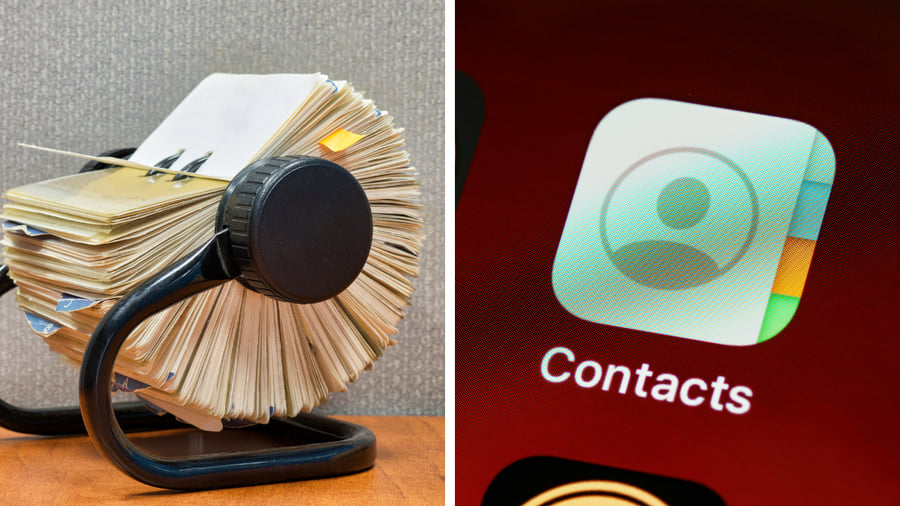
Rolodex address files have been replaced by smartphone contact lists and customer relationship management software. In the mid-1990s, a Rolodex, a rotating file of small index cards, sat on nearly every office desk, holding handwritten names, phone numbers, and addresses for clients and colleagues. Updating an entry meant writing on or replacing a physical card, and finding someone meant spinning the wheel to the right letter.
Personal digital assistants such as the Palm Pilot, introduced in 1996, offered an early digital alternative for storing contacts, letting a person carry hundreds of names on a device that fit in a pocket instead of a desk-bound wheel of cards. These devices remained a niche product through the late 1990s, used mainly by business professionals rather than the general public.
Smartphones absorbed this function completely once they became widespread in the late 2000s, syncing contacts automatically across a phone, a computer, and the cloud rather than requiring manual entry on a single device. Losing a phone no longer meant losing a set of contacts built up over years, since the same list could be restored instantly on a new device.
For business use specifically, customer relationship management software such as Salesforce $CRM, founded in 1999, replaced the Rolodex's original purpose of tracking client relationships, adding the ability to log call history, notes, and follow-up reminders that a paper card never could. Sales teams that once relied on a shared office Rolodex now use a shared digital database instead.
The word Rolodex has outlasted the object itself, still used casually to describe someone's network of professional contacts even though almost nobody keeps an actual rotating card file anymore. The physical device has been replaced by contact lists that sync automatically, update in real time, and never need a new card written out by hand.
-900x506.png)
Credit: Canva Images
Newspaper classified ad sections have been replaced by online marketplaces such as Craigslist and Facebook $META Marketplace. In the mid-1990s, newspapers ran dense pages of small print advertisements for job openings, used cars, apartment rentals, and items for sale, organized into narrow columns and charged by the line or the word. Classifieds were a major source of newspaper revenue and a standard first stop for anyone searching for a job or an apartment.
Craigslist started in 1995 as an email list of local San Francisco events before becoming a website organized much like newspaper classifieds, but free to post and searchable instantly rather than printed once a day. It expanded to other U.S. cities through the late 1990s and eventually to hundreds of cities worldwide, offering the same basic categories without the cost or the wait for the next day's paper.
Newspaper classified advertising revenue in the U.S. fell sharply through the 2000s as more of that business moved online, a decline that hit local newspapers especially hard since classifieds had long been one of their most reliable revenue sources. Specialized sites later split off pieces of the classifieds business further: job listings moved largely to sites such as Indeed and LinkedIn, apartment listings to sites such as Zillow and Apartments.com, and used car listings to sites such as Cars.com and Autotrader.
Facebook Marketplace, launched in 2016, added another layer by connecting listings to real social profiles and locations, making local buying and selling even more direct. What replaced the classified section wasn't one single site but this entire ecosystem of specialized online marketplaces, each one handling a category that used to share a single page of small print in the local paper. A search that once meant scanning tiny newspaper columns now returns results instantly, filtered by price, location, and category.
Credit: Canva Images
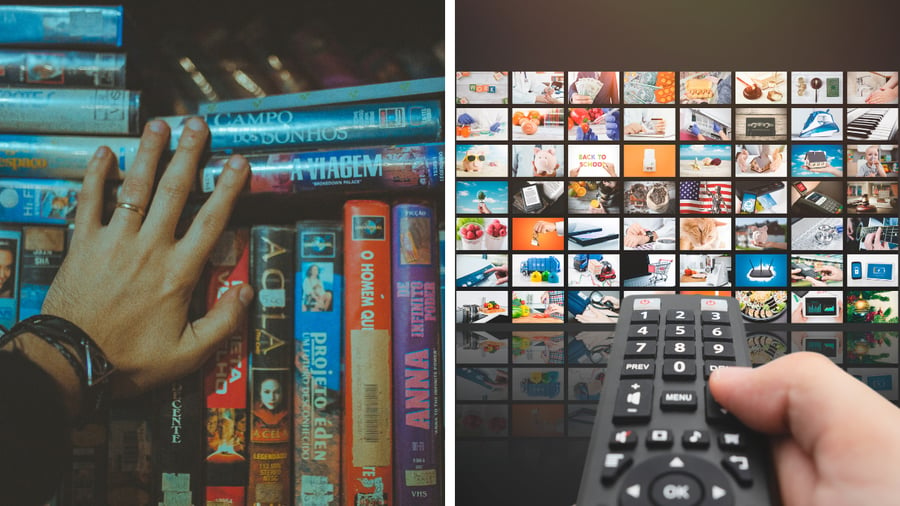
VHS tapes and VCRs have been replaced first by DVDs and later by streaming services. In the mid-1990s, a VCR sat beneath most household televisions, used both to play rented or purchased movies on VHS tape and to record television shows for later viewing, often by programming a blinking clock display that many people never fully figured out how to set correctly.
DVDs launched in the U.S. in 1997, offering sharper picture quality, chapter menus, and bonus features a VHS tape couldn't match, and DVD sales and rentals overtook VHS through the early 2000s. DVRs, led by TiVo starting in 1999, replaced the VCR's recording function by saving shows directly to a hard drive, letting viewers pause and rewind live television without ever touching a tape.
Streaming services then replaced physical media almost entirely for everyday viewing. Once Netflix $NFLX, followed by other services, made large libraries of movies and shows available on demand starting in the late 2000s, there was no longer a need to own or rent a disc, let alone a tape, to watch something at home. Funai Electric, the last major manufacturer still producing VCRs, announced in 2016 that it would stop making them, citing shrinking demand and difficulty sourcing parts, effectively marking the end of new VCR production.
VHS tapes and VCRs haven't vanished from every household; some people keep an old VCR to digitize home movies recorded decades ago, and a small community of collectors still trades tapes for movies never released on other formats. But as the mainstream way to watch a movie or record a television show at home, VHS and the VCR have been replaced twice over, first by the DVD and then by streaming, in a shift that took less than 20 years from VHS's peak popularity to its near-total disappearance from stores and living rooms.
Credit: Canva Images
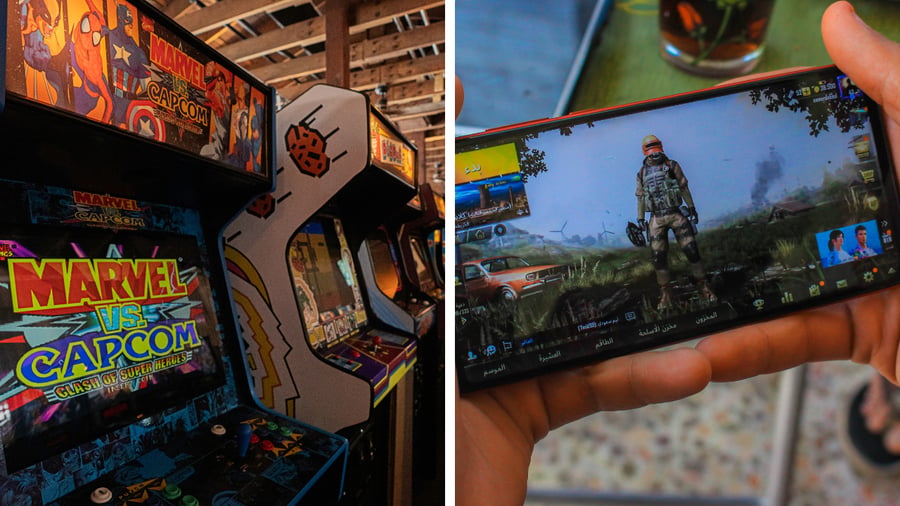
Shopping mall video arcades have been replaced by home game consoles and mobile gaming on smartphones. In the mid-1990s, a mall arcade packed with cabinet games such as fighting games, racing simulators, and Skee-Ball was a common teenage hangout, and trading quarters for a few minutes of play was a routine after-school or weekend activity for many kids.
Home consoles closed the gap in gameplay quality that had once justified a trip to the arcade. The Sony $SONY PlayStation, released in the U.S. in 1995, and the Nintendo 64, released in 1996, offered graphics and gameplay close enough to arcade cabinets that spending money at home on a console started to look like a better long-term value than repeatedly feeding quarters into a machine.
Arcade chains tried adapting through the 1990s and 2000s by adding redemption games that dispensed tickets for prizes, but standalone arcades built around a wall of individual cabinets mostly closed as mall foot traffic itself declined in the 2000s and 2010s. Some arcade-style entertainment survived in a different form, through chains such as Dave & Buster's $PLAY, which combine games with a full restaurant and bar, and through Chuck E. Cheese, aimed specifically at younger children's birthday parties.
Mobile gaming delivered a final blow to what remained of the standalone arcade model. Once smartphones became widespread in the late 2000s and app stores made games available instantly and often for free, the arcade's core pitch, paying to access games not available anywhere else, stopped being true for most casual games. A small number of arcades have opened more recently as retro or bar-arcade concepts aimed at adults seeking nostalgia rather than kids looking for the newest game. But the mainstream mall arcade, built for teenagers killing an afternoon, has been replaced by gaming people now do largely at home or on a phone.
Credit: Canva Images
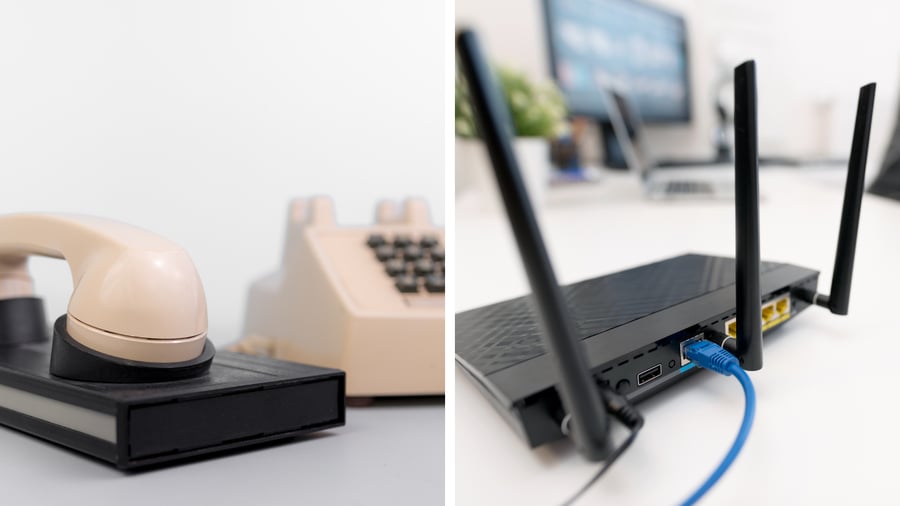
Dial-up internet and the free AOL trial CDs that came with it have been replaced by broadband and wifi, which let a household stay online without tying up a phone line. In the mid-1990s, connecting to the internet meant a modem dialing a phone number, producing a distinctive screeching handshake sound, and using the household's only phone line for as long as the connection stayed active, meaning nobody could make or receive a call while someone else was online.
America Online, commonly known as AOL, mailed free trial CDs and, before that, floppy disks to millions of U.S. households through the 1990s, offering a set number of free hours to try dial-up internet access and its own online services. The discs became so common that finding one in the mail was an ordinary occurrence for much of the decade, and their sheer volume later became a well-known symbol of that era's marketing.
Broadband internet, delivered through cable or DSL lines rather than a phone line's dial-up connection, started reaching U.S. households in the late 1990s and became the mainstream choice through the 2000s, offering a connection that was both faster and always on, without dialing in or tying up the phone. Wifi, which let multiple devices in a home connect wirelessly instead of plugging directly into a modem, became standard in U.S. homes through the 2000s as routers grew cheaper and easier to set up.
Dial-up hasn't disappeared everywhere. Some rural areas with limited broadband infrastructure still rely on it, and a small number of users keep it as a low-cost option. But as the mainstream way most people first got online, dial-up and the promotional discs that introduced millions of households to the internet have been replaced by broadband connections and wifi networks that stay on permanently, without a modem tying up the phone line or a screeching handshake announcing a connection had been made.
