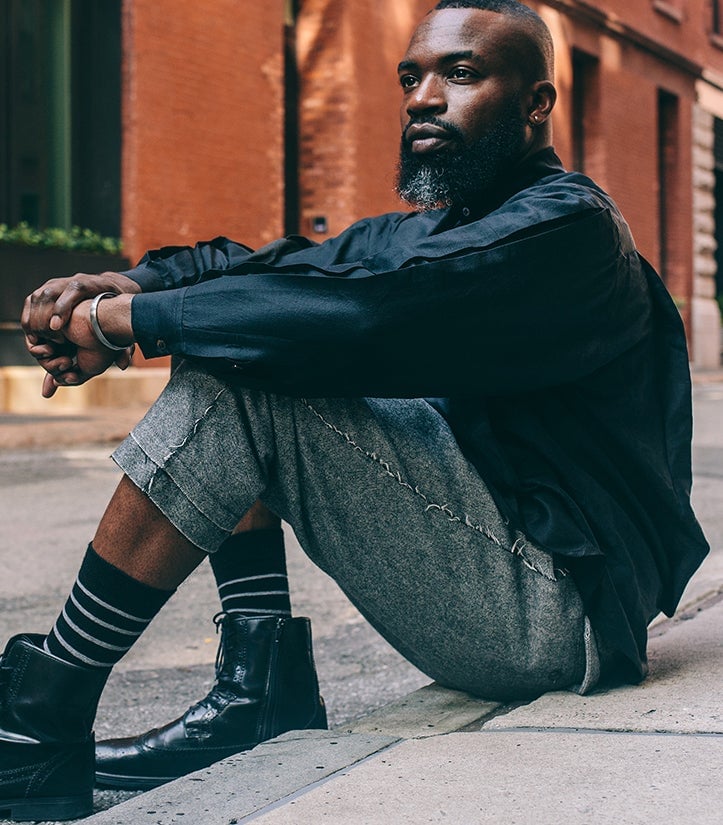
When Darnell Moore was 14 years old, three boys from his neighborhood, people he once thought of as friends, cornered him and doused him in gasoline. Then they lit a match, and tried to set him on fire because he’s gay. Wind blew out the match, and Moore escaped.
Today, Moore, age 42, is an award-winning writer and activist, and a leader in the Black Lives Matter Movement. He’s the author of No Ashes in the Fire, a memoir in which he traces his life from his childhood in Camden, New Jersey, to his search for intimacy in the gay neighborhoods of Philadelphia, and, finally, to social-justice movements in Newark, New Jersey, Brooklyn, New York, and Ferguson, Missouri, where he could fight for those who, like him, have survived on society’s edges.
Moore is the head of strategy and programs at Breakthrough US, a global human rights organization working to end violence against women and girls, and the host of a Mic video series, The Movement. New Jersey senator Cory Booker appointed Moore as chair of the inaugural LGBTQ Concerns Advisory Commission to the city of Newark.
For Quartz’s How We’ll Win project, examining the fight for gender equality, Moore spoke with us about how he talks to other men about feminism, the theory that guides his work on gender equality, and the importance of loving your softness.
I thought about workplace gender inequality as a kid. I didn’t use that language then or have a sense of the systemic nature of gender inequality, but I was confounded when I discovered my mom’s pay stub during my childhood.The amount of money she earned seemed to0 low a number for the amount of hours she worked as a stock person at a nearby department store. I was shocked and could not shake the confusion.
One of the most important lessons I’ve been reflecting on has been the very common ways that men—myself included—often miss the ways we are complicit in everyday forms of sexism, misogyny, and rape culture. It’s easy to call out and demean the “monsters.” It’s harder to name the ways we commit monstrous acts by way of our silences or the many ways we reinforce inequity. If I care about gender inequality, and the ways it impacted my mother, for example, I must then ensure I advocate and do what I can to ensure girls and women aren’t disenfranchised.
I used to identify as a feminist, but now I’ll sooner identify as pro-feminist. I don’t stand outside of the arc of feminist critique. I want to be very clear about that. Black feminists, black lesbian feminists, in particular, have shaped my politics and ways of being.
In my vocational life, I am the head of strategy and programs, US, at Breakthrough US, an intersectional feminist organization that seeks to end gender-based violence impacting girls and women. But I try my best to practice what I preach every day, in every facet of my life. I am committed to a practice of self-reflection and correction. I am part of communities of accountability.
We are our biggest threat. We hinder ourselves when we refuse to examine the extent to which we participate in our dehumanization. Patriarchy, for example, not only impacts girls and women and femmes, it makes boys and men less human because of the ways it predetermines who we are and how we ought to express ourselves in the world. It squeezes us into identities and ways of being that short circuit our potential to be free.
I do. And I try not to use language that can distract us from the heart of the matter. It’s easy to talk to the choir, the people who get it, but it’s not so easy with people who are not part of circles that may not be up on the most current progressive, social justice, feminist lingo. With that in mind, I try to use stories. I am writer. Narrative can often do what theory attempts to do—change hearts by connecting with others at the level of the emotions. I also try my best to practice self-reflection; that is, I don’t preach to men as if I, too, am not also part of the collective problem.
My biggest anxiety is the reality that there exists a category, a cage, that I am expected to interpret as a doorway. I am not trying to be a better man. I am trying to be a better human.
I don’t expect or deserve praise for the work I do in solidarity with girls and women and femmes. I should be doing this work. It’s the work of those who benefit from patriarchal power to undo such power. And that work should be attended to without want for praise.
I’d repeat a quote by the black lesbian feminist Audre Lorde: “Your silence will not protect you.” And that the work of ending the violence impacting girls and women is our work.
There are so many things, but I’d be better at acknowledging that workplace pay parity was real. I’d push back and ensure that my colleagues who were women received equitable pay.
To be me. To love my softness. To love my difference. To love…and not be afraid of it. I’d say the same to others.
