A month ago China’s president, Xi Jinping, said that local government officials will no longer be promoted solely on the basis of how fast they make the economy grow. But it’s evidently a little too soon for the new regimen to have filtered into economic results. For the first half of this year, the GDP reported by local governments added up to a total of 28.0 trillion yuan, or $4.57 trillion, estimates Caixin, one of China’s leading economic magazines. The central government’s GDP figure was only $4.04 trillion.

A month ago China’s president, Xi Jinping, said that local government officials will no longer be promoted solely on the basis of how fast they make the economy grow. But it’s evidently a little too soon for the new regimen to have filtered into economic results. For the first half of this year, the GDP reported by local governments added up to a total of 28.0 trillion yuan, or $4.57 trillion, estimates Caixin, one of China’s leading economic magazines. The central government’s GDP figure was only $4.04 trillion.
Such laughably large gaps between the GDPs reported by local government and the number tallied by the central government are a result of the warped incentives created by the policy Xi said he was changing. In 2012, for instance, total local government GDP was $939 billion more than the central government’s estimate. The $530 billion discrepancy for the first half of this year is even wilder considering that the central government’s GDP is probably , as we explained recently.
Join 500,000+ readers who start their day with Quartz.
By subscribing, you agree to our Terms of Service and Privacy Policy.
And here’s a look at how it compares with past local-vs.-central GDP gaps (for simplicity’s sake, we doubled the figure for the first half of this year to reach a 2013 estimate). In percentage terms, the gulf has been widening:
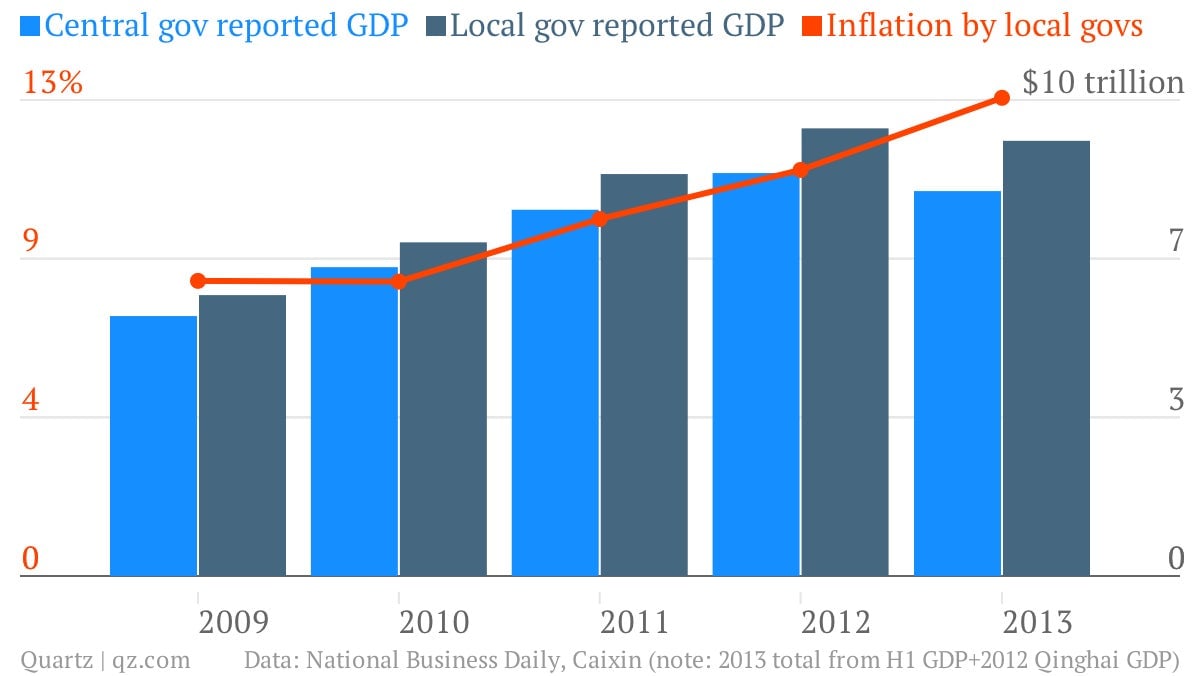
This isn’t just a mildly amusing example of the local cadres trying—and failing—to pull one over on central technocrats. The system that leads local cadres to puff up their GDP data contributes heavily to a host of direr economic problems—debt, real estate prices, ghost cities. The faster you grow your economy, the faster you’re promoted—and the faster you hand off the consequences of how you managed that speedy growth to the sucker who fills your shoes next.
The test will come when next quarter’s GDP data are released. If the discrepancy hasn’t shrunk by then, it will suggest that local officials have not taken Xi’s promise seriously.
