Quartz
Subscribe
Quartz
Subscribe
Edition
Business News
A.I.
Technology
Money & Markets
Leadership
Lifestyle
Latest

Get Quartz in your inbox

Free daily briefing on global business news.

Business News
AirlinesAutomobilesFoodPharmaceuticalsPolitics & GovernmentRetail & EcommerceSpace & AerospaceEarnings
Technology
A.I.ComputingConsumer TechSpace & AerospaceEarnings
Money & Markets
Economic IndicatorsMarketsPersonal FinanceEarnings
Lifestyle
Cars & BikesCollectingEntertainmentFood & Fine DiningHealth and FitnessReal EstateTravel
Economic Indicators

Oil traders are so bearish that they barely noticed when Libya closed two key ports

Here’s how bearish the oil market is: Libya—where rising production has been one of the main reasons for the six-month price plunge—declared force majeure at two major oil ports, taking some 300,000 barrels a day off the market, yet crude prices plunged to a new low in early trading today. The price of international benchmark Brent crude has since recovered a bit, but the dive shows the market’s chronic dark mood.
By Steve LeVine·2 min read·Updated July 21, 2022
Add QZ to Google

Here’s how bearish the oil market is: Libya—where rising production has been one of the main reasons for the six-month price plunge—declared force majeure at two major oil ports, taking some 300,000 barrels a day off the market, yet crude prices plunged to a new low in early trading today. The price of international benchmark Brent crude has since recovered a bit, but the dive shows the market’s chronic dark mood.

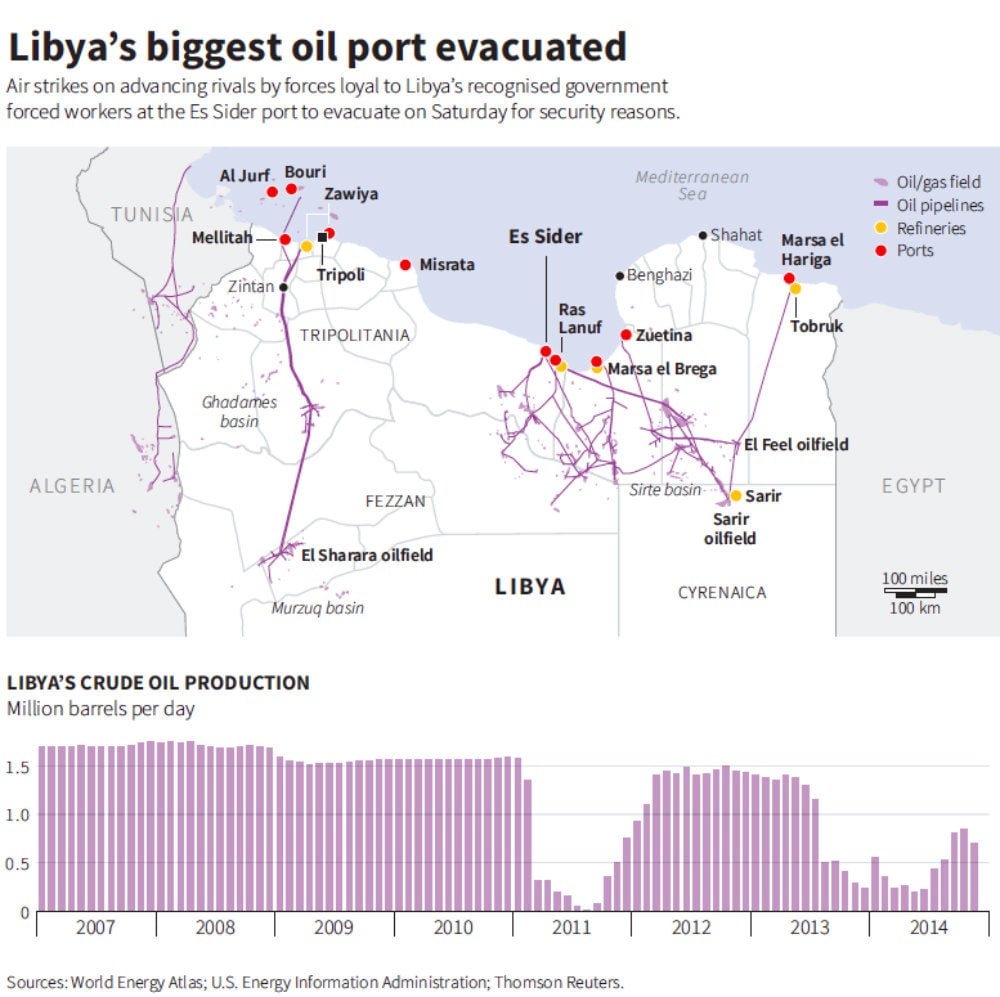
Libya has been exporting more than 750,000 barrels of oil a day, volumes that, along with a surge of US shale oil supplies, have been crucial to sending down global crude oil prices since June. In fact, Libya had said it would export up to 1 million by the end of the year (paywall). But fighting between the government and an Islamic militia the last two days has closed the port of Es-Sider and may have shut down Ras Lanuf as well, reducing exports to about 450,000 barrels a day.

Daily Brief

The essential business news, delivered fresh every morning.

Join 500,000+ readers who start their day with Quartz.

By subscribing, you agree to our Terms of Service and Privacy Policy.
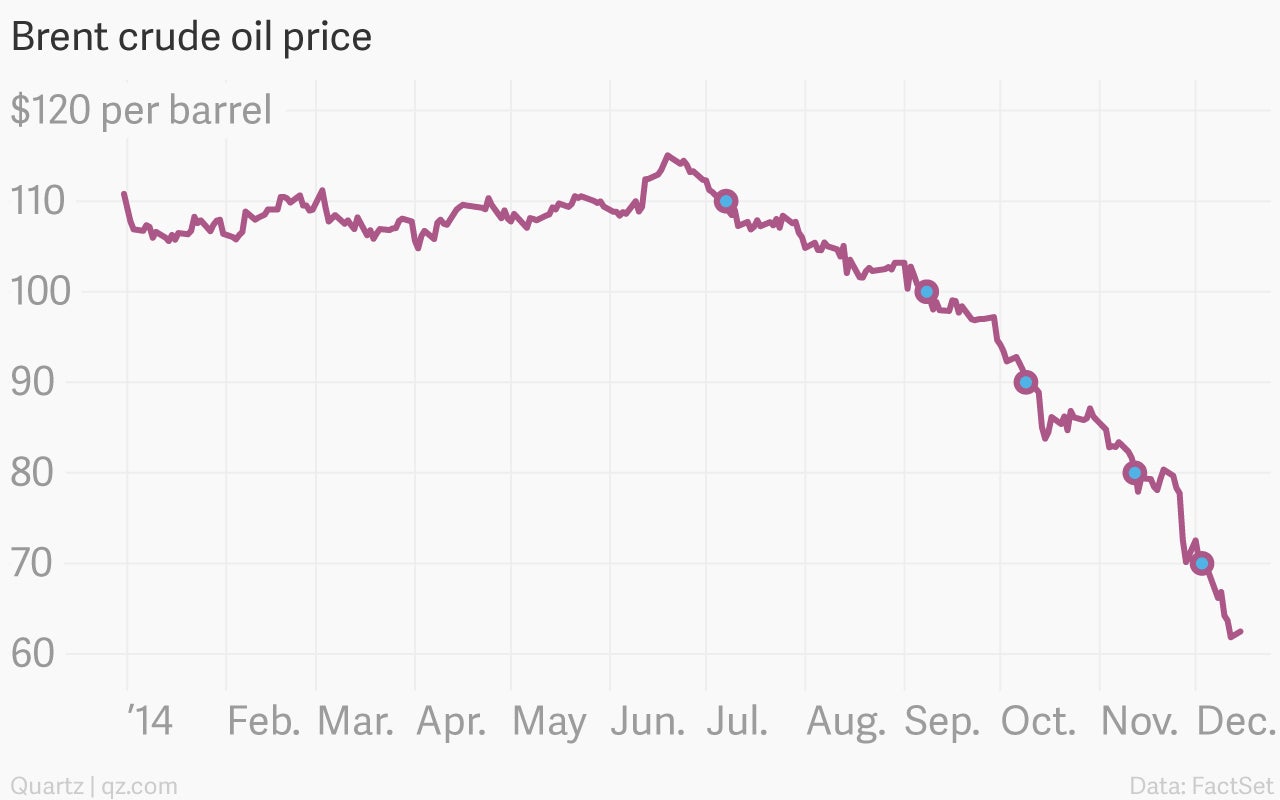
Despite that news, international benchmark Brent crude flirted with the $50s-per-barrel in early Asian trading, falling as low as $60.28 a barrel, 48% below its June peak, before bouncing back once traders decided to buy on the Libyan news.

But the trend remains down. On Dec. 12, the average of what OPEC countries receive for their crude—called the OPEC basket—dropped below $60 a barrel for the first time since 2009; it closed at $58.65.

If Brent—the broader reflection of global oil prices—falls below $60 a barrel, it will have crossed two psychological thresholds in a single month: it only fell under $70 a barrel on Dec. 5. Prior to now, Brent had been crossing a new $10-a-barrel price threshold once a month since September, when it fell below $100 a barrel. It is now breaking through these barriers twice as fast:

Quartz

Global business news for a smarter world

Topics

  • Business News
  • Money & Markets
  • Tech & Innovation
  • Generation A.I.
  • Lifestyle
  • Leadership

Products

  • Daily Brief
  • Weekly Digest
  • Member Benefits
  • Quartz Pro

Legal

  • Sitemap
  • About
  • Accessibility
  • Privacy
  • Terms of Service
  • Advertising

© 2026 Quartz Media, Inc. All rights reserved.