Quartz
Subscribe
Quartz
Subscribe
Edition
Business News
A.I.
Technology
Money & Markets
Leadership
Lifestyle
Latest

Get Quartz in your inbox

Free daily briefing on global business news.

Business News
AirlinesAutomobilesFoodPharmaceuticalsPolitics & GovernmentRetail & EcommerceSpace & AerospaceEarnings
Technology
A.I.ComputingConsumer TechSpace & AerospaceEarnings
Money & Markets
Economic IndicatorsMarketsPersonal FinanceEarnings
Lifestyle
Cars & BikesCollectingEntertainmentFood & Fine DiningHealth and FitnessReal EstateTravel
Quartz

Global business news for a smarter world

Topics

  • Business News
  • Money & Markets
  • Tech & Innovation
  • Generation A.I.
  • Lifestyle
  • Leadership

Products

  • Daily Brief
  • Weekly Digest
  • Member Benefits
  • Quartz Pro

Legal

  • Sitemap
  • About
  • Accessibility
  • Privacy
  • Terms of Service
  • Advertising

© 2026 Quartz Media, Inc. All rights reserved.

Economic Indicators

Obama deplores climate change in the Arctic, but will deploy more icebreakers there anyway

In Alaska this week, Barack Obama earned the distinction of being the first US president to visit the 50th state while in office. His agenda involves a tricky balancing act: warning about the perils of climate change in the Arctic while pushing for even more economic activity to exploit the rapidly melting ice.
By Svati Kirsten Narula·3 min read·Updated July 21, 2022
Add QZ to Google

In Alaska this week, Barack Obama earned the distinction of being the first US president to visit the 50th state while in office. His agenda involves a tricky balancing act: warning about the perils of climate change in the Arctic while pushing for even more economic activity to exploit the rapidly melting ice.

Yesterday (Aug. 31), in an impassioned speech to a group of diplomats and scientists with interests in the Arctic, Obama described a dire “warming loop” in Alaska “that we do not want to be a part of.” Alaska, which has an economy built on oil, is already facing the prospect of rising sea levels that are wiping out villages and exacerbating major wildfires.

Daily Brief

The essential business news, delivered fresh every morning.

Join 500,000+ readers who start their day with Quartz.

By subscribing, you agree to our Terms of Service and Privacy Policy.

This ”has to be the year that the world finally reaches an agreement to protect the one planet we’ve got while we still can,” Obama said. But his call to action was overshadowed by accusations of hypocrisy. This summer his administration permitted Royal Dutch Shell $SHEL to restart drilling for oil and natural gas off Alaska’s shores. Obama has defended this decision by saying that the transition to a fossil fuel-free world will be a slow one, and for now, the US would rather produce oil and gas on its own terms.

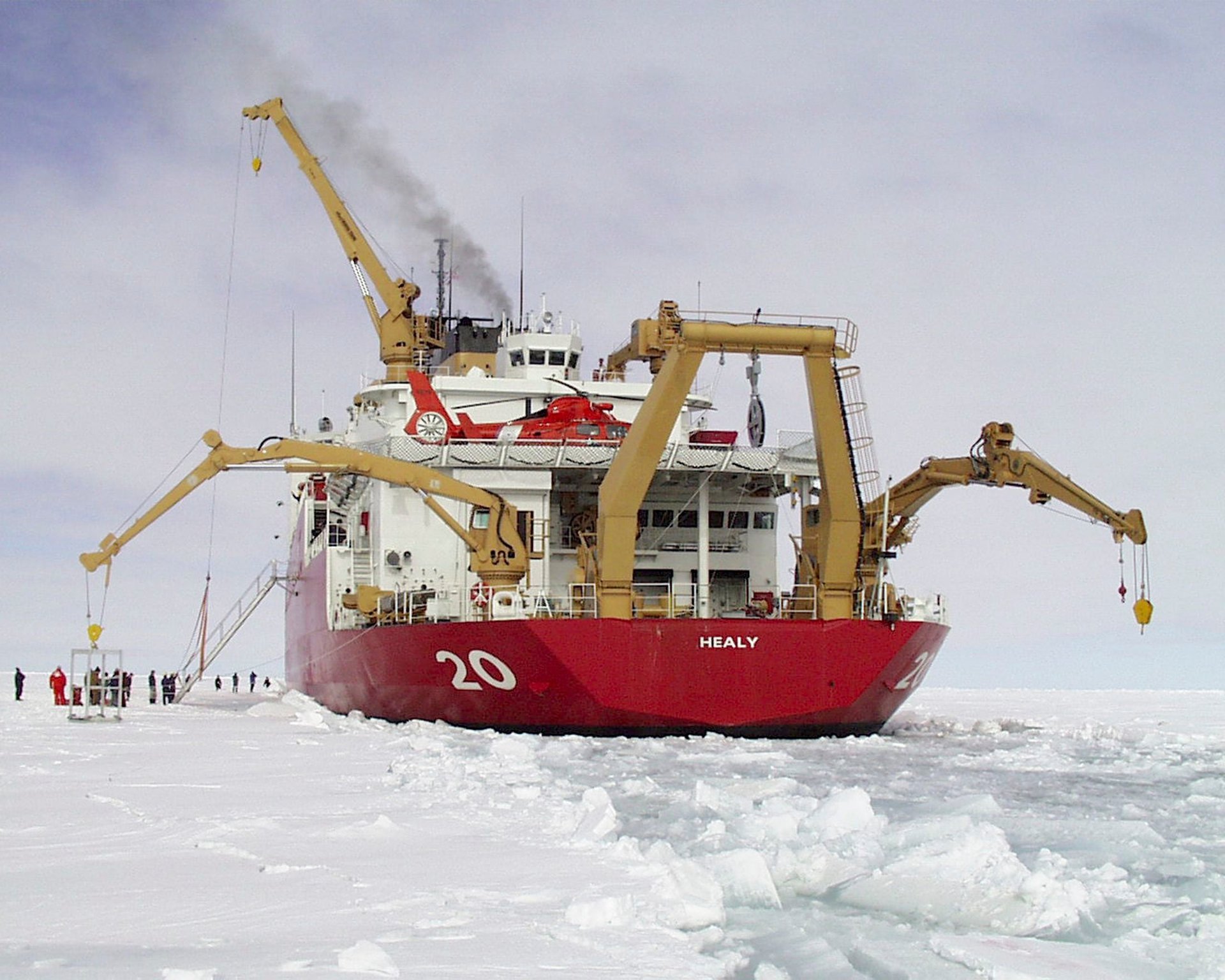
Today, he’s hiking up one of Alaska’s imperiled glaciers in Kenai Fjords National Park, and plans to propose expanding the US coast guard’s fleet of icebreakers. It’s part of a race to take advantage of new mining, drilling, and shipping opportunities in the Arctic.  These new opportunities wouldn’t exist if the Arctic’s ice wasn’t melting, but here they are.

The US currently has only two “fully functional” heavy icebreakers, according to the New York Times, compared to 41 owned by Russia, which is attempting to claim vast swathes of Arctic territory.  Obama is requesting that the construction of one new icebreaker, currently scheduled to be completed in 2022, be sped up and completed in 2020. He proposes $4 billion in federal funding to construct that one and more.

Sending more US icebreakers to the Arctic isn’t exactly at odds with trying to reign in carbon emissions and slow down global warming—even if the warming effects are acutely visible in the Arctic. Arguably, this will put the US in a better position to carry out potentially harmful activities—such as drilling, mining, and shipping—with more oversight. Obama is also about to announce an initiative for mapping and charting the region’s newly open waters, in addition to tasking NOAA with installing technology to enhance marine safety and monitor environmental changes in finer detail.

But as the New York Times Dot Earth blog notes, the push for more icebreakers is directly related to the prospect of oil and gas extraction in the Arctic, which is thought to contain roughly 25% of the world’s total reserves, as Quartz’s Steve LeVine has reported. Those reserves are newly accessible because of global warming, but burning the fossil fuels within will surely make climate change worse—and that’s a contradiction impossible to reconcile.