
How influential was the Rogoff-Reinhart study warning that high debt kills growth?
New research suggests that an influential study showing that high debt levels can hurt economic growth overstated the risk, and thus the importance of speedy debt reduction during a recession. But how influential was the study, anyhow?
New research suggests that an influential study showing that high debt levels can hurt economic growth overstated the risk, and thus the importance of speedy debt reduction during a recession. But how influential was the study, anyhow?
For an indicator, read the following passage from a book on US debt by Republican Senator Tom Coburn. This is a scene that takes place on April 5, 2011, when forty senators met the authors of the study, Harvard economists Kenneth Rogoff and Carmen Reinhart, for a briefing. It was just months before disagreements over America’s fiscal path lead to a confrontation over the country’s borrowing limit and a near-default.
Johnny Isakson, a Republican from Georgia and always a gentleman, stood up to ask his question: “Do we need to act this year? Is it better to act quickly?”
“Absolutely,” Rogoff said. “Not acting moves the risk closer,” he explained, because every year of not acting adds another year of debt accumulation. “You have very few levers at this point,” he warned us.
…
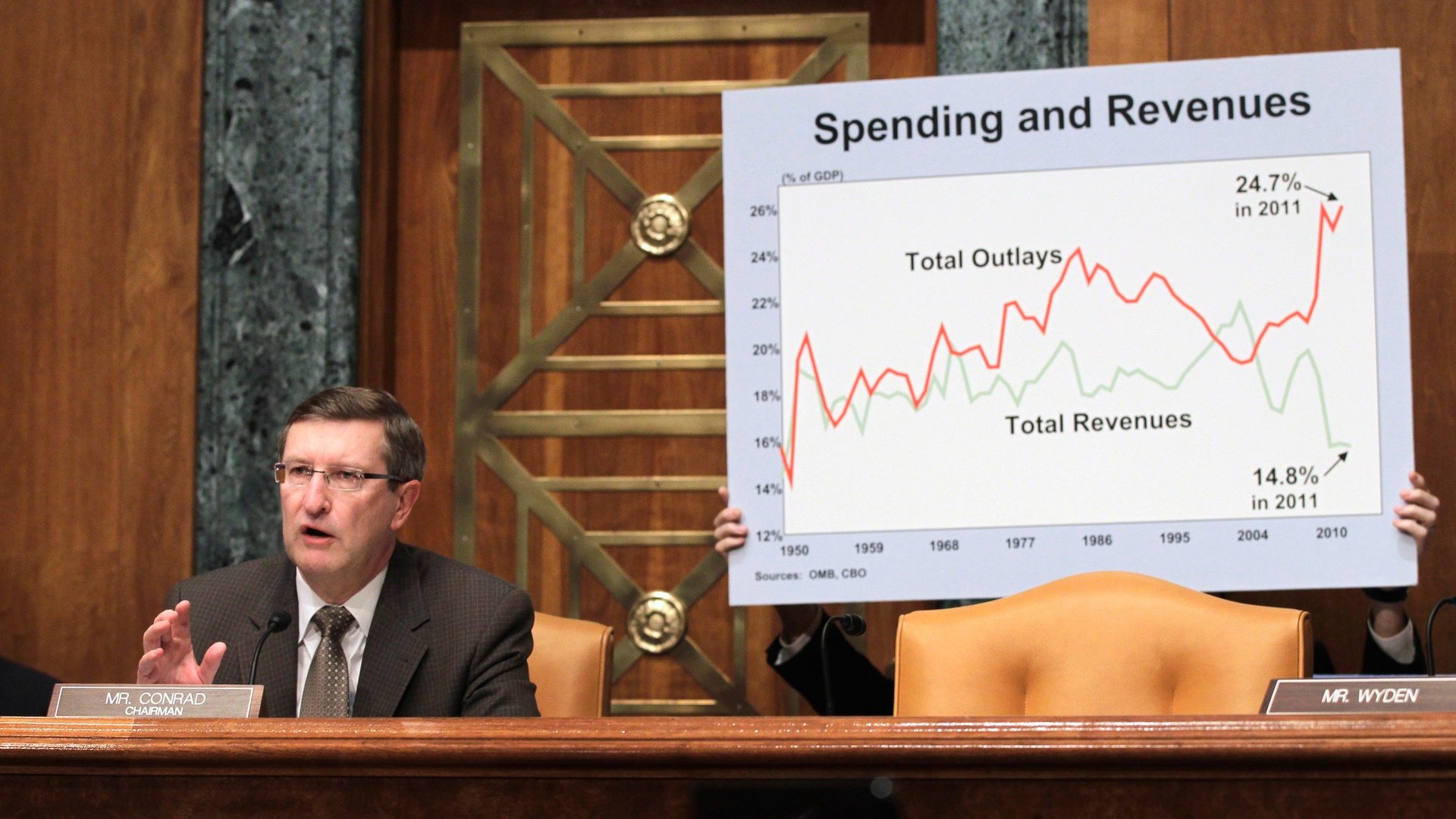
Senator Kent Conrad, the chairman of the Senate Budget Comittee, said our current deficits were severe because we had very low revenues due to a slow economy combined with very high spending. He then offered his own stern warning to the assembled senators. Turning around in his chair in the middle of the room, he explained to his colleagues that when our high debt burden causes our economy to slow by 1 point of GDP, as Reinhart and Rogoff estimate, that doesn’t slow our economy by 1 percent by 25 to 33 percent when we are growing at only 3 to 4 GDP points a year.
Reinhart echoed Conrad’s point and explained that countries rarely pass the 90 percent debt-to-GDP tipping point precisely because it is dangerous to let that much debt accumulate. She said, “If it is not risky to hit the 90 percent threshold, we would expect a higher incidence.”
Senator and former governor Mike Johanns, a Republican from Nebraska, asked, “Is there a point at which the debt market rebels?”
“I don’t want to be fire and brimstone,” Rogoff said. “No one knows when this will happen. ” Yet, he added, “It takes more than two years to turn the ship around … Once you’ve waited too long, it’s hard to take radical steps.”
It’s hard to get bipartisan agreement on anything in the Senate, but you can see influential legislators from both parties were listening closely to the two economists as they engaged in key debates over the economy. Even the notoriously obstreperous Coburn noted that ”there was remarkable agreement about the severity of the problem.”
Were other policymakers around the world paying attention? Absolutely:
- “[I]t is widely acknowledged, based on serious research, that when public debt levels rise about 90% they tend to have a negative economic dynamism, which translates into low growth for many years.” — European Commissioner Olli Rehn.
- “Economists who have studied sovereign debt tell us that letting total debt rise above 90 percent of GDP creates a drag on economic growth and intensifies the risk of a debt-fueled economic crisis.” — House Budget Committee Chairman and former Republican vice-presidential candidate Paul Ryan.
- “It’s an excellent study, although in some ways what you’ve summarized understates the risks.”— Former US Treasury Secretary Tim Geithner.
- “[W]e would soon get to a situation in which a debt-to-GDP ratio would be 100%. As economists such as Reinhart and Rogoff have argued, that is the level at which the overall stock of debt becomes dangerous for the long-term growth of an economy. They would argue that that is why Japan has had such a bad time for such a long period. If deficits really solved long-term economic growth, Japan would not have been stranded in the situation in which it has been for such a long time.” Lord Lamont of Lerwick, former UK chancellor and sometime adviser to current chancellor George Osborne.
- “The debt hurts the economy already. The canonical work of Carmen Reinhart and Kenneth Rogoff and its successors carry a clear message: countries that have gross government debt in excess of 90% of Gross Domestic Product (GDP) are in the debt danger zone. Entering the zone means slower economic growth.”— Doug Holtz-Eakin, Chairman of the American Action Forum.
The essential business news, delivered fresh every morning.
Join 500,000+ readers who start their day with Quartz.
By subscribing, you agree to our Terms of Service and Privacy Policy.