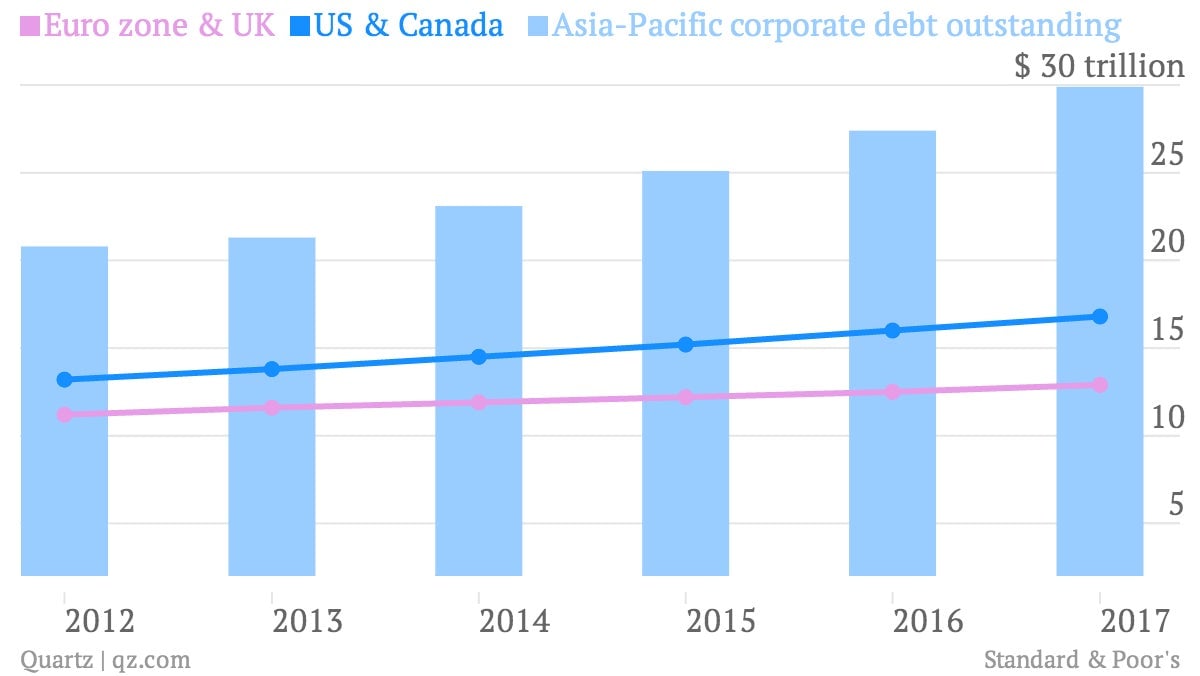
For better or worse, Asian companies are loading up on debt at a staggering rate. By 2017, Standard & Poor’s estimated in a report this week, non-financial corporate debt for Asia-Pacific countries will balloon to $29.9 billion, assuming corporate debt is issued at the rate of economic growth (as pictured above). And that’s the conservative estimate. If debt outstanding grows at a rate of 1.2 times the region’s growth rate, the region’s corporate debt will hit $32.5 billion. Using either estimate, in 2017 the Asia-Pacific region will have more debt outstanding that US, the euro zone, Canada and the UK combined.
For better or worse, Asian companies are loading up on debt at a staggering rate. By 2017, Standard & Poor’s estimated in a report this week, non-financial corporate debt for Asia-Pacific countries will balloon to $29.9 billion, assuming corporate debt is issued at the rate of economic growth (as pictured above). And that’s the conservative estimate. If debt outstanding grows at a rate of 1.2 times the region’s growth rate, the region’s corporate debt will hit $32.5 billion. Using either estimate, in 2017 the Asia-Pacific region will have more debt outstanding that US, the euro zone, Canada and the UK combined.
This also puts China—the region’s biggest borrower—on track to overtake the US as the world’s largest corporate debt borrower by 2014 or 2015. (In the more conservative scenario, Chinese companies would have $14.7 trillion in debt outstanding in 2015, versus $14.1 trillion for US companies.) Fearing its economy will overheat, the Chinese government has taken steps to limit the expansion of credit markets, but it’s too soon to know the impact of those policies.
Join 500,000+ readers who start their day with Quartz.
By subscribing, you agree to our Terms of Service and Privacy Policy.
As we’ve pointed out before, it’s natural for Asia’s corporate debt to grow as its capital markets continue to develop. Also, loose monetary policy among the world’s central banks helps boosts corporate debt by driving up investor demand for riskier assets. S&P believes the demand will likely continue for the next few years. That is, unless monetary policy tightens, reversing the flow of money into corporate bonds:
The balance is tenuous. Governments and banking regulators are not as well positioned as they were last year to counter adverse conditions, having already exhausted much of their fiscal and monetary arsenals. Furthermore, some countries are struggling to implement austerity measures to deal with their own sovereign debt and deficit problems. This may impede their ability to respond to additional economic turbulence. Depending on the severity of a flare-up, a wider set of borrowers than just those that are highly leveraged could find their financing and refinancing needs in jeopardy.
