
Dubai is planning to offer self-flying taxis by July, the city’s Road and Transportation Agency announced this week at the World Government Summit conference.
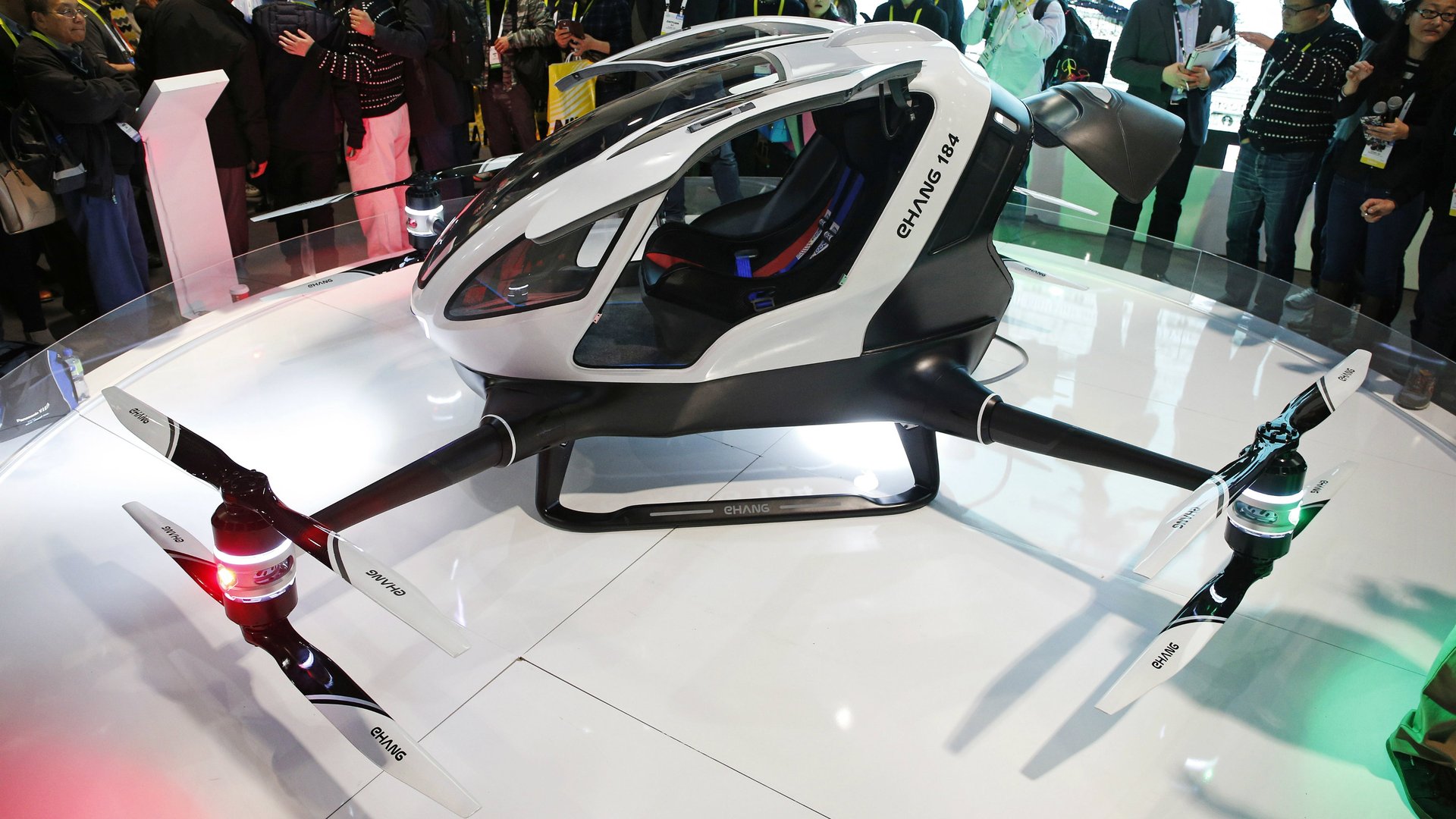

Dubai is planning to offer self-flying taxis by July, the city’s Road and Transportation Agency announced this week at the World Government Summit conference.
These four-legged, eight-propeller drones can carry a single passenger that weighs up to 100 kg (220 lb) and operate within an area of up to 50 km (31 miles) on a single battery charge, according to a video the RTA released on Monday. It can reach speeds of 160 km an hour.
Join 500,000+ readers who start their day with Quartz.
By subscribing, you agree to our Terms of Service and Privacy Policy.
The video shows a dapper businessman placing a briefcase in the craft’s tiny trunk and strapping himself into the single seat with a race-car like seatbelt. Then, he types his destination into a touch screen.
The Chinese-made EHang 184 vehicles have already been tested in the skies above Dubai, the city’s transport chief Mattar al-Tayer said. The concept is not dissimilar from the flying air taxi that Airbus is planning to test this year.
Dubai, which already has a driverless metro system, is trying to meet a lofty goal of alleviating congestion in the city. In April 2016, Dubai’s ruler, Sheikh Mohammed bin Rashid al-Maktoum, said a quarter of the vehicles in Dubai would be driverless by 2030.
The United Arab Emirates as a whole is becoming a hub for futuristic transport. Dubai signed a deal with Hyperloop One in November to study the viability of linking the city-state with Abu Dhabi through a vacuum-sealed tube—a concept that is the brainchild of Elon Musk.
Travelers $TRV inside the tube would travel at near supersonic speeds and complete the journey in 12 minutes. Its competitor, Hyperloop Transportation Technologies, is also studying the construction of a similar tube between Abu Dhabi and the city of al-Ain, a trip that would take as little as 10 minutes.