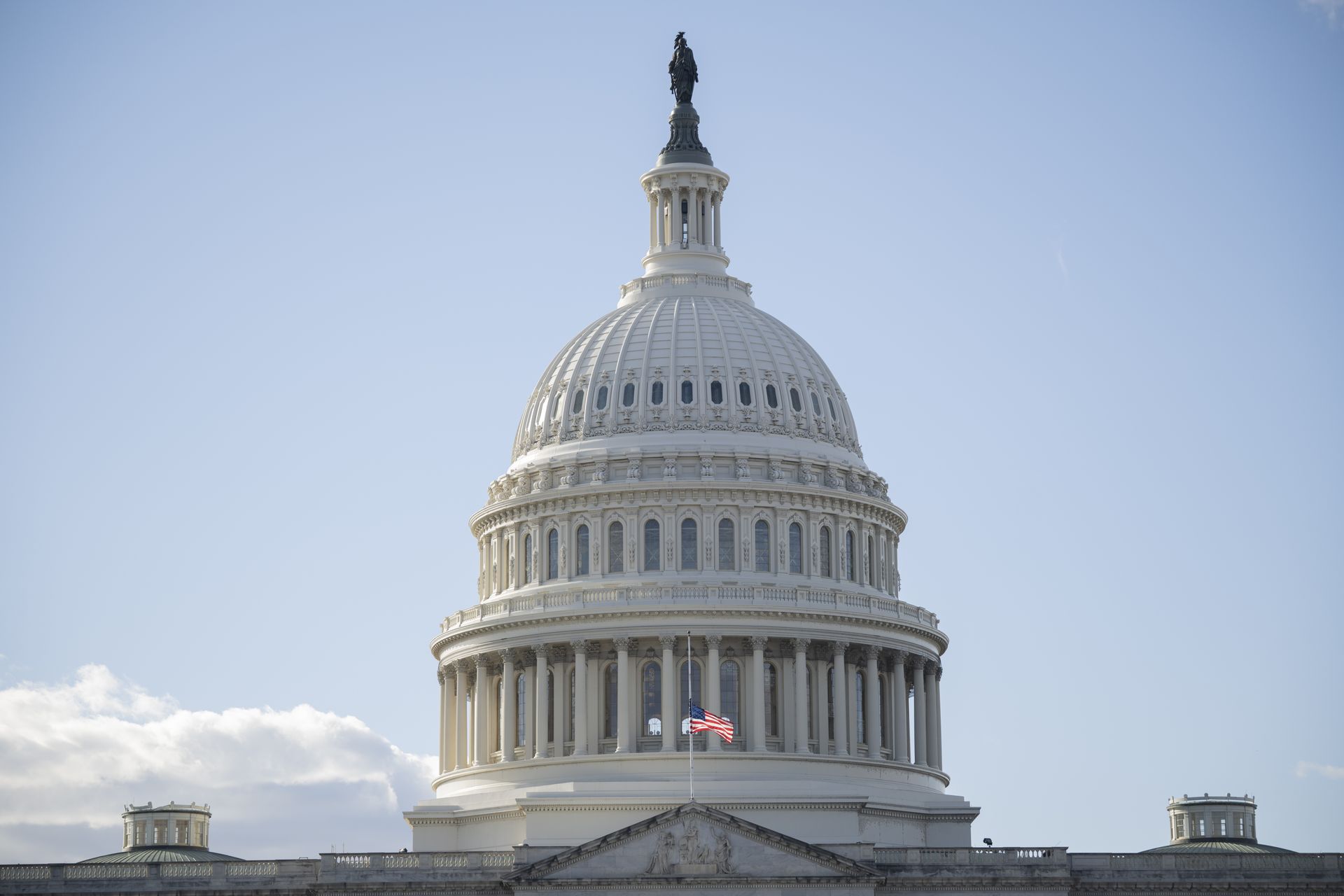
The United States Capitol building is seen in Washington D.C., United States, on November 11, 2025. (Celal Gunes/Anadolu via Getty Images)
WASHINGTON — 2025 will be remembered as the year artificial intelligence swept into town.
Congress grappled with a ban on state-level AI rules, which failed twice in the span of five months. Meanwhile, tech and AI giants — Meta $META, Alphabet $GOOGL, Microsoft $MSFT, and OpenAI among them — pulled out their checkbooks to influence the legislative branch; they poured $50 million into federal lobbying in the first nine months of 2025, according to IssueOne, a nonpartisan group that tracks money in U.S. politics.
“They're replaying what they did with social media,” Republican Sen. Josh Hawley of Missouri told Quartz. “They come in and they flood the zone with money, they flood the zone with lobbyists. They flood the zone with dark money. I can understand why, because they had a lot of success with that playbook.”
The splurge of AI political cash arrived in Washington with plans for a larger physical presence as well. OpenAI has said it will formally open its first D.C. office at the start of 2026. Anthropic has also signaled it will also open a similar office and double its current headcount in D.C., Axios reported.
Hawley described the sector’s influence as “quite significant” within Congress. In late October, he introduced a bipartisan bill that would ban AI companions for minors. The measure attracted support from seven Democratic senators, including Sens. Mark Kelly of Arizona and Chris Murphy of Connecticut. It followed a September Senate hearing in which parents testified in favor of more guardrails for popular chatbots such as ChatGPT.
President Donald Trump recently issued an executive order that challenges state AI regulation, a move that fractured GOP lawmakers still acquainting themselves with the tech. More than half of the American public believes AI poses a major threat to society, per a June Pew Research Center poll.
K Street has experienced an influx of ex-lawmakers lobbying on AI as well. Perhaps the most notable one is former Sen. Kyrsten Sinema, who wielded enormous influence during the first two years of the Biden administration in a 50-50 Senate. Sinema and ex-Rep. Garret Graves of Louisiana launched the AI Infrastructure Coalition late last month. The group has adopted a pro-AI position that focuses on harnessing AI to power a flurry of new jobs in the U.S.
Lawmakers are receptive towards a message that balances AI's promises and a recognition of its risks, particularly as it could eliminate many jobs. “I want to see AI be successful. I think this is a real opportunity for the American people if we get it right,” Kelly told Quartz in an interview last week. “But we got to get it right.”
In August, Sinema testified in favor of constructing a data center in Chandler, Arizona, arguing it was in the city’s best interest to green-light the project since it would benefit its economy. Local officials didn’t buy it, and residents were more concerned with warding off steeper electricity bills and protecting their water supply. The Chandler city council unanimously voted no earlier this month.
The revolt in Chandler underscores that the battle to steer AI at the national level already stretches far beyond Capitol Hill. Leading the Future, a pro-AI superPAC, is assembling a $100 million war chest for the 2026 midterms. The move echoes the crypto industry’s mobilization of the last election.
So far, Leading the Future has singled out Alex Bores, a Democratic House candidate in New York’s 12th congressional district. The group has pledged to spend on behalf of candidates in both parties that it perceives will unleash AI’s potential, not handcuff it with onerous rules.
“At the end of the day, I'd rather be on the right side of history and the wrong side of this PAC,” Bores recently told Quartz. He supports stricter guardrails on AI development, such as requiring frontier companies to first test AI models to pass safety standards before releasing them to the public.
One Republican senator observed that the AI sector hasn’t repeated the mistakes of crypto firms, at least this year. Crypto companies secured their biggest victory this summer when Congress approved legislation to regulate stablecoins, a digital token pegged to the U.S. dollar. But the sector has splintered on designing the next set of crypto guardrails.
“AI is sort of operating as one,” Sen. Thom Tillis of North Carolina told Quartz. “They're all in agreement. So I think they're coming out more coordinated. They also have a long history. So their approach I think is probably more mindful of [Congress].”
