
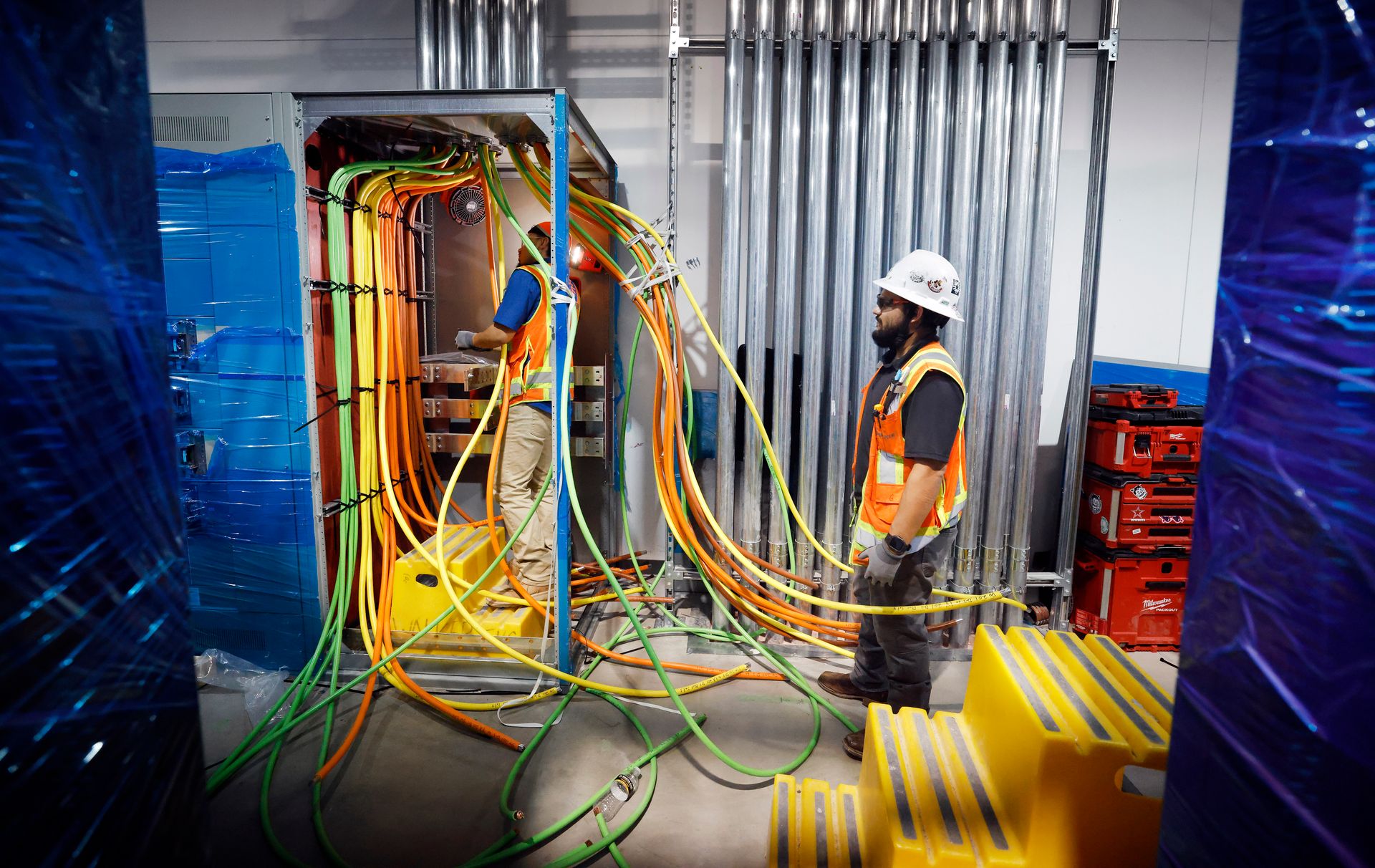
A lot of people are training to become electricians right now because data centers are being built everywhere, and someone needs to wire them. The problem is that becoming a licensed electrician takes years, no matter how fast anyone wants it to happen. Some of these workers won't be ready until after the building boom that got them interested is already over.
Becoming a licensed journeyman electrician means putting in a minimum of 8,000 hours of on-the-job training, plus classroom time, and that usually takes three to five years, according to the Bureau of Labor Statistics. Anyone who started their apprenticeship in 2024 or 2025 won't get their journeyman license until 2028 or 2030 at the earliest.
Applications for electrical apprenticeship programs have jumped sharply over the past couple of years, and most of that jump is tied directly to the data center buildout. The people who sign up now are betting it lasts long enough for them to finish training and get hired.
The fixed-speed pipeline behind the electrician shortage
The International Brotherhood of Electrical Workers, known as the IBEW, runs a union apprenticeship pipeline that lasts five years and requires 10,000 hours on the job, plus classroom time. That pipeline doesn't bend for a construction site in a hurry.
Non-union programs are the faster of the two paths, but only by a year, and even they can't get an apprentice below the 8,000-hour minimum. Two trade associations, Independent Electrical Contractors and Associated Builders and Contractors, run four-year tracks, the fastest legal way into the trade there is. As one Workforce Intelligence Lab analysis put it: "No hiring strategy, no recruitment effort, and no wage increase can meaningfully expand the supply of journeymen in the near term." The pipeline runs at a fixed speed, and demand has accelerated past it.
So many people are jumping into electrician training right now that the numbers are hard to miss. Applications for commercial electrical apprenticeships shot up more than 70% between 2022 and 2024, according to higher education research firm Validated Insights. Right now, the IBEW has more journeyman wiremen, linemen, and apprentices than at any point in its history, according to the union's own reporting.
But most of the people signing up won't actually become journeymen. Research firm Mathematica studied registered apprenticeship programs and found that only about 45% of participants completed their programs. Given more than half canceled without finishing, the actual number of new journeymen will land well below what the sign-up totals suggest.
The constraints of the electrician pipeline
The construction cycle these workers are chasing has its own timeline, and it's moving faster than the training pipeline behind it. Work began on the Stargate flagship campus in Abilene, Texas, in the second quarter of 2024, and within a year, the first two buildings were connected to the power grid and switched on. OpenAI, the company behind ChatGPT, said in September 2025 that the site was already being used to train and run AI models through Oracle $ORCL's cloud service.
The full eight-building campus is projected for completion by the fourth quarter of 2026, according to Epoch AI, a research group tracking Stargate's progress nationwide.
Meta $META's Hyperion project initially called for nine buildings, planned to come online in phases through 2030, according to Data Center Dynamics, a trade publication that reported the plan in July 2026, though it's unclear whether that timeline has since shifted. That's the same year an apprentice who signed up for a five-year IBEW program in early 2025 would finally become a licensed journeyman, and Goldman Sachs $GS Research projected this boom would already be cooling by then too. Data centers would be almost completely full, above 95% occupied, by late 2026, then level off starting in 2027 as more space comes online and demand slows, and the firm even warned that too much data center capacity would be sitting around after that.
So by the time today's apprentices are ready to work, the most expensive part of building these places might already be behind them, and a finished data center just doesn't need that many people to keep it running. It takes way fewer workers to run one than to build it.
Crash courses short of a real apprenticeship
Tech companies recognize the bottleneck and have built stopgap training programs to feed it. Meta has committed $115 million to its America's Workforce Academy, which offers four weeks of paid training, industry-standard credentials, and guaranteed job placement at Meta data center construction sites.
Google $GOOGL is putting $50 million into its AI Opportunity Fund to train more than 300,000 workers in over 20 states. The program includes VR and AR modules that Google built with the National Electrical Contractors Association, known as NECA, and the Electrical Training Alliance.
These programs address immediate staffing shortages. They don't produce journeyman electricians. A four-week credential isn't a four-year apprenticeship, and the work it qualifies someone to do is narrower. More than 60% of data center operators are struggling to find qualified workers, according to consulting firm BRG, which recommended that employers team up with trade schools, unions, and community colleges to grow the pipeline. The IBEW has its own fix: a four-year inside apprenticeship track approved by the federal government back in 2023. It keeps the same number of on-the-job hours but moves classroom instruction online and uses computer-based lessons to speed things up.
Electric demand outside AI data centers
Data centers are the flashy reason people are signing up for this trade right now, but they won't be the reason these workers stay employed. Stargate is only required to keep 57 people on staff once construction wraps, according to Bloomberg, and broader estimates put the eventual headcount at just 357 by 2030. Both numbers are a tiny fraction of the crews that spent more than two years building the place. Data centers take huge crews to build and only a skeleton crew to run.
What actually keeps a new electrician working past 2030 is everything else that needs power. The U.S. Department of Energy's National Renewable Energy Laboratory, in its Electrification Futures Study, projected that total U.S. electricity demand could run 38% higher by 2050 than the standard forecast predicts, mostly because of electric vehicles, heat pumps, and industrial electrification. That's not a one-time construction job. It's decades of installation and maintenance work, and all of it needs a licensed electrician.
Grid planners aren't waiting until 2050 to plan for more demand. Their own five-year load growth forecasts nearly doubled recently, from 2.6% to 4.7%, and data centers are only part of why. Factories are going electric right now, and so are millions of driveways and basements. Electricians will just spend their days on EV chargers, solar panels, heat pumps, and power lines instead of server farms.