In the 2014 book Make It Stick: The Science of Successful Learning, authors Peter Brown, Henry Roediger, and Mark McDaniel describe which learning techniques work, and which ones don’t. I can distill their message into one sentence:

In the 2014 book Make It Stick: The Science of Successful Learning, authors Peter Brown, Henry Roediger, and Mark McDaniel describe which learning techniques work, and which ones don’t. I can distill their message into one sentence:

As the 2016 US election showed, politics is dividing Americans more than ever before. How can we begin to bridge these ideological divides? A recent series of social psychology studies by Jarret Crawford, Mark Brandt, Yoel Inbar, John Chambers and Matt Motyl suggests one possible solution.

The worst thing about Brexit is a key reason Brexit gained so much support: opposition to immigration. Advocates for the UK leaving the European Union were not shy about pointing to opposition to immigration as a key to their success. Nigel Farage captured some of that spirit by declaring “This is a victory for ordinary people, for good people, for decent people.”

After twenty years of slow economic growth, Japan’s Sept. 26, 2012 election centered on Shinzo Abe’s promise to shake up monetary policy. Once in office, Abe appointed Haruhiko Kuroda to head the Bank of Japan. In short order, the Bank of Japan went from defending its monetary policy during those two lost decades of slow growth and bragging about the number of different types of assets it was buying to a serious program of quantitative easing on steroids, with a commitment to buying bonds and other securities equal in value to over half of GDP every year.

Freedom is a rarity in human history, and still too much of a rarity in the world today. This should be no surprise. Would-be tyrants abound, and it is not easy to establish a system that keeps them all in check. The wonder is that we can celebrate the better part of a quarter of a millennium of freedom in the United States, and comparable freedom in some other lucky countries.

The cover of the June 13th Economist magazine trumpets “Watch out: The world is not ready for the next recession.” Within, the cover story explains:

Despite a hard first quarter, someday soon, the US economy may be in a position where it needs people to save more instead of spend more. Economists will start talking about the importance of having people save to provide funds for investment instead of the importance of having people spend to generate enough demand that investment is worthwhile. A few weeks ago, I pointed out here in Quartz how increasing the saving rate can also raise net exports, in a way that has a long-lasting positive effect on jobs. And I pointed out how a regulation making saving something automatic people have to opt out of, instead of something they have to opt into, could dramatically raise the saving rate.

It is no accident that US president Barack Obama asked for fast track trade promotion authority after he had faced his last election. Free trade is good for economic growth. Economic theory predicts that the value to consumers, workers and owners of firms gained from free trade outweighs the value lost. So why do so many politicians see free trade as toxic politically?

A revolution has come to Europe–the revolution of negative interest rates. 10-year Swiss government bonds now have a negative yield. Short-term funds kept at the Swiss National Bank now pay -.75%: that is, private banks have to pay .75% per year to the Swiss National Bank to tend their Swiss francs. Denmark now pays -.75% for short-term funds while Sweden is at -.25% and the Eurozone is at -.2%. How low can interest rates go?

If I were to make a nomination for the most destructive belief in our culture, it would be the belief that some people are born smart and others are born dumb. This belief is not only badly off target as a shorthand description of reality, it is the source of many social pathologies and lost opportunities. For example:

The Swiss National Bank’s dismantling of its ceiling on the value of the Swiss franc yesterday stunned the financial world. Jim Armitage and Russell Lynch of the Independent called the ensuing jump up in the value of the Swiss franc an earthquake; Social media called it “Francogeddon;” while the CEO of Swatch, Nick Hayek, called it “a tsunami for the export industry and for tourism, and finally for the entire country.” Thomas Jordan, the head of the Swiss National Bank, explained, “If you decide to exit such a policy, you have to take the markets by surprise.”

The Economist’s recent list of the 25 most influential economists did not include a single woman. Many male former central bankers and regional Federal Reserve Bank governors were included on the list, but the Economist gave itself a special rule to exclude active central bankers, which meant that Janet Yellen—arguably the world’s most influential economist—didn’t make the list.

Clay Christensen is not only the most famous management guru in the world, he is one of the few public figures—other than full time humanitarians or religious leaders—whom people go out of their way to describe as a good person. For example, in the Financial Times in November 2013, Andrew Hill described Clay Christensen, who had just won an award for most influential management thinker for the second time in a row, as “perhaps the nicest man ever to lecture at Harvard Business School.”

The initials “SNB” for the Switzerland’s central bank, the “Swiss National Bank” are about to become just as familiar as the initials ECB for the European Central Bank. Today, the SNB announced it would cut interest rates for banks that keep large amounts of money at the SNB to -.25%. Yes – a negative interest rate.

The world is a dangerous place. The Russian annexation of the Crimea and invasion of Eastern Ukraine behind tissue-thin pretenses has set Europe on edge. Hard-line factions in Iran are working to sabotage talks to rein in Iran’s nuclear program, in counterpoint to dark words from Bret Stephens in the Wall Street Journal speculating that the Obama administration has accepted the inevitability of an Iranian atom bomb. Meanwhile the Islamic State has carved out large chunks of Iraq and Syria for its grim caliphate. And China, despite its growing economic problems amidst its periodic saber-rattling, is still on track to besting the US in the overall size of its economy, simply because it has four times as many people as the US. (While GDP per person matters for many international comparison it is total GDP that matters most for military strength.)

“Es solo que no soy bueno en matemáticas”.

The remarkable popularity of Danielle and Astro Teller’s essay “How American parenting is killing the American marriage” points to an incipient backlash against the cult of parenthood.

Last month, the US Math Team took second place in the International Math Olympiad—for high school students—held in Cape Town, South Africa. Since 1989, China has won 20 out of 27 times (including this year), and in the entire history of the Olympiad, the US Math Team has won only 4 out of 55 times, so second place is a good showing. According to the American Mathematical Association website: “team leader Loh noted that the US squad matched China in the individual medal count and missed first place by only eight points.”

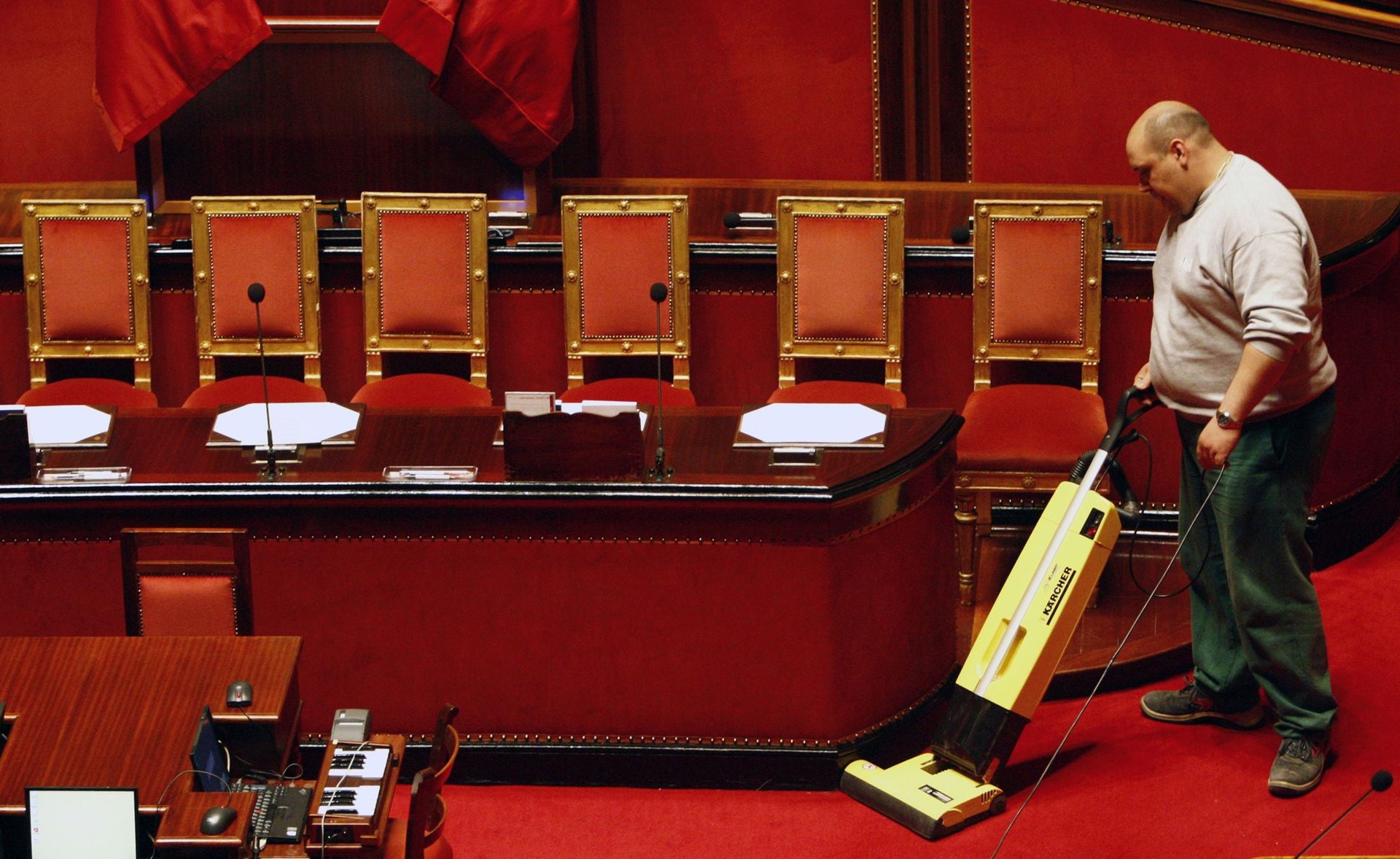
The prime minister of Italy, Matteo Renzi, wants to miniaturize the Italian Senate—both in number of senators and in power. Under Renzi’s reform plan, senators would be appointed by regional councils and have no power to approve budgets, pass most national laws, or hold a no confidence vote on the government.

Concern about income inequality, and the even more striking inequality in wealth in the United States, is a key theme for the 2014 US congressional elections and has made Thomas Piketty’s book Capital in the Twenty-First Century a surprise bestseller. There are many reasons to be concerned about wealth inequality itself, regardless of the source of that inequality, but it is hard to pursue a discussion on the topic for long before someone makes a claim about whether the wealthy acquired their money in a deserving way. Partisans on the political left and right know which side of this argument they are supposed to emphasize: many who feel the government needs more revenue conveniently argue as if almost all wealth comes from underhanded, unscrupulous skullduggery, while many who feel the government needs less revenue conveniently argue as if almost all wealth were created by the likes of Steve Jobs, who brought us i-everything. But unlike these partisan stories, in every list of 1,500 or so billionaires, many deserve their wealth while others deserve very little of the wealth they have. While in some cases the principles for whether wealth is deserved or not are obvious, in other cases they are quite subtle.

Iraq joined Syria in civil war and Ukraine’s crisis persisted this week. And yet let me argue that this week’s most important geopolitical news is the economic program of India’s new prime minister, Narendra Modi.

It is now 25 years since the Tiananmen Square Massacre of June 3 and 4, 1989. On this anniversary of that wretched event, it is right that we honor the man in the iconic picture who at least for a while stopped a column of tanks by putting himself in harm’s way. But let us also honor the man at the controls of the lead tank, who stopped that tank dead in its tracks to avoid crushing another human being. In the final analysis, despots and tyrants cannot impose their will on a country of any size without the help of many thugs and other amoral enforcers to do their dirty work for them.

Janet Yellen led her first monetary policy meeting as chair last week. But with Yellen’s emphasis so far on consensus and continuity, the key news from the Fed last week wasn’t anything Janet Yellen said, but what Federal Reserve Board Governor Jeremy Stein said at the International Research Forum on Monetary Policy on Mar. 21.

In the 1990s, with its economy stagnating after a financial crisis, Japan lavished billions on infrastructure investment. The Japanese government lined rivers and beaches with concrete, turned parks into parking lots, and built bridges to nowhere. The splurge of spending may have allowed Japan to limp along without a full-blown depression, but added to the mountain of government debt that remains to this day.