
The U.S's chief statistics agency finds itself in hot water — and the Trump administration wants to turn up the heat.
Economists say there isn't anything out of the ordinary in BLS's annual revisions that use more comprehensive data that's slower to attain
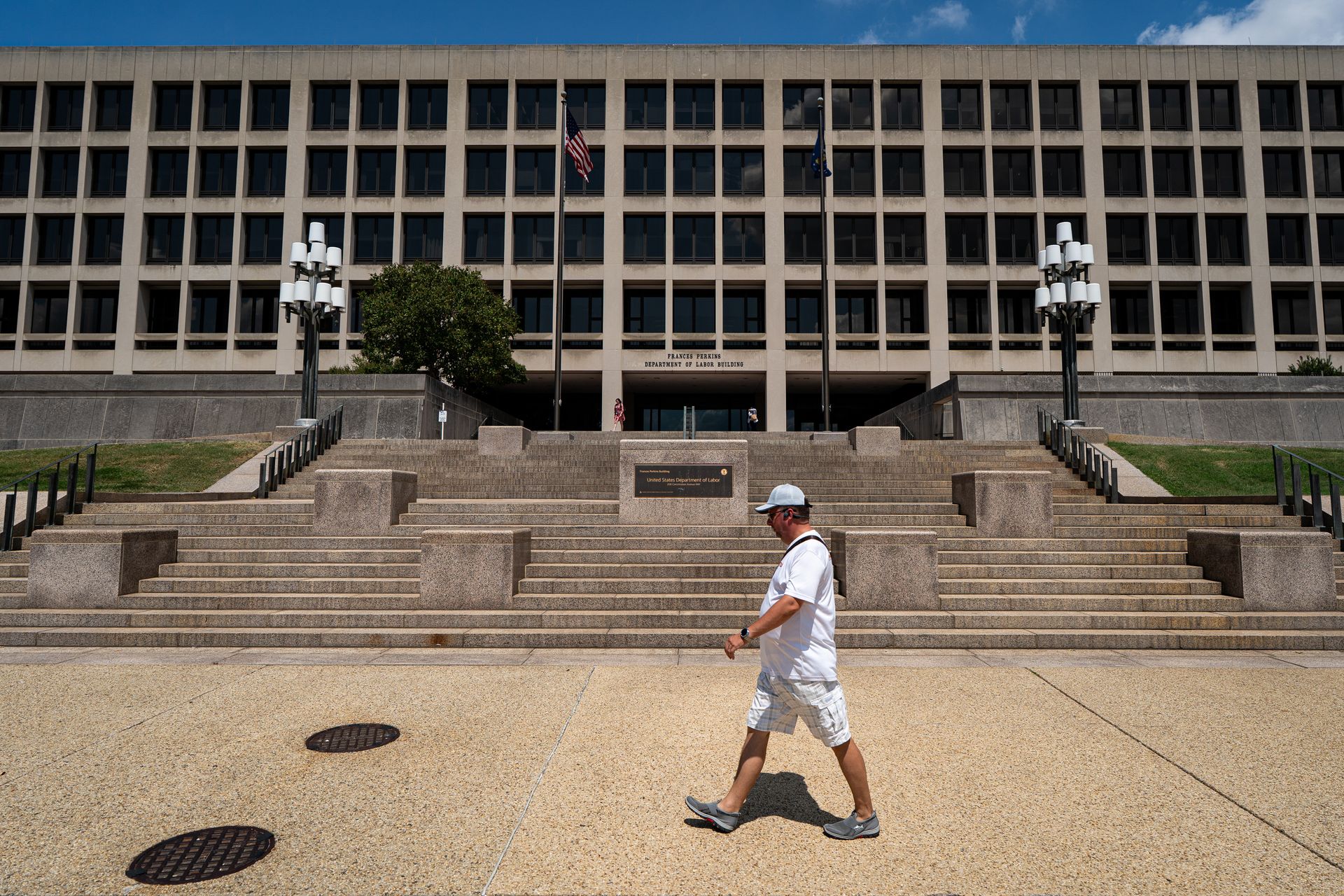
The US Department of Labor headquarters in Washington, DC, US, which houses the Bureau of Labor Statistics. (Al Drago/Bloomberg via Getty Images)
The U.S's chief statistics agency finds itself in hot water — and the Trump administration wants to turn up the heat.
The Bureau of Labor Statistics on Tuesday released data revisions showing that the U.S. added 911,000 fewer jobs than previously thought from April 2024 to March 2025, just before President Donald Trump issued his wave of country-specific tariffs. Forecasters had expected steep revisions, but the larger amount caught many analysts and Wall Street by surprise.
The figures will be revised and finalized at the start of 2026, as is standard BLS practice. But it nevertheless led to a fresh wave of attacks from the White House and Trump administration officials on BLS and the data underpinning critical employment reports. The president already took the extraordinary step of ousting BLS chief Erika McEntarfer in August, arguing without evidence the agency had bungled recent jobs reports that displayed anemic growth.
White House Press Secretary Karoline Leavitt reiterated familiar criticism of the BLS's reports on Tuesday. "We need accurate numbers," she said. "We need truthful and honest data which is why the president took the monumental step to try and appoint new leadership at the BLS so we can have data to rely on."
That was mirrored by Vice President J.D. Vance. He said in a social media post that "it’s difficult to overstate how useless BLS data had become. A change was necessary [to] restore confidence.
Economists and statistics experts, though, say there isn't anything out of the ordinary in the annual revisions, known as benchmarking. That process relies on unemployment insurance tax filings from employers rather than surveys, which reflect more comprehensive records. It's a more drawn-out process.
"There is no political bias at work in the revision," said Michael Strain, an economist at the right-leaning American Enterprise Institute, in a social media post. "This is a standard part of data production that long predates the Trump administration."
The agency itself is mired in turmoil. About one-third of its leadership slots are vacant, according to its website. Earlier this year, two BLS advisory panels that delivered statistical guidance on the monthly jobs reports were eliminated through Trump's executive orders.
"We should be focused on what BLS and other statistical agencies need to be more effective and efficient to continue producing impartial quality statistics: resources, staffing, administration support, and statistical integrity safeguards," Ronald Wasserstein, executive director of the American Statistical Association, told Quartz.
Conservative economist E.J. Antoni has been named as Trump's pick to overhaul the BLS. He must still be confirmed in the Senate, a process that's expected to kick off sometime this month.
However, he has attracted scrutiny over his economic credentials and more recently, a string of social media posts bashing women and spreading conspiracy theories, which was reported by CNN.
Antoni went unnamed in Tuesday's statements from both Leavitt and Labor Secretary Lori Chavez-DeRemer.
Join 500,000+ readers who start their day with Quartz.
By subscribing, you agree to our Terms of Service and Privacy Policy.