
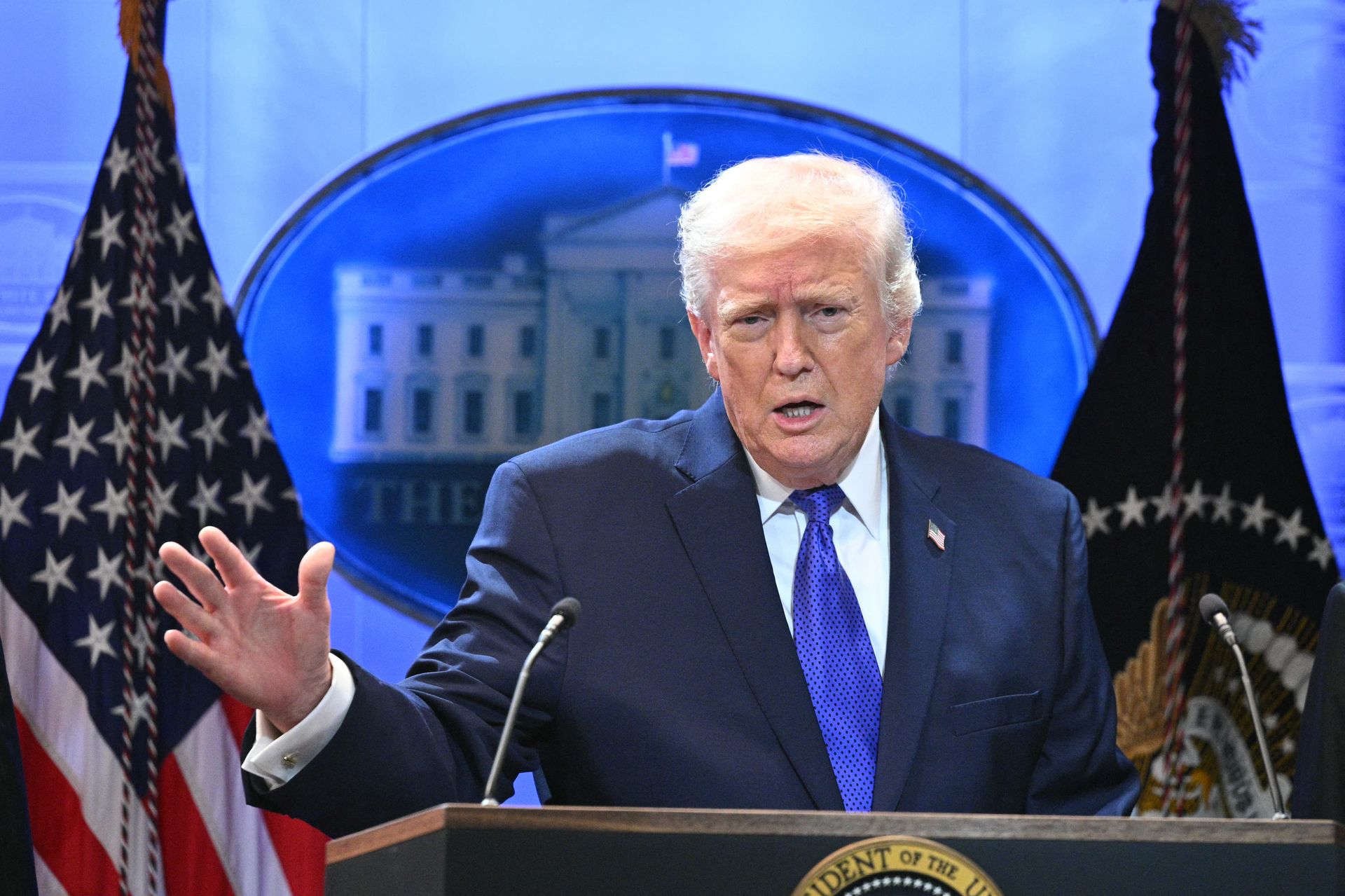
U.S. stock futures pointed higher Thursday morning after President Donald Trump said Iran called him seeking a deal, giving markets some relief following a volatile Wednesday driven by renewed military exchanges between the two countries.
Nasdaq $NDAQ 100 futures rose 0.54%, led by semiconductor stocks. Among individual chip names, Micron $MU jumped 3.4% and SanDisk added 2.4%, helping lift the VanEck Semiconductor ETF by 1.8%. S&P 500 futures were 0.09% higher, while Dow futures slipped 0.17%.
The session follows a difficult Wednesday. The Dow fell and the S&P 500 also declined, though semiconductor strength pushed the Nasdaq higher on the day.
Global markets were also mostly positive. In Europe, the pan-European Stoxx 600 edged up 0.1%. Across Asia, Tokyo's Nikkei 225 finished the session up 1.4%, Seoul's Kospi gained 0.62%, and mainland China's CSI 300 advanced 2.5%, while Hong Kong's Hang Seng was a notable laggard, sliding 0.5%.
The market moves came amid a fast-moving and contradictory set of signals from Washington. The week had already seen Trump declare the U.S.-Iran ceasefire finished following a new round of attacks, and separately suggest that pursuing a negotiated agreement with Tehran was no longer a priority. U.S. Central Command said Wednesday that the military launched strikes on Iran in response to attacks on commercial shipping in and around the Strait of Hormuz. Overnight, Washington said it struck 90 military targets, according to The Wall Street Journal.
Despite the continued fighting, Trump's comments that Iran had called him appeared to ease some investor anxiety. Oil futures, which had surged Wednesday on the escalation, were flat to slightly higher Thursday morning, with Brent crude at $78.77 a barrel.
As the geopolitical temperature appeared to cool slightly, attention in markets drifted back toward artificial intelligence plays, including the anticipated American stock market debut of SK Hynix, according to The Journal. The South Korean chipmaker is set to price its U.S. offering on Thursday.
A note from Wells Fargo $WFC Investment Institute's global real assets analyst Mason Mendez warned that the idea of Persian Gulf oil flows returning to normal quickly faces real headwinds, according to CNBC. With global stockpiles and reserves already lean, Mendez wrote, each additional flare-up in the conflict risks embedding a more durable risk premium into crude prices.